
Top Picks: Best Commercial Auto Insurance Companies in Michigan

Five insurers cover the commercial auto needs most Michigan businesses run into, from single-vehicle operations to mixed fleets. Each earned a place among the best commercial auto insurance providers on affordability, customer experience and coverage depth, though the strongest pick for you still comes down to your vehicle type, industry and how your operation runs.

  1. Progressive Commercial: Best Overall, Best for Fleet Operations
  2. GEICO: Best for Low-Risk Business Areas
  3. The Hartford: Best for Coverage Depth
  4. Nationwide: Best for Agricultural and Specialty Fleets
  5. biBerk: Best for Simple Coverage Needs

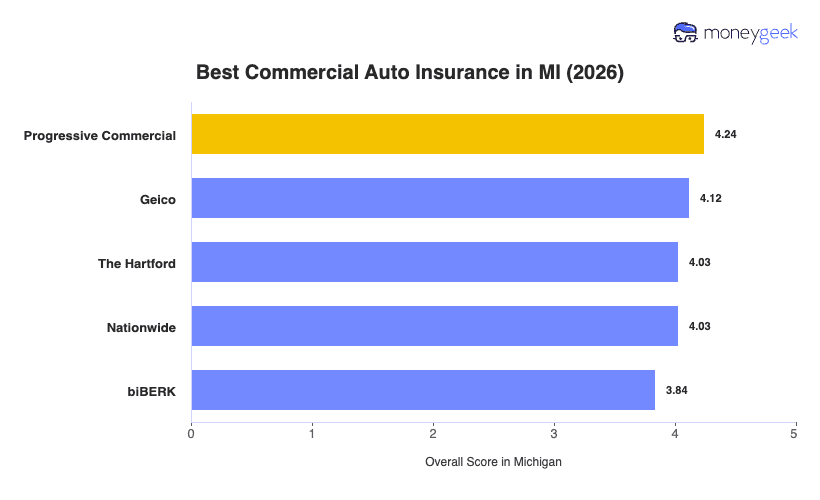
The table below sets all five providers side by side across their overall score and category ranks for a direct comparison.

Progressive Commercial4.24114
Geico4.12223
The Hartford4.03521
Nationwide4.03352
biBERK3.84445

The summaries below show who each provider fits best and who should look elsewhere, because the overall ranking matters far less than how well a carrier matches your specific vehicle type, industry or operational need.

Progressive

Progressive

Best Overall, Best for Fleet Operations

Progressive Commercial writes coverage for more commercial vehicle types than any other provider on this list, and in Michigan its underwriting flexibility extends to new businesses, mixed fleets and some driver violations that other carriers decline. It leads all five Michigan providers for both affordability and customer experience, and its Snapshot ProView platform gives fleet managers GPS tracking, driver behavior scoring and a centralized dashboard rather than a basic discount program. Its main limitation is coverage depth, where it ranks fourth among the five providers, making it a weaker fit for businesses that need complex endorsement structures. Progressive Commercial is best suited for Michigan fleet operators, for-hire truckers who need FMCSA filings handled directly and contractors who need same-day coverage with instant certificate of insurance access.

Learn More: Progressive Business Insurance Review

GEICO

GEICO

Best for Low-Risk Business Areas

GEICO built its commercial auto offering around a fully digital experience, and for Michigan businesses that want to quote, buy and manage a policy without calling an agent, it delivers that better than any other provider on this list. It ranks second overall in Michigan across affordability, customer experience and coverage, with its strongest pricing advantage concentrated in professional services, where consulting, marketing, fitness, tech and beauty operations all pay meaningfully less than the Michigan average. Its DriveEasy Pro telematics program tracks driver behavior, provides real-time GPS and includes an optional road-facing dashcam, a practical safety tool for light commercial fleets. The gap to know about is claims, since GEICO does not appear in J.D. Power's Small Commercial Insurance Study, which leaves its commercial claims performance less independently validated than Progressive or The Hartford. GEICO is the right call for Michigan professional services businesses and light commercial fleets that want competitive rates and a clean digital experience.

The Hartford

The Hartford

Best for Coverage Depth
On The Hartford's site

Coverage quality is where The Hartford separates itself, ranking first among all five Michigan providers for coverage options and earning above-average marks in J.D. Power's Small Commercial Insurance Study for claims handling. Its FleetAhead program goes further than a standard telematics discount, since dedicated risk engineers work directly with Michigan fleet managers to analyze driver data, identify high-risk behaviors and set measurable loss-reduction targets, which lowers the total cost of risk over time rather than just the premium at renewal. The honest tradeoff is price, since The Hartford runs 23% above the Michigan average overall, and that gap holds across every vehicle type in the state. It ranks fifth for affordability among the five providers reviewed. Michigan businesses that need the deepest endorsement structure and the strongest claims support will find The Hartford worth the premium, while those shopping primarily on rate should look at Progressive or GEICO first.

Learn More: The Hartford Business Insurance Review

Nationwide

Nationwide

Best for Agricultural and Specialty Fleets

For Michigan businesses running upfitted work vehicles, Nationwide has a structural advantage over most standard carriers, since it provides clearer valuation for vehicles with permanently installed equipment, including shelving systems, lift gates, ladder racks and mounted service tools, which reduces the total-loss disputes that leave contractors underinsured. Its Vantage 360 Fleet program combines app-based driver scoring with a rewards system that lets drivers earn points for safe behavior, and qualifying fleets can earn up to 10% off their commercial auto premium. It ranks second for coverage depth among the five providers and prices 6% below the Michigan average overall, with manufacturing and childcare operations running 17% and 14% below average respectively. The gap to know about is customer experience, where Nationwide ranks last among the five Michigan providers reviewed, and some policyholders note that its agent-driven model can slow time-sensitive claims compared with digital-first carriers. Nationwide fits Michigan trade contractors, delivery fleets and agricultural operations that need coverage built around the realities of their vehicles and routes.

Learn More: Nationwide Commercial Auto Insurance Review

biBerk

biBerk

Best for Simple Coverage Needs

Built from the ground up as a direct-to-business insurer, biBerk was designed to get a small Michigan business covered and out the door faster than any carrier on this list. A full commercial auto policy can be purchased entirely online in under 10 minutes, with a certificate of insurance available the moment payment clears and a 24/7 self-service portal for adding vehicles, updating drivers and pulling documents without calling anyone. It ranks fifth overall in Michigan, with the lowest coverage depth score among the five providers and a customer experience ranking of fourth, and its NAIC complaint index runs above the national average. The purchase process is genuinely the best on this list, though the post-purchase infrastructure is not. biBerk fits Michigan owner-operators and sole proprietors with straightforward vehicle needs who want coverage activated immediately, not businesses that need specialist claims teams, fleet telematics or deep endorsement customization.

Learn More: biBerk Business Insurance Review

What Determines the Best Commercial Auto Insurance in Michigan for You

The best commercial auto insurance in Michigan is not defined by a single factor. The right provider balances affordability, coverage depth and customer experience across the vehicle types and industries most common in Michigan. Three areas matter most when evaluating which insurer fits your business.

  • money2 icon

    Affordability Across Your Vehicle Type and Industry

    Commercial auto pricing in Michigan varies more by vehicle type than most business owners expect. Limousine and taxi operations see the widest gaps, with the most and least competitive providers running 31% apart on those vehicles. Businesses in construction and contracting, transportation and logistics and manufacturing tend to see the most meaningful savings by comparing the cheapest commercial auto providers in MI directly. The best value for your fleet depends on your specific vehicle mix and industry, not the statewide average.

  • insurance2 icon

    Coverage That Matches Your Fleet's Risks

    Michigan's commercial auto minimums are $250,000 per person and $500,000 per accident for bodily injury liability and $10,000 for property damage (250/500/10). Because Michigan is a no-fault state, every commercial policy must also include PIP and $1 million in property protection insurance. Coverage requirements increase with vehicle weight and passenger capacity, and businesses transporting passengers for hire must carry $1.5 million CSL for vehicles up to 15 passengers and $5 million CSL for 16 or more. Compare these policy terms closely when getting quotes:

    • Liability limits offered: Michigan's 250/500/10 minimums are a legal floor, not a coverage recommendation. High-exposure industries like transportation and logistics and construction should look for providers with liability ceilings well above the state floor.
    • Breadth of vehicles covered: Some providers cover pickup trucks, vans, farm tractors and limousines while others exclude specialty or heavy vehicles. Michigan farm tractors are exempt from coverage requirements when off public highways but require a commercial policy the moment they operate on a road.
    • Standard vs. endorsement coverage: One provider may include roadside assistance and rental reimbursement as standard while another charges extra for both.
    • Hired and non-owned auto coverage: Whether employee-owned or rented vehicles used for business are covered varies by carrier, which is relevant for Michigan businesses in construction, healthcare and professional services.
    • Cargo and equipment protection: Michigan manufacturing, wholesale and distribution and transportation businesses should confirm whether tools and cargo coverage are included or treated as a separate inland marine policy.
    • PIP election and lawsuit exposure: Michigan's 2019 no-fault reform lets fleet operators choose their PIP coverage level. A lower PIP election reduces premiums but increases lawsuit exposure if an at-fault accident produces medical costs above the elected limit.
    • Deductible flexibility: Features like diminishing deductibles or waived deductibles on a total loss are carrier-specific and can have real financial impact at claim time.
    • Coverage for fleet growth: Some Michigan policies make it straightforward to add vehicles mid-term while others require a policy rewrite.
  • talk icon

    Customer Experience and Claims Support

    Claims handling for commercial auto policies works differently than consumer coverage, so check provider performance specifically on commercial claims in Michigan. Look at whether the claims team is available 24/7 or only during business hours, whether a claim gets a dedicated commercial adjuster or goes through a general call center and whether the account will have a consistent, industry-specialized agent over time. NAIC complaint ratios give an unbiased data point to compare alongside provider reviews.

How to Choose the Best Commercial Auto Insurance in MI

Choosing the right commercial auto insurance in Michigan takes more than comparing premiums. These steps give Michigan businesses a structured path to the right coverage.

  1. 1
    Define Your Risk Profile

    Catalog every vehicle your Michigan business operates, including owned, leased and employee-owned vehicles used for work, and note each vehicle's primary use, annual mileage and driver history. Businesses in construction, transportation and logistics, manufacturing and agriculture running pickup trucks, vans, farm tractors or mixed fleets should pay close attention to load type and mileage, since both drive pricing and carrier eligibility.

  2. 2
    Determine Your Coverage Requirements

    With your risk profile documented, identify which coverage types your operations actually require beyond Michigan's 250/500/10 liability minimums, mandatory PIP and $1 million property protection insurance. Businesses transporting goods need cargo coverage, financed or leased vehicles require collision and comprehensive coverage, and operations relying on employee-owned vehicles need hired and non-owned auto coverage. Passenger carriers transporting clients for hire must meet Michigan's escalating minimums of $1.5 million CSL for vehicles carrying up to 15 passengers and $5 million CSL for 16 or more, and Michigan rideshare and TNC drivers need coverage from the moment they open the app.

  3. 3
    Research Providers by Industry and Vehicle Type

    Not all carriers price every risk the same way in Michigan. Some specialize in high-exposure operations like for-hire trucking and construction fleets while others suit the standard light-commercial vehicles common in Michigan's professional services and healthcare sectors. Identify which carriers have demonstrated expertise in your industry and vehicle category before comparing them on price.

  4. 4
    Evaluate Coverage Quality and Policy Terms

    Comparing premiums tells you what a policy costs, while comparing policy terms tells you what you are actually buying. For each shortlisted provider, check which coverages are standard versus endorsement-only, what liability limits are available above Michigan's 250/500/10 floor and what exclusions could void a claim. Because Michigan is a no-fault state, confirm how each provider coordinates PIP benefits and whether a lower PIP election increases your exposure to lawsuits for medical costs above that limit. Adding vehicles mid-policy can create temporary coverage gaps with some carriers, so ask how each provider handles mid-term fleet changes before signing.

  5. 5
    Get Quotes to Confirm

    Request quotes only after research has narrowed your options. A quote should confirm whether a provider's pricing holds for your specific fleet, location and coverage requirements rather than drive the decision on its own. When comparing quotes, keep in mind that Michigan pricing varies materially by vehicle type and industry, and a Michigan limousine operator and a sedan-based consulting business can see rate gaps of 30% or more between the most and least competitive providers, even within the same carrier.

  6. 6
    Confirm Michigan Filing Requirements

    Verify whether your Michigan operation triggers additional filings before purchasing. Commercial vehicles over 10,000 lbs GVWR operating interstate fall under FMCSA minimums, which can reach $750,000 CSL or higher depending on cargo type. Hazmat operations carrying high-risk materials must meet federal minimums up to $5 million CSL regardless of vehicle size. Michigan passenger carriers and TNC operators should confirm state operating authority filings with the Michigan Department of Transportation before coverage takes effect.

Best Commercial Auto Insurance in Michigan: Bottom Line

Picking the right commercial auto insurance for a Michigan business comes down to three questions. What vehicles does your operation run, what industry are you in and what would a serious claim actually cost your business to absorb? Those answers narrow the field faster than a rate comparison alone, because pricing and coverage depth in Michigan shift more by vehicle type and industry than most business owners realize before they start shopping.

A lower-priced policy is not always the better value if it leaves gaps your Michigan operation genuinely needs. Consider whether your business wants a fully digital, self-service buying and management experience or whether agent-supported guidance matters for the size and complexity of your fleet. From there, getting two or three quotes from providers that match your vehicle type and industry will tell you whether the right fit on paper holds up for your specific operation and location in Michigan.

Best Commercial Auto Insurance in MI Chart
mglogo icon
LOOKING FOR THE BEST INSURERS FOR OTHER COVERAGE TYPES?

Commercial auto insurance is only one piece of your best Michigan business insurance bundle, and you'll likely need more coverage to satisfy requirements and protect your company financially. Below, explore more state-specific guides to top insurers for other commonly needed business insurance types.

How We Built These Best Commercial Auto Insurer Rankings

Michigan's commercial auto rankings rest on three things. What businesses in Michigan actually pay for coverage, how a carrier supports them day to day and whether the policy holds up when a claim is filed. Each provider was scored across affordability at 50% of the overall score, customer experience at 30% and coverage options at 20%. Affordability carries the most weight because price is where most Michigan business owners start their search, though claims support and policy depth often decide whether a carrier actually fits once a loss happens. For the full breakdown, see the methodology.

About Mark Flores


Mark Flores, Business Insurance Writer, MoneyGeek

Mark Flores is a Business Insurance Content Writer at MoneyGeek, where he focuses on commercial auto, commercial property, cyber and specialty business insurance coverage. His work simplifies coverage terms, gives business owners a strong baseline for expected costs, and narrows down policies and providers tailored to your operation, regardless of complexity.

Before joining MoneyGeek’s business insurance team, Mark worked as a Senior Content Writer at Clutch.co, where he produced structured B2B reviews and provider analyses based on client interviews, company research and service evaluation. That experience shaped his approach to business insurance content, especially when comparing insurers, explaining coverage differences and translating complex policy features into practical guidance for small business owners.

Mark also spent nearly 4 years as a digital marketing specialist serving small-business clients across industries such as home services, manufacturing and education. That background gives him practical context for how businesses evaluate vendors, manage operational needs and make purchasing decisions.

At MoneyGeek, he applies this research and evaluation experience to build guides that help transportation sectors, those with complex property-related risks (such as hotels and retail stores), and those most at risk of a cyberattack get the coverage they need at a reasonable price.

Linkedin: https://www.linkedin.com/in/mark-jason-flores-7844634a/

Contact Email: mark.flores@moneygeek.com