
What Is Commercial Auto Insurance in Pennsylvania?

Commercial auto insurance covers vehicles Pennsylvania businesses own, lease or use for work, paying liability costs, repair bills and medical expenses after accidents on the job. Personal auto policies exclude work-related driving, so businesses using vehicles for deliveries, client visits, job sites or any other commercial purpose need a separate policy to cover those claims.

A standard Pennsylvania commercial auto policy typically includes these coverage types:

  • Liability coverage: pays for bodily injuries and property damage caused to others when a business vehicle is at fault. Pennsylvania requires minimum liability limits for commercial vehicles, and most contracts and lenders require limits well above the state minimum.
  • Collision insurance: pays to repair or replace a business vehicle after a collision, regardless of who caused the accident.
  • Comprehensive insurance: covers non-collision damage to a business vehicle, including theft, vandalism and weather damage. Pennsylvania winters bring ice, snow and road debris that can damage commercial vehicles sitting overnight or traveling rural routes, making this coverage worth carrying year-round.
  • Uninsured/underinsured motorist coverage: pays costs when an at-fault driver hits a business vehicle but carries no insurance or not enough to cover the full damage.
  • Medical payments and personal injury protection (PIP): pay medical costs for the driver and passengers after an accident regardless of fault. Pennsylvania is a choice no-fault state, meaning businesses can elect PIP coverage or opt out, but carriers writing commercial auto policies in the state will offer it as an option on most policies.

Who Needs Pennsylvania Commercial Auto Insurance?

Any Pennsylvania business that owns a vehicle, sends employees out to drive for work or depends on vehicles as part of daily operations needs commercial auto insurance. Pennsylvania's commercial auto insurance requirements apply broadly across industries, and personal auto policies exclude business use entirely, so a claim from work-related driving gets denied under a personal policy regardless of who was at fault.

Pennsylvania businesses that need commercial auto coverage include:

  • Any business with a vehicle titled in its name needs a commercial policy, even if it only owns one vehicle and uses it occasionally.
  • Contractors, landscapers and tradespeople who haul tools, equipment or materials to job sites across Pennsylvania need commercial coverage for every trip, since the load and business purpose disqualify personal auto policies.
  • Businesses that make deliveries or move products between locations, including e-commerce sellers and wholesale distributors operating out of Philadelphia, Pittsburgh or anywhere in between.
  • Rideshare and for-hire drivers need coverage that recognizes the vehicle is being used commercially. Pennsylvania personal auto policies exclude coverage the moment a driver is active on a platform, and standard commercial policies often don't cover for-hire passenger transport either, so drivers need a policy or endorsement written specifically for TNC use.
  • Employees who drive their personal vehicles for work purposes, such as making client visits or running business errands, create liability exposure the business needs to cover through hired and non-owned auto coverage.
  • Public Utility Commission (PUC)-regulated property carriers in Pennsylvania face weight-based coverage thresholds. A vehicle at or below 10,000 lbs GVWR requires higher liability limits than a standard commercial policy provides, and vehicles above that threshold require even more. Standard business auto coverage may not meet those minimums.
  • Contracts with clients, lenders or property owners in Pennsylvania often require proof of commercial auto coverage before work begins, making the policy a condition of doing business, not just a legal requirement.
  • Businesses that lease or finance vehicles need commercial coverage as a condition of the financing agreement, since Pennsylvania lenders and leasing companies won't fund a commercial vehicle without it.

How Much Does Commercial Auto Insurance Cost in Pennsylvania?

The average cost of commercial auto insurance in Pennsylvania is $79 per month for minimum coverage, based on a sample business profile from MoneyGeek's analysis. That figure is a starting point, not a guaranteed rate. Use MoneyGeek's commercial auto insurance cost calculator for an estimate built around your specific business. Your actual rate depends on the six factors below.

How to Get Commercial Auto Insurance in Pennsylvania

Use these five steps to get the right commercial auto coverage in place and avoid gaps before your Pennsylvania vehicles hit the road.

  1. 1

    Identify Your Coverage Deadline

    Work backward from the date your vehicles need to be operating. Allow at least two to three weeks for quote comparison, underwriting review and policy issuance. Compressing that timeline increases the chance of misclassified vehicles, incorrect limits or coverage gaps that don't surface until a claim gets filed. Common deadlines Pennsylvania businesses run into include:

    • The first day a vehicle is used for any business purpose, including a single delivery run or a client visit
    • Contract start dates that require proof of coverage before work begins, which is common in Pennsylvania construction, logistics and service trades
    • Lease or loan agreements, since Pennsylvania lenders and leasing companies require commercial coverage as a condition of financing before keys change hands
    • PennDOT filing requirements that apply to PUC-regulated carriers, for-hire passenger transport operators and businesses hauling freight across state lines
  2. 2

    Gather the Information Insurers Need

    Pull business and vehicle information together before requesting quotes. Insurers use this data to classify vehicles, rate drivers and confirm coverage eligibility, and missing details mid-quote causes delays and can trigger premium adjustments after the policy is already in place. Have the following ready:

    • Business formation documents and Federal Employer Identification Number (FEIN)
    • Full vehicle list including year, make, model, VIN and primary use for each vehicle
    • Driver list with dates of birth and license numbers so insurers can pull motor vehicle records (MVRs)
    • Annual mileage estimates per vehicle. Pennsylvania businesses running regional routes between Philadelphia, Pittsburgh and Harrisburg log significantly more miles than those operating locally, and that difference affects the rate
    • Estimated annual revenue and total driver count
    • Prior coverage details and a current loss run showing claims history for the past three to five years
    • Any contract requirements specifying minimum liability limits or endorsements clients or lenders require
  3. 3

    Determine Vehicle Classifications and Coverage Needs

    Classify each vehicle by type and use before requesting quotes. Vehicle use codes set the base rate directly, and a misclassified vehicle produces an incorrect premium and can result in a denied claim. A pickup truck a Pennsylvania HVAC contractor drives to service calls across Montgomery County needs a commercial use classification, not a personal one. Work through the following before shopping:

    • Match each vehicle to its actual use. A van used to deliver restaurant supplies around Pittsburgh gets rated differently than one sitting at a single job site five days a week
    • Flag specialty vehicles including food trucks, taxis and limousines. Pennsylvania's livery exclusion means personal and standard commercial policies typically don't cover for-hire passenger transport
    • Decide whether physical damage coverage makes sense for each vehicle. Pennsylvania winters, road salt damage and congested urban corridors in Philadelphia and Pittsburgh make comprehensive and collision worth pricing out even for older vehicles
    • Identify any required endorsements, particularly hired and non-owned auto coverage if employees drive personal or rented vehicles for work
  4. 4

    Compare Quotes From Multiple Insurers

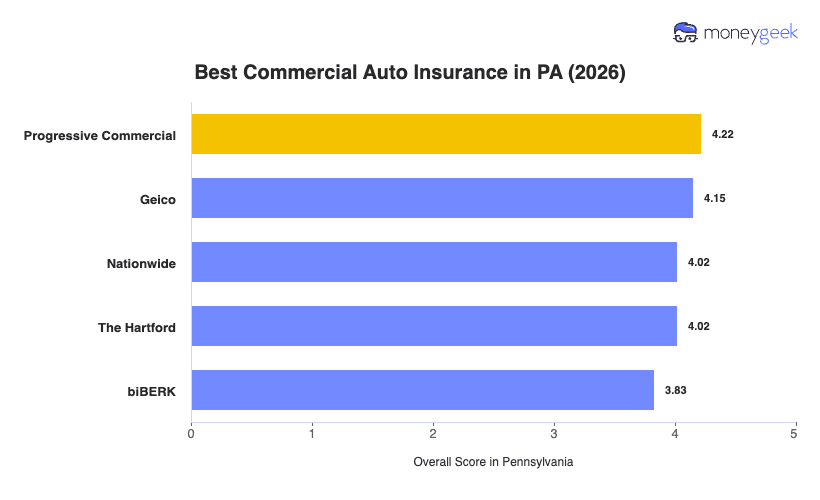
    Rates for identical coverage vary across insurers because each carrier weighs vehicle type, industry and claims history differently. In Pennsylvania, rates range from $67 per month at GEICO to $99 per month at The Hartford for comparable coverage, per MoneyGeek's analysis. That gap adds up to $384 per year on a single vehicle. Getting multiple quotes is the only way to know where your business falls in that range. When comparing:

    • Get at least three quotes to see how different insurers rate your specific vehicle mix and industry
    • Look for insurers with experience in Pennsylvania's key sectors. A carrier familiar with regional freight, construction or home services will classify risk more accurately than one that isn't
    • Ask about fleet discounts and telematics programs, which reward lower-mileage and safer driving patterns with lower rates
    • Confirm all required endorsements are included in each quote before comparing premiums side by side
    • Ask about pay-per-mile programs, which can lower costs for Pennsylvania businesses with vehicles that sit idle for extended periods between jobs
  5. 5

    Finalize Coverage and Get Your Certificate of Insurance

    Before signing, review policy documents carefully to confirm vehicle classifications, coverage limits and all required endorsements match what was requested. Check that the policy effective date matches or precedes the deadline identified in Step 1. After paying the first premium, request certificates of insurance (COIs) right away. Clients, lenders and contract partners across Pennsylvania will ask for a COI before work starts, so keep digital and physical copies accessible and send updated versions any time the policy renews or changes.

Commercial Auto Insurance: Next Steps

For most Pennsylvania businesses, the best starting point is comparing providers. Rates vary across insurers based on vehicle type, industry and claims history, and the spread in Pennsylvania is wide enough that skipping this step costs real money. But if you're looking for something else, we've prepared resources for various decision points.

Recommended: Compare Providers Before You Buy

MoneyGeek's best and cheapest pages rank Pennsylvania commercial auto insurers based on rate data, coverage options and customer experience scores. Our pages give you a side-by-side look at what each insurer offers so you're not choosing blind.

If You're Adding Your First Business Vehicle in Pennsylvania

If You Want to Lower Costs

If You're Working Under a Contract That Requires Proof of Insurance

If You're Running a Specialty Vehicle in Pennsylvania

If You're Managing Employee Drivers

If You're Growing Your Fleet

Get Pennsylvania Commercial Auto Insurance Quotes

Pennsylvania commercial auto rates vary by industry, vehicle type and how your business operates, so the right provider for a Miami logistics company won't be the same as for a Tampa landscaping crew. MoneyGeek matches Pennsylvania businesses to providers that specialize in their industry. Use the tool below to compare quotes side by side.

About Connor Bolton


Connor Bolton headshot

Connor Bolton is Senior SEO and Content Manager at MoneyGeek, where he leads the business and pet insurance editorial teams. As editorial lead for both verticals, Connor sets the research framework, data standards, and content structure that his writers execute, directly authoring in-depth guides himself and reviewing all team content for accuracy and practical value before it goes live. With over four years evaluating insurance products across personal, commercial, and specialty lines, he brings cross-vertical knowledge to every guide the team produces.

Connor architected MoneyGeek's insurance research infrastructure across all major verticals including auto, home, renters, life, health, business, and pet, building systems for pricing analysis, provider-level research, customer experience evaluation, and coverage analysis with AI support. The infrastructure includes over 6 million data points for business insurance across 408 industry areas, all 50 states, and 16 vehicle types, and over 5 million pet insurance profiles across 18 major providers and hundreds of breed and age combinations. Connor's insurance cost research and his team's work has been cited by the U.S. Chamber of Commerce, Allstate, Liberty Mutual, CBS News, Forbes and LegalZoom.

Beyond the data, Connor stays connected to how the market actually operates, drawing on direct conversations with underwriters and carrier liaisons at Ethos, The Hartford, NEXT Insurance, Nationwide, and State Farm, and monitoring business and pet owner communities including Reddit, to inform how he interprets findings and frames guidance for real buyers.

He is the direct editorial contact for methodology questions at connor@moneygeek.com and can be found on LinkedIn.