
Top Picks: Best Commercial Auto Insurance Companies in Pennsylvania

Most Pennsylvania businesses can find the best commercial auto insurance with these providers:

  1. Progressive Commercial: Best Overall, Best for Fleet Operations
  2. GEICO: Best for Low-Risk Business Areas
  3. Nationwide: Best for Agricultural and Specialty Fleets
  4. The Hartford: Best for Coverage Depth
  5. biBerk: Best for Simple Coverage Needs

These five providers cover the most common commercial auto needs Pennsylvania businesses face, from single-vehicle trades operations to multi-vehicle fleets running across the state. Your best pick depends on your vehicle type, industry and the coverage depth your business actually needs.

Progressive Commercial
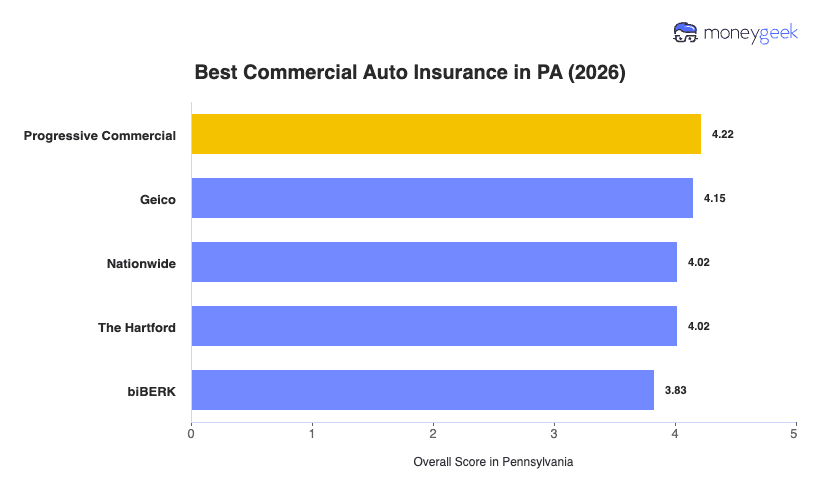
4.22
Ranks first overall for Pennsylvania commercial auto insurance, posting the highest customer experience score among all five providers and average monthly rates 10% below the Pennsylvania average.
GEICO
4.15
Leads all five Pennsylvania providers in affordability, with average monthly rates running 15% below the state average. A strong fit for low-risk, service-based businesses operating standard light commercial vehicles.
Nationwide
4.02
Posts the second-highest coverage score among Pennsylvania providers in our analysis, with competitive options for agricultural operations and specialty fleet vehicles.
The Hartford
4.02
Carries the highest coverage score of any Pennsylvania provider in our analysis, with deep policy options suited for businesses that need broader liability terms and more flexible endorsements.
biBerk
3.83
Built for Pennsylvania small businesses needing straightforward commercial auto coverage, with a digital-first quote process well suited for single-vehicle operations.

For our commercial auto insurance ratings, we analyzed pricing, coverage options and customer experience across 5 providers, 385 industries and 8 vehicle types. Our analysis covers 92% of U.S. small businesses, with coverage levels personalized to vehicle type, industry and state to reflect the real cost conditions facing most business operators.

To build our ratings, we evaluated rate data across more than 27,000 business profiles and over 6,000 customer experience data points. We also performed an in-depth analysis of coverage contracts and endorsements across minimum, mid-level and high-level coverage tiers to compare insurers consistently. We then rated each provider across affordability (50% of overall score), customer experience (30%) and coverage options (20%) to produce an overall rating out of 5. For a detailed breakdown of our scoring methodology, see our full methodology.

92%

% of Small Businesses Covered

Over 27,000

Business Profiles Studied

Over 6,000

Customer Experiences Analyzed

Company Image
Best Overall, Best for Fleet Operations

Progressive

Progressive Commercial ranks first overall for commercial auto insurance in Pennsylvania, with the highest customer experience score among the five providers we analyzed. It covers the broadest range of vehicle types in our analysis, from pickup trucks and vans to food trucks and limousines, and prices competitively across most of them. Pennsylvania contractors, food service operators and cleaning services businesses get particularly strong value, with rates running 18% to 22% below the state average in those categories.

The buying experience is fully digital. Pennsylvania businesses can get a quote, bind coverage and generate a Certificate of Insurance online without an agent. Progressive Commercial's Snapshot ProView telematics program tracks driver behavior and fleet usage, with new enrollees saving an average of 9% and businesses with established safety records qualifying for at least 5% off. Claims are filed online, through the app or by phone with 24/7 availability, and a representative follows up by the end of the business day. The automated claims model works well for straightforward incidents but can feel impersonal on complex or disputed claims.

Where Progressive Commercial Performs Best

  • Pennsylvania construction and contracting businesses running pickup trucks or vans
  • Food truck and taxi operators
  • Multi-vehicle fleets  

Where Progressive Commercial Performs Less Competitively

  • Pennsylvania tech, consulting and fitness businesses
  • Beauty and wellness operations 

Learn More: Progressive Business Insurance Review

Company Image
Best for Low-Risk Business Areas

GEICO

GEICO ranks second overall for Pennsylvania commercial auto insurance and leads all five providers in affordability, averaging $67 per month versus the state average of $79. That pricing advantage is most pronounced for Pennsylvania businesses in lower-risk categories: financial services, fitness, consulting, tech and marketing operations all see rates 19% to 26% below the state average. For office-based and service-sector businesses that don't need the broadest coverage structure, GEICO delivers the strongest value in our Pennsylvania analysis.

The quote and binding process is fully digital, with same-day coverage available for standard vehicles. Pennsylvania business owners can manage their policy, add vehicles and file claims entirely through GEICO's app or website without agent involvement. GEICO's DriveEasy Pro telematics program offers fleet tracking, an OBD plug-in for real-time vehicle monitoring and safe driving discounts. Claims are filed online, through the app or by phone with 24/7 availability, but complex or disputed claims tend to generate more friction than straightforward incidents, a pattern that shows up consistently in customer reviews.

Where GEICO Performs Best

  • Pennsylvania tech, financial services, consulting and marketing businesses  
  • Pickup truck and sedan operators
  • Low-mileage, office-based operations  

Where GEICO Performs Less Competitively

  • Wholesale, distribution and hospitality operations
  • Businesses that need deeper endorsement options or agent-backed support
Company Image
Best for Agricultural and Specialty Fleets

Nationwide

Nationwide ranks third overall for Pennsylvania commercial auto insurance and earns the second-highest coverage score among the five providers in our analysis. Its strength is policy depth rather than price: Pennsylvania businesses get access to a broad endorsement menu including new car replacement, loan/lease gap coverage, hired auto physical damage and roadside assistance, options that less flexible carriers don't match. For operations running limousines, vans or transportation and logistics fleets, Nationwide prices competitively and pairs that with one of the more customizable commercial auto structures available in Pennsylvania.

Quotes and policy purchases require working through an agent or by phone. Pennsylvania businesses cannot bind coverage entirely online, though policy management, bill payments and certificate of insurance access are available through Nationwide's app and website after purchase. Claims can be filed online, through the app or by phone, and Nationwide's agent network provides more hands-on support than the fully digital carriers in our analysis. 

Where Nationwide Performs Best

  • Pennsylvania limousine operators and transportation and logistics businesses
  • Agricultural operations and specialty fleet vehicles
  • Businesses that want agent-backed support and prefer hands-on guidance 

Where Nationwide Performs Less Competitively

  • Pennsylvania tech, fitness and financial services businesses
  • Operations that need a fully digital buying experience 

Learn More: Nationwide Commercial Auto Insurance Review

Company Image
Best for Coverage Depth

The Hartford

The Hartford carries the highest coverage score of any provider in our Pennsylvania analysis and ties for second in customer experience. For Pennsylvania businesses that need broader liability terms, deeper endorsement options or more flexible policy structures, it delivers more than any other carrier we reviewed. That coverage strength comes at a price: The Hartford averages $99 per month in Pennsylvania, 25% above the state average, and ranks last in affordability among the five providers. Businesses where coverage depth matters more than premium cost get the strongest case for The Hartford.

Quotes are available online through The Hartford's partner Tivly, but completing a commercial auto purchase requires working with an independent agent. Once covered, policyholders can manage their policy, access certificates of insurance and file claims online at any time. Claims can also be reported by phone at any hour, and The Hartford assigns experienced claims specialists to commercial accounts. Customer reviews from Pennsylvania policyholders point to responsive claims handling on straightforward incidents, though some report difficulty reaching representatives on more complex cases.

Where The Hartford Performs Best

  • Pennsylvania construction and contracting businesses
  • Businesses running vehicles that require Drive Other Car coverage
  • Operations that prioritize coverage depth and want an agent-supported buying experience

Where The Hartford Performs Less Competitively

  • Pennsylvania businesses running pickup trucks, SUVs or farm tractors
  • Cost-sensitive operations in childcare, healthcare and nonprofit sectors 

Learn More: The Hartford Business Insurance Review

Company Image
Best for Simple Coverage Needs

biBerk

biBerk ranks fifth overall in our Pennsylvania analysis, but it fills a specific role well: sole operators and single-vehicle small businesses that want to get covered quickly without working through an agent. As a direct-to-business carrier backed by Berkshire Hathaway, biBerk lets Pennsylvania business owners quote, bind and manage a policy entirely online, with certificates of insurance available in minutes. Its pricing advantage is concentrated in lower-risk, office-based industries.  

The buying experience is fully digital with no broker involved, which biBerk says can cut premiums by up to 20% compared to agent-based channels. Claims are filed online or by phone. Unlike the larger carriers in our analysis, biBerk does not staff 24/7 claims support: live assistance is available during business hours, with online submission available at any time. Customer reviews are generally positive for the quote and purchase process, but some policyholders report slower claims resolution and inconsistent follow-through on cancellations and billing adjustments.

Where biBerk Performs Best

  • Pennsylvania sole operators and single-vehicle small businesses in financial services, fitness or consulting  
  • Low-risk, office-based businesses  
  • Sedans and SUVs operated by  service-sector businesses

Where biBerk Performs Less Competitively

  • Pennsylvania limousine and taxi operators
  • Multi-vehicle fleets, transportation and logistics operations, and wholesale businesses 

Learn More: biBerk Business Insurance Review

Best Pennsylvania Commercial Auto Insurance by Vehicle Type

Progressive Commercial leads in overall rankings across all eight vehicle types in Pennsylvania, with its sharpest pricing advantages in the categories that typically carry the highest premiums. Limousine and taxi operators see rates 31% below the Pennsylvania average with Progressive Commercial, and food truck operators save 22% versus the state average. Pennsylvania businesses running pickup trucks, sedans, SUVs or farm tractors will find GEICO prices those vehicle types more competitively, holding the top affordability rank in all four categories.

Farm TractorProgressive Commercial214
Food TruckProgressive Commercial114
LimousineProgressive Commercial114
Pickup TruckProgressive Commercial214
SUVProgressive Commercial214
SedanProgressive Commercial414
TaxiProgressive Commercial114
VanProgressive Commercial114

Vehicle type affects pricing more than most Pennsylvania businesses expect, and no single provider prices every category the same way. Here's how the top providers compare across vehicle types in our analysis:

Best Commercial Auto Insurance in Pennsylvania by Industry

The best Pennsylvania commercial auto provider for your business depends heavily on what industry you're in. Progressive Commercial ranks first across 18 industries, including construction and contracting, healthcare, transportation and logistics and food and beverage. GEICO leads in seven lower-risk categories including financial services, tech, consulting and fitness, where it holds the top affordability rank among all five providers.

Agriculture & Natural ResourcesGeico123
Arts, Media & EntertainmentProgressive Commercial314
Beauty, Body & Wellness ServicesGeico123
Childcare ServicesProgressive Commercial114
Cleaning ServicesProgressive Commercial114
Construction & ContractingProgressive Commercial214
Consulting ServicesGeico123
EducationProgressive Commercial214
Financial ServicesGeico123
Fitness ServicesGeico123
Food & BeverageProgressive Commercial114
Healthcare & MedicalProgressive Commercial214
Hospitality, Travel & TourismProgressive Commercial114
ManufacturingProgressive Commercial114
Marketing & CommunicationsGeico123
Nonprofit & AssociationsProgressive Commercial214
Other Professional ServicesProgressive Commercial114
Pet Care ServicesProgressive Commercial214
Real Estate & Property ServicesProgressive Commercial214
Recreation & SportsProgressive Commercial214
Repair & MaintenanceProgressive Commercial114
Retail & Product RentalProgressive Commercial114
Tech/ITGeico123
Transportation & LogisticsProgressive Commercial114
Wholesale & DistributionProgressive Commercial114

We built dedicated resources to help Pennsylvania businesses find the best commercial auto insurance for their industry.

What Determines the Best Commercial Auto Insurance in Pennsylvania for You

No single commercial auto insurance provider in Pennsylvania is the best fit for every business. The right pick depends on how your rates land for your specific vehicle type, whether the policy covers your actual operations under state law and how the carrier performs when you file a claim. Those three dimensions separate a policy that works from one that looks good on paper.

    money2 icon
    Affordability Across Your Vehicle Type and Industry

    Pennsylvania commercial auto pricing shifts substantially depending on what you drive and what industry you're in. A limousine operator in Philadelphia faces a rate spread of up to 31% between the most and least competitive providers in our analysis. A sedan-based consulting business in Pittsburgh sees a much narrower gap. 

    Businesses in construction, food and beverage and transportation tend to see the most pricing variation across providers, while lower-risk office-based operations in tech and financial services see less spread but can still find meaningful savings by comparing carriers directly.

    insurance2 icon
    Coverage That Matches Your Fleet's Risks

    Pennsylvania sets a base commercial auto minimum of 15/30/5: $15,000 bodily injury per person, $30,000 per accident and $5,000 property damage. The state also requires $5,000 in first-party medical benefits on every commercial policy. Those floors rise quickly for regulated operations. PUC-regulated vehicles under 10,000 lbs need $300,000 CSL. Heavier vehicles require $750,000 CSL. Passenger carriers operating for hire face higher thresholds still, and interstate operators fall under FMCSA minimums of $750,000 to $5,000,000 depending on cargo. Beyond the minimums, evaluate policies on these points:

    • Liability limits: Pennsylvania's base minimums won't cover a serious multi-vehicle accident. Construction, transportation and food service businesses should confirm what ceiling each carrier offers above the 15/30/5 floor.
    • Breadth of vehicles covered: Coverage eligibility varies by carrier. Pennsylvania businesses running limousines, taxis, food trucks or farm tractors should verify the vehicle is covered before comparing rates.
    • Standard vs. endorsement coverage: Hired auto physical damage, rental reimbursement and roadside assistance are included by some carriers and cost extra with others.
    • Hired and non-owned auto: Relevant for Pennsylvania healthcare, real estate and consulting businesses where employees use personal vehicles for client work.
    • Cargo and equipment: Pennsylvania contractors and logistics operators should confirm whether tools and cargo in transit are covered under the commercial auto policy or require a separate policy.
    • No-fault and PIP: Pennsylvania is a choice no-fault state. Every commercial auto policy must include at least $5,000 in PIP. Businesses should also understand how tort election affects their ability to pursue claims against at-fault drivers.
    • Deductible structure: Diminishing or waived deductibles on total losses are available from some carriers and can have real financial impact on Pennsylvania businesses running higher-value vehicles.
    • Mid-term fleet changes: Pennsylvania fleets that add vehicles frequently should confirm how each carrier handles mid-term additions, since some require policy rewrites that create short coverage gaps.
    talk icon
    Customer Experience and Claims Support

    Pennsylvania commercial auto claims move through different channels depending on the carrier. Confirm whether claims support is available around the clock or only during business hours, since an overnight accident on I-76 or I-95 doesn't wait until morning. 

    Check whether your account gets a dedicated commercial adjuster or enters a general queue, and whether you'll have a consistent contact for the life of the policy. NAIC complaint ratios offer an objective comparison point that sits outside any carrier's own marketing.

How to Choose the Best Commercial Auto Insurance in PA

Getting the right commercial auto insurance in Pennsylvania takes more than pulling quotes and picking the lowest number. These steps give you a cleaner path to a policy that actually covers your operation.

  1. 1
    Define Your Risk Profile

    Before contacting any provider, build a complete picture of your exposure. List every vehicle your business operates in Pennsylvania, including owned, leased and any employee-owned vehicles used for work. Note how each is used, how often it runs and the driving records of everyone behind the wheel. 

    Pennsylvania contractors hauling equipment between job sites, food truck operators running city routes and transportation businesses logging high annual mileage all face different risk profiles, and carriers price that exposure differently.

  2. 2
    Determine Your Coverage Requirements

    With your vehicle list in hand, identify which coverage types your operations actually require beyond Pennsylvania's base minimum of 15/30/5 and the required $5,000 in first-party medical benefits. For example:

    • Pennsylvania businesses transporting goods, including contractors, manufacturers and food distributors, need cargo coverage that a standard commercial auto policy typically does not include.
    • Financed or leased vehicles require collision and comprehensive coverage regardless of vehicle type.
    • Businesses where employees use personal vehicles for client visits or deliveries need hired and non-owned auto coverage, relevant for Pennsylvania healthcare, real estate and consulting operations.
    • Passenger carriers operating fewer than 16 seats for hire in Pennsylvania must meet PUC minimums of $35,000 split coverage plus $25,000 in first-party medical benefits and $10,000 in wage loss benefits per 52 Pa. Code §32.11.
    • Carriers transporting 16 to 28 passengers require $1,000,000 CSL. Vehicles seating more than 28 require $5,000,000 CSL.
    • PUC-regulated property carriers operating vehicles under 10,000 lbs GVWR need $300,000 CSL. Vehicles over 10,000 lbs require $750,000 CSL, plus $5,000 in cargo liability.
    • Interstate operators fall under FMCSA minimums ranging from $750,000 to $5,000,000 depending on cargo type.

    Match coverage types to real operational needs in Pennsylvania rather than assumptions.

  3. 3
    Research Providers by Industry and Vehicle Type

    Not every carrier prices Pennsylvania risk the same way. Some perform better for high-exposure operations like construction, transportation and food service. Others suit lower-risk, light-commercial vehicles common in consulting, financial services and tech. Identify which providers have a track record in your industry and vehicle category before comparing on price, since a carrier that prices sedans well may not be competitive on pickup trucks or vans.

  4. 4
    Evaluate Coverage Quality and Policy Terms

    A premium tells you what a policy costs. The policy terms tell you what you're actually buying. For each provider you're considering, check which coverages are standard versus endorsement-only, what liability limits are available above Pennsylvania's 15/30/5 floor and what exclusions could affect a claim. 

    Pennsylvania is a choice no-fault state, so confirm how each carrier handles PIP coordination and tort election, since those choices affect how medical costs and liability claims are processed after an accident. Also confirm how the policy handles mid-term vehicle additions, as some carriers require a policy rewrite that can create a brief coverage gap.

  5. 5
    Get Quotes to Confirm

    Request quotes only after narrowing your options by vehicle type, industry and coverage requirements. In Pennsylvania, the rate spread between the most and least competitive providers reaches 31% for limousine and taxi operators and up to 36% for pickup truck fleets. A quote confirms whether a carrier's pricing holds for your specific fleet and location, not just an average profile. If a quote comes back higher than expected, review coverage selections and driver records before ruling out a provider that otherwise fits.

  6. 6
    Confirm Pennsylvania-Specific Filing Requirements

    Before purchasing, verify whether your operation triggers state or federal filing requirements. Pennsylvania PUC regulates carriers transporting passengers or property for hire, and losing proof of insurance on file immediately suspends your Certificate of Public Convenience. Interstate operations fall under FMCSA authority and require MCS-90 endorsements confirmed before starting routes. Taxis, limousines and non-emergency medical transport vehicles all carry specific PUC insurance thresholds that must be on file before operating legally in Pennsylvania.

Best Commercial Auto Insurance in Pennsylvania: Bottom Line

Picking the right commercial auto insurance in Pennsylvania starts with three questions: What vehicles does your business operate? What industry are you in? What would a serious at-fault accident cost your operation if your coverage came up short? Those questions narrow the field faster than any rate comparison, because pricing and policy depth in Pennsylvania shift more by vehicle type and industry than most business owners expect before they start shopping.

Price matters, but the least expensive policy isn't always the right one if it leaves gaps in financial protection your business actually needs. Think about whether you want a fully digital buying and claims experience or agent-backed guidance with more hands-on support, since that preference shapes which carriers are worth your time. From there, getting two or three quotes from providers that match your vehicle type and industry confirms whether the right fit on paper holds up for your specific Pennsylvania operation.

Best Commercial Auto Insurance: Next Steps

Progressive Commercial and GEICO are the right starting points for most Pennsylvania businesses, but our rankings are built on a standardized profile that may not match your specific operation. Wherever you are in the buying process, we have resources to help.

Recommended: If You're Ready to Get Quotes Now

Pull quotes from at least three providers, not just the two you're most familiar with. Pennsylvania pricing varies enough by vehicle type and industry that a carrier you've overlooked may come in meaningfully lower for your specific fleet. Compare policy terms alongside price since what's standard with one carrier may cost extra with another. If a quote runs higher than expected, check driver records and coverage selections before crossing that provider off your list.

If You Want to Confirm Cost Before Deciding

If You're Unsure What Coverage Your Fleet Needs

If You Operate Taxis, Limousines or Passenger Transport Vehicles in Pennsylvania

How We Chose the Best Pennsylvania Commercial Auto Insurance Companies

Our goal was to identify which providers deliver the most consistent overall value across the three dimensions that matter most to business owners: what they pay, how well they're covered and how the carrier performs when they need support. Five providers made the cut for our Pennsylvania analysis: Progressive Commercial, GEICO, The Hartford, Nationwide and biBerk. We analyzed all five across all eight vehicle types and 25 general industry categories covering more than 400 specific industry areas.

Our Scoring Model

We scored each of the five providers across three weighted categories that combine into an overall score out of 5.

  • Affordability (50% of overall score): We measured how competitively and consistently each provider prices commercial auto coverage across vehicle types, industries and states, benchmarked against national average rates.
  • Customer Experience (30% of overall score): We evaluated how well each provider supports businesses across the full policy lifecycle — buying, policy management and claims handling.
  • Coverage Options (20% of overall score): We assessed how well each provider addresses common commercial fleet risks and how much flexibility it allows across coverage types and endorsements.

Learn more about our methodology.

About Connor Bolton


Connor Bolton headshot

Connor Bolton is Senior SEO and Content Manager at MoneyGeek, where he leads the business and pet insurance editorial teams. As editorial lead for both verticals, Connor sets the research framework, data standards, and content structure that his writers execute, directly authoring in-depth guides himself and reviewing all team content for accuracy and practical value before it goes live. With over four years evaluating insurance products across personal, commercial, and specialty lines, he brings cross-vertical knowledge to every guide the team produces.

Connor architected MoneyGeek's insurance research infrastructure across all major verticals including auto, home, renters, life, health, business, and pet, building systems for pricing analysis, provider-level research, customer experience evaluation, and coverage analysis with AI support. The infrastructure includes over 6 million data points for business insurance across 408 industry areas, all 50 states, and 16 vehicle types, and over 5 million pet insurance profiles across 18 major providers and hundreds of breed and age combinations. Connor's insurance cost research and his team's work has been cited by the U.S. Chamber of Commerce, Allstate, Liberty Mutual, CBS News, Forbes and LegalZoom.

Beyond the data, Connor stays connected to how the market actually operates, drawing on direct conversations with underwriters and carrier liaisons at Ethos, The Hartford, NEXT Insurance, Nationwide, and State Farm, and monitoring business and pet owner communities including Reddit, to inform how he interprets findings and frames guidance for real buyers.

He is the direct editorial contact for methodology questions at connor@moneygeek.com and can be found on LinkedIn.