
Cheapest Commercial Auto Insurance Companies in Pennsylvania

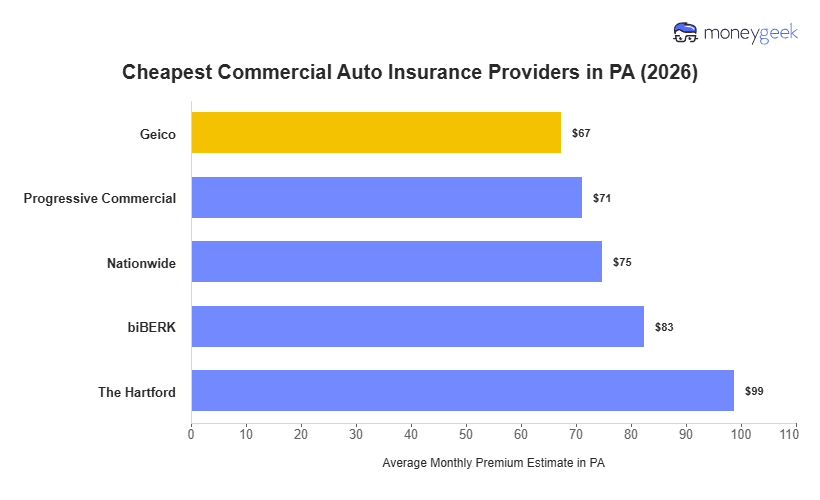
MoneyGeek analyzed average monthly rates across vehicle types and industries to identify the cheapest commercial auto insurers in Pennsylvania.

  1. GEICO averages $67 per month for commercial auto insurance in Pennsylvania, 15% below the state average. It prices lowest across 15 of 25 general industries in MoneyGeek's Pennsylvania analysis, with its strongest savings for office-based businesses, financial services and wellness-sector companies. Pennsylvania businesses in financial services see GEICO's deepest savings at 26% below the industry average.
  2. Progressive Commercial averages $71 per month, 10% below the Pennsylvania state average. It ranks first in affordability for 10 general industries in MoneyGeek's Pennsylvania analysis, including wholesale and distribution, transportation and logistics, childcare services and manufacturing. Pennsylvania businesses in wholesale and distribution see Progressive Commercial's strongest savings at 31% below the industry average.
  3. Nationwide averages $75 per month, 5% below the Pennsylvania state average. It's the third-cheapest option overall in MoneyGeek's Pennsylvania analysis and a reasonable fit for businesses that don't fall squarely into the industry profiles where GEICO or Progressive Commercial price lowest.

Pennsylvania commercial auto insurance costs vary by vehicle fleet details, driver records, services offered and location within the state, so these rankings won't apply uniformly to every Pennsylvania business. Use these companies as a starting point when comparing Pennsylvania commercial auto insurance costs to get the lowest-cost policy that meets your needs.


Geico$67$80915%
Progressive Commercial$71$85410%
Nationwide$75$8975%
biBERK$83$990-5%
The Hartford$99$1,187-25%

How We Determined the Cheapest Commercial Auto Insurance Providers

lightbulb icon
CHEAPEST DOESN'T ALWAYS MEAN BEST

A lower monthly premium can leave coverage gaps that cost more at claim time than the savings were worth. Before binding a policy, check how each insurer handles liability limits, physical damage coverage, hired and non-owned auto and claims service quality, not just the quoted rate. MoneyGeek's best commercial auto insurance in Pennsylvania guide walks through which providers balance price and coverage most effectively.

Industry and vehicle type determine which insurer is actually cheapest for your business. The provider breakdowns below show where each one prices lowest in Pennsylvania.

Cheapest Pennsylvania Commercial Auto Insurance by Vehicle Type

GEICO and Progressive Commercial are the only two insurers that rank first in affordability for at least one vehicle type in Pennsylvania. GEICO prices lowest for Sedans, SUVs, Pickup Trucks and Farm Tractors, while Progressive Commercial ranks first for Vans, Food Trucks, Taxis and Limousines. Progressive Commercial's strongest vehicle type advantage is in Taxis and Limousines, where it prices 31% below the Pennsylvania state average.

Farm TractorGeico$6725%
Food TruckProgressive Commercial$9022%
LimousineProgressive Commercial$10531%
Pickup TruckGeico$7222%
SUVGeico$5318%
SedanGeico$4519%
TaxiProgressive Commercial$10631%
VanProgressive Commercial$8115%

Pennsylvania rates vary by what you drive. The guides below cover cheapest rates by vehicle type.

Cheapest Commercial Auto Insurance by Industry in Pennsylvania

GEICO leads in affordability in 15 of the 25 general industries in MoneyGeek's Pennsylvania analysis, with its deepest savings in financial services at 26% below the industry average and consistent pricing advantages across agriculture, tech and fitness sectors. Progressive Commercial accounts for the remaining 10 industry wins, pricing lowest for businesses in wholesale and distribution, transportation and logistics and manufacturing, where its rates run 25% to 31% below their respective industry averages.

Agriculture & Natural ResourcesGeico$6321%
Arts, Media & EntertainmentGeico$5120%
Beauty, Body & Wellness ServicesGeico$3919%
Construction & ContractingGeico$8017%
Consulting ServicesGeico$4219%
EducationGeico$5118%
Financial ServicesGeico$3526%
Fitness ServicesGeico$3925%
Healthcare & MedicalGeico$5715%
Marketing & CommunicationsGeico$3619%
Nonprofit & AssociationsGeico$6813%
Pet Care ServicesGeico$6115%
Real Estate & Property ServicesGeico$5711%
Recreation & SportsGeico$6518%
Tech/ITGeico$4723%
Childcare ServicesProgressive Commercial$5426%
Cleaning ServicesProgressive Commercial$7122%
Food & BeverageProgressive Commercial$7418%
Hospitality, Travel & TourismProgressive Commercial$7620%
ManufacturingProgressive Commercial$7025%
Other Professional ServicesProgressive Commercial$738%
Repair & MaintenanceProgressive Commercial$7218%
Retail & Product RentalProgressive Commercial$768%
Transportation & LogisticsProgressive Commercial$9225%
Wholesale & DistributionProgressive Commercial$6131%

The industry breakdowns below show which insurer prices lowest for your specific business type in Pennsylvania.

Is the Cheapest Commercial Auto Insurance Right for Your Pennsylvania Business?

Cheap commercial auto policies in Pennsylvania cover standard collisions, liability and property damage at the 15/30/5 base minimum the state requires. The problem is that 15/30/5 isn't enough for every Pennsylvania business. Public Utility Commission (PUC)-regulated carriers, interstate operators and businesses running vehicles through Pennsylvania's most accident-prone corridors often need substantially higher limits than a base-minimum policy provides, and the difference comes out of pocket when a claim hits.

  • PUC carrier threshold gap: A Berks County food and beverage company operating a box truck with a gross vehicle weight rating at or under 10,000 lbs bought the cheapest policy available, priced at the 15/30/5 base minimum. Because the vehicle qualified as a PUC-regulated property carrier, the required minimum was $300,000 per accident, not 15/30/5. The insurer voided the policy at audit, leaving the business unable to operate legally until a compliant policy was in place.
  • Underinsured transport liability on I-81: A Harrisburg-based wholesale distributor running vans along the I-81 corridor held a budget policy with $30,000 per-accident bodily injury limits. After a multi-vehicle accident near the I-78 interchange during a winter weather event, medical and legal costs for the other parties exceeded the policy limit. The business owner paid the gap out of pocket.
  • Use code misclassification in construction: A Lancaster County contractor hauling tools and equipment between job sites had its pickup truck coded as business use rather than commercial use on a low-cost policy. After a collision on US-30, the insurer denied the claim because the vehicle's actual use didn't match its policy classification. The contractor paid vehicle repair costs and third-party property damage without any insurer reimbursement.
  • Hired and non-owned auto gap for healthcare businesses: A Philadelphia home health agency whose staff drove personal vehicles to patient visits in Bucks County carried no hired and non-owned auto coverage on its cheap commercial policy. After a staffer's personal vehicle was involved in an at-fault accident while traveling to a patient, the agency's policy did not cover the liability claim brought against the business.
  • Cargo coverage exclusion for agricultural haulers: A Lancaster County farm operation used a pickup truck to haul produce to wholesale buyers in Philadelphia. Its low-cost policy had no cargo coverage. A load damaged in transit left the farm owner responsible for the full replacement value with no insurer reimbursement.
  • FMCSA gap for cross-border logistics operators: A Pittsburgh-based freight company arranged regular shipments crossing into Ohio and West Virginia using vehicles insured under a Pennsylvania-only commercial policy. The policy met Pennsylvania's state minimums but did not include the federal endorsement required for interstate operations. After an accident on I-70 near the Ohio border, the policy did not respond to the claim.

A Lehigh Valley manufacturer running a fleet of delivery vans along I-78 carries substantially different risk than a Pittsburgh-based consulting firm using a single sedan for client meetings across Allegheny County. Pennsylvania businesses operating PUC-regulated routes, crossing state lines or running vehicles through high-incident corridors like I-81 and I-78 should check coverage limits and use classifications before choosing based on price alone.

Read MoneyGeek's full guide to commercial auto insurance in Pennsylvania for a broader look at coverage options.

Is the cheapest provider right for your business?

How To Get Cheaper Commercial Auto Insurance in PA Without Sacrificing Protection

These six strategies can lower your Pennsylvania commercial auto insurance costs without reducing the coverage your business actually needs.

    vs icon
    Compare quotes using identical coverage terms

    A $50 gap between two Pennsylvania quotes usually means one policy has a $500 deductible and the other has a $2,000 one, not that one insurer is genuinely cheaper. Before comparing prices, confirm that each quote uses the same deductible amounts, bodily injury liability limits and endorsements. A quote comparison that doesn't control for those variables tells you nothing useful about which insurer is actually cheaper for your business.

    loanReview icon
    Confirm each vehicle's use code before you bind

    Commercial auto policies in Pennsylvania use four use classifications: pleasure, commute, business and commercial. The difference matters at claim time. A delivery van hauling goods to customers in Philadelphia is a commercial use vehicle, and if it's coded as business use on your policy, your insurer can deny the claim after an accident. Ask your agent to confirm every vehicle's classification before the policy goes into effect.

    insurance2 icon
    Bundle commercial auto with other business insurance policies

    Bundling your commercial auto policy with general liability, workers' compensation or commercial property coverage can reduce your total premium by up to 20% depending on the insurer and your business profile. Pennsylvania businesses with multiple coverage needs will generally get better combined pricing from a single carrier than from separate policies across multiple insurers.

    locationPin icon
    Install telematics or GPS fleet-tracking hardware

    Progressive Commercial's Snapshot ProView program locks in a 5% discount at enrollment, with an additional 8% to 20% possible at renewal based on how your fleet actually drives. The program monitors hard braking, speeding and nighttime miles. If your Pennsylvania drivers regularly run late routes or deal with heavy traffic on I-76 or I-95, review your fleet's driving patterns before enrolling, because poor scores at renewal can push your rate up rather than down.

    trendingUp icon
    Raise your deductible if your fleet has a clean claims history

    Increasing your deductible from $500 to $1,000 or $2,000 can reduce your Pennsylvania commercial auto premium by 10% to 20% depending on your vehicle type and insurer. This only makes financial sense if your fleet has at least two years of clean claims history and your business has sufficient cash reserves to cover the higher out-of-pocket cost after an incident. Don't raise your deductible beyond what your cash flow can absorb.

    variableRate icon
    Update your annual mileage estimates mid-policy if your routes changed

    Pennsylvania commercial auto premiums are rated at policy inception based on estimated annual mileage. If your routes shortened, you reduced delivery frequency or a vehicle sat idle for part of the year, your current estimate may be overstating your actual exposure. Contact your insurer mid-policy to update your mileage figures. Lower mileage typically reduces your rate at renewal and may trigger a mid-term adjustment depending on your policy terms.

Affordable Commercial Auto Insurance in Pennsylvania: Bottom Line

It's possible that the cheapest commercial auto insurer on our Pennsylvania list won't be the cheapest option for your business. What your fleet consists of, what your business does and how your drivers operate all shift which insurer prices lowest for your specific situation. A Pittsburgh-based cleaning company running a fleet of vans pays a different rate than a Harrisburg financial services firm with a single company car.

Get quotes from at least three insurers using identical coverage terms, then evaluate each option on price and coverage together.

Ready to confirm your cheapest option? Get matched to your lowest Pennsylvania rate.

Cheap Pennsylvania Commercial Auto Insurance: Next Steps

Before committing to a policy, confirm it actually covers how your vehicles are used in Pennsylvania, with the right liability limits, use classifications and endorsements in place. A policy that meets the base 15/30/5 minimum may not be sufficient if your vehicles are PUC-regulated, cross state lines or operate in high-liability industries. Take the time to understand what your business actually needs before locking in a price.

Recommended: If You're Still Learning About Commercial Auto Coverage

Personal auto policies don't cover vehicles used for business purposes, and the gap can be costly after an accident. Before comparing quotes, understand what triggers commercial auto coverage, what common exclusions apply and what Pennsylvania specifically requires for your vehicle type and operation. The answers will change which policy is actually the right fit for your business.

If You Want to Confirm Cost Before Deciding

If You Need Related Business Coverage

How We Determined The Cheapest Commercial Auto Insurance Providers in Pennsylvania

To identify the cheapest commercial auto insurers, MoneyGeek analyzed pricing estimates from five providers that met our criteria for pricing availability, customer experience feedback and coverage transparency (Progressive Commercial, GEICO, The Hartford, Nationwide and biBerk). Insurers in Pennsylvania were studied across eight vehicle types and 25 general industry categories.

How rankings work: Overall recommendations reflect average estimated rates across all vehicle types, industries and states combined. Factor-specific recommendations (by vehicle, industry or state) reflect which provider ranks lowest within that specific segment.

What these rates represent: Figures are standardized pricing estimates for comparison, not personalized quotes. Actual premiums depend on your vehicle classifications, annual mileage, claims history, driver records, selected limits, deductibles and endorsements. Compare quotes from at least three insurers with identical coverage parameters for the most accurate result.

About Connor Bolton


Connor Bolton headshot

Connor Bolton is Senior SEO and Content Manager at MoneyGeek, where he leads the business and pet insurance editorial teams. As editorial lead for both verticals, Connor sets the research framework, data standards, and content structure that his writers execute, directly authoring in-depth guides himself and reviewing all team content for accuracy and practical value before it goes live. With over four years evaluating insurance products across personal, commercial, and specialty lines, he brings cross-vertical knowledge to every guide the team produces.

Connor architected MoneyGeek's insurance research infrastructure across all major verticals including auto, home, renters, life, health, business, and pet, building systems for pricing analysis, provider-level research, customer experience evaluation, and coverage analysis with AI support. The infrastructure includes over 6 million data points for business insurance across 408 industry areas, all 50 states, and 16 vehicle types, and over 5 million pet insurance profiles across 18 major providers and hundreds of breed and age combinations. Connor's insurance cost research and his team's work has been cited by the U.S. Chamber of Commerce, Allstate, Liberty Mutual, CBS News, Forbes and LegalZoom.

Beyond the data, Connor stays connected to how the market actually operates, drawing on direct conversations with underwriters and carrier liaisons at Ethos, The Hartford, NEXT Insurance, Nationwide, and State Farm, and monitoring business and pet owner communities including Reddit, to inform how he interprets findings and frames guidance for real buyers.

He is the direct editorial contact for methodology questions at connor@moneygeek.com and can be found on LinkedIn.