Key Takeaways
blueCheck icon

ERGO NEXT ranks first overall for business insurance in California, due to its combination of affordability and excellent customer experience.

blueCheck icon

The best insurer also changes with the risks your business carries. Hiscox specializes in providing coverage for professional services, which is why it outranks even ERGO NEXT for consulting firms.

blueCheck icon

Before comparing insurers, get clear on what your business does, what could go wrong and what a serious claim would cost you, since those risks decide which coverages you need and how high your limits should be.

Best Business Insurance Companies in California: My Top Picks

No single company serves as the best commercial insurance provider for every type of California business. ERGO NEXT leads in my ranking, but the right insurer for you comes down to what your business does, what you need covered and other factors specific to your business. A home-based marketing consultant and a contractor running crews and trucks across job sites will have very different answers, even though both are shopping for the same product.

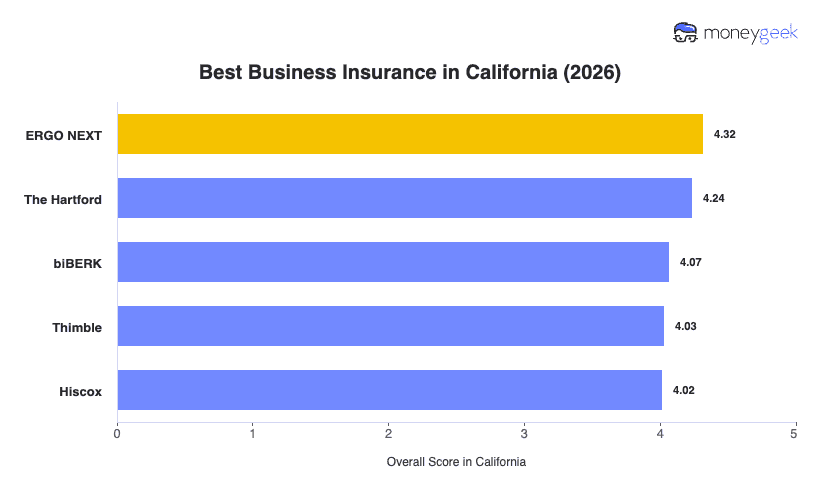
My rankings reflect a typical small business in California with one to four employees. The companies below are listed by their performance based on my rankings, but I've also identified the strongest reason why you should consider each one.

  1. ERGO NEXT: Best Overall for Small Businesses
  2. The Hartford: Best for Coverage Depth
  3. biBerk: Best for Quick Online Coverage
  4. Thimble: Best for On-Demand Coverage
  5. Hiscox: Best for Professional Liability

The table below compares how the seven providers rank across the factors that shape my rankings.

ERGO NEXT4.32113
The Hartford4.24221
biBERK4.07466
Thimble4.03347
Hiscox4.02535

The summaries that follow lay out who each insurer fits best and who should look elsewhere, because an overall rank means little if the provider can't satisfy the actual needs of your business.

ERGO NEXT

ERGO NEXT

Best Overall for Small Businesses
On ERGO NEXT's site

ERGO NEXT (formerly NEXT Insurance) is my best overall pick for small businesses in California. It wins on the two things owners care about most, which are an easy experience and a fair price. You can quote, buy and pull a certificate of insurance from your phone in minutes, with no agent and no waiting. That ease is why it ranks first for customer experience in every industry I analyzed, and with rates landing well below the state average, it takes first place overall in 22 of 25 industries. I recommend it most for construction, food and beverage, cleaning and childcare businesses. If you need high limits or broad endorsements, though, a fuller carrier will serve you better, since its coverage ranks third of seven.

Learn More: ERGO NEXT Business Insurance Review

The Hartford

The Hartford

Best for Coverage Depth
On The Hartford's site

The Hartford is my pick for California businesses with real coverage needs, the kind that a bare-bones online policy cannot handle. It ranks first on coverage in all 25 industries I analyzed, so if you carry complex risks, high limits or exposures that do not fit a template, this is the carrier with the most room to protect you. Founded in 1810, it is also one of the most financially solid insurers in the country, which matters when a large claim lands and you need it paid. Its strength in workers' compensation makes it a standout once you have employees, and it backs all of it with fair, reliable claims handling. You can quote a business owner's policy, workers' comp, general liability and property online, though a few lines like professional liability still need a phone call. Where it falls short is the trades, running expensive and near the bottom for construction and transportation, so businesses there are better off with a specialist.

Learn More: The Hartford Business Insurance Review

biBerk

biBerk

Best for Quick Online Coverage

biBerk is my pick for small business owners who want to buy no-frills coverage quickly online. It is part of Berkshire Hathaway, so its policies carry top-tier financial strength behind a fully digital model. It ranks third overall in California, with its strongest showings in fitness, pet care and recreation businesses, where it ranks second. You can get a quote, buy coverage, manage your policy and pull your own certificates of insurance without having to speak to an agent, which suits small operations with simple coverage needs. It is not the best fit if you need extensive coverage or responsive, hands-on support.

Learn More: biBerk Business Insurance Review

Thimble

Thimble

Best for On-Demand Coverage

If your business needs flexible coverage you can activate for a single job, a season or a month at a time, Thimble is my pick. It is a digital insurer owned by Arch that places coverage through A-rated carriers, with policies you can buy in minutes online and certificates of insurance you can share instantly. It ranks second in California for industries full of project-based and event-based work, including construction and contracting, repair and maintenance, and food and beverage. Its flexibility is the real draw for freelancers, contractors and vendors whose coverage needs start and stop with the job. It is not the best fit if you need deep, year-round coverage (it ranks last on that measure), and it does not offer commercial auto coverage.

Learn More: Thimble Business Insurance Review

Hiscox

Hiscox

Best for Professional Liability

Hiscox is my pick for consultants and advisors, whose biggest risk is not a fire or a break-in but a client suing over the work itself. That risk is covered by professional liability, and Hiscox is a specialist that built its whole business around it, tracing back to Lloyd's of London. That focus is exactly why it beats bigger, higher-ranked generalists to rank first for consulting in California. It also lands second in eight more industries, from financial services to childcare, and prices competitively across them. Where it trails is coverage depth and customer experience, so it fits service businesses that want specialist liability coverage, not asset-heavy operations that need broad property protection.

Learn More: Hiscox Business Insurance Review

Best California Business Insurance by Industry

What counts as the best insurer depends on your industry, because every industry runs on a different set of risks. A software firm worries about a line of bad code; a contractor worries about an injury on site; a logistics company worries about a collision on the freeway. I have identified the best insurers for California's largest industries, choosing providers based on their balance of coverage, customer experience and pricing for specific industry categories.

  • computer icon
    Tech and IT

    The biggest risk for a tech business is being blamed for a client's financial loss, a bug that takes down their site, a missed deadline, a product that underperforms. Professional liability, also called errors and omissions or E&O, covers claims like that. Because these businesses hold client data, cyber coverage matters too, alongside general liability and protection for equipment.

    For a small or early-stage tech firm, I recommend ERGO NEXT. It ranks first for the industry on the strength of its customer experience, and you can get E&O in place and send a client a certificate of insurance from your phone in minutes, which is what a young software shop signing its first contracts actually needs.

    Once a firm grows, The Hartford becomes the stronger choice, and it ranks a close second here for that reason. It leads the industry on coverage and offers higher liability limits, plus the option to add data breach and professional liability onto one policy. That matters when an enterprise client's contract demands higher E&O and cyber limits than a starter policy carries, or when you hold enough client data that a breach would be catastrophic. If your contracts set high coverage requirements, compare the two before deciding.

    Learn More: Best Business Insurance for Tech and IT

  • hammer icon
    Construction and Contracting

    Contractors constantly face the risk of someone getting hurt or property getting damaged or stolen on a job site. General liability with high limits is usually non-negotiable, since general contractors and project owners tend to demand proof of it before you start. Many contractors also need workers' compensation and coverage for vehicles, equipment and the surety bonds that come with licensing.

    For most contractors, ERGO NEXT is my pick. It ranks first for the industry, prices lower than any provider in the analysis, and issues certificates of insurance online in minutes, so you can prove coverage to a general contractor on the spot.

    The Hartford is the pick once your projects get bigger. Its Contractor's Broad Form Endorsement builds in blanket additional-insured status, so you can meet a general contractor's requirements without an underwriter signing off on each new job, and it writes GL limits up to $2 million per occurrence with umbrella coverage well beyond. That is what a larger commercial contract demands and a low-cost basic policy cannot match.

    Learn More: Best Business Insurance for Contractors

  • hospital icon
    Healthcare and Medical

    If you have a medical or wellness business, you carry constant exposure to claims tied to the care you provide and to the patient data you hold. The care side is covered by malpractice insurance (also called professional liability), and for licensed clinical providers it is usually the most important coverage you carry. General liability protects you against everyday accidents, and cyber coverage protects the patient records you store.

    Keep in mind that true clinical malpractice for a physician, dentist or similar provider almost always comes from a specialized medical malpractice carrier, not the general small-business insurers here. What these providers cover is the business around the practice. 

    For that coverage, ERGO NEXT is my pick, ranking first for healthcare in California and letting a small practice get liability and cyber in place online without an agent. If your practice is larger or holds a high volume of patient records, The Hartford is the stronger alternate, leading the industry on coverage and able to add data breach protection onto one policy. Pair either with a dedicated malpractice policy if your work involves direct clinical care.

  • briefcase icon
    Consulting

    Consultants sell advice, and that is exactly where the risk sits. If a client decides your recommendation cost them money, they can come after you, even when you did nothing wrong. The coverage that answers that is professional liability, often called errors and omissions or E&O. Cyber coverage matters too if you handle client data or log into their systems to do the work.

    Hiscox is my pick for consultants because it built its business around professional liability, the exact risk a consultant carries. That focus is why it ranks first for consulting in California, ahead of larger generalists, and it prices the coverage low enough that a solo consultant or small firm can carry solid E&O without overpaying.

    If you want more coverage and a more hands-on insurer, The Hartford ranks a close second. It leads the industry on coverage and outscores Hiscox on customer experience, with agents who can help structure the policy, which suits a larger consultancy or one whose contracts demand higher E&O limits than a lean specialist policy carries.

    Learn More: Best Business Insurance for Consultants

  • graph icon
    Financial Services

    Accountants, planners and advisers work with their clients' money and trust, so their biggest exposures are a client blaming them for bad financial advice and a breach of the sensitive data they keep. The central coverage is professional liability, the errors-and-omissions policy that responds when a client says your advice cost them money, with cyber coverage close behind. Many of these firms also carry crime or management liability coverage, depending on how they are set up.

    The Hartford is my pick for financial services in California, raking first for the industry and leading on coverage. It can put the pieces these firms actually need onto one policy with higher limits than a basic package, covering professional liability, cyber and data breach in the same place. For a regulated firm that has to meet specific coverage requirements, that depth in one spot is the draw.

    If you are a solo adviser and that feels like more than you need, Hiscox ranks a close second and is the lighter, more focused alternative, strong on the E&O coverage that does most of the work for a one-person shop.

  • guitar icon
    Arts, Media and Entertainment

    Arts, media and entertainment is a broad category, but people working in this space share the same handful of risks. You need general liability for the events, shoots and venues you work in, coverage for the expensive gear you haul from place to place, and often the option to insure a single production or pop-up rather than commit to a full year.

    ERGO NEXT is my pick for businesses that work steadily through the year. It ranks first for the category, and its fast online setup lets a studio, agency or production company add a venue or client as an additional insured and send the certificate from a phone before load-in.

    If your work runs project to project, Thimble is the better fit. It sells coverage by the day or the month, so you can turn a policy on for a shoot or an event and off again when it wraps, instead of paying year-round for weeks of actual work.

How to Choose Business Insurance in California

Business insurance gets a lot less overwhelming when you stop shopping on price and start with what your business actually needs to cover. These six steps take you from your risks to a policy you can trust.

  1. 1
    Map what could actually go wrong

    Before you look at a single quote, write down how your business could face a claim, a customer injury, damaged property, a lawsuit over your work, a data breach or a wreck in a company vehicle. Your list of needed coverages falls straight out of this, and it keeps you from buying policies you do not need or skipping ones you do.

  2. 2
    Settle what you are required to carry

    For most businesses, California requires workers' compensation the moment you hire your first employee, and any vehicle used for business has to meet the state's commercial auto minimums, which rose to 30/60/15 in January 2025. On top of state mandates, your landlord, client or general contractor routinely demand general liability before they sign, so check your leases and contracts for any coverage they require.

  3. 3
    Set limits to the size of the claim

    The cheapest policy is almost always the one with the lowest limits, and a limit that runs out when you file a claim can lead to a heavy financial loss. Picture what a serious lawsuit or a total loss would actually cost you in your line of work, and set your limits to cover that. If a contract sets a minimum limit you have to carry, treat that as your floor, not your target.

  4. 4
    Decide how much help you want

    Insurers are split between self-service and agent-supported, and you should know which one you want before you start. Some, like ERGO NEXT and biBerk, let you quote, buy and manage everything online in an afternoon. Others, like The Hartford and Nationwide, give you an agent who builds the policy and picks up the phone when something goes wrong. Neither model is inherently better than the other, but deciding upfront what works for you lets you narrow your shortlist.

  5. 5
    Compare quotes on identical coverage

    A price comparison only tells you something when every quote covers the same things at the same limits. Put them side by side, coverage for coverage, before you look at the numbers at the bottom. Otherwise, you may be holding a bare-bones policy against an extensive coverage and calling the cheaper one the better deal.

  6. 6
    Check the insurer before you buy, and again each year

    Before you commit, do a little digging on the insurer itself. Read through customer reviews and complaint patterns to see how it actually treats people when a claim is on the line, since that is the moment the policy either works or it does not. MoneyGeek's reviews are a good place to start, and it is worth confirming the company is licensed to sell in California through the state Department of Insurance. Once you are covered, look at the whole policy once a year. A new hire, vehicle, service or jump in revenue all change what you need to carry.

Best Business Insurance in California: Bottom Line

The best provider is rarely the same for two businesses, so instead of asking who is best overall, ask which company is built for the way you operate. Three questions usually settle it:

  • What single risk would actually take you down? It might be a lawsuit over your work, an injury to an employee, a wrecked work vehicle or a bad run of claims. The provider you want is the one strongest on that exposure, not the one with the best average score.
  • Do you want to handle insurance yourself or have someone handle it for you? This question alone splits the field in half. Self-service insurers sit on one side and agent-supported ones on the other.
  • How steady is your work? A business that runs the same way all year buys differently than one that works project to project.

Once you can answer those, the shortlist gets short fast. Match the provider to your biggest risk first, set your limits to what a serious claim would really cost, and compare only insurers that cover the same things at the same limits. The company that fits how you actually work will almost always serve you better than whichever one looked cheapest.

Best Business Insurance in California Chart

Best California Commercial Insurance: Next Steps

For most California businesses, the next move is to put your shortlist of insurers side by side and get quotes on matching coverage. My  rankinng tells you which providers are worth your time, but it cannot tell you which one fits your specific business, budget and tolerance for doing things online versus through an agent.

Recommended: If You're Ready to Get Quotes Now

The best provider shifts by industry, size and how you like to buy, so the smart starting point is a shortlist, not a single name. Compare the highest-ranked insurers for your business before you commit to any one of them.

If you are not ready to request quotes yet, find your situation below.

If You Want to Check What California Requires

If You Want to Match Coverage to Your Industry

If You Want to Know Whether a Quote Is Fair

How I Chose the Best Business Insurance Companies in CA

My business insurance rankings for California come down to three things: what businesses pay for coverage, how a provider treats a policyholder who needs help and whether the policy holds up when a claim is filed. I rated seven providers across affordability (50% of the score), customer experience (30%) and coverage (20%). Affordability carries the most weight because price is where most owners start, but the remaining half of the score reflects a simple truth: a cheap policy that is hard to use or thin on coverage is not a good deal.

  • Affordability (50% of the Score): I measured how competitively and consistently each provider prices coverage across 25 California industries, benchmarked against the average rate for each one. Comparing within industries, rather than against a single statewide average, is what keeps the scoring fair, since a contractor and a consultant face very different baseline costs and should be judged against their own peers.
  • Customer Experience (30% of the Score): I looked at how each provider supports a business across the full life of a policy: buying it, managing it and filing a claim. The assessment draws on customer reviews, public forums and third-party research, alongside a direct look at each provider's quoting and policy-management process. Service quality varies as much as price across these seven providers, which is why it carries nearly a third of the score.
  • Coverage (20% of the Score): I compared policy terms, endorsement options and coverage structure at the same tiers for every provider, so the comparison reflects real differences rather than one carrier being measured on a richer policy than another. The question behind this part of the score is how well each provider's coverage answers the risks California businesses actually carry.

For the full breakdown, see MoneyGeek's methodology.

About Connor Bolton


Connor Bolton, Senior SEO and Content Manager (Business & Pet), MoneyGeek

Connor Bolton is Senior SEO and Content Manager at MoneyGeek, where he leads the business and pet insurance editorial teams. He sets the research framework, data standards and content structure for his team. All content goes through his accuracy review before publication. Connor also writes in-depth guides and has spent more than four years covering insurance products across personal, commercial and specialty lines.

The research infrastructure Connor built covers auto, home, renters, life, health, business and pet insurance across pricing analysis, carrier research, customer experience and coverage evaluation. It includes over 6 million data points for business insurance across 408 industry areas, all 50 states and 16 vehicle types. The pet insurance side covers over 5 million profiles across 18 major providers, 100+ breeds and ages up to 20 years. Connor’s insurance research and his team's work has been cited by the U.S. Chamber of Commerce, Allstate, Liberty Mutual, CBS News, Forbes and LegalZoom.

Connor also talks with underwriters and carrier liaisons at Ethos, The Hartford, ERGO NEXT, Nationwide and State Farm, and monitors business and pet owner communities on Reddit. Those sources shape how his team evaluates carriers, structures rate analysis and writes for human buyers rather than search engines.

For questions about MoneyGeek's business and pet insurance content, contact him at connor@moneygeek.com or on LinkedIn.