Key Takeaways
blueCheck icon

Business insurance in California averages $160 per month ($1,921 per year), which is about $49 above the national average. It's the second most expensive state for commercial insurance in the U.S., only behind New York.

blueCheck icon

California's high premiums stem largely from the state's earthquake and wildfire exposure, litigious legal climate and worker-friendly labor rules. In general, any business's rate moves with its industry, size, location, coverage limits and claims history.

blueCheck icon

To lower your commercial insurance costs, I recommend that you compare quotes on identical limits and deductibles, classify your operations and payroll accurately, and keep a clean claims history. I'd also reassess coverage after hiring, buying equipment or signing a contract.

How Much Does Business Insurance Cost in California?

The average cost of small business insurance in California is $160 per month ($1,921 per year). That figure is a composite average across coverage types, industries and business sizes, so treat it as a general benchmark for insurance costs in the state, not a quote for any specific business. What you actually pay depends on the coverages you carry, and those individual costs are where the number takes shape.

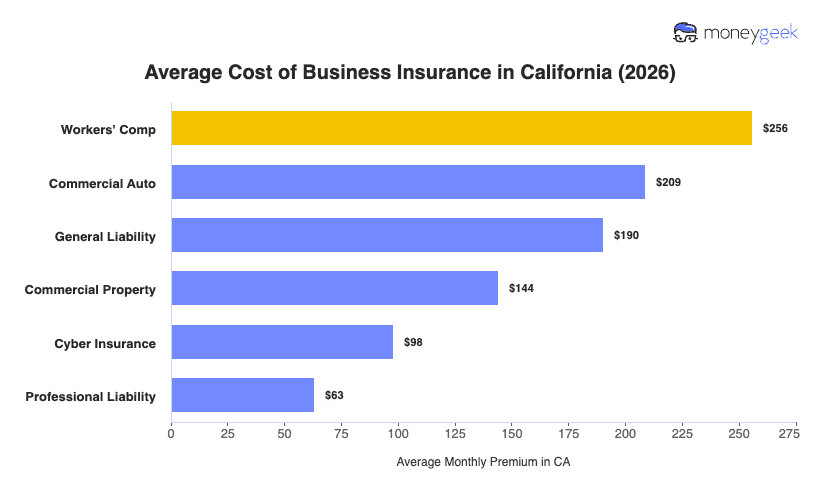
Keep in mind that workers' compensation is priced per employee, so it scales with your headcount, and commercial auto is priced per vehicle, so it scales with the size of your fleet. The rest are flat monthly averages for a typical small business. Here's what each policy costs, what it covers and when your business needs it.

Workers' Compensation
$256/mo ($3,069/yr)
Medical bills and lost wages when an employee is hurt on the job.
Required in California once you have any employees, including part-time.
Commercial Auto
$209/mo ($2,503/yr)
Injuries and property damage from an accident involving a work vehicle.
Required for any vehicle your business owns or uses for work.
General Liability
$190/mo ($2,284/yr)
Customer injuries and property damage you're legally responsible for.
When clients, landlords or licensing boards require proof, which is most businesses.
Commercial Property
$144/mo ($1,730/yr)
Your building, equipment and inventory against fire, theft and similar losses.
When you own or lease space, or hold equipment and inventory worth protecting.
Cyber Insurance
$98/mo ($1,177/yr)
Breach costs like customer notification, legal fees and data recovery.
When your business stores customer data or takes card payments.
Professional Liability
$63/mo ($760/yr)
Financial losses a client claims your work or advice caused them.
When you sell advice or professional services, or a client contract requires it.

To build these estimates, our team collected cost data on standardized business profiles across every state, then I analyzed it to produce comparable figures by coverage type, industry and business size. Modeling the same profiles everywhere keeps the numbers on this page consistent, so what you see reflects a shared baseline rather than one company's quote.

Dataset Scope and Assumptions

The data our team gathered covers:

  • Six coverage types: general liability, workers' compensation, commercial auto, commercial property, professional liability and cyber
  • 25 general industries and more than 400 sub-industries
  • Five business-size bands, from no employees up to 49
  • All 50 states plus Washington, D.C.

How We Calculated

Two kinds of figures show up on this page. The national average is a single reference point, the average premium across every state in the dataset, which is how I place California against the rest of the country. Segment averages isolate one variable at a time, coverage, industry or business size, so you can see where your own business is likely to land. All of these are modeled estimates, not quotes, and your real premium depends on your specifics.

California Commercial Insurance Cost Calculator

Enter your details into MoneyGeek's small business insurance calculator  below to get a rate estimate based on your business profile. You can adjust the coverage type, industry and number of employees to see how each one moves your cost.

CA Small Business Insurance Cost Estimate Calculator

Set your coverage type, industry and employee count in the calculator to get an average monthly and annual rate for a business like yours in California. Treat it as a budgeting baseline, not a quote, since your real premium also depends on your claims history and coverage limits. Once you've got a number to work from, hit Get Quotes to compare real offers from a few insurers.

Select General Industry Category
Select Coverage Type
Select Employee Count
Average monthly rate in CA—

Average Business Insurance Costs in California by Industry

The $160 statewide figure is a composite average, so it flattens a wide range of costs and doesn't reflect what any single business actually pays. Your real cost is the sum of the coverages you carry, which depends on what your business does and what it's required to insure. A retail shop, for instance, can run anywhere from about $386 to $638 a month. At the low end, the estimate covers general liability and commercial property to protect the storefront and inventory, and at the high end, it adds workers' comp for store staff and cyber coverage for card payments and customer data.

The table below breaks down the average monthly cost of each coverage type by industry in California, based on a business with one to four employees and a commercial van.

Agriculture & Natural Resources
$150
$356
—
$126
$61
$206
Arts, Media & Entertainment
$57
$238
$45
$28
$84
$194
Beauty, Body & Wellness
$67
$32
$38
$28
$96
—
Childcare Services
$232
$95
$185
$26
$86
$224
Cleaning Services
$169
$300
$21
$30
$77
$239
Construction & Contracting
$596
$728
$96
$151
$88
$261
Consulting Services
$36
$48
$57
$15
$118
$173
Education
$72
$166
$83
$60
$86
$219
Financial Services
$68
$25
$102
$30
$134
—
Fitness Services
$151
$169
$34
$36
$90
$188
Food & Beverage
$211
$107
—
$80
$96
$237
Healthcare & Medical
$320
$127
$49
$320
$137
$289
Hospitality, Travel & Tourism
$185
$109
$58
$242
$126
$270
Manufacturing
$116
$371
—
$544
$85
$240
Marketing & Communications
$41
$60
$44
$16
$113
—
Nonprofit & Associations
$88
$153
$42
$50
$67
$217
Other Professional Services
$124
$49
$54
$58
$114
$224
Pet Care Services
$87
$151
$35
$35
$90
$223
Real Estate & Property Services
$63
$52
$81
$14
$90
$218
Recreation & Sports
$95
$277
$58
$64
$66
$217
Repair & Maintenance
$131
$198
—
$61
$93
$258
Retail & Product Rental
$131
$147
—
$255
$105
$218
Tech/IT
$34
$97
$83
$39
$185
$173
Transportation & Logistics
$102
$772
—
$77
$71
$362
Wholesale & Distribution
$182
$478
—
$559
$80
$268

The breakdowns below show what a coverage package costs across California's most common industries, from the minimum most businesses start with to fuller, comprehensive protection. All figures assume one to four employees, and a commercial van where a vehicle applies.

How Business Insurance Scales With Your Business in California

As your business grows, so does the cost of insuring it. You have more to insure, your required limits go up, and you take on new policies for risks that didn't exist when you started. The figures below are averages by business size in California, running from about $61 a month for an owner-operator with no employees to $993 for a business with 20 to 49. Like any average, they smooth over a wide range, so treat each stage as a benchmark rather than a precise quote for your business.

0$61$731
1 to 4$150$1,804
5 to 9$247$2,965
10 to 19$462$5,541
20 to 49$993$11,918

Here's how your coverage needs change at each stage of growth:

What Affects Business Insurance Costs in California?

Industry and business size explain most of what you'll pay, but a few other factors decide the final number. Some depend on how you run your business, and others come with operating in California specifically.

  • locationPin icon
    Where You Operate in the State

    Your rate changes depending on where in California you're based. A business in a wildfire-prone or high-crime area pays more for property and liability coverage than one in a quieter market, and metro areas like Los Angeles and the Bay Area tend to cost more than rural parts of the state because claims happen more often and cost more to settle.

  • graph icon
    California's Risk and Legal Climate

    California ranks among the most expensive states largely because of the conditions its businesses operate under. Wildfire and earthquake exposure raises property premiums, and the state's litigious reputation increases the cost of liability and workers' comp claims. Together, those pressures are part of why the average business here pays about $160 per month, compared with $104 in Arizona, $112 in Oregon and $113 in Nevada.

  • umbrella icon
    Your Coverage Limits and Deductibles

    Higher coverage limits cost more, and a lower deductible raises your premium because the insurer covers more of each claim. You won't always control this, since client contracts and commercial leases often set the minimum limits you have to carry. Where you do have room, raising your deductible is one of the simpler ways to lower what you pay.

  • insurance2 icon
    Your Claims History

    Insurers treat a record of frequent or expensive claims as a sign you'll likely file again, which can keep your rates higher for years. A clean history does the reverse. It takes time to build, but it's one of the few cost factors you genuinely control.

  • smallBusiness icon
    Your Payroll and Revenue

    Workers' comp costs are based on your payroll, charged at a rate for every $100 you pay out, and that rate climbs with how risky your business is. A lot of other policies also move with your revenue, so a busy, high-earning business usually have higher rates than a slower one even when they employ the same number of people. This is also why accurate payroll records and job classifications matter, because getting them wrong can leave you paying more than you should.

How to Lower Your Business Insurance Costs in California

You can usually trim your premium without dropping coverage you actually need. The goal is to pay less for the same protection, not to leave gaps that cost you far more after a claim. These strategies take effect at your next quote or renewal, and most come down to how you buy rather than what you buy.

  1. 1
    Compare Quotes on Identical Coverage Terms

    The cheapest quote only means something if it's covering the same thing as the others. Before you compare prices, make sure each quote carries the same liability limits, deductibles and added coverages, since a lower number often just means less protection. A policy that comes in cheap by dropping below the limits your contracts require isn't a deal, it's a liability.

  2. 2
    Bundle Into a Business Owner's Policy

    A business owner's policy, or BOP, packages general liability and commercial property together for less than you'd pay for each on its own, and many insurers extend the same multi-policy discount when you add commercial auto or other lines. These savings don't show up on standalone quotes, so you have to ask. In a state where the average business already pays around $160 a month, a bundling discount puts a real dollar amount back in your pocket.

  3. 3
    Classify Your Business and Payroll Accurately

    Workers' comp and liability rates ride on how your business and employees are classified, and an overly broad or outdated classification can quietly inflate your bill. Review your class codes with your broker, especially after you change what your business does or shift people between roles. Getting this right is one of the few fixes that lowers your cost without changing your coverage at all.

  4. 4
    Raise Your Deductible Where It Makes Sense

    A higher deductible lowers your premium because you're agreeing to cover more of a claim yourself. This works well if your business has the cash reserves to absorb a larger out-of-pocket hit and a clean claims history that makes a big claim unlikely. It's a poor trade if a single bad year would leave you unable to pay, so size the deductible to what you could realistically cover.

  5. 5
    Pay Your Premium Annually

    Paying your full premium up front instead of in monthly installments usually avoids the financing fees insurers tack onto a payment plan. If your cash flow allows it, it's a straightforward way to save on the cost of the same policy. Ask your insurer what the difference actually comes to before you decide.

  6. 6
    Manage Risk to Protect Your Claims History

    A clean claims record is one of the strongest things working in your favor at renewal, and basic risk management is how you keep it. Safety training, documented procedures and quick attention to hazards all reduce the claims that drive rates up over time. This one pays off slowly, but it compounds, since every year without a major claim strengthens your position.

Average Cost of Commercial Insurance in California: Bottom Line

The right coverage starts with an honest look at what could go wrong in your business and what it would cost you to recover. Before you shop, it helps to work through a few basic questions:

  • What am I required to carry? Some coverage are mandated by the state, and more is often required by your clients, lease or licensing board.
  • What would actually put me out of business? A lawsuit, an injured employee, a fire, a lost laptop full of client data. Your biggest risks should drive your biggest coverage decisions.
  • What can I afford to absorb myself? What you can cover out of pocket sets your deductible. What you can't is exactly what insurance is for.

From there, the goal is simple. Buy enough coverage to survive your worst realistic day, match it to what your contracts demand, and pay a fair price for it by comparing real quotes. Insurance is rarely a one-time decision, so plan to revisit it as your business changes, then move on with confidence once it's in place.

Average Cost of Business Insurance in California (2026) Chart

California Business Insurance Costs: Next Steps

Once you have a sense of business insurance costs, the next move is to see what specific insurers will actually charge you. Our best and cheapest pages are a good place to start, since they show what other California businesses are paying.

Recommended: If You're Ready to Compare Providers

These pages rank insurers by what they charge and how they handle claims, so you can see who's worth a quote.

If You Want to Know What Other Coverage Costs

If You Want to Understand the Coverage Itself

About Connor Bolton


Connor Bolton, Senior SEO and Content Manager (Business & Pet), MoneyGeek

Connor Bolton is Senior SEO and Content Manager at MoneyGeek, where he leads the business and pet insurance editorial teams. He sets the research framework, data standards and content structure for his team. All content goes through his accuracy review before publication. Connor also writes in-depth guides and has spent more than four years covering insurance products across personal, commercial and specialty lines.

The research infrastructure Connor built covers auto, home, renters, life, health, business and pet insurance across pricing analysis, carrier research, customer experience and coverage evaluation. It includes over 6 million data points for business insurance across 408 industry areas, all 50 states and 16 vehicle types. The pet insurance side covers over 5 million profiles across 18 major providers, 100+ breeds and ages up to 20 years. Connor’s insurance research and his team's work has been cited by the U.S. Chamber of Commerce, Allstate, Liberty Mutual, CBS News, Forbes and LegalZoom.

Connor also talks with underwriters and carrier liaisons at Ethos, The Hartford, ERGO NEXT, Nationwide and State Farm, and monitors business and pet owner communities on Reddit. Those sources shape how his team evaluates carriers, structures rate analysis and writes for human buyers rather than search engines.

For questions about MoneyGeek's business and pet insurance content, contact him at connor@moneygeek.com or on LinkedIn.