Best Colorado Workers' Comp Insurance: Fast Answers

What are the best and cheapest workers' comp insurance providers in Colorado?

Is workers' comp insurance required in Colorado?

How much does workers' comp insurance cost in Colorado?

How do you get workers' comp insurance in Colorado?

What does Colorado workers' comp insurance cover?

Best Workers' Comp Insurance Companies in Colorado

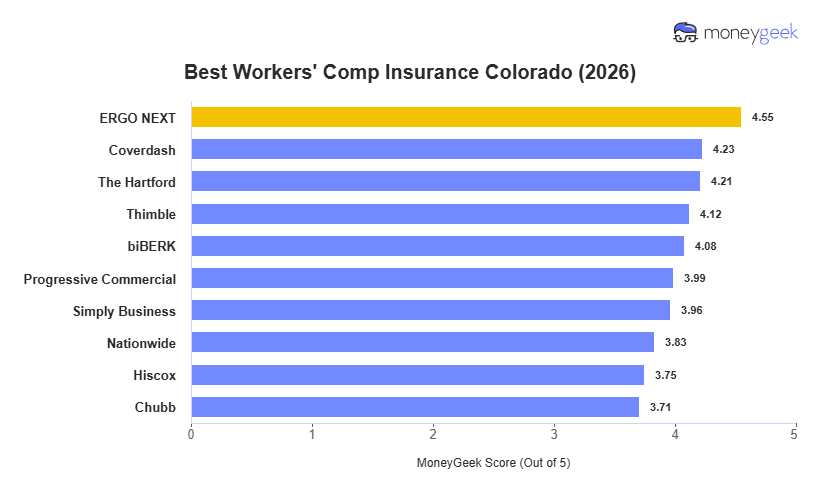
One pattern stood out when we analyzed the best workers' comp insurance providers in Coloardo: the carriers with the strongest coverage rankings don't always have the lowest rates. Coverdash ranks first for coverage at $109 per month, while ERGO NEXT leads on average price at $78 but ranks sixth for coverage. For most Colorado small businesses with fewer than five employees, that trade-off is the core decision. Whether rate savings or coverage depth matters more depends almost entirely on your industry's injury risk profile.

The spread between the cheapest provider, ERGO NEXT, and the most expensive, Chubb, is $69. Low-hazard Colorado employers in professional services, tech, and consulting gain the most from that gap. The advantage compresses in construction and transportation, where base loss costs are elevated across all carriers.

Best Workers' Comp Insurance Companies in Colorado
ERGO NEXT4.55$7816
Coverdash4.23$10951
The Hartford4.21$11333
Thimble4.12$9989
biBerk4.08$10888
Progressive Commercial3.99$11187
Simply Business3.96$12022
Nationwide3.83$11965
Hiscox3.75$123610
Chubb3.71$14734

How Did We Determine These Rates and Rankings?

ERGO NEXT

ERGO NEXT

Best Workers' Comp Insurance in Colorado

MoneyGeek Rating
4.5/ 5
5/5Affordability Score
4.4/5Customer Experience Score
3.8/5Coverage Score
  • Average Monthly Cost

    $78
  • Claims Processing Score

    4/5
  • Policy Management Score

    4.1/5
  • Buying Process Score

    4.4/5
Coverdash

Coverdash

Best Colorado Workers' Comp Insurance: Runner-Up

MoneyGeek Rating
4.2/ 5
4.2/5Affordability Score
3.9/5Customer Experience Score
5/5Coverage Score
  • Average Monthly Cost

    $109
  • Claims Processing Score

    4/5
  • Policy Management Score

    4/5
  • Buying Process Score

    4/5

Cheapest Workers' Comp Insurance in Colorado

At $78 per month, ERGO NEXT is the cheapest workers' comp insurance provider in Colorado, $21 less than the next-cheapest option, Thimble. That's the largest gap between any two adjacent carriers in our analysis. But the more useful observation is at the other end: Chubb's $147 monthly rate is 88% higher than ERGO NEXT's, meaning Colorado small business owners who don't compare quotes could pay nearly double for the same state-required coverage.

In the middle of the pack, biBerk, Coverdash and Progressive Commercial cluster within $3 per month of each other. When rates are that close, coverage differences and claims experience matter more than price. biBerk and Hiscox both write policies through established carriers with strong AM Best ratings, while newer entrants like Coverdash operate as brokers rather than direct insurers, which changes how a claim gets handled.

ERGO NEXT$78$936
Thimble$99$1,188
biBERK$108$1,296
Coverdash$109$1,308
Progressive Commercial$111$1,332
The Hartford$113$1,356
Nationwide$119$1,428
Simply Business$120$1,440
Hiscox$123$1,476
Chubb$147$1,764

Cheapest Workers' Comp Insurance in Colorado by Industry

When we pulled workers' comp quotes across 25 Colorado industries, ERGO NEXT was the cheapest option in 21 of them. But the pattern that caught our attention was where it wasn't the rate leader. The Hartford wins the four industries where monthly rates are lowest in our entire dataset, including Financial Services ($10/month), Consulting ($16/month), Real Estate ($18/month) and Tech/IT ($34/month). These are desk-based, low-injury-risk industries, where The Hartford rates are more favorable than ERGO NEXT.

Agriculture & Natural ResourcesERGO NEXT$127$1,524
Arts, Media & EntertainmentERGO NEXT$74$888
Beauty, Body & Wellness ServicesERGO NEXT$11$132
Childcare ServicesERGO NEXT$31$372
Cleaning ServicesERGO NEXT$91$1,092
Construction & ContractingERGO NEXT$184$2,208
Consulting ServicesThe Hartford$16$192
EducationERGO NEXT$53$636
Financial ServicesThe Hartford$10$120
Fitness ServicesERGO NEXT$54$648
Food & BeverageERGO NEXT$33$396
Healthcare & MedicalERGO NEXT$42$504
Hospitality, Travel & TourismERGO NEXT$37$444
ManufacturingERGO NEXT$117$1,404
Marketing & CommunicationsERGO NEXT$12$144
Nonprofit & AssociationsERGO NEXT$49$588
Other Professional ServicesERGO NEXT$18$216
Pet Care ServicesERGO NEXT$49$588
Real Estate & Property ServicesThe Hartford$18$216
Recreation & SportsERGO NEXT$87$1,044
Repair & MaintenanceERGO NEXT$57$684
Retail & Product RentalERGO NEXT$44$528
Tech/ITThe Hartford$34$408
Transportation & LogisticsERGO NEXT$235$2,820
Wholesale & DistributionERGO NEXT$149$1,788

How Much Is Workers' Comp Insurance in Colorado?

The average workers' comp cost in Colorado is $113 across all industries, $39 above the $74 national average. Workers' comp costs in the state vary by a factor of nearly 23x depending on industry. Beauty and financial services businesses pay as little as $15 per month, while transportation and logistics companies pay $344. That spread is the most important thing to understand before reading any single figure in the table below.

If your business sits near a category boundary, it's worth asking your carrier how they've classified your work. A cleaning services company at $135 per month and a repair and maintenance business at $83 per month can share overlapping job duties. The classification your insurer assigns matters as much as the industry you're in.

Beauty, Body & Wellness Services$15$180
Financial Services$15$180
Marketing & Communications$17$204
Consulting Services$22$264
Real Estate & Property Services$24$288
Other Professional Services$25$300
Childcare Services$41$492
Food & Beverage$46$552
Tech/IT$46$552
Hospitality, Travel & Tourism$48$576
Healthcare & Medical$56$672
Retail & Product Rental$61$732
Nonprofit & Associations$63$756
Pet Care Services$72$864
Education$73$876
Fitness Services$73$876
Repair & Maintenance$83$996
Arts, Media & Entertainment$104$1,248
Recreation & Sports$129$1,548
Cleaning Services$135$1,620
Manufacturing$159$1,908
Agriculture & Natural Resources$185$2,220
Wholesale & Distribution$204$2,448
Construction & Contracting$314$3,768
Transportation & Logistics$344$4,128

Colorado Workers' Comp Insurance Cost Factors

Colorado's workers' comp system is overseen by the Colorado Division of Workers' Compensation under the Department of Labor and Employment. Colorado uses NCCI class codes with loss costs filed by carriers through the Colorado DOI. Pinnacol Assurance operates as a competitive state fund alongside private carriers. One distinguishing cost driver is Colorado's outsized outdoor recreation, construction, and ski resort economy, which elevates average rates above pure professional-sector benchmarks.

How Much Workers' Comp Insurance Do I Need in Colorado?

Colorado requires all employers with one or more employees to carry workers' compensation insurance, whether your staff works part-time, full-time or are family members. Your policy works differently from auto insurance. Colorado mandates specific benefit levels rather than coverage limits: injured workers receive two-thirds of their average weekly wages plus unlimited medical treatment for work-related injuries.

Your total annual payroll and industry classification determine your premium. Failing to maintain the required workers' compensation coverage brings serious consequences, including fines up to $500 per day per employee, potential business shutdown and an additional 25% penalty if a claim happens while you're uninsured.

Colorado Workers' Comp Insurance Exemptions

While you're required to have coverage in Colorado, some business categories are exempt from workers' comp requirements:

  • Sole proprietors, general partners, corporate officers and LLC members: You're not required to carry coverage for yourself if you own at least 10% of your business (corporate officers and LLC members must hold specific leadership positions like president, vice president, secretary, treasurer or chairman of the board).
  • Construction industry owners: If you're a sole proprietor or partner in construction, Colorado requires you to either purchase workers' compensation insurance for yourself or formally file a rejection of coverage form with the state.
  • Independent contractors: You're exempt if you control how you perform your work and operate an independent business providing the same type of services (simply paying someone with a 1099 doesn't automatically make them an independent contractor).
  • Casual workers earning under $2,000 annually: Maintenance workers, repair workers, farm workers and ranch workers are exempt if you pay them less than $2,000 per calendar year.
  • Domestic workers: Nannies, au pairs and household help are exempt if they work less than 40 hours per week AND less than five days per week (both conditions must be met).
  • Real estate agents and brokers: Agents working entirely on commission are exempt from coverage requirements.
  • Motor carriers and rideshare drivers: Drivers under lease agreements with contract transportation carriers like Uber and Lyft are exempt under specific circumstances.
  • Ski volunteers: Unpaid volunteers at ski areas don't require coverage.
  • Federal employees and railroad workers: These workers receive coverage under federal workers' compensation programs rather than Colorado state coverage.
mglogo icon
FEDERAL WORKERS' COMP PROGRAMS OVERRIDE STATE REQUIREMENTS

Federal employees working in Colorado fall under the Federal Employees' Compensation Act (FECA). Railroad workers are covered under FELA. Workers at Colorado's commercial airfreight and logistics facilities performing qualifying maritime-adjacent work may fall under the Longshore and Harbor Workers' Compensation Act in limited circumstances. Employers with federal employees, railroad workers, or workers on federally contracted projects must maintain compliance with federal programs separate from the state policy.

How to Get the Best Workers' Comp Insurance in Colorado

Follow these steps to find and bind the right workers' comp coverage for your Colorado business. Note that Pinnacol Assurance should be included in any Colorado quote comparison.

  1. 1
    Step 1: Confirm Your Coverage Obligation

    Colorado requires coverage for employers with any number of employees. Verify exemption eligibility for corporate officers or sole proprietors through the Colorado Division of Workers' Compensation under the Department of Labor and Employment. The one-employee trigger applies to most Colorado businesses.

  2. 2
    Step 2: Assign NCCI Class Codes

    Colorado uses NCCI class codes to set per-$100-payroll rates. Seasonal outdoor and construction roles carry higher codes than office-based work. Review your class code assignments with a broker or carrier before soliciting quotes to catch any misclassification that would affect your premium.

  3. 3
    Step 3: Gather Payroll Records and Loss History

    Compile payroll by class code and your three-year claims history. Colorado employers with multiple worksites, seasonal schedules, or mixed indoor/outdoor operations should organize payroll carefully, as audit adjustments at renewal are common in these employment patterns.

  4. 4
    Step 4: Include Pinnacol Assurance in Your Quote Comparison

    Pinnacol Assurance is Colorado's state-chartered competitive insurer and accepts most Colorado employers. Request a Pinnacol quote alongside private carrier quotes from ERGO NEXT, Coverdash, and The Hartford. Pinnacol's rates are competitive in many Colorado industry segments.

  5. 5
    Step 5: Compare Total Cost Including Audit Risk

    Look beyond the headline monthly rate. Colorado's seasonal and construction-heavy economy means audit adjustments at renewal can be substantial. Compare carrier audit procedures and payroll classification practices alongside the base rate.

  6. 6
    Step 6: Bind Coverage Before Employees Work

    The Colorado Division of Workers' Compensation requires proof of coverage before employees begin work. File your certificate of insurance and maintain it throughout the policy term.

  7. 7
    Step 7: Prepare for the Annual Payroll Audit

    Colorado workers' comp policies are audited annually. Mixed payrolls (ski season, summer construction, and year-round office staff) create classification complexity. Keep payroll records detailed by class code throughout the year to minimize audit disputes.

Bottom Line and Next Steps

ERGO NEXT is the strongest starting point for most Colorado small businesses seeking workers' compensation insurance, combining the state's lowest rate with the highest customer experience scores in our analysis. Coverdash is the better choice for employers who need the broadest coverage options. The Hartford provides competitive claims performance and industry-specific rates for professional-sector businesses.

Next Steps

Use the resources below to move forward with your Colorado workers' comp coverage. Include Pinnacol Assurance in any Colorado quote comparison alongside private carriers.

Colorado Workers' Compensation Insurance FAQs

What are the penalties for not having workers' comp insurance in Colorado?

Does Colorado workers' comp cover remote or work-from-home employees?

How does an experience modification factor affect Colorado workers' comp premiums?

Can corporate officers opt out of workers' comp coverage in Colorado?

What is the difference between workers' comp and employer's liability in a Colorado policy?

How long does a workers' comp claim stay on a Colorado employer's record?

MoneyGeek analyzed workers' comp insurance rates and provider performance across Colorado using small business profiles with 1 to 4 employees spanning 408 major industries. Companies earn up to five points in each category in our scoring system. We then use a weighted average of these category scores to calculate a MoneyGeek score out of five.

  • Affordability (55%): Based on average payroll for the most common employee code per industry and state classification, priced per employee for a 1 to 4 employee business.
  • Customer Experience (35%): Evaluates buying (20%), which covers quote access, pricing accuracy and sales support; policy management (30%), which covers payroll reporting, audits, billing and loss control; and claims (50%), which covers FNOL speed, adjuster support, medical access, wage replacement and dispute handling.
  • Coverage Options (10%): Assesses coverage completeness (35%), including employers' liability and wage and medical reimbursement; policy flexibility and endorsements (25%); eligibility, state and industry breadth (20%); and policy terms, limits and exclusions (20%).

About Connor Bolton


Connor Bolton headshot

Connor Bolton is Senior SEO and Content Manager at MoneyGeek, where he leads the business and pet insurance editorial teams. As editorial lead for both verticals, Connor sets the research framework, data standards, and content structure that his writers execute, directly authoring in-depth guides himself and reviewing all team content for accuracy and practical value before it goes live. With over four years evaluating insurance products across personal, commercial, and specialty lines, he brings cross-vertical knowledge to every guide the team produces.

Connor architected MoneyGeek's insurance research infrastructure across all major verticals including auto, home, renters, life, health, business, and pet, building systems for pricing analysis, provider-level research, customer experience evaluation, and coverage analysis with AI support. The infrastructure includes over 6 million data points for business insurance across 408 industry areas, all 50 states, and 16 vehicle types, and over 5 million pet insurance profiles across 18 major providers and hundreds of breed and age combinations. Connor's insurance cost research and his team's work has been cited by the U.S. Chamber of Commerce, Allstate, Liberty Mutual, CBS News, Forbes and LegalZoom.

Beyond the data, Connor stays connected to how the market actually operates, drawing on direct conversations with underwriters and carrier liaisons at Ethos, The Hartford, NEXT Insurance, Nationwide, and State Farm, and monitoring business and pet owner communities including Reddit, to inform how he interprets findings and frames guidance for real buyers.

He is the direct editorial contact for methodology questions at connor@moneygeek.com and can be found on LinkedIn.


Sources