



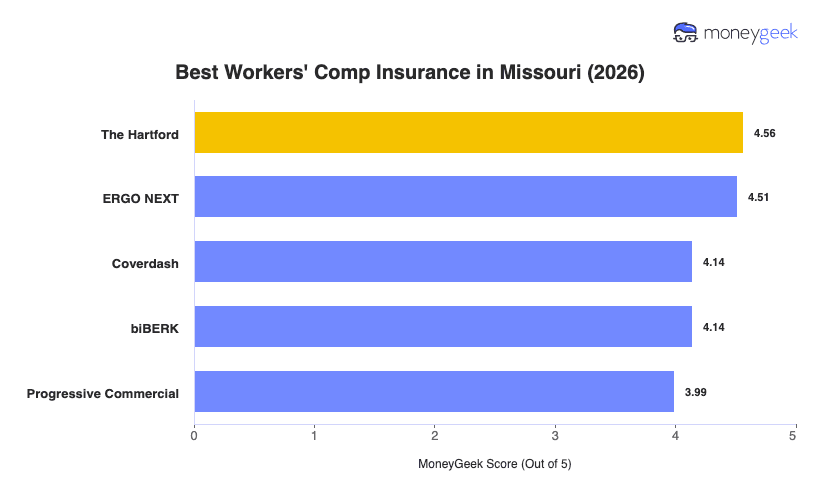
My analysis showed that The Hartford is the best workers' compensation insurance company for small businesses in Missouri. While it didn't have the lowest rates among the carriers in our study, you still save around $23 per month. Considering that The Hartford has a dedicated team of industry-focused specialists and provides resources for risk management, which provides long-term value.
Best Workers' Comp Insurance in Missouri (2026)
With rates as low as $9 per month, The Hartford, ERGO NEXT and Coverdash have the best workers' comp insurance in Missouri.
With our matching tool below, you can connect to top Missouri workers' comp insurance providers and find your ideal coverage.
Select state
Updated: August 27, 2026
Advertising & Editorial Disclosure
Best Workers' Comp Insurance Companies in Missouri
| The Hartford | 4.56 | $68 | 3 | 3 |
| ERGO NEXT | 4.51 | $66 | 1 | 6 |
| Coverdash | 4.14 | $92 | 5 | 1 |
| biBERK | 4.14 | $84 | 8 | 8 |
| Progressive Commercial | 3.99 | $90 | 8 | 7 |
MoneyGeek analyzed workers' comp insurance rates and provider performance across Missouri using small business profiles with one to four employees spanning 408 major industries. Companies earn up to five points in each category in our scoring system. MoneyGeek then uses a weighted average of these category scores to calculate a MoneyGeek score out of five.
- Affordability (55%): Based on average payroll for the most common employee code per industry and state classification, priced per employee for a one to four employee business.
- Customer Experience (35%): Evaluates buying (20%), which covers quote access, pricing accuracy and sales support; policy management (30%), which covers payroll reporting, audits, billing and loss control; and claims (50%), which covers FNOL speed, adjuster support, medical access, wage replacement and dispute handling.
- Coverage Options (10%): Assesses coverage completeness (35%), including employers' liability and wage and medical reimbursement; policy flexibility and endorsements (25%); eligibility, state and industry breadth (20%); and policy terms, limits and exclusions (20%).

The Hartford
Best Workers' Comp Insurance in Missouri
MoneyGeek Rating
4.6/ 5
4.8/5Affordability
4.1/5Customer Experience
4.5/5Coverage
Average Monthly Cost
$68Claims Processing Score
4.1/5Policy Management Score
4/5Buying Process Score
4/5

ERGO NEXT
Best Missouri Workers' Comp Insurance: Runner-Up
MoneyGeek Rating
4.5/ 5
4.8/5Affordability
4.4/5Customer Experience
3.9/5Coverage
Average Monthly Cost
$66Claims Processing Score
4/5Policy Management Score
4.1/5Buying Process Score
4.4/5
Cheapest Workers' Comp Insurance in Missouri
The Hartford offers the most affordable workers' comp rates for financial services ($9 per month), consulting, real estate, tech and health care in Missouri. ERGO NEXT is the most affordable for beauty, marketing, childcare, food and beverage and most service and goods industries.
Financial services through The Hartford is Missouri's cheapest industry category at $9 per month. Transportation and logistics through ERGO NEXT has the lowest provider rate in that industry at $195 per month. The Missouri state average for transportation and logistics is $274 per month across all carriers and risk profiles. ERGO NEXT's $195 per month is the cheapest provider rate in that industry, not the statewide average.
| Financial Services | The Hartford | $9 | $108 |
| Beauty, Body & Wellness Services | ERGO NEXT | $10 | $120 |
| Marketing & Communications | ERGO NEXT | $10 | $120 |
| Consulting Services | The Hartford | $12 | $144 |
| Real Estate & Property Services | The Hartford | $14 | $168 |
| Other Professional Services | The Hartford | $17 | $204 |
| Childcare Services | ERGO NEXT | $26 | $312 |
| Tech/IT | The Hartford | $26 | $312 |
| Food & Beverage | ERGO NEXT | $27 | $324 |
| Hospitality, Travel & Tourism | The Hartford | $30 | $360 |
| Healthcare & Medical | The Hartford | $32 | $384 |
| Retail & Product Rental | ERGO NEXT | $36 | $432 |
| Nonprofit & Associations | ERGO NEXT | $39 | $468 |
| Pet Care Services | ERGO NEXT | $40 | $480 |
| Education | ERGO NEXT | $44 | $528 |
| Fitness Services | ERGO NEXT | $44 | $528 |
| Repair & Maintenance | ERGO NEXT | $47 | $564 |
| Arts, Media & Entertainment | ERGO NEXT | $62 | $744 |
| Recreation & Sports | ERGO NEXT | $72 | $864 |
| Cleaning Services | ERGO NEXT | $74 | $888 |
| Manufacturing | ERGO NEXT | $96 | $1,152 |
| Agriculture & Natural Resources | ERGO NEXT | $107 | $1,284 |
| Wholesale & Distribution | ERGO NEXT | $122 | $1,464 |
| Construction & Contracting | ERGO NEXT | $152 | $1,824 |
| Transportation & Logistics | ERGO NEXT | $195 | $2,340 |
How to Get the Best Workers' Comp Insurance in Missouri
When you get workers' compensation insurance, you'll need to consider your class codes and preferences. My guide helps you explore all angles instead of just choosing the most affordable provider.
- 1Confirm Missouri Coverage Requirements
Your industry determines when Missouri’s workers’ comp requirement begins. Most businesses need coverage at five employees, but construction employers need it as soon as they hire one. Part-time and casual workers count, as do corporate officers and LLC members. Sole proprietors and partners do not count unless they elect coverage. Missouri’s employer guidance explains how each ownership type affects the threshold.
- 2Identify Your NCCI Class Codes
Missouri relies on National Council on Compensation Insurance (NCCI) classifications, but your company’s main activity does not automatically determine every employee’s code. An office employee may qualify for a separate classification only when the work and workspace meet NCCI’s rules. Describe those arrangements accurately rather than choosing the lowest-looking code. You can check state-specific wording through NCCI’s Class Look-Up tool.
- 3Document Payroll, Employee Count and Claims History
Bring your payroll records and prior loss runs together before approaching carriers. If you hire subcontractors, collect their workers’ compensation certificates as well. This matters most in construction, where an uninsured subcontractor’s workers may create exposure under your policy. Account for family members and business owners correctly, since Missouri presumes LLC members are covered unless they opt out with the insurer.
- 4Request Quotes From Multiple Licensed Missouri Carriers
Missouri insurers build their rates from approved loss costs but can price risk differently, so submit the same payroll and class-code details to each one. This makes it easier to compare business insurance quotes without mistaking different assumptions for genuine savings. If the voluntary market declines your business, ask your agent about Missouri’s assigned-risk option through NCCI.
- 5Compare on Quality, Not Just Price
Pay particular attention to each carrier’s medical network. Missouri gives you or your insurer the right to choose the treating provider and requires the policy to pay for authorized care. An employee may choose another physician, but generally at their own expense. Look for a carrier that offers suitable providers near your worksites and gives supervisors clear authorization instructions. The state outlines these responsibilities in its medical care guidance.
- 6Complete Purchase and Establish Payroll and Audit Reporting
Put one person in charge of receiving injury notices and notifying the carrier. Missouri gives you five days from the injury or from the day the employee reports it, whichever is later, to send the information to your insurer or third-party administrator. The insurer then has 30 days after learning of the injury to file the First Report of Injury with the Division of Workers’ Compensation. Review the state’s reporting responsibilities with anyone who supervises employees.
- 7Review at Annual Renewal
Recount your employees before renewing, especially if you are approaching Missouri’s five-person threshold or have started construction work. Reconcile audited payroll with each NCCI classification and review open claims that may affect your experience modification, the factor that adjusts your premium based on past losses. If your insurer’s medical or claims service fell short, renewal is your opportunity to compare alternatives instead of carrying the same problems into another year.
Best Workers' Compensation Insurance in Missouri: Bottom Line
The Hartford, ERGO NEXT and Coverdash are Missouri's top three workers' comp insurance providers. The Hartford leads on MoneyGeek score and per-industry rates for professional sectors. ERGO NEXT is the better choice for food, beverage, agriculture, and construction employers by per-industry rate. Coverdash is the strongest option for businesses that need the broadest coverage options.

LEARN MORE ABOUT MISSOURI BUSINESS INSURANCE
Whether you're in healthcare or wealth management, your Missouri business insurance policy needs to include other coverages beyond workers' compensation. I've prepared resources below that recommend our picks for other coverage types.
Missouri Workers' Compensation Insurance FAQ
The Hartford is the best workers' comp provider in Missouri with the top MoneyGeek score. ERGO NEXT ranks second in our analysis and is the cheaper option by monthly rate at $66 vs. The Hartford's $68:
- ERGO NEXT: $66 a month
- The Hartford: $68 a month
- biBerk: $84 a month
- Progressive Commercial: $90 a month
- Nationwide: $91 a month
Missouri requires workers' comp insurance for employers with five or more employees in most industries. Construction employers have stricter requirements and must cover any number of employees. The Missouri Division of Workers' Compensation, under the Department of Labor and Industrial Relations, oversees enforcement of workers' comp requirements. Penalties for non-compliance include civil fines and personal employer liability for all injury costs.
The average cost of workers' comp insurance in Missouri' is around $91 per employee monthly on average, which is higher than the national average of $74. Beauty/Body & Wellness Services ($14 a month) and Financial Services ($15 a month) are the most affordable industries in the state, while Transportation & Logistics ($274 a month) and Construction ($252 a month) are the most expensive.
Missouri operates as a competitive private market with no state fund, so employers can get workers' comp insurance directly from private carriers. Employers who cannot obtain voluntary coverage may access the Missouri Workers' Compensation Assigned Risk Plan administered through NCCI. Self-insurance is allowed for qualifying large employers under the Missouri Division of Workers' Compensation.
Workers' comp insurance in Missouri covers:
- Medical expenses: covers all reasonable and necessary medical treatment for work-related injuries; Missouri requires employers to designate a panel of physicians from which injured workers may choose their treating doctor.
- Wage loss benefits: pays temporary total disability at 66⅔% of the employee's average weekly wage.
- Vocational rehabilitation: provides retraining and placement support for workers who cannot return to their pre-injury occupation; the Missouri Division of Workers' Compensation administers vocational rehabilitation services.
- Death benefits: pays burial expenses and compensation to qualifying dependents based on the deceased worker's average weekly wage under Missouri statute.
About Angelique Palenzuela-Cruz

Angelique Palenzuela-Cruz is a Business Insurance Content Writer at MoneyGeek, where she specializes in general liability, workers’ compensation and professional liability insurance. Her work helps small business owners understand how these policies apply to coverage, including risks like customer injuries, employee injuries, professional mistakes, client contract terms and industry-specific coverage requirements.
She primarily covers service-based businesses where liability and employee coverage decisions are especially important, including cleaning, consulting, beauty and wellness, childcare, education, fitness, food service, pet care, repair and maintenance, and other professional services.
Before joining MoneyGeek, Angelique spent nearly 12 years at Guthrie-Jensen Consultants, one of Southeast Asia’s largest management training firms, where she advanced from Training Consultant to Managing Consultant. In that role, she worked with business clients to assess operational needs, develop training programs and present performance analyses to executive decision-makers. She also helped establish Gladwin Training Consultancy, where she served in learning solutions and client service roles.
Her background gives her practical context for writing about how businesses operate, manage client expectations, structure teams and make risk decisions. At MoneyGeek, she applies that experience to business insurance content, connecting coverage to actual business needs.
LinkedIn: linkedin.com/in/ma-angela-cruz
Email Contact: angelique.palenzuela@moneygeek.com