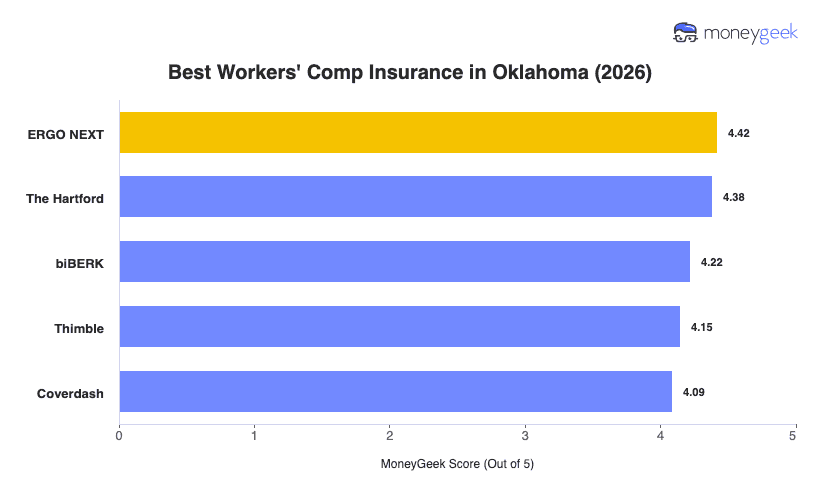
ERGO NEXT has the best Oklahoma workers' comp insurance, combining the state's lowest monthly rate with top customer experience scores. The Hartford and biBERK are strong alternatives, each offering competitive pricing and broad industry eligibility.
Best Workers' Comp Insurance in Oklahoma (2026)
With rates starting at $9 monthly, ERGO NEXT, The Hartford and biBERK offer the cheapest and best workers' comp insurance in Oklahoma.
Get matched to top Oklahomaworkers' comp insurance providers and find your ideal coverage.

Updated: May 8, 2026
Advertising & Editorial Disclosure
What are the best and cheapest workers' comp insurance providers in Oklahoma?
ERGO NEXT offers the top cheap workers' compensation insurance in Oklahoma. The following are the state's cheapest and best workers' comp insurance providers and their average monthly rates:
- ERGO NEXT: $77/month
- Thimble: $80/month
- biBERK: $83/month
- The Hartford: $86/month
- Coverdash: $94/month
Is workers' comp insurance required in Oklahoma?
Oklahoma requires most employers with one or more employees to carry workers' comp insurance, though sole proprietors and certain corporate officers may opt out of coverage. Employers who fail to carry required coverage face penalties including fines and potential civil liability. Some business owners choose to opt in voluntarily even when exempt to protect themselves from out-of-pocket medical and wage costs.
How much does workers' comp insurance cost in Oklahoma?
The average cost of workers' comp insurance in Oklahoma cost is $94 monthly per employee, but rates vary widely by industry. The cheapest industry in the state is Beauty, Body & Wellness Services at $15/month, while Transportation & Logistics is the most expensive at $287/month.
How do you get workers' comp insurance in Oklahoma?
Oklahoma operates as a private competitive market with no state fund, meaning employers can get workers' comp coverage directly from licensed private insurers. If your business is declined by standard carriers, Oklahoma's assigned risk pool provides fallback coverage as a market of last resort. Comparing quotes from multiple carriers is the most reliable way to find competitive pricing.
What does Oklahoma workers' comp insurance cover?
Oklahoma workers' comp insurance covers the following:
- Medical expenses for work-related injuries and illnesses
- Wage loss benefits capped at 70% of the employee's average weekly wage, not to exceed the state's average weekly wage
- Vocational rehabilitation services to support return to work
- Death benefits and burial expenses for dependents of workers killed on the job
Best Workers' Comp Insurance Companies in Oklahoma
| ERGO NEXT | 4.42 | $77 | 1 | 5 |
| The Hartford | 4.38 | $86 | 3 | 3 |
| biBERK | 4.22 | $83 | 7 | 7 |
| Thimble | 4.15 | $80 | 7 | 8 |
| Coverdash | 4.09 | $94 | 5 | 1 |
| Simply Business | 4.02 | $98 | 2 | 2 |
| Hiscox | 3.90 | $97 | 6 | 9 |
| Progressive Commercial | 3.75 | $99 | 7 | 6 |
| Chubb | 3.65 | $131 | 3 | 4 |
How Did We Determine These Rates and Rankings?
These rates are estimates based on MoneyGeek's analysis of small businesses with 1 to 4 employees across 408 major industries. Actual rates vary based on your business location, industry risk factors, claims history, coverage limits and individual insurer underwriting criteria. Contact insurers directly for personalized quotes.

ERGO NEXT
Best Workers' Comp Insurance in Oklahoma
Average Monthly Cost
$77Claims Processing Score
4/5Policy Management Score
4.1/5Buying Process Score
4.4/5
- pros
Lowest monthly rate in Oklahoma at $77
Fast online quotes and instant proof of insurance
Easy digital policy management
Good fit for contractors, freelancers, and small service businesses
consLimited agent interaction and personalized service
Less ideal for specialized or high-risk industries
ERGO NEXT is the best workers’ compensation provider in Oklahoma with the lowest average monthly rate of $77 per employee across all industries. It also leads Oklahoma on customer experience, earning our highest marks for buying process, onboarding support and policy management.
ERGO NEXT has the lowest in Oklahoma for construction and contracting businesses ($183 per employee monthly), cleaning services ($87/month), recreation and sports companies ($86/month), and transportation and logistics businesses ($232/month).
Read our full ERGO NEXT review.
ERGO NEXT may not be the best fit for Oklahoma employers in high-hazard industries such as transportation or construction, where its underwriting appetite can be more restrictive. In those cases, The Hartford's broader industry eligibility and established claims infrastructure make it a stronger alternative.
The Hartford
Best Oklahoma Workers' Comp Insurance: Runner-Up
Average Monthly Cost
$86Claims Processing Score
4.1/5Policy Management Score
4/5Buying Process Score
4/5
- pros
Lowest rates in 12 of 25 industries we reviewed
Strong reputation with 200+ years in business
Comprehensive workers’ comp coverage and industry-specific expertise
Strong claims management and return-to-work programs
consBuying process less streamlined than digital-native competitors
Rates less competitive for high-risk industries
The Hartford ranks second overall for workers’ compensation in Oklahoma but leads on price in 12 of the state’s 25 industries we reviewed. Oklahoma businesses pay $86 per employee monthly ($1,036 annually), 8% below the state average and saving roughly $94 per employee each year. It leads Oklahoma on claims handling and policy management and ranks third for coverage breadth.
Financial services firms pay $9 per employee monthly, 41% below the state average. Tech and IT businesses pay $27/mo (34% savings), consulting firms pay $13/mo (34% savings) and real estate businesses pay $14/mo (33% savings).
Read our full The Hartford review.
The Hartford is a less compelling choice for Oklahoma small businesses with very tight budgets and simple, low-risk operations. In those cases, ERGO NEXT at $77/month provides comparable coverage at a lower cost with a faster digital buying experience.
Cheapest Workers' Comp Insurance Companies in Oklahoma
ERGO NEXT is Oklahoma’s cheapest workers’ comp provider at $77 per month ($924 annually), about 18% below the state average of $94. Thimble follows at $80 monthly, with biBERK at $83, giving small businesses three workers’ comp options under $85 per month in Oklahoma’s competitive private market.
The pricing gap between ERGO NEXT ($77/month) and Chubb ($131/month) amounts to $648 per employee annually. These savings are most meaningful for businesses with multiple employees and clean claims histories, but the pricing gap shrinks in high-risk industries, where underwriting factors reduce differences between carriers.
| ERGO NEXT | $77 | $924 |
| Thimble | $80 | $960 |
| biBERK | $83 | $996 |
| The Hartford | $86 | $1,032 |
| Coverdash | $94 | $1,128 |
| Hiscox | $97 | $1,164 |
| Simply Business | $98 | $1,176 |
| Progressive Commercial | $99 | $1,188 |
| Chubb | $131 | $1,572 |
Cheapest Workers' Comp in Oklahoma by Industry
The Hartford is the cheapest workers' comp provider in more Oklahoma industries than any other carrier in our analysis. With the lowest rates in 12 of the 25 industries we reviewed, its wins are concentrated in office-based and professional work, where monthly rates start at $9 for financial services and top out at $106 for manufacturing.
ERGO NEXT is the cheapest for most high-risk industry in our analysis, posting the lowest rates for Construction, Transportation & Logistics, Agriculture, Cleaning Services, and Recreation & Sports. If your business involves physical labor or fleet vehicles, ERGO NEXT belongs at the top of your comparison list.
| Financial Services | The Hartford | $9 | $108 |
| Beauty, Body & Wellness Services | The Hartford | $11 | $132 |
| Marketing & Communications | The Hartford | $12 | $144 |
| Consulting Services | The Hartford | $13 | $156 |
| Real Estate & Property Services | The Hartford | $14 | $168 |
| Other Professional Services | The Hartford | $17 | $204 |
| Childcare Services | biBERK | $27 | $324 |
| Tech/IT | The Hartford | $27 | $324 |
| Hospitality, Travel & Tourism | The Hartford | $30 | $360 |
| Food & Beverage | ERGO NEXT | $32 | $384 |
| Healthcare & Medical | The Hartford | $32 | $384 |
| Retail & Product Rental | The Hartford | $37 | $444 |
| Nonprofit & Associations | The Hartford | $42 | $504 |
| Pet Care Services | biBERK | $47 | $564 |
| Fitness Services | biBERK | $51 | $612 |
| Education | Thimble | $54 | $648 |
| Repair & Maintenance | ERGO NEXT | $58 | $696 |
| Arts, Media & Entertainment | biBERK | $74 | $888 |
| Recreation & Sports | ERGO NEXT | $86 | $1,032 |
| Cleaning Services | ERGO NEXT | $87 | $1,044 |
| Manufacturing | The Hartford | $106 | $1,272 |
| Agriculture & Natural Resources | ERGO NEXT | $126 | $1,512 |
| Wholesale & Distribution | biBERK | $147 | $1,764 |
| Construction & Contracting | ERGO NEXT | $183 | $2,196 |
| Transportation & Logistics | ERGO NEXT | $232 | $2,784 |
How Much Is Workers' Comp Insurance in Oklahoma?
Oklahoma's average workers' comp cost is $94 monthly per employee, above the national average of $74/month. The cheapest industry is Beauty, Body and Wellness Services at $15/month, while Transportation and Logistics is the most expensive at $287/month.
The steepest jump in our analysis lies in the midrang tier. Industries like Cleaning Services ($112/month) and Manufacturing ($133/month) pay more than double what Retail ($51) pays, despite all three involving physical labor. That gap reflects Oklahoma's classification system, which weights injury frequency and severity by industry type. Cleaning and manufacturing workers file claims at higher rates and with greater severity than general retail workers, which pushes those premiums up sharply.
| Beauty, Body & Wellness Services | $15 | $180 |
| Financial Services | $15 | $180 |
| Marketing & Communications | $15 | $180 |
| Consulting Services | $20 | $240 |
| Real Estate & Property Services | $21 | $252 |
| Other Professional Services | $23 | $276 |
| Childcare Services | $34 | $408 |
| Food & Beverage | $38 | $456 |
| Hospitality, Travel & Tourism | $40 | $480 |
| Tech/IT | $41 | $492 |
| Healthcare & Medical | $47 | $564 |
| Retail & Product Rental | $51 | $612 |
| Nonprofit & Associations | $54 | $648 |
| Pet Care Services | $59 | $708 |
| Fitness Services | $62 | $744 |
| Education | $63 | $756 |
| Repair & Maintenance | $69 | $828 |
| Arts, Media & Entertainment | $87 | $1,044 |
| Recreation & Sports | $108 | $1,296 |
| Cleaning Services | $112 | $1,344 |
| Manufacturing | $133 | $1,596 |
| Agriculture & Natural Resources | $155 | $1,860 |
| Wholesale & Distribution | $171 | $2,052 |
| Construction & Contracting | $262 | $3,144 |
| Transportation & Logistics | $287 | $3,444 |
Oklahoma Workers' Comp Insurance Cost Factors
Oklahoma workers' comp rates are filed with the National Council on Compensation Insurance (NCCI) and regulated by the Oklahoma Insurance Department. The state operates as a private competitive market, meaning carriers set their own rates within NCCI's approved loss cost framework. Oklahoma's elevated share of high-hazard industries is the single most distinguishing cost driver in the state.
Oklahoma uses NCCI class codes to classify workers by occupation and assign base loss costs to each classification. The Oklahoma Insurance Department regulates rate filings and approves NCCI loss cost multipliers submitted by individual carriers. Each employer's premium begins with the applicable class code rate, then adjusts for payroll size, experience modification, and any applicable schedule credits or debits. Businesses with multiple job types must correctly assign employees across all applicable class codes to avoid audit adjustments.
Oklahoma is a private competitive market with no state fund. All workers' comp coverage is purchased from licensed private carriers or, as a last resort, through the assigned risk pool. This structure benefits small businesses by creating genuine price competition among carriers, but it also means that businesses in high-risk industries may find limited carrier appetite. Oklahoma employers who cannot obtain voluntary market coverage apply through the NCCI-administered assigned risk pool.
Oklahoma workers' comp benefits include temporary total disability, permanent partial disability, permanent total disability, and medical benefits. Wage replacement rates and weekly maximums are set by state statute and adjusted periodically. Verify current figures with the Oklahoma Workers' Compensation Commission. Benefit generosity directly affects carrier loss costs and, in turn, the premiums Oklahoma employers pay. Industries with higher rates of permanent disability claims carry disproportionately higher class code base rates.
Oklahoma's average workers' comp cost of approximately $79/month per employee sits above the national average of $74/month. This premium reflects the state's concentration of employment in oil and gas extraction, agriculture, and transportation, all high-hazard industries with elevated NCCI class code base rates. Research from WCRI and NASI has consistently identified Oklahoma as a state with above-average medical costs per claim, which contributes to higher carrier loss costs. Employers in low-hazard professional services industries typically pay below the state average.
Oklahoma employers who cannot obtain workers' comp coverage in the voluntary market apply through the NCCI-administered assigned risk pool, also known as the residual market. The assigned risk pool provides coverage as a market of last resort, but rates are typically higher than voluntary market pricing. Businesses placed in the pool should work to improve their claims history and safety record to qualify for voluntary market coverage at renewal. Pool placement does not exempt an employer from Oklahoma's coverage requirements.
Oklahoma's oil and gas sector creates a structural cost dynamic not present in most other states. A large portion of Oklahoma's workforce is employed in extraction, pipeline, and oilfield services occupations, which carry some of the highest NCCI class code base rates in the country. This sector concentration elevates the statewide average premium even for employers with no direct connection to energy industries. Verify current class code assignments for energy-adjacent occupations with the Oklahoma Insurance Department or a licensed NCCI-certified agent.
How Much Workers' Comp Insurance Do I Need in Oklahoma?
Oklahoma law mandates workers' compensation insurance for nearly all employers, regardless of employee count. Your coverage amounts depend on total payroll and industry classification, not fixed dollar limits. Policies must provide unlimited medical benefits and wage replacement at 70% of average weekly wages, up to $1,128.66 weekly for 2026 injuries. Failing to maintain required workers' compensation coverage can result in misdemeanor charges, fines and potential business closure.
Oklahoma Workers' Comp Insurance Exemptions
While you're often required to have coverage in Oklahoma, some business categories are exempt from workers' comp requirements:
- Sole Proprietors: Sole proprietors with no employees are not required to carry workers' comp coverage, but may elect to cover themselves voluntarily to protect against personal income loss from a work-related injury.
- Corporate Officers: Officers of corporations may elect to exclude themselves from coverage by filing the appropriate form with their insurer. Verify current opt-out procedures with the Oklahoma Workers' Compensation Commission.
- Partners: Partners in a general partnership are generally exempt from mandatory coverage requirements but may opt in voluntarily.
- Independent Contractors: Properly classified independent contractors are not employees and are not covered under an employer's workers' comp policy. Misclassification exposes employers to substantial liability.
- Domestic Workers: Workers employed in private households, such as housekeepers or nannies, are generally exempt from Oklahoma's mandatory workers' comp requirements.
- Agricultural Workers: Agricultural laborers employed by farm operators meeting specific size thresholds may be exempt. Verify current thresholds with the Oklahoma Workers' Compensation Commission.
- Casual Workers: Workers hired for occasional, incidental tasks not in the course of the employer's regular business may qualify for the casual worker exemption under Oklahoma law.
Federal workers' comp programs apply to specific employee categories regardless of Oklahoma state law. The Federal Employees' Compensation Act (FECA) covers federal civilian employees. The Federal Employers' Liability Act (FELA) governs railroad workers. The Longshore and Harbor Workers' Compensation Act covers maritime employees working on navigable waters. In Oklahoma, federal installations and interstate railroad operations fall under these federal frameworks, and employers in those sectors must comply with federal requirements rather than, or in addition to, the Oklahoma Workers' Compensation Commission's rules.
How to Get the Best Workers' Comp Insurance in Oklahoma
Getting workers' comp insurance in Oklahoma requires confirming your legal obligations, classifying your workforce accurately, and comparing licensed carriers. Follow these steps to secure the right coverage for your business. See our full guide on how to get workers' compensation insurance for additional detail.
- 1
Confirm Oklahoma Coverage Requirements
Determine whether your business meets the employee threshold that triggers mandatory coverage under Oklahoma law. Contact the Oklahoma Workers' Compensation Commission to verify your obligations, including any exemptions that may apply to your ownership structure or workforce type. Document your determination before proceeding.
- 2
Identify Your Class Codes Accurately
NCCI class codes define the occupational risk category for each employee and directly determine your base premium. Review the job duties of every employee and match them to the correct NCCI class code using the Oklahoma Insurance Department's resources or a licensed agent. Incorrect class code assignments lead to audit adjustments and potential coverage gaps.
- 3
Document Payroll, Employee Count, and Claims History
Gather your total annual payroll by class code, your current employee count, and a three-to-five year loss run from any prior workers' comp carrier. Carriers use this information to calculate your experience modification rate (EMR) and assess underwriting risk. Clean documentation speeds the quoting process and may improve your pricing.
- 4
Request Quotes From Multiple Licensed Oklahoma Carriers
Contact at least three carriers licensed to write workers' comp in Oklahoma. Include both direct writers such as ERGO NEXT and The Hartford and independent agents who can access multiple markets. Oklahoma's private competitive market means pricing can vary by $17 or more per employee monthly across the five featured carriers, so multiple quotes are important.
- 5
Compare Total Value, Not Just Monthly Rate
Evaluate each quote on claims processing capability, policy management tools, audit procedures, and financial strength in addition to monthly premium. A carrier with a lower rate but slower claims handling may cost more in lost productivity and employee relations over time. Review each carrier's CX scores and coverage rank alongside its price.
- 6
Complete Purchase and Establish Payroll and Audit Reporting
Once you select a carrier, complete the application, bind coverage, and set up your payroll reporting schedule. Oklahoma workers' comp policies are typically audited at renewal based on actual payroll. Establish accurate payroll records from day one to avoid large audit adjustments at the end of the policy term.
- 7
Review at Annual Renewal
Review your policy at each annual renewal to confirm that your class codes, employee count, and payroll estimates remain accurate. Changes in business operations, new hires, or shifts in job duties may require class code updates. Use renewal as an opportunity to re-quote with competing carriers and verify that your current provider remains competitive in Oklahoma's market.
Bottom Line and Next Steps
ERGO NEXT is the best workers' comp provider for most Oklahoma small businesses. The Hartford is the better option for employers in high-hazard industries who prioritize claims support, while biBERK offers a competitive middle-ground for businesses seeking a nationally recognized carrier below $85/month. The right choice balances your industry risk profile, employee count and tolerance for claims process complexity.
Next Steps
Oklahoma workers' comp rates vary by industry, carrier, and individual business risk profile. Use the resources below to move from comparison to coverage.
- Use MoneyGeek's workers' comp calculator to estimate your premium based on payroll and industry.
- Input your NCCI class codes and employee count for the most accurate estimate.
- Use the result as a benchmark when reviewing carrier quotes.
- Request quotes through MoneyGeek's workers' comp quotes tool to compare Oklahoma-licensed providers.
- Gather at least three quotes to capture the full range of Oklahoma's price spread across all licensed carriers.
- Have your payroll records and prior loss runs ready before requesting quotes.
- Confirm your mandatory coverage obligations with the Oklahoma Workers' Compensation Commission before binding a policy.
- Review exemption eligibility for owners, officers, and independent contractors.
- Revisit requirements annually, as workforce changes may alter your obligations.
Oklahoma Workers' Compensation Insurance FAQs
What are the penalties for not having workers' comp insurance in Oklahoma?
Workers' comp coverage prevents penalties for non-compliance rather than eliminating them. Oklahoma employers who fail to carry required coverage face civil fines, potential stop-work orders, and personal liability for employee injury costs. Verify current penalty amounts with the Oklahoma Workers' Compensation Commission, as fine structures are subject to legislative revision.
Does Oklahoma workers' comp cover employees who work remotely in another state?
Oklahoma workers' comp policies generally cover employees whose employment is principally located in Oklahoma, even when they temporarily work in another state. If an employee permanently relocates to another state, that state's coverage requirements may apply. Notify your carrier of any employees who work across state lines to confirm your policy includes the appropriate other-states coverage endorsement.
How does an experience modification rate affect Oklahoma workers' comp premiums?
An EMR above 1.0 increases your Oklahoma premium, while an EMR below 1.0 reduces it. Oklahoma uses NCCI's experience rating formula, which compares your actual losses to expected losses for your industry and size. A single large claim can elevate your EMR for up to three policy years, making proactive safety programs and prompt claims reporting important cost controls.
Can business owners opt out of workers' comp coverage in Oklahoma?
Sole proprietors and certain corporate officers in Oklahoma may elect to exclude themselves from coverage by filing the appropriate exclusion form with their insurer. Partners in general partnerships are generally exempt by default. Opting out means the owner assumes personal financial responsibility for any work-related injury costs. Verify current opt-out procedures and eligibility criteria with the Oklahoma Workers' Compensation Commission before making this election.
What is the difference between workers' comp and employer's liability insurance in Oklahoma?
Workers' comp covers an employee's medical expenses and lost wages after a work-related injury without requiring proof of employer fault. Employer's liability insurance, which is typically included as Part Two of a workers' comp policy, covers the employer if an injured worker sues for damages beyond the workers' comp benefit schedule. In Oklahoma, both coverages are generally included in a standard workers' comp policy.
How long does a workers' comp claim stay on an Oklahoma employer's premium record?
Workers' comp claims affect an Oklahoma employer's experience modification rate for approximately three policy years under NCCI's experience rating formula. The most recent policy year is excluded from the EMR calculation, so a claim filed this year will influence premiums for the following three renewal cycles. Closing claims quickly and implementing return-to-work programs can limit the long-term premium impact.
MoneyGeek analyzed workers' comp insurance rates and provider performance across Oklahoma using small business profiles with 1 to 4 employees spanning 408 major industries. Companies earn up to five points in each category in our scoring system. We then use a weighted average of these category scores to calculate an overall MoneyGeek score out of five.
- Affordability (55%): Based on average payroll for the most common employee code per industry and state classification, priced per employee for a 1 to 4 employee business.
- Customer Experience (35%): Evaluates buying (20%), which covers quote access, pricing accuracy and sales support; policy management (30%), which covers payroll reporting, audits, billing and loss control; and claims (50%), which covers FNOL speed, adjuster support, medical access, wage replacement and dispute handling.
- Coverage Options (10%): Assesses coverage completeness (35%), including employers' liability and wage and medical reimbursement; policy flexibility and endorsements (25%); eligibility, state and industry breadth (20%); and policy terms, limits and exclusions (20%).
About Connor Bolton

Connor Bolton is Senior SEO and Content Manager at MoneyGeek, where he leads the business and pet insurance editorial teams. As editorial lead for both verticals, Connor sets the research framework, data standards, and content structure that his writers execute, directly authoring in-depth guides himself and reviewing all team content for accuracy and practical value before it goes live. With over four years evaluating insurance products across personal, commercial, and specialty lines, he brings cross-vertical knowledge to every guide the team produces.
Connor architected MoneyGeek's insurance research infrastructure across all major verticals including auto, home, renters, life, health, business, and pet, building systems for pricing analysis, provider-level research, customer experience evaluation, and coverage analysis with AI support. The infrastructure includes over 6 million data points for business insurance across 408 industry areas, all 50 states, and 16 vehicle types, and over 5 million pet insurance profiles across 18 major providers and hundreds of breed and age combinations. Connor's insurance cost research and his team's work has been cited by the U.S. Chamber of Commerce, Allstate, Liberty Mutual, CBS News, Forbes and LegalZoom.
Beyond the data, Connor stays connected to how the market actually operates, drawing on direct conversations with underwriters and carrier liaisons at Ethos, The Hartford, NEXT Insurance, Nationwide, and State Farm, and monitoring business and pet owner communities including Reddit, to inform how he interprets findings and frames guidance for real buyers.
He is the direct editorial contact for methodology questions at connor@moneygeek.com and can be found on LinkedIn.
Sources
- Insurance Journal. "Oklahoma Governor Signs Workers' Compensation Overhaul." Accessed May 14, 2026.
- Insurance Journal. "Oklahoma Lawmakers Pass Workers' Comp Reform Legislation." Accessed May 14, 2026.
- National Council on Compensation Insurance. "ABCs of Experience Rating." Accessed May 14, 2026.
- Oklahoma Insurance Department. "Insurance Commissioner Approves Loss-Cost Reduction for 2025 Workers' Compensation." Accessed May 14, 2026.
- Oklahoma Workers' Compensation Court of Existing Claims. "Employer's FAQ." Accessed May 14, 2026.