
Best Kentucky Workers' Comp Insurance: Fast Answers

Best Workers' Comp Insurance Companies in Kentucky

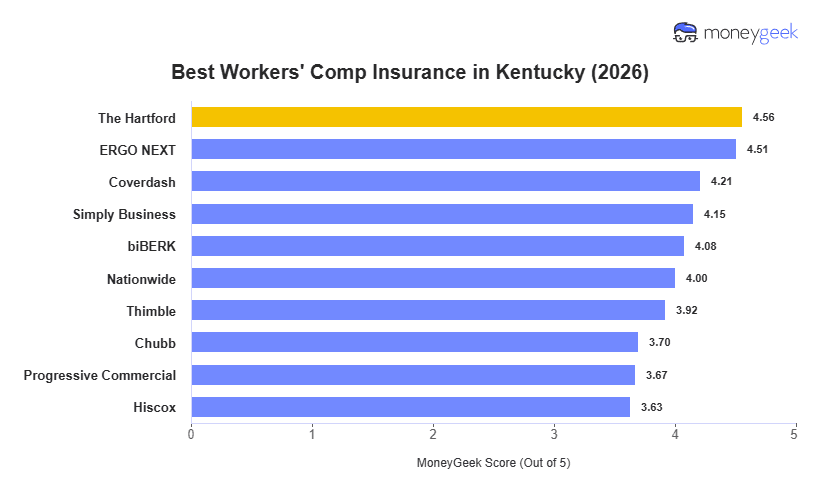
The Hartford leads Kentucky workers' comp insurance with the top MoneyGeek score, combining strong claims performance with the second-lowest rate in the state. ERGO NEXT ranks second at $56 a month, $3 below The Hartford, and holds the highest customer experience score in the state.

The $50 spread from ERGO NEXT to Chubb gives Kentucky employers a rate range to shop against, but the gap between provider rates narrows in construction, agriculture, and transportation class codes.

The Hartford4.56$5933
ERGO NEXT4.51$5616
Coverdash4.21$7751
Simply Business4.15$7922
biBERK4.08$7488
Nationwide4$7865
Thimble3.92$7589
Chubb3.7$10634
Progressive Commercial3.67$8887
Hiscox3.63$94610

How Did We Determine These Rates and Rankings?

The Hartford

The Hartford

Best Workers' Comp Insurance in Kentucky

MoneyGeek Rating
4.6/ 5
4.4/5Affordability Score
4.1/5Customer Experience Score
4.5/5Coverage Score
  • Average Monthly Cost

    $59
  • Claims Processing Score

    4.1/5
  • Policy Management Score

    4/5
  • Buying Process Score

    4/5
ERGO NEXT

ERGO NEXT

Best Kentucky Workers' Comp Insurance: Runner-Up

MoneyGeek Rating
4.5/ 5
4.6/5Affordability Score
4.3/5Customer Experience Score
3.8/5Coverage Score
  • Average Monthly Cost

    $56
  • Claims Processing Score

    4/5
  • Policy Management Score

    4.1/5
  • Buying Process Score

    4.4/5

Cheapest Workers' Comp Insurance in Kentucky

ERGO NEXT leads every provider in our Kentucky analysis at $56 per month, but the more useful finding is the spread. The gap between the cheapest and most expensive option in the state is $50 per month, or $600 per year. For a small business owner renewing annually, that difference buys coverage upgrades or can simply stay in the business.

The top two providers, ERGO NEXT and The Hartford, are separated by just $3 per month. That's a narrow gap, and The Hartford brings name recognition, claims infrastructure and customer service scores that ERGO NEXT can't match at this stage.

ERGO NEXT$56$672
The Hartford$59$708
biBERK$74$888
Thimble$75$900
Coverdash$77$924
Nationwide$78$936
Simply Business$79$948
Progressive Commercial$88$1,056
Hiscox$94$1,128
Chubb$106$1,272

How Did We Determine These Rates?

Cheapest Workers' Comp in Kentucky by Industry

When we analyzed workers' comp rates across 25 industries in Kentucky, one pattern stood out right away: ERGO NEXT is the cheapest provider in 20 of them. The more useful takeaway, though, is how strongly the industry itself drives cost. The five industries where The Hartford beats ERGO NEXT are all desk-based or low-physical-risk categories. For Kentucky businesses in those verticals, The Hartford's pricing advantage is worth getting a direct quote rather than defaulting to ERGO NEXT.

Agriculture & Natural ResourcesERGO NEXT$90$1,080
Arts, Media & EntertainmentERGO NEXT$52$624
Beauty, Body & Wellness ServicesERGO NEXT$9$108
Childcare ServicesERGO NEXT$22$264
Cleaning ServicesERGO NEXT$62$744
Construction & ContractingERGO NEXT$130$1,560
Consulting ServicesThe Hartford$11$132
EducationERGO NEXT$38$456
Financial ServicesThe Hartford$9$108
Fitness ServicesERGO NEXT$38$456
Food & BeverageERGO NEXT$23$276
Healthcare & MedicalThe Hartford$27$324
Hospitality, Travel & TourismThe Hartford$25$300
ManufacturingERGO NEXT$81$972
Marketing & CommunicationsERGO NEXT$9$108
Nonprofit & AssociationsERGO NEXT$35$420
Other Professional ServicesERGO NEXT$15$180
Pet Care ServicesERGO NEXT$35$420
Real Estate & Property ServicesThe Hartford$12$144
Recreation & SportsERGO NEXT$61$732
Repair & MaintenanceERGO NEXT$40$480
Retail & Product RentalERGO NEXT$30$360
Tech/ITThe Hartford$23$276
Transportation & LogisticsERGO NEXT$166$1,992
Wholesale & DistributionERGO NEXT$106$1,272

Average Workers' Comp Insurance Cost in Kentucky by Industry

At an average of $79 per month across all industries, workers' compensation costs in Kentucky are roughly on par with the national average of $74. The pattern that surprised us most in our data was Transportation & Logistics outpacing Construction as Kentucky's most expensive category. Most business owners expect Construction to lead, but it ranks second here at $218 per month. The higher Transportation figure likely reflects Kentucky's dense freight corridor activity along I-64 and I-75, which puts commercial drivers in sustained high-risk conditions.

Beauty, Body & Wellness Services$14$168
Financial Services$14$168
Marketing & Communications$14$168
Consulting Services$17$204
Real Estate & Property Services$19$228
Other Professional Services$21$252
Childcare Services$29$348
Food & Beverage$32$384
Hospitality, Travel & Tourism$34$408
Tech/IT$35$420
Healthcare & Medical$40$480
Retail & Product Rental$42$504
Nonprofit & Associations$46$552
Pet Care Services$49$588
Education$53$636
Fitness Services$53$636
Repair & Maintenance$57$684
Arts, Media & Entertainment$73$876
Recreation & Sports$89$1,068
Cleaning Services$93$1,116
Manufacturing$110$1,320
Agriculture & Natural Resources$128$1,536
Wholesale & Distribution$140$1,680
Construction & Contracting$218$2,616
Transportation & Logistics$237$2,844

How Much Workers' Comp Insurance Do I Need in Kentucky?

If you employ even one person in Kentucky, state law dictates you need workers' compensation insurance. Your policy covers all medical expenses for work injuries without deductibles and pays two-thirds of your employees' wages during recovery. Your premium depends on your total payroll and the level of risk associated with your industry. For example, construction companies pay more than office-based businesses.

Kentucky employers without required workers' compensation coverage face $1,000 in daily fines per employee, forced closure and possible criminal charges. Most Kentucky small businesses buy policies through private insurers, though the Kentucky Employers' Mutual Insurance Authority provides coverage when private carriers decline.

Kentucky Workers' Comp Insurance Exemptions

Most Kentucky employers must carry workers' comp, but these business categories are exempt from workers' comp requirements:

  • Domestic workers: Kentucky exempts domestic workers employed fewer than two at a time in a private home who work under 40 hours weekly.
  • Short-term home maintenance workers: Workers hired for 20 days or less to handle home repairs or maintenance don't need coverage when the employer has no other employees.
  • Agricultural employees: Workers in agriculture fall outside Kentucky's workers' comp requirements.
  • Religious and charitable organization workers: Employees who work solely for aid or sustenance from religious or charitable groups are exempt.
  • Federal employees: Workers covered by federal liability laws don't need Kentucky coverage, except those under the Black Lung Benefits of the Federal Coal Mine Health and Safety Act of 1969.
  • Carpool and vanpool participants: Employees carpooling or vanpooling to work aren't covered during their commute.
  • Religious sect members: Members of religious sects that oppose insurance and have supported their communities for at least 10 years can claim exemption.
  • Voluntary rejection: Employees can opt out of coverage by filing a written rejection with the Kentucky Department of Workers' Claims.
  • Independent contractors and sole proprietors: Independent contractors and self-employed sole proprietors don't need to cover themselves, though employers can have "up the ladder" liability if subcontractors skip coverage for their workers.

How to Get the Best Workers' Comp Insurance in Kentucky

Finding the right workers' compensation insurance means matching coverage to your specific business risks at competitive rates.

  1. 1
    Determine if you need workers' comp coverage in Kentucky

    The state requires coverage from hiring your first employee. Check the exemption list to see if your business structure qualifies for an exception. Sole proprietors don't need coverage, but bringing on even one staff member changes that requirement.

    Kentucky applies strict standards when classifying workers. Someone you pay as an independent contractor might legally count as an employee under state rules.

  2. 2
    Gather your business information

    Pull together your total employee count, annual payroll and industry classification codes. Kentucky bases your rates on your business type and workplace risk level. Construction companies pay higher premiums than office businesses because injuries are more likely. Getting your payroll or classification wrong leads to audit bills and coverage gaps when you file claims. Verify these numbers before requesting quotes.

  3. 3
    Request workers' comp quotes from multiple carriers

    Contact at least three insurers and compare rates and coverage. Include the Kentucky Employers' Mutual Insurance Authority (KEMI) in your search, since KEMI provides coverage when private insurers decline.

    Private insurers price competitively against KEMI, though KEMI won't always give you the lowest rate. Compare quotes side by side to balance business insurance costs with coverage.

  4. 4
    Research providers with industry experience

    Focus on insurers who understand your industry. Restaurants have different hazards than construction sites, and experienced carriers recognize these distinctions instead of just offering affordable business insurance rates.

    Seek out insurers familiar with Kentucky workplace safety requirements and your business risks.

  5. 5
    Evaluate your top provider options

    Check each insurer's track record to find the best insurance for your business:

    • Review claim processing speed, customer ratings and complaint history with the Kentucky Department of Insurance
    • Ask about safety training and return-to-work programs that help injured employees get back on the job faster
    • Confirm the insurer's financial strength ratings to ensure they'll pay claims when you need them
    • Find carriers experienced with Kentucky's workers' compensation dispute process
  6. 6
    Review and purchase your workers' compensation policy

    Read policy details before signing. Check your policy for coverage limits, exclusions and renewal terms under Kentucky law. Pick a payment plan that fits your cash flow. Pay-as-you-go workers' comp structures benefit businesses with seasonal workers or changing payroll, so you pay premiums on actual wages instead of estimates.

    Make sure your policy covers all employees and provides the required Kentucky benefits, including full medical care and two-thirds wage replacement during temporary disability.

  7. 7
    Reassess before annual renewal

    Check your coverage each year before renewal, as changes in employee count, payroll, or business activities can affect your rates.

    Your experience modification rate shows how your claims compare with those of similar Kentucky businesses. Fewer claims lower your rates, while frequent claims raise premiums. Rates can shift even without claims as Kentucky's workers' compensation market adjusts to statewide trends.

Best Kentucky Workers' Compensation Insurance: Bottom Line

The Hartford, ERGO NEXT and Coverdash lead Kentucky's workers' comp insurance market. What's ideal for you depends on your business risks and employee needs. Research each company's service quality, maximize discounts and select coverage that fits your budget.

Best Workers' Comp Insurance in Kentucky Chart

MoneyGeek analyzed workers' comp insurance rates and provider performance across Kentucky using small business profiles with one to four employees spanning 408 major industries. Companies earn up to five points in each category in our scoring system. We then use a weighted average of these category scores to calculate a MoneyGeek score out of five.

  • Affordability (55%): Based on average payroll for the most common employee code per industry and state classification, priced per employee for a one to four employee business.
  • Customer Experience (35%): Evaluates buying (20%), which covers quote access, pricing accuracy and sales support; policy management (30%), which covers payroll reporting, audits, billing and loss control; and claims (50%), which covers FNOL speed, adjuster support, medical access, wage replacement and dispute handling.
  • Coverage Options (10%): Assesses coverage completeness (35%), including employers' liability and wage and medical reimbursement; policy flexibility and endorsements (25%); eligibility, state and industry breadth (20%); and policy terms, limits and exclusions (20%).

Data and rankings are reviewed regularly to reflect current market conditions. Rates shown reflect 2026 estimates.

About Connor Bolton


Connor Bolton, Senior SEO and Content Manager (Business & Pet), MoneyGeek

Connor Bolton is Senior SEO and Content Manager at MoneyGeek, where he leads the business and pet insurance editorial teams. He sets the research framework, data standards and content structure for his team. All content goes through his accuracy review before publication. Connor also writes in-depth guides and has spent more than four years covering insurance products across personal, commercial and specialty lines.

The research infrastructure Connor built covers auto, home, renters, life, health, business and pet insurance across pricing analysis, carrier research, customer experience and coverage evaluation. It includes over 6 million data points for business insurance across 408 industry areas, all 50 states and 16 vehicle types. The pet insurance side covers over 5 million profiles across 18 major providers, 100+ breeds and ages up to 20 years. Connor’s insurance research and his team's work has been cited by the U.S. Chamber of Commerce, Allstate, Liberty Mutual, CBS News, Forbes and LegalZoom.

Connor also talks with underwriters and carrier liaisons at Ethos, The Hartford, ERGO NEXT, Nationwide and State Farm, and monitors business and pet owner communities on Reddit. Those sources shape how his team evaluates carriers, structures rate analysis and writes for human buyers rather than search engines.

For questions about MoneyGeek's business and pet insurance content, contact him at connor@moneygeek.com or on LinkedIn.