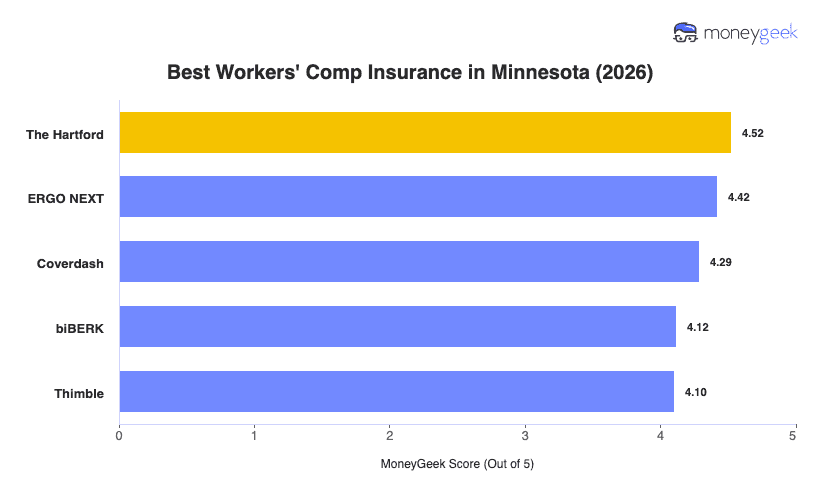
The Hartford is the best workers' comp insurance in Minnesota, averaging $91 per employee per month and ranking first for both overall score and affordability among the 10 providers MoneyGeek reviewed. ERGO NEXT ties it on price at an average rate of $91 and ranks second overall, with the top customer experience score in the group. Both pull well ahead of the rest of the field. The next cheapest option, Thimble, averages $97 per month, while the most expensive, Chubb, averages $148.
Best Workers' Comp Insurance in Minnesota (2026)
With rates as low as $9 monthly, The Hartford, ERGO NEXT and Coverdash offer the cheapest and best workers' comp insurance in Minnesota.
Get matched to top Minnesota workers' comp insurance providers and find your ideal coverage.

Updated: May 7, 2026
Advertising & Editorial Disclosure
Best Minnesota Workers' Comp Insurance: Fast Answers
What are the best and cheapest workers' comp insurance providers in Minnesota?
The Hartford leads Minnesota workers' comp providers with the top MoneyGeek score. Both The Hartford and ERGO NEXT average $91 per employee monthly, tying as the cheapest providers in the state.
- The Hartford: $91/month
- ERGO NEXT: $91/month
- Thimble: $97/month
- biBERK: $101/month
- Coverdash: $103/month
Is workers' comp insurance required in Minnesota?
Minnesota requires workers' comp coverage for all employers with at least one employee. Non-compliance is a misdemeanor criminal violation (not merely a civil penalty) and exposes employers to personal liability for all injury costs. The Minnesota Department of Labor and Industry administers enforcement.
How much does workers' comp insurance cost in Minnesota?
Minnesota's state average is approximately $112 per employee monthly, above the $74 national average. Beauty, Body and Wellness Services and Financial Services are among the most affordable industries, with state averages around $15/month. Transportation and Logistics ($339/month) and Construction ($311/month) are the most expensive in the state.
How do you get workers' comp insurance in Minnesota?
Minnesota operates as a competitive private market where most employers get workers' comp coverage through private insurers. Verify with the Minnesota Department of Commerce whether State Fund Mutual Insurance Company currently operates as a competitive state fund option. Employers unable to get voluntary coverage may access the Minnesota Workers' Compensation Assigned Risk Plan (MWCARP).
What does Minnesota workers' comp insurance cover?
- Medical expenses: Covers all reasonable and necessary medical treatment; the Minnesota Department of Labor and Industry administers the fee schedule.
- Wage loss benefits: Pays temporary total disability at 66⅔% of the employee's average weekly wage (verify 2026 maximum against the Minnesota Department of Labor and Industry).
- Vocational rehabilitation: Minnesota's mandatory rehabilitation consultation program requires carriers to provide rehab support to qualifying injured workers within a specified timeframe.
- Death benefits: Pays burial expenses and compensation to qualifying dependents based on the deceased worker's average weekly wage.
Best Workers' Comp Insurance Companies in Minnesota
| The Hartford | 4.52 | 90.91 | 3 | 3 |
| ERGO NEXT | 4.42 | 90.76 | 1 | 6 |
| Coverdash | 4.29 | 102.98 | 5 | 1 |
| biBERK | 4.12 | 101.09 | 8 | 8 |
| Thimble | 4.10 | 97.42 | 8 | 9 |
| Progressive Commercial | 3.90 | 111.35 | 8 | 7 |
| Nationwide | 3.88 | 114.34 | 6 | 5 |
| Simply Business | 3.80 | 131.85 | 2 | 2 |
| Hiscox | 3.71 | 126.07 | 6 | 10 |
| Chubb | 3.70 | 148.37 | 3 | 4 |
How Did We Determine These Rates and Rankings?
These rates are estimates based on MoneyGeek's analysis of small businesses with 1 to 4 employees across 408 major industries. Actual rates vary based on your business location, industry risk factors, claims history, coverage limits and individual insurer underwriting criteria. Contact insurers directly for personalized quotes.
The Hartford
Best Workers' Comp Insurance in Minnesota
Average Monthly Cost
$91Claims Processing Score
4.1/5Policy Management Score
4/5Buying Process Score
4/5
- pros
Most affordable for professional, financial and tech businesses
Leads Minnesota on claims handling
Leads on price in 13 of 25 industries
consBuying process score ranks below digital-first competitors
Less competitive on per-industry rates for food, pet care, and agricultural sectors
The Hartford is our top overall pick for workers' compensation insurance in Minnesota. Businesses in the state pay an average of $91 per employee monthly ($1,091 annually), 19% below the state average. It leads Minnesota on claims handling and policy management and ranks third for coverage breadth.
The Hartford is the most affordable choice in 13 of 25 Minnesota industries we reviewed, with the deepest savings for professional services businesses. Financial services firms pay $9 per employee monthly (39% below state average), tech and IT businesses pay $29/mo (37% savings), consulting firms pay $15/mo (33% savings) and real estate businesses pay $16/mo (32% savings). Construction, recreation and trade businesses will find lower rates with ERGO NEXT.
Read our full The Hartford review.
Minnesota businesses in food and beverage, pet care, education, and agricultural industries should compare ERGO NEXT's per-industry rates. ERGO NEXT is cheaper in those categories. Employers who prioritize a fast digital enrollment should also compare ERGO NEXT, which holds Minnesota's top buying process score.

ERGO NEXT
Best Minnesota Workers' Comp Insurance: Runner-Up
Average Monthly Cost
$91Claims Processing Score
4/5Policy Management Score
4.1/5Buying Process Score
4.4/5
- pros
Rate tied with The Hartford at Minnesota's lowest average ($91/month)
Top customer experience and buying process scores in the state
Lowest per-industry rates for food, pet care, education, agriculture, and construction
consCoverage score ranks sixth among Minnesota providers
Trails The Hartford on per-industry rates for financial services and tech
ERGO NEXT ranks second in Minnesota but leads the state on customer experience. It earns top marks in our analysis for its buying process, policy management and onboarding support, and its the cheapest option across seven industries in the state.
Construction and contracting businesses get the deepest savings at $217 per employee monthly, 30% below the state average. Recreation and sports companies ($102/mo), repair and maintenance businesses ($67/mo) and pet care businesses ($58/mo) also get Minnesota's lowest rates from ERGO NEXT.
Read our full ERGO NEXT review.
Minnesota businesses in financial services, marketing, or tech should compare The Hartford's per-industry rates. The Hartford is cheaper in those categories. Businesses that need the broadest endorsement options should compare Coverdash, which holds Minnesota's top coverage score.
Cheapest Workers' Comp Insurance in Minnesota by Industry
The Hartford is the cheapest workers' compensation provider in more Minnesota industries than any other provider in our analysis, leading in 13 of 25 categories. Its strongest price advantage is in low-hazard work, including financial services ($9/month), consulting ($15/month) and marketing ($13/month).
ERGO NEXT leads where physical risk is highest, including Construction ($217/month) and Agriculture ($152/month). Two providers appear in just one category each: Progressive Commercial for Transportation and Logistics, and Coverdash for Fitness Services, both worth comparing if your business falls in those categories.
| Agriculture & Natural Resources | ERGO NEXT | $152 | $1,824 |
| Arts, Media & Entertainment | Thimble | $88 | $1,056 |
| Beauty, Body & Wellness Services | The Hartford | $12 | $144 |
| Childcare Services | biBERK | $31 | $372 |
| Cleaning Services | The Hartford | $103 | $1,236 |
| Construction & Contracting | ERGO NEXT | $217 | $2,604 |
| Consulting Services | The Hartford | $15 | $180 |
| Education | ERGO NEXT | $60 | $720 |
| Financial Services | The Hartford | $9 | $108 |
| Fitness Services | Coverdash | $59 | $708 |
| Food & Beverage | ERGO NEXT | $39 | $468 |
| Healthcare & Medical | The Hartford | $38 | $456 |
| Hospitality, Travel & Tourism | The Hartford | $36 | $432 |
| Manufacturing | The Hartford | $126 | $1,512 |
| Marketing & Communications | The Hartford | $13 | $156 |
| Nonprofit & Associations | The Hartford | $48 | $576 |
| Other Professional Services | The Hartford | $19 | $228 |
| Pet Care Services | ERGO NEXT | $58 | $696 |
| Real Estate & Property Services | The Hartford | $16 | $192 |
| Recreation & Sports | ERGO NEXT | $102 | $1,224 |
| Repair & Maintenance | ERGO NEXT | $67 | $804 |
| Retail & Product Rental | The Hartford | $44 | $528 |
| Tech/IT | The Hartford | $29 | $348 |
| Transportation & Logistics | Progressive Commercial | $272 | $3,264 |
| Wholesale & Distribution | biBERK | $173 | $2,076 |
Average Workers' Comp Insurance Cost in Minnesota by Industry
The average cost of workers' comp insurance in Minnesota is $112 per employee monthly, but rates vary widely by industry. The spread across Minnesota industries runs from $15 monthly for financial services to $339 for transportation and logistics. That's a 23x difference that reflects how dramatically physical risk affects workers' comp rates.
| Beauty, Body & Wellness Services | $15 | $180 |
| Financial Services | $15 | $180 |
| Marketing & Communications | $16 | $192 |
| Consulting Services | $22 | $264 |
| Real Estate & Property Services | $24 | $288 |
| Other Professional Services | $25 | $300 |
| Childcare Services | $41 | $492 |
| Food & Beverage | $46 | $552 |
| Tech/IT | $46 | $552 |
| Hospitality, Travel & Tourism | $47 | $564 |
| Healthcare & Medical | $56 | $672 |
| Retail & Product Rental | $61 | $732 |
| Nonprofit & Associations | $64 | $768 |
| Pet Care Services | $71 | $852 |
| Fitness Services | $72 | $864 |
| Education | $73 | $876 |
| Repair & Maintenance | $82 | $984 |
| Arts, Media & Entertainment | $102 | $1,224 |
| Recreation & Sports | $128 | $1,536 |
| Cleaning Services | $133 | $1,596 |
| Manufacturing | $158 | $1,896 |
| Agriculture & Natural Resources | $184 | $2,208 |
| Wholesale & Distribution | $203 | $2,436 |
| Construction & Contracting | $311 | $3,732 |
| Transportation & Logistics | $339 | $4,068 |
Minnesota Workers' Comp Insurance Cost Factors
These cost factors affect workers' compensation insurance rates in Minnesota:
Insurers pay a 4.17% Special Compensation Fund assessment on pure premium to fund Minnesota's workers' comp programs, including benefits for uninsured employers' workers, second-injury fund reimbursement and Department of Labor and Industry operations. This state-specific surcharge is factored into your premium calculation, making Minnesota coverage more expensive than in states without similar assessments. You're essentially paying for other employers' failures to carry insurance plus state administrative costs.
Businesses that can't get coverage in the private market pay higher rates through Minnesota's assigned risk pool, with average annual premiums around $1,470 following a 6.8% rate decrease in 2023. The pool covers high-risk businesses with poor claims history, dangerous operations or previous coverage lapses. If you end up in assigned risk due to claims or violations, you'll pay substantially more than the voluntary market and its existence affects all pricing since insurers can decline marginal risks.
Minnesota's waiting period creates cost uncertainty: wage-loss benefits don't start until after three calendar days of disability, but if disability continues for 10 days or longer, insurers must retroactively pay from the first day at two-thirds of average weekly wage. This "cliff effect" means insurers face either minimal costs or substantial payouts with little middle ground, forcing conservative pricing to account for potential retroactive payments on claims that cross the 10-day threshold.
Minnesota operates an independent workers' comp system without National Council on Compensation Insurance oversight, allowing insurers to apply policy credits and debits up to 25% to adjust filed rates. This creates rate variation between carriers for identical coverage, potentially 40% to 60% differences, since insurers use proprietary methods to evaluate risk. While this means potential savings through diligent shopping, you could overpay significantly without comparing multiple carriers in Minnesota's non-standardized system.
Minnesota recalculates benefit levels annually based on statewide wage data. The average SAWW increase since 2016 is 3.72% annually, meaning benefit costs rise faster than general inflation. Insurers must price premiums today to cover claims filed months or years later when benefit levels will be higher, forcing them to build future increases into current calculations.
This construction-specific program rewards contractors paying higher wages with premium credits of 5% to 25% based on average hourly wages, but lost premium is offset through rate adjustments of 1% to 1.284% on construction classification codes. Contractors paying below-average wages subsidize credits given to higher-wage competitors through inflated base rates. Missing the annual application means paying inflated rates without receiving credits, creating a two-tier pricing system unique to Minnesota's construction industry.
How Much Workers' Comp Insurance Do I Need in Minnesota?
Minnesota law requires all employers to purchase workers' compensation insurance or become self-insured, regardless of business size. You need the required workers' compensation coverage even with just one part-time employee.
Your policy must provide unlimited medical treatment for work-related injuries and wage loss benefits paying two-thirds of your employee's average weekly wage. Coverage amounts scale based on your payroll and industry classification code. Skipping coverage can cost you up to $1,000 per employee per week in fines. If an employee gets injured while you're uninsured, you'll reimburse the state's Special Compensation Fund plus a 65% penalty.
Minnesota Workers' Comp Insurance Exemptions
You're required to have coverage in Minnesota, but some business categories are exempt from workers' comp requirements:
- Sole proprietors who are self-employed can exclude themselves and immediate family members (spouse, parents, children) working in the business from coverage requirements.
- Business partners enjoy the same exemption for themselves and their spouse, parents and children employed by the partnership.
- Corporate officers and LLC managers who own at least 25% of a closely held business can opt out of coverage. Your business qualifies as "closely held" if it has 10 or fewer shareholders (or members for LLCs) with less than 22,880 payroll hours annually. This exemption extends to your spouse, parents and children working in the company.
- Extended family members of qualifying owners can also be excluded. This includes relatives within the third degree of kinship: uncles, nieces, siblings and grandchildren. You'll need to file a written election with the Minnesota Department of Labor and Industry.
- Family farm workers employed by qualifying family farms don't need coverage. This exemption extends to the farmer's spouse, parents and children working in the operation, along with executive officers of family farm corporations.
- Household employees earning less than $1,000 in a three-month period from a single household don't require coverage. This includes domestic workers, repairers, groundskeepers and maintenance workers in private homes.
- Casual employees performing occasional labor outside your normal business operations are exempt from coverage requirements.
- Independent contractors who work for multiple clients, set their own schedules, provide their own tools and control how they complete their work don't need workers' comp coverage. The key distinction is that you can't control when, where or how they do their job.
- Small nonprofit organizations paying less than $1,000 in total annual wages can skip coverage. Officers or members of veterans' organizations whose only employment relationship involves attending meetings or conventions are also exempt unless the organization chooses to provide coverage.
- Federal program volunteers like AmeriCorps or Senior Corps members fall outside state workers' compensation requirements since they're covered under federal programs.
How to Get the Best Workers' Comp Insurance in Minnesota
Find out how to get workers' comp insurance with the right provider at the best price.
- 1Determine if you need workers' comp coverage in Minnesota
Check if workers' comp exemptions apply to your business structure or employee types. A sole proprietor graphic designer doesn't need coverage, but hiring one employee changes that. Minnesota classifies workers differently than other states, so people you consider independent contractors might legally qualify as employees requiring coverage.
- 2Gather your business information
Collect your employee count, annual payroll and classification codes for accurate quotes. Minnesota uses the National Council on Compensation Insurance system with industry-specific codes that determine your rates.
Accurate numbers matter. Estimating your payroll or using the wrong classification code can trigger audit penalties or leave you with coverage gaps during a claim. Restaurants and construction businesses face extra scrutiny since Minnesota applies different rates for tipped employees and seasonal workers. - 3Request workers' comp quotes from multiple carriers
Request quotes from at least three insurers to compare business insurance costs side by side. Add Minnesota's assigned risk pool to your list if you're struggling to find standard market coverage.
Minnesota doesn't run a state insurance fund, so you'll work with private carriers or enter the assigned risk pool for difficult-to-insure businesses. Rates vary widely based on your industry and loss history. Target insurers who specialize in your field rather than just household names. - 4Research providers with industry experience
Review insurers who understand your specific risks beyond simply offering affordable business insurance rates. Warehousing operations should look for carriers experienced with material handling injuries and OSHA standards rather than general commercial providers.
- 5Evaluate your top provider options
Compare each insurer's performance to find the best insurance for your business:
- Review claim processing speed, service quality and complaint records filed with the Minnesota Department of Commerce.
- Confirm the insurer offers managed care networks that control medical costs and coordinate treatment for injured employees.
- Ask about their experience navigating Minnesota's workers' compensation court and their success rate with disputed claims.
- Look for safety training resources, return-to-work programs and workplace assessments designed for Minnesota employers.
- 6Review and purchase your workers' compensation policy
Read your policy terms closely, focusing on coverage limits, exclusions and renewal terms under Minnesota regulations. Choose payment structures that fit your budget, such as pay-as-you-go workers' comp for businesses with variable payrolls. Ask about premium discounts for safety programs or claim-free periods.
- 7Reassess before annual renewal
Review how your business has changed before renewal. Update your employee count, examine filed claims and check your experience modification rate.
Your business evolves. Maybe you hired more staff, expanded services or relocated. Share these updates with your insurer to avoid overpaying or carrying inadequate coverage. Minnesota rates adjust based on statewide trends, so your premium might rise even without claims.
Best Minnesota Workers' Compensation Insurance: Bottom Line
The Hartford, ERGO NEXT and Coverdash lead Minnesota's workers' comp rankings. Businesses should research each company's service quality, maximize discounts and select coverage that fits their budget.
MoneyGeek analyzed workers' comp insurance rates and provider performance across Minnesota using small business profiles with 1 to 4 employees spanning 408 major industries. Companies earn up to five points in each category in our scoring system. We then use a weighted average of these category scores to calculate a MoneyGeek score out of five.
- Affordability (55%): Based on average payroll for the most common employee code per industry and state classification, priced per employee for a 1 to 4 employee business.
- Customer Experience (35%): Evaluates buying (20%), which covers quote access, pricing accuracy and sales support; policy management (30%), which covers payroll reporting, audits, billing and loss control; and claims (50%), which covers FNOL speed, adjuster support, medical access, wage replacement and dispute handling.
- Coverage Options (10%): Assesses coverage completeness (35%), including employers' liability and wage and medical reimbursement; policy flexibility and endorsements (25%); eligibility, state and industry breadth (20%); and policy terms, limits and exclusions (20%).

About Connor Bolton

Connor Bolton is Senior SEO and Content Manager at MoneyGeek, where he leads the business and pet insurance editorial teams. As editorial lead for both verticals, Connor sets the research framework, data standards, and content structure that his writers execute, directly authoring in-depth guides himself and reviewing all team content for accuracy and practical value before it goes live. With over four years evaluating insurance products across personal, commercial, and specialty lines, he brings cross-vertical knowledge to every guide the team produces.
Connor architected MoneyGeek's insurance research infrastructure across all major verticals including auto, home, renters, life, health, business, and pet, building systems for pricing analysis, provider-level research, customer experience evaluation, and coverage analysis with AI support. The infrastructure includes over 6 million data points for business insurance across 408 industry areas, all 50 states, and 16 vehicle types, and over 5 million pet insurance profiles across 18 major providers and hundreds of breed and age combinations. Connor's insurance cost research and his team's work has been cited by the U.S. Chamber of Commerce, Allstate, Liberty Mutual, CBS News, Forbes and LegalZoom.
Beyond the data, Connor stays connected to how the market actually operates, drawing on direct conversations with underwriters and carrier liaisons at Ethos, The Hartford, NEXT Insurance, Nationwide, and State Farm, and monitoring business and pet owner communities including Reddit, to inform how he interprets findings and frames guidance for real buyers.
He is the direct editorial contact for methodology questions at connor@moneygeek.com and can be found on LinkedIn.
Sources
- Minnesota Department of Labor and Industry. "Fines and Penalties for Employers' Failure to Insure." Accessed May 14, 2026.
- Minnesota Department of Labor and Industry. "Independent Contractor or Employee." Accessed May 14, 2026.
- Minnesota Department of Labor and Industry. "Rate Information, Statewide Average Weekly Wage (SAWW)." Accessed May 14, 2026.
- Minnesota Department of Labor and Industry. "Results of Special Compensation Fund Assessment." Accessed May 14, 2026.
- Minnesota Department of Labor and Industry. "Waiting Period After Injury." Accessed May 14, 2026.
- Minnesota Department of Labor and Industry. "Wage-Loss and Monetary Benefits." Accessed May 14, 2026.
- Minnesota Department of Revenue. "Commerce Approves Decrease in Rates for Businesses Buying Workers' Compensation Insurance Through State Program." Accessed May 14, 2026.
- Minnesota Legislature. "176.181 Insurance." Accessed May 14, 2026.
- Minnesota Workers' Compensation Insurers Association. "Agent FAQs." Accessed May 14, 2026.
- Minnesota Workers' Compensation Insurers Association. "Minnesota Contractors Premium Adjustment Program." Accessed May 14, 2026.
- Workers Compensation Research Institute. "Workers Compensation Premium Credits for Construction Contractors." Accessed May 14, 2026.