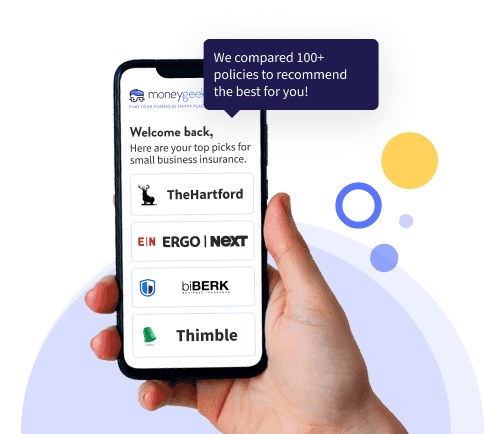




The cost of small business insurance varies quite a bit depending on the coverage type. Professional liability is the least expensive option, with The Hartford offering this coverage for $45 monthly. General liability comes in at $102 monthly with The Hartford. At the high end, commercial auto insurance costs an average of $143 per month with Progressive.
Cheapest Small Business Insurance Companies of 2026
ERGO Next has the lowest average small business insurance cost across all coverage types at $99 per month, according to MoneyGeek’s analysis. The cheapest coverage you can buy is professional liability with The Hartford for $45 per month.
Select state
Safe & SecureVerified and VettedTrusted Brands
Updated: October 15, 2026
Advertising & Editorial Disclosure
Why You Can Trust MoneyGeek
MoneyGeek researched 12 insurance companies and compared their offerings across 25 industries and 408 sub-industries. We obtained quotes in all 50 states and Washington, D.C. to get a pricing picture for each of the carriers we looked at. Read our methodology for a more detailed explanation.
Key Takeaways
The cost of small business insurance policies varies significantly depending on coverage type, industry and the location of your business.
Ways to save money on your premium include bundling policies, paying for a policy annually (instead of monthly) and raising your deductible.
Cheapest Small Business Insurance Companies
| ERGO NEXT | $99 | $1,182 |
| Thimble | $105 | $1,260 |
| The Hartford | $109 | $1,302 |
| biBERK | $110 | $1,319 |
| Nationwide | $112 | $1,345 |
Featured Partner

The Hartford
- A business owner's policy from The Hartford bundled with workers' compensation may qualify for a discount of up to 10%.
- The Hartford ranks third among the cheapest small business insurers in MoneyGeek's 2026 analysis, averaging $109 a month across six coverage types and more than 400 industries.
- Once a business has five or more employees, The Hartford becomes the cheapest option.
- For general liability and professional liability, MoneyGeek's coverage-level analyses also put The Hartford cheapest.
On The Hartford's site
*MoneyGeek featured partner. Editorial rankings below are independent of this placement. Rates, rankings and savings comparisons are based on MoneyGeek's independent research and Hartford-reported data as of 2026. Figures are estimates and averages, not a guarantee of any individual quote, premium or discount.
Cheapest Small Business Insurance by Coverage Type
The Hartford | $102 | $1,227 | 17% | |
ERGO NEXT | $86 | $1,030 | 24% | |
The Hartford | $45 | $537 | 20% | |
Progressive Commercial | $143 | $1,713 | 13% | |
Thimble | $111 | $1,330 | 11% | |
Chubb | $69 | $822 | 18% |
Cheapest Small Business Insurance by Industry and State
What your business does and where it's located are the two most significant cost factors for business insurance. They help insurers determine your risk profile, which is ultimately how they set rates. Because of this, an insurer that has the lowest rate for a cleaning company in Texas may not have the lowest rate for a company in the same industry in a different state. The same is true for other occupations like contractors.
Use our table filters to find the best rates for your business based on its industry and location.
Data filtered by:
Agriculture & Natural Resources
Alabama
| Agriculture & Natural Resources | Alabama | Thimble | $104 | $1,253 |
How to Get the Cheapest Small Business Insurance
 Get quotes before you talk to a broker, not after
The least expensive insurance companies in our data, particularly ERGO NEXT and biBERK, sell directly to consumers and aren't always represented by brokers. If you get a broker quote first and use it as your baseline, you may be comparing quotes against an incomplete market. Start with direct quotes from the carriers that lead for your industry profile, then use a broker to fill any gaps.
 Ensure your business classification is correct
Carriers use either a business’s NAICS code or their own internal classification system when building a quote. If your business is misclassified, you might be paying more than you should be. Before signing up for a policy, ask the carrier what code they gave your business and whether another code is available. This is worth doing for every quote.
 Pay for your policy annually
According to MoneyGeek’s pricing analysis, paying for a policy annually saves a business around 5% on average. If you require year-round coverage, consider this option – particularly if you have a more expensive policy such as commercial auto or commercial property.
 Bundle when it makes sense
Buying small business insurance from the same carrier you have another policy with can save you money through a bundling discount, but not in every case. Sometimes, holding policies with different insurers is cheaper overall.
If you’re looking to bundle, however, The Hartford has the best rates for bundling other policies with its general liability and/or professional liability options. ERGO Next offers the lowest bundling rates for its workers’ compensation policies, while Thimble leads the way for bundling commercial property coverage with another policy.
 Raise your deductible if you can afford it
Our research shows that having a higher deductible can save you as much as 18% in premiums. The coverage type where this makes the most sense is commercial property, which has straightforward deductibles. General liability policies make less sense with a higher deductible because those claims can be higher, which means you’d be responsible for paying more – sometimes significantly more – out of pocket.
 Review your coverage limits every year
Changes in revenue, payroll and assets happen periodically, so it’s important for business owners to review their coverage limits on an annual basis. There’s no point in keeping the same limits if your risk profile shrinks, for example. On the other hand, if your business grows and you have more assets to protect, you may want to raise your limits to stay properly insured.
Cheapest Small Business Insurance: Next Steps
We recommend comparing quotes from multiple small business insurance providers to determine your best rate and the best overall fit for your business. It’s also a good idea to verify the amount of coverage you need.
Here is some guidance to help you in your decision making process:
You just need to meet a contract requirement
If a client or contract is driving your search, you likely need general liability and possibly to add them as an "additional insured" on your policy. This is one of the most affordable insurance situations for small businesses. Check your business insurance requirements specific to state law and any contracts you are involved with for clarity before buying.
I want to know what coverage I need and what I can skip
The most common reason small businesses overpay is buying coverage they don't actually need. The right answer to “do I need business insurance?” depends on whether you have employees, a physical location, and what kind of work you do.
- Almost always worth it: General liability. It covers third-party injury and property damage claims and is required by most clients, landlords, and licensing boards.
- Worth it if you give advice or provide a service: Professional liability (E&O) covers mistakes in your work. Freelancers, consultants, and service businesses need this more than product-based ones.
- Skip until you need it: Commercial umbrella, cyber liability, and inland marine are real policies, but not the right first purchase for most very small businesses just starting out.
- Required by law, not optional: Workers' comp is legally required in almost every state the moment you hire your first W-2 employee, regardless of business size. Commercial auto is also required in some form if you use vehicles for business.
I have business insurance, but I think I'm overpaying
If you haven't shopped your policy in the last 12 to 18 months, there's a good chance you're paying more than you need to. The online insurance market for small businesses has gotten significantly more competitive, and switching is easier than most people expect.
- Pull your current declarations page. It shows your exact coverage limits and annual premium. You need this to compare apples-to-apples.
- Get business insurance quotes from at least two online competitors using the same limits you currently have. The process takes 10 minutes or less per quote.
- Check whether you're paying for a BOP when you could use standalone general liability insurance. If you don't have significant business property or inventory, you may not need the property portion.
- Ask your current insurer to match or beat any lower quote before you cancel. They may do so, especially if you've been claims-free or if you're a long-time customer.
About Connor Bolton

Connor Bolton is Senior SEO and Content Manager at MoneyGeek, where he leads the business and pet insurance editorial teams. He sets the research framework, data standards and content structure for his team. All content goes through his accuracy review before publication. Connor also writes in-depth guides and has spent more than four years covering insurance products across personal, commercial and specialty lines.
The research infrastructure Connor built covers auto, home, renters, life, health, business and pet insurance across pricing analysis, carrier research, customer experience and coverage evaluation. It includes over 6 million data points for business insurance across 408 industry areas, all 50 states and 16 vehicle types. The pet insurance side covers over 5 million profiles across 18 major providers, 100+ breeds and ages up to 20 years. Connor’s insurance research and his team's work have been cited by the U.S. Chamber of Commerce, Allstate, Liberty Mutual, CBS News, Forbes and LegalZoom.
Connor also talks with underwriters and carrier liaisons at Ethos, The Hartford, ERGO NEXT, Nationwide and State Farm, and monitors business and pet owner communities on Reddit. Those sources shape how his team evaluates carriers, structures rate analysis and writes content for real pet owners.
Questions about MoneyGeek's business or pet insurance content? Reach him at connor@moneygeek.com or on LinkedIn.