


ERGO NEXT is my pick for the best small business insurance company in Virginia. It averages $91 per month and is an excellent match if you want to create and share COIs through a website or app. If your priority is keeping costs low, The Hartford is a better match, costing $15 less. It also has stronger risk-management resources and provides more hands-on support once you're covered.
Best Small Business Insurance in Virginia
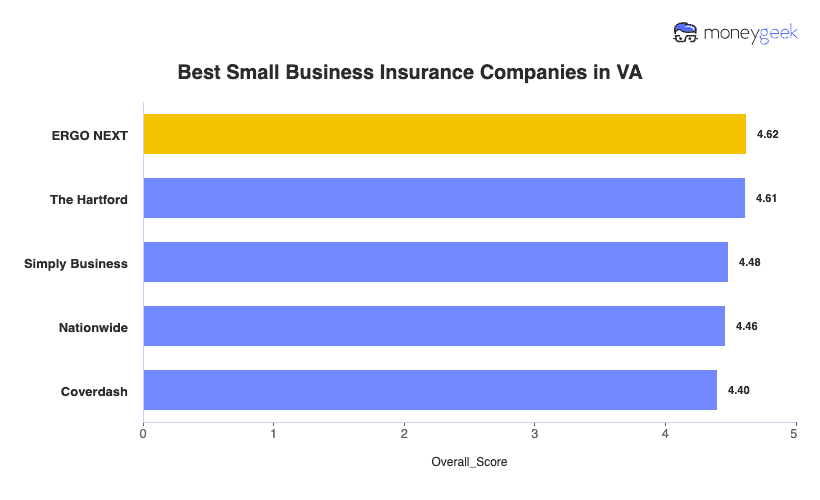
Our top small business insurers in Virginia are ERGO NEXT, The Hartford and Simply Business, based on price, service quality and coverage breadth.
MoneyGeek helps you compare insurers and uses your business details like your state and industry to connect you to providers that fit your business.
Ready to buy? Use the tool below to find insurers that match your Virginia business and the coverage you need.
Select state
Safe & SecureVerified and VettedTrusted Brands
Updated: November 4, 2026
Advertising & Editorial Disclosure
Best Small Business Insurance Companies in Virginia
| ERGO NEXT | 4.62 | $91 | 1 | 2 |
| The Hartford | 4.61 | $76 | 2 | 3 |
| Simply Business | 4.48 | $88 | 5 | 1 |
| Nationwide | 4.46 | $93 | 2 | 4 |
| Coverdash | 4.40 | $92 | 6 | 2 |
| biBERK | 4.38 | $95 | 2 | 5 |
| Progressive Commercial | 4.32 | $90 | 7 | 5 |
| Thimble | 4.30 | $86 | 8 | 5 |
| Hiscox | 4.27 | $98 | 4 | 6 |
| Chubb | 4.26 | $107 | 3 | 4 |
Note: The Virginia figures are meant to help you compare coverage costs on equal terms. MoneyGeek’s methodology calculates them using a two-employee business across 79 major industries. That consistency is useful for comparison, but your own insurer will price factors such as your payroll, type of work and chosen coverage.

ERGO NEXT
Best Virginia Business Insurance
MoneyGeek Rating
4.6/ 5
4.4/5Affordability
4.7/5Customer Experience
4.8/5Coverage Options
Average Monthly Cost of General Liability Insurance
$94This rate is for small businesses with two employees across 79 major industries or business types and focus solely on general liability policies.Average Monthly Cost of Workers' Comp Insurance
$62This rate is for small businesses with two employees across 79 major industries or business types and focus solely on workers' comp policies.Our Survey: Digital Experience
4.8/5 (1st)Our Survey: Likely to Be Recommended to Others
4.8/5 (1st)

The Hartford
Cheapest Virginia Business Insurance
MoneyGeek Rating
4.6/ 5
4.6/5Affordability
4.6/5Customer Experience
4.7/5Coverage Options
Average Monthly Cost of General Liability Insurance
$74This rate is for small businesses with two employees across 79 major industries or business types and focus solely on general liability policies.Average Monthly Cost of Workers' Comp Insurance
$63This rate is for small businesses with two employees across 79 major industries or business types and focus solely on workers' comp policies.Our Survey: Claims Process
4.5/5 (1st)Our Survey: Agent Service
4.7/5 (1st)

Simply Business
Best Commercial Coverage Options in Virginia
MoneyGeek Rating
4.5/ 5
4.4/5Affordability
4.2/5Customer Experience
4.9/5Coverage Options
Average Monthly Cost of General Liability Insurance
$87This rate is for small businesses with two employees across 79 major industries or business types and focus solely on general liability policies.Average Monthly Cost of Workers' Comp Insurance
$64This rate is for small businesses with two employees across 79 major industries or business types and focus solely on workers' comp policies.Our Survey: Digital Experience
4.5/5Our Survey: Service Quality
4.0/5
How to Get the Best Cheap Business Insurance in Virginia
The best small business insurance in Virginia needs to account for state requirements, flood exposure in coastal areas, contract-driven insurance limits or work that crosses into nearby jurisdictions. Start with those needs, then get business insurance by comparing providers on both cost and fit.
- 1
Assess what coverage your Virginia business actually needs
Figure out your coverage needs by looking at what Virginia requires, then at the risks your business creates. You’ll need workers’ comp once you regularly employ more than two people, which include part-time, seasonal and temporary workers. Contractors need to be especially careful since the employees of subcontractors you hire to complete your work may count too.
Your operations can add other needs. A business-owned vehicle registered in Virginia must carry liability insurance, and you’ll need property coverage if you own or lease a building or have equipment and inventory to protect. If you’re in a flood-prone area such as Norfolk, check whether you need separate flood insurance. Most commercial property policies in Virginia don’t cover damage caused by floods, surface water or storm surge.
Read More: How Much Business Insurance Do I Need?
- 2
Get quotes from affordable providers with strong customer ratings
Get at least three quotes, but make sure each one’s built around the same coverage setup. Keep your limits consistent, and use the same deductibles so you can see whether one insurer is genuinely charging less for the same financial protection. When comparing business insurance quotes, look closely at what’s included in the base price and what each carrier treats as an add-on. A cheaper quote can look attractive at first, but it won’t be the better deal once you add back the coverage another insurer included from the start.
- 3
Check insurer reliability before choosing based on price
The first thing to do is confirming that an insurer is licensed to sell the coverage you need in Virginia, but assessing a provider goes beyond that. You also need to consider whether the company fits how you run your business. Price matters because the policy has to fit your operating budget, but service is just important when you need help. Check how the insurer handles claims, like whether you can reach someone when a problem stalls and what kind of support you get for policy changes. Financial-strength plays a part because it helps show whether the insurer has the resources to pay claims.
- 4
Lower your premium without creating coverage gaps
Once you know what coverage you need, look for savings that don’t leave you some risks unaddressed. Your business insurance cost can change based on how you structure the policy, so focus on the parts you can control:
- Bundle when the combination makes sense. A BOP can cost less than buying general liability and commercial property separately if you need both.
- Raise your deductible only if you could comfortably pay it after a loss. You may lower the premium, but you’ll take on more of the upfront cost yourself.
- Ask about annual-payment discounts. Paying the full premium upfront can cost less than monthly installments, as long as it doesn’t strain your cash flow.
- Update your payroll and business details accurately. Overstating payroll, revenue or other rating information can push your premium higher than it needs to be, while understating them can create problems later.
- 5
Secure coverage that meets contract or lease requirements
Your legal minimums may not be enough for a lease or client contract. Virginia state contracts, for example, can require specific liability limits and auto coverage. They may also ask you to add the Commonwealth as an additional insured and provide a certificate of insurance (COI) before work starts. Check those requirements before you buy so you don’t end up changing the policy later. For construction work, subcontractors may also need to carry their own workers’ comp and liability coverage. If they don’t, you may have trouble meeting the prime contract’s insurance requirements or proving everyone on the job is properly covered.
Read More: Business Insurance Requirements
- 6
Review your coverage when the business changes
The policy you buy today might no longer fit once your operations change. You don’t need to rethink everything on a fixed schedule, but these changes should prompt a coverage review:
- You hire or change your staffing model. More employees can change your workers’ comp obligations in Virginia, while using subcontractors can affect how those requirements apply to your business.
- You add vehicles or start driving for work. A personal auto policy may not cover a vehicle once the business owns it or your employees regularly use it for work.
- Your contracts get larger or more demanding. New clients may require higher liability limits, additional insured status or coverage you didn’t need for smaller jobs.
- You add a location or start working outside Virginia. Expanding into nearby markets such as D.C. or Maryland can introduce different insurance requirements, so check whether your existing policies follow you before the work begins.
Best Business Liability Insurance in Virginia: Bottom Line
ERGO NEXT is my top overall pick if you want to manage most of your insurance online while keeping several core policies with one provider. The Hartford is the stronger alternative if price and hands-on support matter more; it has the lowest overall average in my study at $76 per month and gives businesses more options if they need higher limits or more specialized coverage. Simply Business makes the most sense if you’d rather compare several carriers through one application. The best fit is the provider that gives you enough protection at a price your business can comfortably carry. Compare equivalent policies, then choose based on what you’re actually getting for the premium rather than the lowest number alone.

LOOKING FOR THE BEST INSURANCE FOR A SPECIFIC COVERAGE TYPE?
If you already know which coverage you need, the next step is to see which provider is best for it. Use these resources to see our recommendations.
Business Insurance in Virginia: FAQ
Virginia's workers' comp thresholds, federal contractor requirements and coastal risk factors create unique coverage decisions for small businesses.
Your Virginia requirements can change just by adding an employee. Most businesses need workers’ compensation at three employees, while construction businesses have a lower threshold. From there, check the work itself. Your business vehicles need commercial auto coverage, and government or private contracts could include general liability requirements. I’d use those obligations as the floor, then insure the risks your business actually carries.
Use these average costs to get a sense of what individual coverages may add to your insurance costs in Virginia:
- General liability: $136 per month or $1,627 per year
- Workers' comp: $85 per month per employee or $1,015 per year per employee
- Commercial auto: $173 per month per vehicle or $2,071 per year per vehicle
- Commercial property: $127 per month or $1,518 per year
- Professional liability: $53 per month or $635 per year
- Cyber insurance: $92 per month or $1,109 per year
Let the way customers can hold you responsible shape the package. If people visit your premises or your team works at client sites, general liability is an important starting point. If you’re paid for advice, design or other professional work, professional liability should be a priority. Add workers’ comp and commercial auto when your staffing and vehicle use trigger them.
Tell the insurer where you regularly work before you buy the policy. Don’t assume coverage written for a Virginia operation automatically satisfies requirements in D.C. or Maryland. I’d ask the carrier to confirm your coverage territory and review workers’ comp, auto and contract requirements for each jurisdiction where you operate. Get any needed endorsements in place before sending employees or vehicles across state lines.
About Connor Bolton

Connor Bolton is Senior SEO and Content Manager at MoneyGeek, where he leads the business and pet insurance editorial teams. He sets the research framework, data standards and content structure for his team. All content goes through his accuracy review before publication. Connor also writes in-depth guides and has spent more than four years covering insurance products across personal, commercial and specialty lines.
The research infrastructure Connor built covers auto, home, renters, life, health, business and pet insurance across pricing analysis, carrier research, customer experience and coverage evaluation. It includes over 6 million data points for business insurance across 408 industry areas, all 50 states and 16 vehicle types. The pet insurance side covers over 5 million profiles across 18 major providers, 100+ breeds and ages up to 20 years. Connor’s insurance research and his team's work have been cited by the U.S. Chamber of Commerce, Allstate, Liberty Mutual, CBS News, Forbes and LegalZoom.
Connor also talks with underwriters and carrier liaisons at Ethos, The Hartford, ERGO NEXT, Nationwide and State Farm, and monitors business and pet owner communities on Reddit. Those sources shape how his team evaluates carriers, structures rate analysis and writes content for real pet owners.
Questions about MoneyGeek's business or pet insurance content? Reach him at connor@moneygeek.com or on LinkedIn.
Sources
- Commonwealth of Virginia, Department of General Services. "General Conditions of the Design-Build Contract." Accessed November 13, 2026.
- Commonwealth of Virginia, Department of General Services. "Vendors Manual." Accessed November 13, 2026.
- Virginia Department of Motor Vehicles. "Insurance Requirements." Accessed November 13, 2026.
- Virginia State Corporation Commission. "Commercial Property Insurance / Flood Coverage Guidance." Accessed November 13, 2026.
- Virginia Workers’ Compensation Commission. "Workers’ Compensation Insurance Information for Employers." Accessed November 13, 2026.