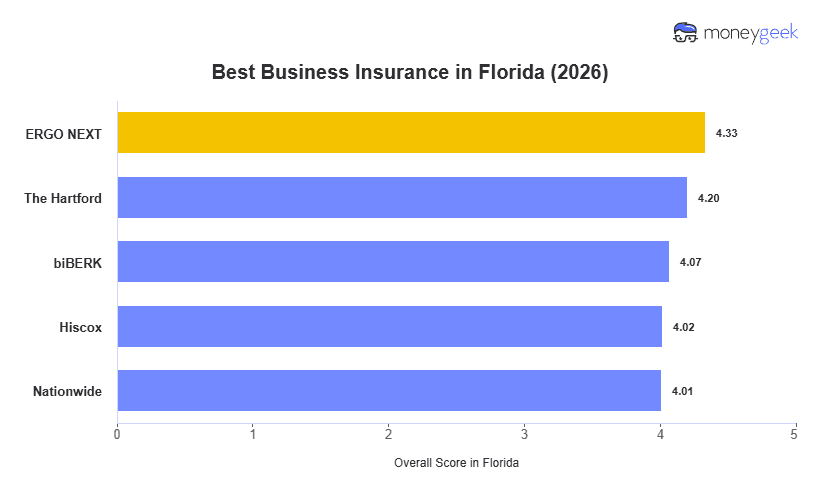

Florida law requires workers' compensation once your employee count crosses the threshold for your industry, and you need commercial auto coverage on any vehicle registered to the business. General liability isn't mandated by the state for most businesses, but your lease, your clients or your professional license can require it, and licensed contractors have to carry it to stay licensed.
Business Insurance in Florida
Business insurance in Florida covers the costs of running a company when something goes wrong, like a customer injury lawsuit, hurricane damage to your inventory, an employee hurt on the job or a crash in a work vehicle. Business insurance isn't a single policy you buy off the shelf, rather it's a set of separate coverages, and what you're actually covered for comes down to which ones you carry.
In this article, I cover what Florida requires you to carry, what a business like yours usually buys and what each coverage costs.
If you want coverage now, use MoneyGeek's matching tool to get quotes tailored to your small business.

Updated: July 14, 2026
Advertising & Editorial Disclosure
Florida Business Insurance Requirements
- Workers' Compensation
Workers' compensation pays an employee's medical bills and lost wages after a job-related injury, and Florida sets the trigger by industry. Construction businesses need it at the first employee, including working owners. Non-construction businesses need it once they reach four employees, counting part-time and seasonal staff. Agricultural operations are in once they hit six regular workers or 12 seasonal ones. Non-construction sole proprietors and partners aren't automatically counted and can file for an exemption. If you skip the coverage when you owe it, the Florida Division of Workers' Compensation can issue a stop-work order plus a fine of double the premium you dodged, with a $1,000 floor.
- Commercial Auto
Commercial auto covers the liability and physical damage tied to vehicles your business owns. Florida is a no-fault state, and it requires every registered vehicle to carry at least $10,000 in personal injury protection (PIP) and $10,000 in property damage liability. The state doesn't set a bodily injury liability minimum for standard business vehicles, though heavier trucks carry weight-based minimums and any for-hire carrier crossing state lines meets the federal floor of $750,000. Treat the state numbers as a starting point, because clients and lenders routinely write $1 million into their contracts before they'll let your trucks on site.
- General Liability
General liability pays for a third party's bodily injury or property damage you're responsible for, along with the legal defense those claims bring. Florida law doesn't require it for a typical business, but your commercial lease, your client contracts and your professional license often will.
For general and building contractors, the Department of Business and Professional Regulation sets the floor at $300,000 in liability coverage and $50,000 in property damage, with the board named on your certificate. Other trades carry lower minimums, at $100,000 and $25,000, respectively. And if your credit score is under 660, you're required to post a surety bond to obtain your license.
What Types of Business Insurance Should Florida Businesses Get?
What you carry depends mostly on what your business does, because your industry decides which risks are worth insuring against. Find your business type in the table below to see the bundle most Florida owners start with and the coverages worth raising with your agent.
Restaurants, Bars and Hospitality | Business owner's policy (general liability, property, business interruption), workers' comp | Tourism keeps this sector busy, but a hurricane can close your doors for weeks. Business interruption is the piece that matters most, since it replaces the income you lose while you're shut. | Liquor liability, food spoilage, cyber |
Retail and E-commerce | General liability, commercial property, workers' comp | A storefront's risks center on customers, inventory and the space itself. If you take card payments or store customer data, a breach becomes one of your larger exposures. | Cyber liability, product liability, business interruption |
Construction and Trades | General liability, workers' comp, commercial auto | This is the widest bundle. General liability is what holds your state license, and workers' comp applies from your first hire. The gap most contractors miss is their tools, which a standard property policy won't follow to the jobsite. | Inland marine (tools and equipment), surety bonds, umbrella |
Real Estate and Property Management | Professional liability (errors and omissions), general liability | Agents, brokers and property managers sell advice, so the main risk is a client claiming a bad recommendation or a missed disclosure cost them money. General liability won't cover that kind of claim. | Cyber, commercial property, umbrella |
Healthcare and Professional Services | Professional liability, general liability, cyber | Clinics, accountants and consultants are paid for their judgment, so a claim of a mistake is the main exposure. These businesses also hold sensitive records, which pushes cyber coverage close to essential. | Business owner's policy, workers' comp, medical malpractice for clinical practices |
Logistics and Trucking | Commercial auto, general liability, workers' comp | Florida's ports in Miami, Jacksonville and Tampa keep freight moving, and here commercial auto is the core of the policy rather than a support piece. Carriers crossing state lines meet the federal $750,000 liability floor and insure the cargo they haul. | Motor truck cargo, hired and non-owned auto, umbrella |
Agriculture | Commercial property, commercial auto, workers' comp | Growers and nurseries insure barns, greenhouses, equipment and stored crops rather than a storefront. Workers' comp becomes mandatory at six regular employees or 12 seasonal ones, a threshold that catches operations relying on harvest labor. | Inland marine (mobile equipment), crop insurance, flood |
Marine and Boating | Marine general liability, commercial property, workers' comp | Charters, marinas and watercraft dealers carry risks a standard policy wasn't built for, since the exposure is on the water. Hull coverage pays for damage to the vessel itself, and protection and indemnity covers injuries and liability at sea. | Hull, protection and indemnity, dock and marina liability |
Standard commercial property coverage excludes flood damage. Flood is a separate policy, available through the National Flood Insurance Program (NFIP), which covers commercial buildings and contents up to $500,000 each, or through Florida's large private flood market for higher limits. With so much of Florida on coastal or low-lying ground, a separate flood policy is worth it for most businesses with a physical location.
How Much Does Business Insurance Cost in Florida?
The average cost of business insurance in Florida is $128 per month (or $1,538 per year), based on my analysis of premium estimates across the state. That figure blends every coverage and business type together, and what you actually pay depends mostly on which policies you carry and how much risk your work involves. A solo consultant with one professional liability policy sits at the low end while a contractor running trucks and a field crew sits well above the average.
Costs also run higher in Florida than in much of the country, ranking 43rd of 51 for affordability, which puts it among the more expensive places to insure a business. Hurricane exposure is a large part of why, since property and related coverages price in the state's storm risk.
| Commercial Auto | $230 | $2,763 |
| Commercial Property | $140 | $1,682 |
| Cyber Insurance | $90 | $1,080 |
| General Liability | $144 | $1,732 |
| Professional Liability | $61 | $731 |
| Workers' Comp | $103 | $1,237 |
Your industry sets the baseline, since it decides which risks you're insuring and how likely a claim is. From there, the size of your business does most of the work through payroll, revenue and number of employees, because those drive both your workers' comp and liability premiums. Your claims history, the limits you pick and your deductible move the number up or down from there. In coastal areas, storm and flood exposure adds another layer that inland businesses don't carry.
Florida Business Insurance Checklist
I put together a checklist you can use when you're setting up your coverage. Each item is a decision to make or a detail to confirm before you sign anything
- Confirm what Florida requires of you
Start with the coverages the state actually mandates for your situation. If you have employees, check whether you've crossed the workers' comp threshold for your industry, which is one employee in construction, four in most other fields and six regular workers in agriculture. If your business owns vehicles, you need commercial auto. If you hold a contractor license, general liability is part of keeping it.
- Pull your lease and contracts and note what they require
Read your commercial lease and any client or vendor agreements, and write down the exact coverage types and limits each one demands. Many require general liability at a set limit and ask to be named as an additional insured. Bring those numbers when you shop, because a policy that falls short of the contract can cost you the space or the job.
- List the risks that could actually close you down
Think through what would hurt most: the value of your equipment and inventory, whether you sell advice that could draw a professional liability claim, and whether you hold customer data that creates breach exposure. In coastal areas, add flood and windstorm to that list, since standard property leaves both out.
- Decide on your limits and deductibles before you compare
Set the coverage amounts you want ahead of time so every quote reflects the same thing. A higher deductible lowers your premium but means more out of pocket at claim time, so pick the balance that fits your cash flow.
- Get at least three quotes with identical specs
Quotes are only comparable when the coverages, limits and deductibles match. Ask each insurer to quote the same package so the price difference reflects the insurer, not a different level of protection.
- Set a reminder to review your coverage as the business changes
Revisit your policies at renewal and any time you hire, move, buy a vehicle, add a service or sign a larger contract. Coverage that fit last year can leave gaps once the business grows.
Commercial Insurance in Florida: Bottom Line
The mistake I see most often is treating insurance as a bill to shrink rather than a backstop for the things that would end the business. Those are different goals, and they lead to different policies. Shopping for the lowest premium gets you a number you're comfortable with today, but shopping for what actually protects you gets you a business that survives the storm, the lawsuit or the injured employee.
That choice is more important in Florida than in most states. Hurricanes flood inventory and tear off roofs here every season, and one customer injury can turn into a claim that outlasts the savings from a cheaper policy. Buy for the day something goes wrong, not the day the premium is due, and the rest of the decisions get easier.
Florida Business Insurance: Next Steps
For most Florida businesses, the right next move is to compare a few vetted carriers before you buy, since prices for the same coverage vary widely and the state's storm exposure makes the strength of an insurer's claims process worth as much as the quote. Start there, then use the branches below for your situation.
Recommended: Compare Providers Before You Buy
See how the top insurers stack up on price and coverage, find the most affordable options, and get a fuller picture of what you'll pay.
If You Want to Learn About Coverage Types
If you want to understand a specific policy before you buy it, these explain what each one covers and when you need it.
If You're Buying Your First Policy
Have your basic details ready before you start: what your business does, your annual revenue, your payroll and employee count, and any vehicles the business owns. A business owner's policy is the common starting point for a small operation with a location, since it bundles general liability and property into one. Get matched with carriers once you know roughly what you need.
If You're Working Under a Contract or Lease
Read the insurance clause before you shop. Note the exact general liability limit required, whether the client or landlord has to be named as an additional insured, and whether they want a waiver of subrogation. Bringing those details to every quote means the prices you get back already meet the requirement, and if you're against a deadline, favor insurers that issue certificates of insurance quickly.
If You Want to Lower Your Costs
Bundle general liability and property into a business owner's policy, which usually costs less than buying them apart. Ask about paying annually instead of monthly, raise your deductible if your cash flow can absorb it, and confirm your business is coded correctly, since a wrong classification can inflate the premium. Then compare identical specs across carriers.
If Your Business Is Growing or Changing
Coverage that fit a smaller operation develops gaps as you scale. A first hire triggers workers' comp, a new vehicle needs commercial auto, and a larger contract can raise the liability limits you're required to carry. Review your policies at each renewal and after any change like that.
About Connor Bolton

Connor Bolton is Senior SEO and Content Manager at MoneyGeek, where he leads the business and pet insurance editorial teams. He sets the research framework, data standards and content structure for his team. All content goes through his accuracy review before publication. Connor also writes in-depth guides and has spent more than four years covering insurance products across personal, commercial and specialty lines.
The research infrastructure Connor built covers auto, home, renters, life, health, business and pet insurance across pricing analysis, carrier research, customer experience and coverage evaluation. It includes over 6 million data points for business insurance across 408 industry areas, all 50 states and 16 vehicle types. The pet insurance side covers over 5 million profiles across 18 major providers, 100+ breeds and ages up to 20 years. Connor’s insurance research and his team's work has been cited by the U.S. Chamber of Commerce, Allstate, Liberty Mutual, CBS News, Forbes and LegalZoom.
Connor also talks with underwriters and carrier liaisons at Ethos, The Hartford, ERGO NEXT, Nationwide and State Farm, and monitors business and pet owner communities on Reddit. Those sources shape how his team evaluates carriers, structures rate analysis and writes for human buyers rather than search engines.
For questions about MoneyGeek's business and pet insurance content, contact him at connor@moneygeek.com or on LinkedIn.