

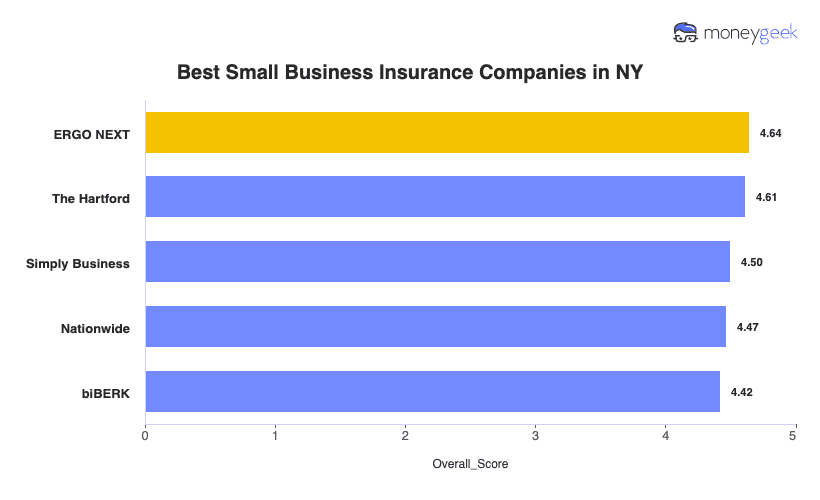
Based on my analysis, ERGO NEXT is the best small business insurance provider in New York overall. Its costs $116 per month on average, and you can handle several policy tasks online instead of calling an agent. The Hartford is more affordable at an average of $99 per month and is worth considering if you want support from teams that specialize in your industry. If you prefer to shop around before choosing an insurer, Simply Business lets you compare policies from multiple carriers.
Best Small Business Insurance in New York
The best small business insurers in New York are ERGO NEXT, The Hartford and Simply Business, based on cost, service quality and coverage breadth.
MoneyGeek helps you compare insurers and connects you to the providers that fit your business using your state and industry.
Ready to buy? Use the tool below to find insurers that match your New York business and the coverage you need.
Select state
Safe & SecureVerified and VettedTrusted Brands
Updated: October 5, 2026
Advertising & Editorial Disclosure
Best Small Business Insurance Companies in New York
Featured Partner

The Hartford
- The Hartford is New York's cheapest small business insurer in MoneyGeek's 2026 analysis, at $99 a month.
- That $99 monthly average puts The Hartford about $8 below the next-cheapest option MoneyGeek analyzed.
- In New York, The Hartford also ranks first for general liability at $97 a month and for business owner's policies at $135.
- The Hartford, founded in 1810, insures more than 1.5 million small business customers today.
On The Hartford's site
*MoneyGeek featured partner. Editorial rankings below are independent of this placement. Rates, rankings and savings comparisons are based on MoneyGeek's independent research and Hartford-reported data as of 2026. Figures are estimates and averages, not a guarantee of any individual quote, premium or discount.
| ERGO NEXT | 4.64 | $116 | 1 | 2 |
| The Hartford | 4.61 | $99 | 2 | 3 |
| Simply Business | 4.50 | $112 | 5 | 1 |
| Nationwide | 4.47 | $119 | 2 | 4 |
| biBERK | 4.42 | $118 | 2 | 5 |
| Coverdash | 4.41 | $118 | 6 | 2 |
| Thimble | 4.34 | $107 | 8 | 5 |
| Progressive Commercial | 4.31 | $118 | 7 | 5 |
| Hiscox | 4.30 | $123 | 4 | 6 |
| Chubb | 4.27 | $137 | 3 | 4 |
Note: These New York figures are designed for side-by-side comparison, not to mirror one particular business. MoneyGeek’s methodology runs the same two-employee profile through 79 major industries so each coverage type starts from a common baseline. Your actual quote will shift once the insurer prices the details of your own operation.

ERGO NEXT
Best New York Business Insurance
MoneyGeek Rating
4.6/ 5
4.5/5Affordability
4.7/5Customer Experience
4.8/5Coverage Options
Average Monthly Cost of General Liability Insurance
$120This rate is for small businesses with two employees across 79 major industries or business types and focus solely on general liability policies.Average Monthly Cost of Workers' Comp Insurance
$80This rate is for small businesses with two employees across 79 major industries or business types and focus solely on workers' comp policies.Our Survey: Digital Experience
4.8/5 (1st)Our Survey: Likely to Be Recommended to Others
4.8/5 (1st)

The Hartford
Cheapest New York Business Insurance
MoneyGeek Rating
4.6/ 5
4.6/5Affordability
4.6/5Customer Experience
4.7/5Coverage Options
Average Monthly Cost of General Liability Insurance
$97This rate is for small businesses with two employees across 79 major industries or business types and focus solely on general liability policies.Average Monthly Cost of Workers' Comp Insurance
$81This rate is for small businesses with two employees across 79 major industries or business types and focus solely on workers' comp policies.Our Survey: Claims Process
4.5/5 (1st)Our Survey: Agent Service
4.7/5 (1st)

Simply Business
Best Commercial Coverage Options in New York
MoneyGeek Rating
4.5/ 5
4.5/5Affordability
4.2/5Customer Experience
4.9/5Coverage Options
Average Monthly Cost of General Liability Insurance
$111This rate is for small businesses with two employees across 79 major industries or business types and focus solely on general liability policies.Average Monthly Cost of Workers' Comp Insurance
$83This rate is for small businesses with two employees across 79 major industries or business types and focus solely on workers' comp policies.Our Research: Digital Experience
4.5/5Our Survey: Service Quality
4.0/5
How to Get the Best Cheap Business Insurance in New York
The right policy depends on what your business does and what New York requires of you. To find the best business insurance in New York, compare quotes using the same coverage terms so you can judge price without overlooking a requirement or coverage gap.
- 1
Assess what coverage your New York business actually needs
How your business operates is the best starting point for understanding your risks. A Manhattan retailer with customer traffic and inventory has different needs than a consultant working from home. Location matters too. Between 1996 and 2024, flash flooding caused about $2.5 billion in reported property damage across New York, so businesses in flood-prone areas should check whether they need separate flood coverage instead of assuming commercial property insurance will cover the loss.
Then check what New York requires based on how you operate. Most employers need workers’ compensation once they hire employees, and adding staff can also trigger disability and Paid Family Leave requirements on a separate timeline.
Read More: How Much Business Insurance Do I Need?
- 2
Compare quotes using the same assumptions
When comparing business insurance quotes, give each insurer the same description of your business, then hold the liability limits and deductible steady. That makes it easier to see whether a lower quote reflects a better price or simply less coverage.
If one quote is much cheaper, look at how the insurer classified your business and what assumptions it made about your operations. A small difference in underwriting can change the price enough to make two quotes look more comparable than they really are.
- 3
Check insurer reliability before choosing based on price
A cheap policy loses its value if getting help after a loss becomes difficult. Before choosing an insurer, check that it is authorized to operate in New York and look at how it handles claims once you report one. New York’s Department of Financial Services lets you verify insurers and gives you a place to escalate unresolved claim issues.
I’d also look at whether the carrier makes it easy to reach a claims representative and keeps you updated as the claim moves forward. Those details matter more after a loss than a small premium difference does.
- 4
Cut insurance costs without reducing your protection
You can often lower business insurance costs without reducing the amount of financial protection you genuinely need. Focus on changes that give you affordable insurance rates without leaving your business underinsured.
- Raise the deductible carefully: A higher deductible can lower your premium, but only if you have enough cash to cover a smaller loss yourself.
- Bundle when the pricing works: A BOP may cost less than buying general liability and commercial property separately.
- Update your property values: Remove equipment you no longer own and adjust values that no longer match what the business would actually need to replace.
- Check annual billing: Paying for the year upfront can sometimes cost less than paying in installments.
- 5
Secure coverage that meets client contract requirements
Your lease or client contract may require more coverage than New York law does. A commercial landlord might ask for liability or property insurance and require you to list the building owner as an additional insured. Contractors can face separate requirements when a permit or project calls for specific liability limits or endorsements before work starts. Those requirements usually show up on a certificate of insurance (COI), so check the exact wording before you bind coverage.
Read More: Business Insurance Requirements
- 6
Change your coverage when the business changes
Your policy should change with the business, not something you set once and forget. A new location may increase the property you need to insure, or taking on larger client contracts can lead to higher liability limits. If you add a service your current insurer doesn’t cover, you’ll likely need to compare carriers again. Review your policy whenever you change the way you operate, rather than waiting for renewal and assuming the old setup still fits.
Best Business Liability Insurance in New York: Bottom Line
ERGO NEXT is my top pick if you want strong self-service tools without giving up customer support, while The Hartford is worth a closer look if keeping premiums down matters more. Simply Business takes a different approach by shopping several carriers for you, which can help when your business is harder to place or a contract calls for specific policy terms. The best business insurance in New York for you is the one that can meet the coverage requirements you actually have at a price that still makes sense for your business.

LOOKING FOR THE BEST INSURANCE FOR A SPECIFIC COVERAGE TYPE?
I've prepared resources so you'll see which providers we recommend for the different coverage types you might need to include in your insurance mix.
Business Insurance in New York: FAQ
Small business owners across New York face numerous questions when selecting business insurance coverage. We've compiled answers to the most common concerns below:
In New York, hiring employees can put workers’ compensation on your must-have list, and vehicles used for business need commercial auto coverage with the appropriate limits. Other policies often come from the way you operate rather than state law. If you rent space or serve commercial clients, read those agreements closely because they may require general liability with specific limits.
How much you spend on coverage depends on the policies in your insurance mix. On a per-policy level, expect to pay these on average:
- General liability: $180 per month or $2,157 per year
- Workers' comp: $269 per month per employee or $3,226 per year per employee
- Commercial auto: $211 per month per vehicle or $2,537 per year per vehicle
- Commercial property: $150 per month or $1,794 per year
- Professional liability: $65 per month or $777 per year
- Cyber insurance: $101 per month or $1,206 per year
Instead of starting with a preset bundle, look at what you’d need to keep operating after a loss. A Brooklyn café may depend heavily on its premises, equipment and ability to serve customers, making general liability and property protection important early. An upstate design studio may have little physical exposure but significant risk tied to client work, which can make professional liability the more pressing addition.
Often, but the reason may be your contract rather than New York law. General liability doesn’t have one statewide minimum for every business, so a landlord or client may effectively set the limit you need. I’d check those requirements before buying coverage. If a contract calls for $1 million per occurrence or more, make sure your policy meets it before you sign or bid.
About Connor Bolton

Connor Bolton is Senior SEO and Content Manager at MoneyGeek, where he leads the business and pet insurance editorial teams. He sets the research framework, data standards and content structure for his team. All content goes through his accuracy review before publication. Connor also writes in-depth guides and has spent more than four years covering insurance products across personal, commercial and specialty lines.
The research infrastructure Connor built covers auto, home, renters, life, health, business and pet insurance across pricing analysis, carrier research, customer experience and coverage evaluation. It includes over 6 million data points for business insurance across 408 industry areas, all 50 states and 16 vehicle types. The pet insurance side covers over 5 million profiles across 18 major providers, 100+ breeds and ages up to 20 years. Connor’s insurance research and his team's work have been cited by the U.S. Chamber of Commerce, Allstate, Liberty Mutual, CBS News, Forbes and LegalZoom.
Connor also talks with underwriters and carrier liaisons at Ethos, The Hartford, ERGO NEXT, Nationwide and State Farm, and monitors business and pet owner communities on Reddit. Those sources shape how his team evaluates carriers, structures rate analysis and writes content for real pet owners.
Questions about MoneyGeek's business or pet insurance content? Reach him at connor@moneygeek.com or on LinkedIn.
Sources
- Office of the New York State Comptroller. "Severe Weather Events and Resiliency in New York State." Accessed November 5, 2026.