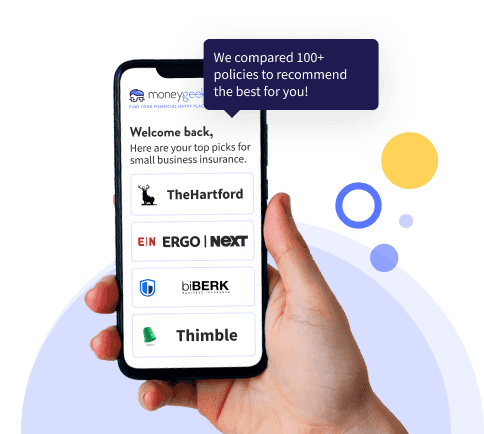
The best insurer overall won’t be the best fit for every business, so I’ve broken out my top picks for the six most common industries in North Carolina as well:

Best North Carolina Small Business Insurance Companies Overview

The best small business insurance company in North Carolina is ERGO NEXT, which ranked first in my analysis with a MoneyGeek score of 4.36 out of 5. It’s also the cheapest carrier in my study at $92 per month on average, saving you around $154 annually. You can buy coverage and handle routine policy tasks online, which cuts down on back-and-forth when you need to make a change or provide proof of insurance quickly. The Hartford scored 4.19 out of 5 and ranks second. Its agent support after purchase makes it a better fit if you want help with coverage questions and policy changes, while its broader policy lineup gives you more options to keep additional coverage with the same insurer as your needs grow.

If ERGO NEXT or The Hartford doesn't match how you operate, the next three providers in my analysis stand out for more specific coverage needs:

  • biBerk: Its Berkshire Hathaway backing gives you added confidence in the insurer’s financial strength, while in-house commercial auto makes it worth considering if vehicles are a major part of your business.
  • Thimble: Best suited to solo businesses with straightforward liability needs. Its short-term general liability coverage can run for a month or less, making it a good fit you only need protection for specific jobs or seasonal work.
  • Hiscox: Specializes in small business insurance and tailors professional liability coverage to specific professions, which can be useful if you want coverage that reflects the risks tied to your actual line of work.

Use the comparison below to see what these five insurers charge on average for small businesses insurance in North Carolina and how their service and coverage features differ.

4.36
$92
Unlimited self-service COIs, COI Analyzer
HNOA and cyber add-ons for eligible businesses, profession-specific BOPs
4.19
$107
Risk Engineering consultations, Team•Work return-to-work support
Spectrum BOP can be customized, professional liability up to $2 million, umbrella up to $10 million
4.10
$103
Buy direct online or work with licensed experts, carrier-direct policy service
Customizable BOP for profession-specific risks, commercial auto tailored for for-hire trucking
4.07
$99
Quote and bind in minutes, modify, pause or cancel coverage online

Flexible on-demand liability coverage, equipment protection up to $25,000

4.03
$108
Dedicated claims representative, monthly payments with no added fee

Retroactive dates on PL policies, customizes PL policies based on profession

Best Small Business Insurance in North Carolina for White Collar and Freelance Services

Includes: Consultants, accountants and bookkeepers, IT and technology firms, marketing and advertising businesses, financial-services firms, legal services, research businesses and other professional-service firms.

I’d choose The Hartford as the best small business insurance provider for professionals in North Carolina like software developers and tax preparers because it can still fit as your business grows beyond a one-person operation. If larger clients start asking for higher limits or extra coverage, Hartford gives you more room to add what you need without starting over with another insurer. Hiscox makes more sense for solo professionals and very small firms that mainly need E&O and want coverage tailored to their profession. Its professional liability policy is built around the specific mistakes and client claims that come with the work you do, rather than treating every professional business the same.

Choose The Hartford if:

  • You run a professional firm with five or more employees
  • Your business earns more than $1 million annually
  • You work with larger commercial or public-sector clients that require liability limits higher than $5 million per occurrence or multiple policies
  • You want an agent to help with coverage decisions as your contracts and insurance needs get more involved

Choose Hiscox if:

  • You’re self-employed or run a professional firm with fewer than five employees
  • Your business earns under $1 million annually
  • You mainly need E&O for consulting, accounting, marketing, IT or similar professional work
  • You prefer quoting and buying coverage directly online rather than building a larger multi-policy setup
The Hartford

The Hartford: Best for Professional Firms With Growing Coverage Needs

On The Hartford's site
checkmarkpros
  • Professional liability limits reach up to $5 million

  • Agents can help place higher-limit or multi-policy accounts

  • Tech E&O combines professional and cyber-related protection

closecons
  • Some policies require working with an agent to buy

  • May be more insurer than a solo professional needs

COMPANY HIGHLIGHTS

The Hartford can keep up as your professional business moves beyond a basic E&O policy. Larger commercial or public-sector clients often ask you to carry more coverage. One Wake County public-school contract, for example, required $1 million in professional liability and up to $5 million in cyber coverage for work involving personal information or software. Hartford offers up to $5 million in miscellaneous professional liability for eligible firms, while technology businesses can get up to $10 million in Tech E&O, allowing to satisfy those requirements. That gives you room to take on clients with more demanding insurance requirements without immediately looking for another insurer.

Technology firms may find the Hartford an excellent fit since its FailSafe Tech E&O covers technology errors alongside data privacy and network-security liability, with first-party cyber protection also available on the standalone policy. That’s particularly relevant in North Carolina, where there were 2,349 data breaches in 2025, affecting more than 9.2 million residents.

Hiscox

Hiscox: Best for Established Solo Professionals and Small Businesses with E&O-Focused Needs

checkmarkpros
  • Has the lowest rates for Tech/IT and Financial Services

  • Different professional-service industries get profession-specific E&O features

  • Direct online buying works well for straightforward E&O needs

closecons
  • Attorneys and law firms aren’t eligible for Hiscox PL

  • Better suited to E&O-first businesses than firms needing several policies

COMPANY HIGHLIGHTS

Hiscox makes sense if E&O is still your main insurance need but you already have years of client work behind you. Its professional liability policies come with a retroactive date, and coverage can even go back to when your business started. That  matters when you pursue larger clients that have more requirements than just the policy limit. A UNC-Chapel Hill website-redesign contract, for example, required $1 million in professional liability and required claims-made coverage to reach back before the agreement began. For an established consultant or marketing firm Hiscox helps protect the work you've already built up while satisfying client requirements.

Another unique feature of Hiscox is how specifically it builds professional liability around your work. Hiscox can address intellectual-property risks tied directly to software and marketing work. For example, you can get $200,000 in software copyright infringement coverage, while marketing consultants can get $200,000 for copyright and trademark claims arising from their services.

Best Small Business Insurance in North Carolina for Contracting and Construction

Includes: General contractors, remodelers, electricians, plumbers, HVAC contractors, roofers, handymen, landscapers, tree-service businesses, junk-removal contractors, architects, engineers and other specialty construction trades.

ERGO NEXT is my top choice for contractors in North Carolina because its low pricing pairs well with tools coverage and workers’ comp for smaller crews doing hands-on work. If your trade is harder to insure or your workload changes from project to project, Thimble is a better fit, especially for roofers and certain tree-service businesses that only need general liability for shorter periods.

Choose ERGO NEXT if:

  • You run a smaller contractor crew with under $5 million in annual revenue or payroll and need general liability, workers’ comp or tools coverage from the same insurer.
  • Your work stays below 30 feet or three stories when you perform exterior jobs.
  • You prefer handling policy documents and routine changes online instead of working through an agent.

Choose Thimble if:

  • You’re a solo contractor that works by project or has slower periods during the year.
  • You do higher-risk work, like roofing or tree-service work at height, that may be harder to place with another small-business insurer.
  • Your annual revenue is below $5 million.
ERGO NEXT

ERGO NEXT: Best for Smaller Contractor Crews That Want Affordable Coverage

On ERGO NEXT's site
checkmarkpros
  • Lowest construction rate in our study at $138 monthly

  • Tools coverage scales from $3,000 to $30,000 per occurrence

  • Workers’ comp available for eligible contractor professions

closecons
  • Exterior work above 30 feet or three stories may be ineligible

  • General liability tops out at $1 million per occurrence / $2 million aggregate

COMPANY HIGHLIGHTS

Construction and contracting is the fourth most expensive industry in North Carolina, with small business insurance averaging $171 per month. Smaller contractor crews benefit from ERGO NEXT’s pricing, which is the lowest in my study at $138 monthly. That saves you about $396 per year, which can help cover routine tool replacement as equipment wears out.

Wear and tear isn’t the only reason contractors have to replace tools. North Carolina recorded about 10,505 tool thefts in 2025, ranking ninth nationally, and nearly a third were stolen from vehicles. ERGO NEXT lets you customize your tools and equipment coverage with Basic, Pro and Pro+ options, with per-occurrence equipment limits ranging from $3,000 to $30,000. The coverage can also extend to borrowed equipment, which lets you match the coverage to the value of your gear.

If you have employees doing hands-on work, workers’ comp can protect your business from the medical costs and lost wages that follow a job-related injury. ERGO NEXT offers this coverage with employers’ liability limits up to $1 million for certain employee-injury lawsuits beyond standard workers’ comp benefits. That matters in construction, where the work itself carries serious physical risk. In 2024, North Carolina construction employers reported about 2,700 nonfatal workplace injuries and illnesses, and around 1,600 had to time away from work or changes to an employee’s duties.

Thimble

Thimble: Best for Higher-Risk Trades and Project-Based Contractors

checkmarkpros
  • Covers higher-risk work like roofing and certain above-ground tree-service work

  • General liability available by job, month or year

  • Instant COIs support short-notice project requirements

closecons
  • Doesn't offer workers’ compensation

  • Equipment protection tops out at $5,000 for most trades

COMPANY HIGHLIGHTS

Some contractor trades are harder to insure because the work carries more inherent risk, especially when it involves heights or other hazardous job conditions, such as roofing. Thimble covers roofers and certain above-ground tree-service work, which gives you another option when other small-business insurers won’t cover what you do. It also works well when storm damage creates a sudden burst of projects, like when Hurricane Helene caused nearly $60 billion in damage across North Carolina in 2024 and damaged or destroyed more than 73,000 homes. Repair contractors such as roofers and tree-service businesses saw work spike after an event like that. Thimble lets eligible contractors buy general liability by the job, month or year, so you can add coverage for a busy recovery period instead of defaulting to a full-year policy.

Best Small Business Insurance in North Carolina for Real Estate Businesses

Includes: Real estate agents and brokers, property managers, appraisers, home inspectors, leasing and rental-management businesses, transaction coordinators and other real estate service firms.

Hiscox is my top recommendation for solo real estate agents and firms with fewer than 10 employees that want E&O built around real estate work and the option to buy coverage directly online. Go with The Hartford once your annual revenue exceeds $5 million and you prefer ongoing support from industry specialists after purchase.

Choose The Hiscox if:

  • You have fewer than five employees and don’t expect to expand your team soon.
  • Your real estate business earns under $5 million annually.
  • You’re a solo agent, broker or property manager and E&O is still your main insurance need.
  • You prefer to quote and buy straightforward coverage online instead of working through an agent.

Choose The Hartford if:

  • You have more than 10 employees or expect to grow beyond that soon.
  • You need standalone cyber limits above $1 million or dedicated commercial crime coverage.
  • You prefer an agent-supported setup when you need several policies or more specialized underwriting.
  • You manage a property portfolio large enough that client funds are spread across many rental units, such as hundreds of properties.
Hiscox

Hiscox: Best for Solo Real Estate Professionals and Small Property Managers With E&O-Focused Needs

checkmarkpros
  • Real estate E&O covers transaction-specific mistakes

  • Cyber aggregate limits reach up to $1 million

  • Professional liability can be bought online in minutes

closecons
  • Cyber requires a separate policy

  • Commercial crime is only available with a BOP

COMPANY HIGHLIGHTS

Real estate agents can get pulled into professional-liability claims when a buyer says they failed to disclose a property defect or gave misleading information during a transaction. Hiscox builds its real estate E&O around those kinds of mistakes, including claims involving undisclosed defects and negligent misrepresentation. If you work solo, you may also store buyer information and transaction documents yourself, which creates a separate privacy risk if someone gains unauthorized access.

Hiscox’ Cyber Security Insurance has a $250,000 per-occurrence limit and aggregate options up to $1 million. It can help with breach response and data recovery, while privacy liability covers claims tied to mishandled information. Hiscox also offers optional cyber-crime protection for losses from social engineering and fraudulent funds transfers.

Property managers also handle client money through rent and security deposits, which North Carolina generally requires brokers to keep in trust or escrow accounts. In one regulatory case, a property manager overseeing about 50 to 60 properties had a $13,527 rent-account shortage and a $4,250 security-deposit overage. If you have a Hiscox BOP, you can add commercial crime coverage for losses from employee dishonesty or computer and funds-transfer fraud.

The Hartford

The Hartford: Best for Established Brokerages and Property-Management Firms With Broader Coverage Needs

On The Hartford's site
checkmarkpros
  • Standalone cyber limits reach up to $5 million

  • CrimeSHIELD covers certain client-fund losses

  • Umbrella and excess capacity reaches up to $25 million

closecons
  • May be more coverage than a solo agent needs

  • Cyber and crime require separate policies

COMPANY HIGHLIGHTS

North Carolina real estate firms can get pulled into payment fraud during a closing. In a 2025 case, a buyer lost $42,000 after a broker forwarded fraudulent wiring instructions that appeared to come from the closing attorney, which shows how easily fraudulent payment instructions can enter a real estate transaction. The Hartford’s CyberChoice First Response adds Cyber Crime coverage for social engineering and funds-transfer fraud, which helps when a covered scam causes the brokerage itself to lose money. The policy offers limits up to $5 million, which gives larger firms more room as transaction volume and cyber exposure grow. 

Property managers can hold large amounts of rent and security-deposit money for owners, which makes trust accounts a major financial exposure. In one 2025 North Carolina disciplinary case, a firm managing about 277 properties had more than $300,000 in trust-account shortages. The Hartford’s CrimeSHIELD Advanced covers certain losses involving client money you hold, including employee theft and fraudulent transfers from covered accounts. That gives larger property-management firms protection for crime-related losses that E&O isn’t designed to handle.

Best Small Business Insurance in North Carolina for Transportation Businesses

Includes: Trucking companies and motor carriers, towing companies, household-goods movers, couriers, local delivery businesses, freight haulers and other commercial transportation businesses.

Progressive is the best small business insurance provider in North Carolina for transportation businesses that operate fleets with more than 10 vehicles or need help with cargo coverage and motor-carrier filings. biBERK could be the better fit if you mainly handle courier or local delivery work and earn under $2 million annually.

Choose Progressive Commercial if:

  • You operate 10 or more vehicles.
  • You run a trucking or moving business that needs cargo coverage.
  • You need help with motor-carrier filings tied to your operating authority.
  • You want specialist support when the account gets more involved.

Choose biBerk if:

  • Your transportation business earns under $2 million annually.
  • You run a courier or local delivery business using cargo vans or box trucks.
  • You want to handle your commercial auto policy online yourself.
  • You want workers’ comp from the same direct insurer once you start hiring drivers.
Progressive

Progressive Commercial: Best for Trucking, Moving and Fleet Businesses with Fleet or Cargo Needs

checkmarkpros
  • Commercial auto costs about $34 below the NC average

  • Handles FMCSA and intrastate insurance filings for you

  • Heavy-truck claims network includes 100+ repair shops

closecons
  • Cargo coverage excludes items such as artwork, jewelry, alcohol and pharmaceuticals

  • Trailer interchange coverage is limited to tractors and pickups

COMPANY HIGHLIGHTS

Progressive does more than provide the commercial auto insurance that lets qualifying North Carolina motor carriers meet the $750,000 federal liability requirement. It can also handle the paperwork tied to your operating authority, such as the BMC-91X with FMCSA, as well as add the MCS-90 endorsement to your policy when required. It says this process usually takes 48 hours once you provide the necessary authority information, so you don’t have to coordinate the proof of insurance separately. If you only operate within the state and need proof of insurance for intrastate authority, Progressive can also file Form E for you.

If you move household goods, you’re responsible for your customer’s belongings while they’re in transit. North Carolina requires intrastate movers to carry at least $50,000 in cargo coverage, and customers with shipments worth more than that may ask for proof of higher limits. Progressive’s motor truck cargo insurance covers eligible loss or damage to the goods you haul, so you can build the policy around the value of your customers’ property. Its Cargo Plus endorsement also extends protection to wetness, rust and corrosion, which can matter when household goods like furniture or appliances get exposed to moisture in transit.

Progressive averages $197 per vehicle monthly in North Carolina, $34 below the $231 state average and about $410 less per vehicle each year. That can add up as you put more vehicles on the road. If you enroll at least three vehicles in Snapshot ProView, you can use safety scorecards and fleet tracking to keep a closer eye on driving. New commercial auto customers also save an average of 9% for enrolling.

biBerk

biBERK: Best for Couriers and Local Delivery Businesses

checkmarkpros
  • Covers cargo vans, box trucks and refrigerated trucks

  • Quote and buy commercial auto entirely online

  • FMCSA insurance filings handled for eligible carriers

closecons
  • Highest transportation rate in our study at about $309 monthly

  • Driver or coverage changes may take up to two business days

COMPANY HIGHLIGHTS

I’d recommend biBERK for smaller delivery and courier businesses since it directly writes commercial auto coverage for the cargo vans and box trucks these businesses commonly use. You spend much of the workday on the road, and a single accident can damage your vehicle or injure someone else. That risk is easy to see in North Carolina, where 5,433 crashes involving two-axle single-unit trucks were recorded in 2024, and 1,184 caused injuries. 

If your trucking business uses owner-operators or subcontracted drivers, North Carolina can still hold you responsible for workers’ comp when those drivers don’t carry their own coverage. That can apply even if you have fewer than three employees, which is normally when the state requires workers’ comp. biBerk directly writes workers’ comp for transportation businesses, and it may count what you paid an uninsured driver as payroll when calculating your premium. That can raise your cost, but it also shows why you should collect proof of coverage from every owner-operator or subcontracted driver you use. North Carolina can fine businesses $20 to $100 per day when they fail to carry required workers’ comp.

Best Small Business Insurance in North Carolina for Retail Businesses

Includes: Clothing and accessory stores, flower shops, bookstores, jewelry stores, furniture retailers, beauty-supply shops, electronics stores, online sellers and other small retail businesses.

ERGO NEXT is my top recommendation for smaller North Carolina retailers, especially if you run one location and want to manage coverage online. It’s a strong fit for businesses with fewer than 10 employees and under $5 million in annual revenue. The Hartford makes more sense once you add locations or want more support from agents and retail specialists.

Choose ERGO NEXT if:

  • You have fewer than 10 employees and operate one retail location.
  • Your business earns under $5 million annually.
  • You run a small specialty store or e-commerce retail business.
  • You want to buy and manage coverage online without relying on an agent.

Choose The Hartford if:

  • You have 10 or more employees or operate multiple locations.
  • Your store generates $5 million to $15 million in annual sales per location.
  • You run a franchise or an established storefront with heavier inventory exposure.
  • You want agent-supported service as your insurance setup becomes more involved.
ERGO NEXT

ERGO NEXT: Best for Small, Single Location Retail Businesses

On ERGO NEXT's site
checkmarkpros
  • Retail rates run about 12% below state average

  • Retailers can add theft-related property protections to a BOP

  • Buy coverage and access documents online

closecons
  • $500,000 property limit may constrain higher-value retailers

  • Agent support is limited compared with traditional carriers

COMPANY HIGHLIGHTS

My top choice for small, owner-operated retail businesses in North Carolina is ERGO NEXT. It costs about $121 per month on average, roughly 12% below the state average of $137. That matters when you’re working with a tighter operating budget, since the $192 you save each year can go toward point-of-sale software or a modest digital campaign to help bring in sales.

Better locks can reduce the chance of a break-in, but they can’t eliminate the risk. In 2024, 14,000 out of the 35,422 burglaries in North Carolina involved nonresidential properties. If someone breaks into your store, you could lose inventory and still have to pay for damaged fixtures or equipment. The commercial property part of ERGO NEXT’s BOP can help cover those losses, including your inventory, furniture and equipment. You can also add coverage for theft, money and securities, employee dishonesty or outdoor signs if those risks apply to your shop.

ERGO NEXT also works well if you prefer to manage insurance yourself instead of relying on an agent. You can buy coverage online and access your policy documents through your account, which cuts down on the back-and-forth for an owner-operated shop where you may already be handling most administrative tasks yourself.

The Hartford

The Hartford: Best for Established, Multi-Location Retailers

On The Hartford's site
checkmarkpros
  • 25% seasonal increase in business property limits

  • Franchise and dependent-property add-ons fit complex retail operations

  • Still fits if your store grows toward $15 million in sales

  • Online policy tools backed by human service support

closecons
  • Does not directly insure convenience stores

  • Franchise and dependent-property protections cost extra on a BOP

COMPANY HIGHLIGHTS

In 2024, 27% of reported larceny offenses in North Carolina involved shoplifting, totaling around $14.7 million in stolen property. If you carry a lot of inventory, you have more merchandise at risk when shoplifting happens. Spectrum can help replace merchandise after a covered theft, and it automatically increases your business property limit by 25% during seasonal peaks when you stock up for busier sales periods.

Spectrum’s business income coverage matters when damage to your store also stops you from making sales, such as after a fire or severe storm. After Hurricane Helene, North Carolina businesses and nonprofits saw about $3 billion in property damage and lost more than $12.4 billion in revenue when operations were disrupted. If a covered storm damages your shop and forces you to close temporarily, Spectrum helps replace some of the income you miss while you recover on top of the property loss.

Best Small Business Insurance in North Carolina for Health Care Businesses

Includes: Therapists, chiropractors, nurse practitioners, physical therapy practices, outpatient medical practices, home care agencies, home health businesses and other small health care providers.

I find that The Hartford is the best small business insurer for health care businesses in North Carolina, especially if you’re self-employed or run an outpatient practice with fewer than five employees. It’s a strong fit if malpractice and cyber coverage are your main needs and you want agent-supported help. biBerk becomes the better choice if you’re running a home care or home health agency with more than 10 caregivers, or if employees drive to and work in clients’ homes.

Choose The Hartford if:

  • You’re self-employed or run an outpatient practice with fewer than five employees
  • Your practice earns under $2 million annually
  • You’re an allied-health professional who primarily needs malpractice and cyber coverage
  • You prefer agent-supported help with coverage decisions

Choose biBerk if:

  • You run a home care or home health agency with more than 10 caregivers
  • Your agency earns more than $2 million annually
  • Your employees provide care in clients’ homes and regularly drive between visits
  • You prefer handling most policy tasks online
The Hartford

The Hartford: Best for Independent Practitioners and Small Outpatient Practices

On The Hartford's site
checkmarkpros
  • Healthcare Pro supports solo practitioners and groups with fewer than five people

  • Health care risk engineers help reduce workplace hazards

  • Cyber coverage includes 24/7 incident-response support

closecons
  • Malpractice insurance doesn’t cover surgeons

  • Home care businesses are referred to Tivly

COMPANY HIGHLIGHTS

North Carolina recorded 134 medical malpractice payments totaling about $48.7 million in 2025, or roughly $363,000 per payment. If you provide patient care, that shows how costly a malpractice claim can become. The Hartford’s Healthcare Pro is built for more than 50 allied-health professions, including self-employed practitioners and small groups, with limits up to $2 million per occurrence and $6 million aggregate. Along with malpractice coverage, it provides up to $100,000 across benefits like license protection and subpoena representation, which help if a complaint puts your professional license at issue or requires you to respond to a legal request for records or testimony.

The Hartford lets you add data breach and malware protection to a BOP, or use CyberChoice First Response if more employees rely on electronic records and systems. That policy includes 24/7 incident support and can help pay for data restoration, lost income and regulatory response costs. If your practice keeps patient records or billing information, cyber coverage matters, especially since 14% of all data breaches in North Carolina are from the health care sector.

biBerk

biBerk: Best for Home Care and Home Health Businesses

checkmarkpros
  • Covers home health aides and senior home care providers

  • 350+ safety-training modules for policyholders

  • Handle common insurance tasks like downloading COIs online

closecons
  • Doesn’t offer malpractice to physicians or surgeons

  • Custom COIs can take about two business days

COMPANY HIGHLIGHTS

North Carolina requires home assistance services providers to maintain liability insurance. For nonmedical home care, biBerk’s general liability policies offer $1 million per occurrence and $2 million aggregate, giving eligible providers a way to meet that liability need while covering everyday third-party claims such as accidental damage in a client’s home. For skilled home health businesses, biBerk’s medical malpractice covers eligible professions, including home health aides and traveling nurses, for claims tied to the professional care they provide.Driving between clients creates a separate auto risk, and North Carolina recorded 5,269 serious traffic injuries in 2024. biBerk can cover that exposure in two ways, depending on who owns the vehicle. If your agency owns or leases the car, you can buy commercial auto coverage. If caregivers use their own cars for work, you can add hired and non-owned auto (HNOA) coverage to an eligible general liability policy or BOP.

As you add caregivers, workers’ comp becomes a legal requirement once you regularly employ three or more people. biBerk's worker's comp program let's you meet that state mandate and gives policyholders access to more than 350 safety-training modules, including back safety and defensive driving. Those resources can help if your employees assist clients with mobility or spend part of the workday driving between visits.

How To Buy The Best Small Business Insurance in North Carolina

You're more likely to find the best small business insurance in North Carolina if you know what you’re required to carry, then working through the risks and policy details that apply to how you operate. Use the steps below to narrow your options without paying for coverage you don’t need or overlooking protection that could matter later.

  1. 1

    Identify the coverage North Carolina requires

    North Carolina requires workers’ compensation once you regularly employ three people. If you’re a trucking owner-operator who contracts with a motor carrier and don’t carry workers’ comp yourself, the carrier may have to provide coverage even if it hasn’t reached the state’s threshold. Your industry can add its own requirements. If you run a structural pest-control business, North Carolina requires liability insurance with at least $100,000 in property damage and $300,000 in bodily injury per occurrence, or a $300,000 combined single limit.

    Check your contracts too. A public contract can set its own liability limits, while a landlord or client may ask you to add them as an additional insured so your policy provides specified protection to them. You may also need to provide a certificate of insurance (COI) to show that you have the required coverage before you start work.

    Read More: Small Business Insurance Requirements

  2. 2

    Map the risks created by your work and location

    Assess the risks built into your day-to-day work. A contractor needs general liability for job-site damage and tools coverage for stolen gear. If you’re a consultant, mistakes that cost a client money points to professional liability, while handling sensitive data makes cyber insurance more important.

    Where you operate can affect your coverage needs. Coastal businesses around Wilmington and Jacksonville have greater wind and hurricane exposure, while businesses around Asheville and Boone may be more affected by flooding and utility disruptions. Use these risks to identify which losses could hurt your business most before deciding which protections you need.

  3. 3

    Determine how much coverage you need

    Start with any minimum your contract or lease requires. Once you've covered that, choose limits based on the largest loss your business could reasonably be responsible for. For general liability, that could mean a severe injury or expensive damage to someone else’s property. With professional liability, look at how much a client could lose if your work goes wrong. If a loss could destroy business property, set the limit around what it would actually cost to replace those assets today, not what you paid for them years ago.

    Read More: How Much Business Insurance Do I Need?

  4. 4

    Check which insurers will actually cover your business

    Make sure the insurer covers the way your business operates. If you’re a contractor, check your specific trade before you compare policies. An insurer may cover interior remodeling or painting but turn down higher-risk work like demolition or excavation. The same goes if your business uses commercial vehicles. Review the insurer’s rules for the driving you do, since local deliveries may fit easily, while long-haul routes or for-hire transport can limit your choices.

    Location can narrow your options too. If you own commercial property near the North Carolina coast, ask whether the insurer covers wind and hail at your address and whether a separate deductible or restriction would leave you paying more after a loss. If standard insurers won’t take the property, eligible coastal businesses may need to look at North Carolina’s Coastal Property Insurance Pool instead.

  5. 5

    Compare quotes using the same setup

    Once you know which insurers can actually cover your business, compare business insurance quotes using the same limits and deductibles each time. Give each insurer the same details about what your business does so they classify your operation consistently. If one quote leaves out an endorsement you need or uses a different classification, it may look cheaper without giving you comparable protection. Review the coverage first, then compare prices. You want to know what you’re giving up, if anything, before choosing the cheaper policy.

  6. 6

    Review the policy terms before you buy

    Don’t stop at the coverage name and limit. Read the policy closely enough to understand what triggers coverage, what it leaves out and what could still come out of your pocket.

    With professional liability, check the retroactive date so you know whether earlier work is covered. Also review how the policy handles defense costs, since legal expenses can sometimes reduce the amount left to pay a claim. Commercial property policies need a different check. See whether the insurer pays replacement cost or actual cash value, since actual cash value subtracts depreciation and can leave you with a smaller payout. If you’re in coastal North Carolina, pay close attention to wind or hail deductibles and exclusions that could leave flood or earth-movement losses uncovered.

  7. 7

    Review your insurance when your business changes

    Check your insurance whenever your business starts operating differently. If you add a new service, your current policy may not cover the new work. But if you stop offering a service or close a location, you could keep paying for coverage tied to risks you no longer have. Some changes can also affect what you need in North Carolina. A public contract often requires higher limits, and moving to the coast can make wind coverage harder to find or more expensive.

Best Small Business Insurance in North Carolina: FAQ

To make sure you had all the information you need about small business insurance in North Carolina, I've answered commonly asked questions.

insurance2 icon
WANT TO COMPARE TOP INSURERS FOR A SPECIFIC COVERAGE TYPE?

How We Chose The Best Small Business Insurance in North Carolina

I built my North Carolina analysis around the businesses that are most common in the state and the conditions that can change what they need from an insurer. That meant looking at the state’s industry mix first, then testing providers against the kinds of risks, coverage needs and operating models that matter within those groups.

The overall MoneyGeek score uses three weighted factors:

  • Affordability (50%): Pricing across 25 North Carolina industries was measured against the average cost for each industry, which shows where a provider is genuinely cheaper or more expensive instead of relying on one statewide average.
  • Customer experience (30%): Customer feedback and third-party research helped show what it’s like to work with each insurer, from getting a quote through policy service and claims.
  • Coverage (20%): Insurers were compared at similar protection levels, with extra attention to the policy details that can materially change what you actually get, including endorsements, limits and coverage structure.

I used those weights to produce the overall ranking. The industry recommendations work differently. For each North Carolina business category, I looked at how those businesses operate, which state-specific conditions affect them and which insurers offer the strongest fit for those needs. Because of that, the best provider for a particular industry may not be the company that ranks highest overall.

About Connor Bolton


Connor Bolton, Senior SEO and Content Manager (Business & Pet), MoneyGeek

Connor Bolton is Senior SEO and Content Manager at MoneyGeek, where he leads the business and pet insurance editorial teams. He sets the research framework, data standards and content structure for his team. All content goes through his accuracy review before publication. Connor also writes in-depth guides and has spent more than four years covering insurance products across personal, commercial and specialty lines.

The research infrastructure Connor built covers auto, home, renters, life, health, business and pet insurance across pricing analysis, carrier research, customer experience and coverage evaluation. It includes over 6 million data points for business insurance across 408 industry areas, all 50 states and 16 vehicle types. The pet insurance side covers over 5 million profiles across 18 major providers, 100+ breeds and ages up to 20 years. Connor’s insurance research and his team's work have been cited by the U.S. Chamber of Commerce, Allstate, Liberty Mutual, CBS News, Forbes and LegalZoom.

Connor also talks with underwriters and carrier liaisons at Ethos, The Hartford, ERGO NEXT, Nationwide and State Farm, and monitors business and pet owner communities on Reddit. Those sources shape how his team evaluates carriers, structures rate analysis and writes content for real pet owners.

Questions about MoneyGeek's business or pet insurance content? Reach him at connor@moneygeek.com or on LinkedIn.


Sources