

In my analysis, The Hartford is the best business insurance company in Georgia, with the lowest monthly rate of $85. With the number of coverages it offers, this provider can grow with you as your business changes. You can, for example, start with a business owner’s policy (BOP), then add coverage such as workers’ compensation or commercial auto if you hire employees or put vehicles on the road. ERGO NEXT costs more at $102 per month on average, but could be a better match if you want to handle more of your insurance online. You can buy coverage and manage your policy through their app or website.
Best Small Business Insurance in Georgia
The Hartford, ERGO NEXT and Simply Business are my top small business insurers in Georgia, based on cost, service quality and coverage breadth.
Using your business details, including your state and industry, MoneyGeek helps you compare insurers and connects you to the providers that best fits your business.
Ready to buy? Use the tool below to find insurers that match your Georgia business and the coverage you need.
Select state
Updated: October 5, 2026
Advertising & Editorial Disclosure
Best Small Business Insurance Companies in Georgia
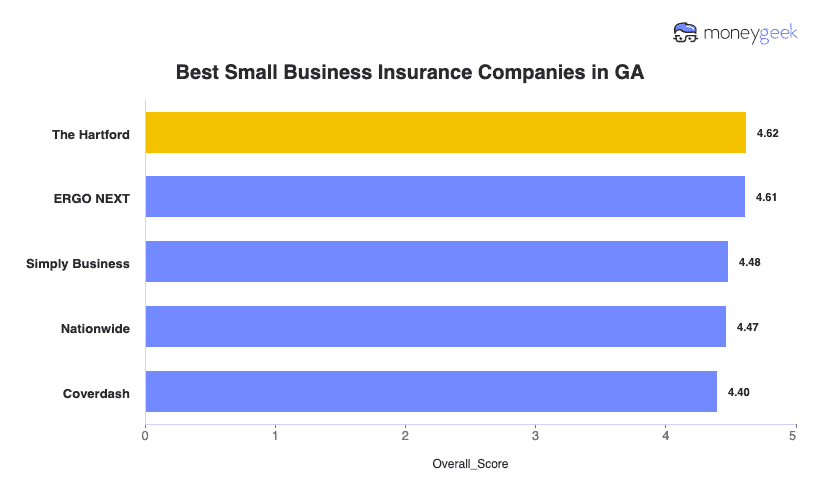
| The Hartford | 4.62 | $85 | 2 | 3 |
| ERGO NEXT | 4.61 | $102 | 1 | 2 |
| Simply Business | 4.48 | $98 | 5 | 1 |
| Nationwide | 4.47 | $103 | 2 | 4 |
| Coverdash | 4.40 | $103 | 6 | 2 |
| biBERK | 4.38 | $106 | 2 | 5 |
| Progressive Commercial | 4.32 | $101 | 7 | 5 |
| Thimble | 4.31 | $95 | 8 | 5 |
| Chubb | 4.26 | $119 | 3 | 4 |
| Hiscox | 4.26 | $109 | 4 | 6 |
Note: Your final premium depends on how an insurer views your business, so use these figures mainly to compare coverage types. The averages come from MoneyGeek's analysis of small businesses with two employees across 79 major industries. Your quote may land higher or lower once your own operations, limits and risk factors come into play.

The Hartford
Best and Cheapest Georgia Business Insurance
MoneyGeek Rating
4.6/ 5
4.6/5Affordability
4.6/5Customer Experience
4.7/5Coverage Options
Average Monthly Cost of General Liability Insurance
$83This rate is for small businesses with two employees across 79 major industries or business types and focus solely on general liability policies.Average Monthly Cost of Workers' Comp Insurance
$70This rate is for small businesses with two employees across 79 major industries or business types and focus solely on workers' comp policies.Our Survey: Claims Process
4.5/5 (1st)Our Survey: Agent Service
4.5/5 (1st)

ERGO NEXT
Best Georgia Customer Experience
MoneyGeek Rating
4.6/ 5
4.4/5Affordability
4.7/5Customer Experience
4.8/5Coverage Points
Average Monthly Cost of General Liability Insurance
$105This rate is for small businesses with two employees across 79 major industries or business types and focus solely on general liability policies.Average Monthly Cost of Workers' Comp Insurance
$70This rate is for small businesses with two employees across 79 major industries or business types and focus solely on workers' comp policies.Our Survey: Digital Experience
4.8/5 (1st)Our Survey: Likely to Be Recommended to Others
4.8/5 (1st)

Simply Business
Best Commercial Coverage Options in Georgia
MoneyGeek Rating
4.5/ 5
4.4/5Affordability
4.2/5Customer Experience
4.9/5Coverage Options
Average Monthly Cost of General Liability Insurance
$97This rate is for small businesses with two employees across 79 major industries or business types and focus solely on general liability policies.Average Monthly Cost of Workers' Comp Insurance
$72This rate is for small businesses with two employees across 79 major industries or business types and focus solely on workers' comp policies.Our Research: Digital Experience
4.5/5Our Survey: Service Quality
4.0/5
How to Get the Best Cheap Business Insurance in Georgia
The right business insurance in Georgia depends on how your business operates and what risks you need to cover. Start there, then compare insurers using the same coverage setup. That lets you see which option fits without overpaying or leaving important gaps.
- 1
Assess what coverage your Georgia business actually needs
Start with what Georgia law requires, then add coverage for the risks your business actually has. Georgia requires workers’ compensation once you regularly employ three or more people, including regular part-time workers. Certain contractor licenses also come with general liability minimums. Residential-basic contractors, for example, need at least $300,000 per occurrence, while residential-light-commercial and general contractors generally need at least $500,000.
From there, look at how you operate. A consultant may need professional liability because a client could claim their advice caused a financial loss, while a storefront business may need property coverage for its space and equipment.
Read More: How Much Business Insurance Do I Need?
- 2
Get quotes from affordable providers with strong customer ratings
When you’re comparing business insurance quotes, make sure each one uses the same coverage types, limits and deductibles. A lower premium could mean the policy gives you less financial protection or leaves you with a higher out-of-pocket cost when you file a claim. Also, check what each insurer includes automatically versus what costs extra, so you’re comparing the actual value of the coverage rather than just the monthly price.
- 3
Check insurer reliability before committing to save a few dollars
Before you buy a policy, confirm that the insurer or agency is licensed to do business in Georgia. The Office of the Commissioner of Insurance and Safety Fire has a lookup tool you can use to verify that. Next, look at what happens once you’re covered. See how the insurer handles claims and whether you can reach someone when you need help. Financial strength is worth checking separately, since it gives you a better sense of whether the company is positioned to pay claims over time. If a dispute comes up and you can’t resolve it directly with the insurer, Georgia’s Consumer Services Division accepts complaints and can review the issue.
- 4
Cut insurance costs without reducing your protection
Cutting coverage isn’t the best path to lower business insurance costs. Focus on these right levers to find better rates:
- Raise your deductible carefully. A higher deductible can lower your premium, but only if you could comfortably cover that amount after a claim.
- Ask about bundling. Combining policies with the same insurer may qualify you for a discount, depending on the carrier and coverage.
- Check for workplace-safety savings. Georgia businesses certified through the state’s Drug-Free Workplace Program receive a 7.5% workers’ comp premium reduction. You need to give your insurer the certification each year to keep the discount.
- 5
Secure coverage that meets client contract requirements
Before you buy, check if your contracts or lease have additional requirements. Landlords and licensing boards often ask for a certificate of insurance (COI) before you can start work or sign an agreement. Some contracts may also require you to name the client or property owner as an additional insured, which extends certain protections under your policy to that party. Those details can change what you need to buy, so it’s better to confirm them upfront.
Read More: Business Insurance Requirements
- 6
Change your coverage when the business changes
Don’t wait for renewal before reviewing your policy. Do that whenever the way you operate changes. Taking on larger contracts can make your current liability limits too low, while buying more expensive equipment may leave you underinsured if your property limits haven’t kept up. The earlier you catch those shifts and update the policy, the less likely you’ll have a coverage gap.
Best Business Liability Insurance in Georgia: Bottom Line
The Hartford is the best small business insurance provider in Georgia, especially if you want lower average rates without giving up access to a broad coverage lineup and human support. ERGO NEXT makes more sense if you’d rather manage your policy online and regularly need COIs, while Simply Business gives you a wider shopping path by comparing policies from multiple carriers. Your best fit comes down to the coverage your business needs and how you want to buy and manage it, so compare providers using the same limits before you decide.

LOOKING FOR THE BEST INSURANCE FOR A SPECIFIC COVERAGE TYPE?
I've put resources together so you can see which providers we recommend for different coverage types. You can use these are references as you build your insurance bundle.
Business Insurance in Georgia: FAQ
Small business owners in Georgia often have questions about selecting appropriate business insurance coverage. We've compiled answers to the most common inquiries:
In Georgia, your employee count affects the coverage you need. Workers’ compensation becomes a requirement once you've hired three employees, while business-owned vehicles makes commercial auto coverage part of your mix. General liability often enters the picture through client contracts, leases or licensing requirements, so check those obligations against how you operate.
Business insurance costs in Georgia range from $58 monthly for professional liability to $156 for commercial auto. Industry and risk factors drive these price differences. Here are average rates for the four most common business insurance types in Georgia:
- General liability: $121 per month or $1,451 per year
- Workers' comp: $99 per month per employee or $1,193 per year per employee
- Commercial auto: $156 per month per vehicle or $1,866 per year per vehicle
- Commercial property: $124 per month or $1,483 per year
- Professional liability: $58 per month or $693 per year
- Cyber insurance: $88 per month or $1,061 per year
For a small Georgia business, I’d build an insurance policy from the exposures you already have instead of buying a preset bundle. General liability covers everyday third-party risks, while a business owner’s policy makes sense if you also need property protection. Once you reach Georgia’s workers’ comp threshold, add that coverage to the package.
Put the policies side by side using the same limits, then look beyond the premium. I’d compare how each insurer handles claims tied to risks your business actually encounter, such as storm damage or power outages. Also, check whether the carrier can meet contract requirements and provide insurance documents quickly when a client asks for them.
About Connor Bolton

Connor Bolton is Senior SEO and Content Manager at MoneyGeek, where he leads the business and pet insurance editorial teams. He sets the research framework, data standards and content structure for his team. All content goes through his accuracy review before publication. Connor also writes in-depth guides and has spent more than four years covering insurance products across personal, commercial and specialty lines.
The research infrastructure Connor built covers auto, home, renters, life, health, business and pet insurance across pricing analysis, carrier research, customer experience and coverage evaluation. It includes over 6 million data points for business insurance across 408 industry areas, all 50 states and 16 vehicle types. The pet insurance side covers over 5 million profiles across 18 major providers, 100+ breeds and ages up to 20 years. Connor’s insurance research and his team's work have been cited by the U.S. Chamber of Commerce, Allstate, Liberty Mutual, CBS News, Forbes and LegalZoom.
Connor also talks with underwriters and carrier liaisons at Ethos, The Hartford, ERGO NEXT, Nationwide and State Farm, and monitors business and pet owner communities on Reddit. Those sources shape how his team evaluates carriers, structures rate analysis and writes content for real pet owners.
Questions about MoneyGeek's business or pet insurance content? Reach him at connor@moneygeek.com or on LinkedIn.
Sources
- Georgia Secretary of State. "Residential and Commercial General Contractors Frequently Asked Questions." Accessed October 6, 2026.
- Georgia State Board of Workers’ Compensation. "Drug-Free Workplace." Accessed October 6, 2026.
- Georgia State Board of Workers’ Compensation. "Workers’ Compensation Insurance FAQs." Accessed October 6, 2026.
- Office of the Commissioner of Insurance and Safety Fire. "Agent (Individual), Agency, Company Search." Accessed October 6, 2026.
- Office of the Commissioner of Insurance and Safety Fire. "File a Consumer Insurance Complaint." Accessed October 6, 2026.