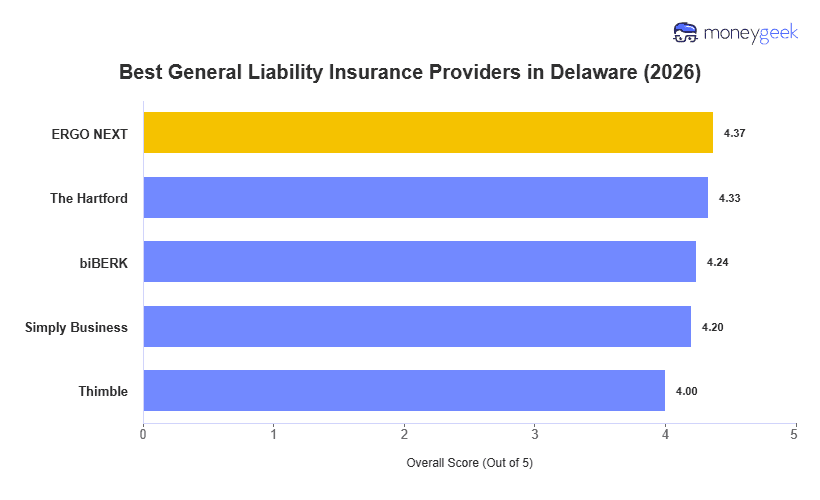

Best General Liability Insurance Companies in Delaware

I looked at 10 major insurers across 25 industries to compare average rates to determine the best general liability insurers in Delaware. I also checked whether insurers underwrite policies for common industries in the state, including professional service and real estate, and clearly explains what it doesn’t cover. I also considered how easy adding a location or getting updated proof of insurance is since these can delay work with a new client or leave a new property off the policy.

My top picks are:

For our Delaware general liability insurance ratings, we analyzed pricing, coverage options and customer experience across 408 industries within the state. Our analysis focuses on one-to-four-person businesses, which represent a large share of Delaware's small business market, while weighting results to ensure broader industry and location representation across New Castle County, Kent County, Sussex County and smaller markets throughout the state.

To do this, we evaluated over 20,000 business profiles, more than 300 customer experience data points and performed in-depth analysis of coverage contracts and endorsements to compare how insurers serve Delaware businesses consistently across different industries and regions. 

We then rated each company across categories of affordability (50%), customer experience (30%) and coverage options and terms (20%) to form an overall rating. For a detailed breakdown of the metrics, scoring methodology and pricing analysis specific to Delaware, see our full methodology.

95%

% of Small Businesses Covered

Over 20,000

Business Profiles Studied

308

Customer Experiences Analyzed

ERGO NEXT

ERGO NEXT: Best Overall, Best for Hands-On and Service Industries

On ERGO NEXT's site
COMPANY HIGHLIGHTS

In Delaware, ERGO NEXT ranks first overall, earning top marks for customer experience and competitive pricing across most industries. Users report getting bindable quotes in under 10 minutes through a fully online process, with no phone calls required. Its self-service portal makes COI generation instant, a feature contractors and vendors frequently praise. Businesses needing phone support may find response times slower, with email replies often taking 24 to 48 hours. Reddit and Trustpilot reviews cite slow communication after filing and settlements that feel lower than expected.

ERGO NEXT ranks second for affordability, with savings up to 37% for hospitality and tourism operations, 28% for repair and maintenance and 26% for manufacturing. It ranks first among GL providers for 12 Delaware industries, including solo operators and micro-businesses. Standard limits and common endorsements like additional insured and waiver of subrogation are available, though businesses needing higher limits or specialized coverage won't find as many options as larger carriers offer.

Learn More: ERGO NEXT Review

The Hartford

The Hartford: Best Cheap General Liability Insurance

On The Hartford's site
COMPANY HIGHLIGHTS

The Hartford ranks second for Delaware, leading in affordability and scoring high in coverage breadth. It offers the biggest savings in health care (31%), wholesale and distribution (28%) and education (28%). Businesses with one to 49 employees get the lowest rates, with double-digit savings across the board.

Coverage ranks second through direct limits up to $2 million per occurrence and $4 million aggregate, plus a contractor broad form endorsement that bundles blanket additional insured status, waiver of subrogation and primary and noncontributory language. Policy management tops all providers through responsive agent support and fast endorsement processing, but the buying experience ranks mid-pack, as some business types can't complete a purchase entirely online.

Learn More: The Hartford Review

biBerk

biBerk: Best for Solo Operators

COMPANY HIGHLIGHTS

Affordability and customer experience drive biBerk’s performance, placing it third overall in Delaware. As a direct arm of Berkshire Hathaway, biBerk keeps purchasing simple: users report clear underwriting questions and quick online quotes without broker involvement. Policy management and claims handling are mid-pack, with users noting slower endorsement processing and COI generation. That said, Berkshire Hathaway's financial strength provides confidence that claims will be paid.

The tradeoff extends to coverage options. Although biBerk offers standard limits and makes common endorsements like additional insured and waiver of subrogation available digitally, the $300,000 damage to rented premises sublimit is lower than some competitors. It's the most affordable option for solopreneurs, and businesses in hospitality and tourism, fitness services, cleaning and real estate see the most savings, ranging from 20% to 36%.

Learn More: biBerk Review

Simply Business

Simply Business: Best for Food and Wholesale Businesses

On Simply Business site
COMPANY HIGHLIGHTS

Ranking fourth is Simply Business, with above-average competitive customer experience rank as an insurance aggregator rather than a direct carrier. Unlike other providers in our analysis, Simply Business presents quotes from multiple carriers in one interface. Delaware business owners can compare options side-by-side, though once you purchase, policy management and claims handling shift to whichever carrier you select. That means your ongoing experience depends on that carrier's service quality.

The aggregator model brings a different kind of flexibility. It connects you with multiple carriers, so you'll likely find more limit options or endorsements than a single direct carrier provides, though you'll need to evaluate each carrier's policy terms yourself. Simply Business offers savings in certain Delaware industries: 26% for food and beverage operations and 22% for repair and maintenance businesses. Wholesale, retail and beauty services also get competitive rates.

Learn More: Simply Business Review

Thimble

Thimble: Best for Short-Term and Project-Based Coverage

COMPANY HIGHLIGHTS

Thimble is the fifth provider in our analysis of the best general liability insurance in Delaware, built around flexible, short-term policies rather than annual coverage. Unlike other carriers, Thimble offers policies by the hour, day, week or month, appealing to freelancers, event vendors and seasonal contractors who need coverage for individual projects. Delaware construction businesses see the highest savings at 20%, with manufacturing and beauty services also showing competitive rates.

The short-term model keeps buying fast and simple. Users praise quick mobile-friendly quotes and the ability to bind coverage immediately. While buying is a clear strength, policy management is mid-pack, though short-term policies usually need less ongoing attention. Claims handling also ranks lower, with user reviews citing slower communication and lower settlement satisfaction. Thimble’s streamlined approach translates to narrower limits (like its $100,000 limit for damage to rented premises), fewer endorsements and limited customization options.

Learn More: Thimble Review

What Determines the Best General Liability Insurance for Delaware Businesses

A Wilmington accounting office doesn’t interact with customers the same way a surf shop in Bethany Beach does. The best general liability insurance for your Delaware business should reflect those differences while providing reliable pricing and support when operations change.

How to Choose the Best General Liability Insurance in Delaware

You can get general liability insurance without evaluating every insurer on the market. The steps below provide a repeatable process to filter options, compare finalists and choose a provider that fits your Delaware business.

  1. 1
    Optimize your payment and coverage structure

    Start with what could lead to a claim and what your agreements require.

    Ask yourself:

    • Where could a customer get hurt or my work damage someone else’s property: at my location, on a client’s premises or both?
    • What general liability requirements appear in my contracts or lease, and which limits or endorsements must I carry?
    • Would paying annually or using monthly installments work better with my cash flow once I include any payment fees?

    Use your contracts to establish the minimum coverage you request. A common setup has a $1 million per-occurrence limit and a $2 million aggregate limit, but remember that depending on the work you do, worst-case scenario claims could require more than this. The same goes if you have commercial clients, so don’t assume those figures will satisfy every agreement. Monthly installments are usually more common, though paying annually lets you avoid fees, so your total cost goes down.

    Read More: How Much General Liability Insurance Do You Need?

  2. 2
    Choose your primary priority

    Decide which insurer weakness could cause the biggest problem for your business. Make that your priority and keep in mind when providers appear evenly matched later on.

    • Affordability may lead if your Delaware business relies on a short selling season or has little room for a renewal increase. You’ll need a premium that remains manageable after the busiest months end.
    • Put customer experience first when client work depends on getting responses quickly. A service business working under corporate deadlines won’t be able to wait several days for a routine question to reach the right person.
    • Coverage options become more important as your operations change. If you’re a tech consultant beginning to install equipment at client locations, you’ll need different coverage than if you only provide remote advice.
  3. 3
    Shortlist two to three providers

    You don’t need to examine every insurer that appears in your search. Keeping two or three realistic options gives you enough choice while leaving time to look closely at their policy terms. 

    First, remove providers that don’t insure everything you regularly do. This matters if your operations include food processing or roofing, since an insurer comfortable with office-based firms may not accept those activities. Among the providers that remain, keep the ones that appear strongest in your main priority.

  4. 4
    Double-check for dealbreakers before investing more time

    A provider may work well for one Delaware industry and still be unusable for another. Check the issues most likely to interfere with how your business operates:

    • Check whether the policy leaves out a service you regularly provide. For example, a Delaware technology consultant who also installs equipment needs coverage for the hands-on work, not only the advice it gives. If the insurer excludes installation claims, remove it from your shortlist.
    • For businesses that must provide proof of coverage before starting work, test the insurer against a deadline from one of your contracts. If it can’t issue or revise a COI in time, you could lose the job.
    • Do you regularly serve customers in Maryland or Pennsylvania? Get written confirmation that the insurer accepts those operations rather than assuming your Delaware policy follows you across state lines.
    • Bring your most demanding active contract when asking about available limits and endorsements. A provider that cannot meet those terms won’t qualify you for the work.
    • Seasonal operators should ask what the insurer reviews during a premium audit and how that review could change the final price. Vague answers make it difficult to know what the policy will actually cost.
  5. 5
    Compare your finalists using the same three lenses

    Each remaining provider should meet your basic requirements. Compare them side by side, giving the most weight to the priority you chose earlier.

    • Affordability: Review how clearly each insurer explains its fees and renewal pricing. If your revenue changes with Delaware’s coastal season, ask how those fluctuations could affect future premiums.
    • Customer experience: Base your comparison on an actual interaction. Consider whether the insurer understood your question and gave you a helpful answer within a time frame that would work for your business.
    • Coverage options: Choose one realistic change you may make next and ask how each insurer would handle it. A provider should explain whether it can update the policy and what information it would need from you.
  6. 6
    Use quotes as the final confirmation step

    Request quotes from your finalists using the same business description and matching limits. Give each insurer consistent seasonal information when it applies, then compare business insurance quotes to confirm that the prices reflect similar financial protection. If you get an unusually low quote, ask what contributed to the cost difference before it assuming it offers better value.

Best Small Business General Liability Insurance in Delaware: Bottom Line

ERGO NEXT, The Hartford and biBerk rank highest for Delaware small businesses, but the right choice depends on your setup. A Dover professional services firm, a Sussex County seasonal operation or a Newark retailer drawing tax-free shoppers from Maryland each deals with different risks.

Don’t default to the lowest quote. Compare how each provider handles pricing over time, how quickly they respond and how flexible their policies are. Choose coverage that fits your actual exposure and budget. A one-size-fits-all decision usually misses key details that matter to your business.

Best General Liability Insurance For Small Business in Delaware Chart
insurance2 icon
LOOKING FOR THE BEST INSURERS FOR OTHER COVERAGE TYPES?

You'll likely have general liability in your coverage mix, but the best small business insurance in Delaware should include other policies. I've provided resources so you can see which providers we recommend for other coverage types your might need.

About Angelique Palenzuela-Cruz


Angelique Palenzuela-Cruz, Business Insurance Writer, MoneyGeek

Angelique Palenzuela-Cruz is a Business Insurance Content Writer at MoneyGeek, where she specializes in general liability, workers’ compensation and professional liability insurance. Her work helps small business owners understand how these policies apply to coverage, including risks like customer injuries, employee injuries, professional mistakes, client contract terms and industry-specific coverage requirements.
She primarily covers service-based businesses where liability and employee coverage decisions are especially important, including cleaning, consulting, beauty and wellness, childcare, education, fitness, food service, pet care, repair and maintenance, and other professional services.
Before joining MoneyGeek, Angelique spent nearly 12 years at Guthrie-Jensen Consultants, one of Southeast Asia’s largest management training firms, where she advanced from Training Consultant to Managing Consultant. In that role, she worked with business clients to assess operational needs, develop training programs and present performance analyses to executive decision-makers. She also helped establish Gladwin Training Consultancy, where she served in learning solutions and client service roles.
Her background gives her practical context for writing about how businesses operate, manage client expectations, structure teams and make risk decisions. At MoneyGeek, she applies that experience to business insurance content, connecting coverage to actual business needs.

LinkedIn: linkedin.com/in/ma-angela-cruz

Email Contact: angelique.palenzuela@moneygeek.com