Best General Liability Insurance Companies in Wisconsin

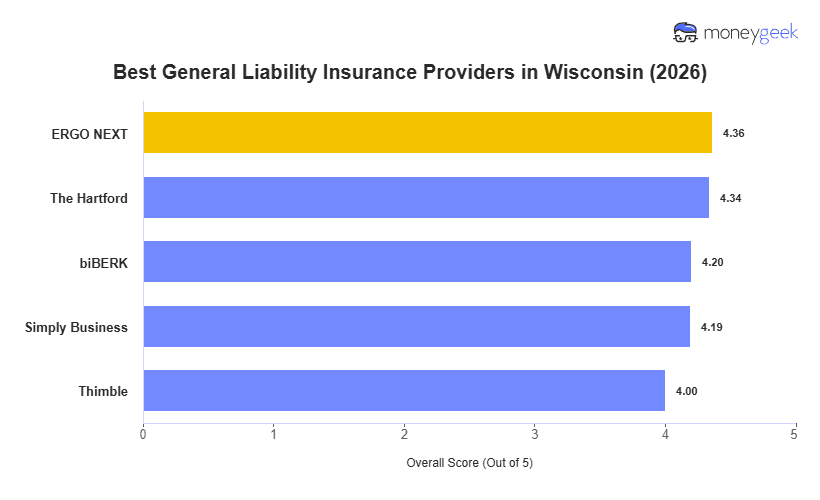
To determine the best general liability providers in Wisconsin, I reviewed quotes from 10 insurers across 25 industries and compared their average costs for a GL policy with $1 million per claim and $2 million total limits. I also researched how accessible each insurer is and whether they provide risk-management resources and if they manage claims from start to finish.

My top picks are:

  • Choose if you provide service as a tradesperson: ERGO NEXT
  • Choose if you prioritize affordability: The Hartford
  • Choose if your in consumer services: biBerk
  • Choose if you want to compare coverage options: Simply Business
  • Choose if you need seasonal or project-based coverage: Thimble

For our Wisconsin general liability insurance ratings, we analyzed pricing, coverage options and customer experience across 408 industries statewide. Our analysis focuses on 1-to-4-person businesses, which represent a large share of Wisconsin's small business market, while weighting results for broader industry and location representation across the state's commercial centers and rural service areas, including the Fox Valley, Milwaukee metro, Northwoods region and western agricultural communities. 

To do this, we evaluated over 20,000 business profiles, more than 1,700 customer experience data points and reviewed coverage contracts and endorsements to compare how insurers serve Wisconsin businesses consistently across different industries and regions. 

We then rated each company across categories of affordability (50%), customer experience (30%) and coverage options and terms (20%) to form an overall rating. For a detailed breakdown of the metrics, scoring methodology and pricing analysis specific to Wisconsin, see our full methodology.

95%

% of Small Businesses Covered

Over 20,000

Business Profiles Studied

1,748

Customer Experiences Analyzed

ERGO NEXT

ERGO NEXT: Best Overall, Best for Service and Trade Businesses

On ERGO NEXT's site
COMPANY HIGHLIGHTS

The best general liability insurance company in Wisconsin is ERGO NEXT, which leads on customer experience and affordability. Wisconsin businesses can get a certificate of insurance without an agent, with pricing that doesn't change at binding, a pattern small business owners cite on Trustpilot and Reddit. Day-to-day policy management involves generating and sending COIs instantly through the app, though claims handling is less competitive since adjuster communication is slower and escalation options are limited.

ERGO NEXT performs well on affordability, being the cheapest option for 14 out of 25 general industries in our study. Businesses in hospitality, travel and tourism, construction and repair and maintenance see the most savings, ranging between 23% and 25%. It also offers the most affordable rates on average for solo operators and businesses with up to nine employees. Policies have the standard $1 million per occurrence/$2 million aggregate limits, and add-ons like tools and equipment and cyber liability are available through the platform.

Learn More: ERGO NEXT Review

The Hartford

The Hartford: Best Cheap General Liability Insurance

On The Hartford's site
COMPANY HIGHLIGHTS

Ranking second overall in Wisconsin is The Hartford with the most affordable general liability premiums and coverage depth that most competitors don't carry. Its GL policy covers defense costs outside policy limits, so legal fees don't reduce the coverage available for settlements and rented premises sublimits reach up to $500,000. Wisconsin contractors get a broad form endorsement that auto-includes blanket additional insured status, without needing to add it separately.

Several industries see double-digit savings, with education leading at 29%, followed by health care and medical at 26% and arts, media and entertainment at 22%. The Hartford also has the lowest average rates across all business sizes, from solo operators to mid-sized companies. You need an agent to purchase a policy, and the process takes longer than fully digital options, but that support pays off after purchase. Wisconsin businesses get COIs processed within four hours for contractor and landlord requirements, and customer reviews point to consistent communication and fair outcomes on claims.

Learn More: The Hartford Review

biBerk

biBerk: Best for Consumer Service Businesses

COMPANY HIGHLIGHTS

Competitive general liability rates and a highly positive customer experience make biBerk third overall. The fully digital platform suggests coverage options based on business inputs and binds coverage in minutes, with phone support available for those who want it. Post-purchase, COI delays and slow endorsement processing appear consistently across reviews. One policyholder reported waiting several weeks for certificates before leaving the carrier. Claims handling is mid-pack with no clear strength or weakness.

biBerk is most affordable for consumer-facing and activity-based industries. These include fitness services (21% savings), cleaning services and real estate and property services (20% savings each) and recreation and sports (18% savings). Coverage follows a standard GL structure with a useful endorsement menu, including cyber liability, liquor liability and tools coverage, but sublimit details aren't publicly documented and there's no contractor-specific broad form.

Learn More: biBerk Review

Simply Business

Simply Business: Best for Comparing Coverage Options

On Simply Business site
COMPANY HIGHLIGHTS

Unlike traditional insurers, Simply Business ranks fourth overall in Wisconsin as a broker rather than a carrier. It pulls quotes from multiple insurers at once, including Liberty Mutual, Hiscox, Travelers and Markel, giving businesses broader carrier access and more coverage options at purchase. Sublimits and endorsement terms vary by the carrier matched to your business, and the platform doesn't standardize them.

Simply Business binds policies online in minutes and recommends coverage based on business inputs, without requiring an agent. After purchase, policy changes and claims go directly to the underlying carrier, and reviewers report phone wait times exceeding an hour for platform support. Simply Business isn't the most affordable option in Wisconsin, but businesses in beauty, childcare, repair and retail see modest savings. Tech and IT firms have the biggest cost advantage, saving 23%.

Learn More: Simply Business Review

Thimble

Thimble: Best for Seasonal and Project-Based Businesses

COMPANY HIGHLIGHTS

While most insurers lock you in for a year when purchasing general liability insurance, Thimble offers flexible terms, resulting in a fifth-place ranking. You can get coverage by the job, day, or month rather than annual contracts only for reasonable rates. While not the cheapest option, two industries see double-digit savings: construction businesses at 21% and manufacturers at 19%. Beyond those sectors, most Wisconsin businesses pay above or near the state average.

During the buying process, policies bind in minutes, COIs generate instantly at purchase. Post-purchase, there is no phone support, email responses take days and claims go entirely to third-party administrator Sedgwick rather than Thimble directly and reviewers report slow adjuster assignment and weak dispute resolution. Despite providing on-demand coverage, Thimble has a limited endorsement menu, though core GL limits are standard at $1 million per occurrence/$2 million aggregate.

Learn More: Thimble Review

What Determines the Best General Liability Insurance for Wisconsin Businesses

Think about when you’ll rely on the policy, not only what it costs. A contractor could mandate specific limits before a project begins, while a manufacturer is likely to need protection after a product reaches the customer. Use these realistic scenarios to find general liability insurance in Wisconsin that fits your business.

How to Choose the Best General Liability Insurance in Wisconsin

Wisconsin small businesses don't shop for general liability insurance the same way. A Minocqua fishing guide and a Madison software consultant could all be looking for coverage, but their risk profiles, contract requirements and budget constraints pull them in different directions. The steps below helps you get general liability insurance that fits your business.

  1. 1

    Optimize your payment and coverage structure

    Decide how much protection you need separately from how you want to pay for it. Your coverage should reflect your work and general liability requirements, while your billing schedule should fit your cash flow.

    Ask yourself:

    • What is the highest liability limit required by one of your contracts? Does the agreement also require an additional insured endorsement?
    • Could a product you sell or an installation you complete later cause costly damage to other equipment or property?
    • If your income changes with Wisconsin’s tourism season, can you comfortably pay the annual premium upfront, or would monthly installments be easier to manage?

    A common starting point is $1 million per occurrence and $2 million aggregate, but a contractor working inside a dairy processing facility may need higher limits to meet the client’s agreement. Monthly billing spreads out the premium but may include installment fees, while paying annually requires more cash upfront and may reduce the total cost.

  2. 2

    Choose your primary priority

    Depending on your business's current situation, your priority varies. That priority can break a tie between two providers that look equally good when you do your research.

    • Choose pricing predictability if an unexpected renewal increase would strain your budget. This may matter most if your income depends on Wisconsin’s tourism, growing or outdoor seasons.
    • Choose responsive service if you regularly need certificates or policy changes. A contractor should know that proof of coverage won’t hold up a job while the insurer processes the request.
    • Choose coverage flexibility if you normally bid for larger contracts or are planning to expand your operations. Review your general liability limits and required endorsements before choosing an insurer that can't support your next project.
  3. 3

    Shortlist two to three providers

    Any insurer that doesn’t cover your regular work or meet your contract requirements shouldn’t be on your list. From those that qualify, keep the two or three that perform best in your priority area. Having too many options can leave you sorting through minor differences without getting closer to a decision. A shorter list makes it easier to see which insurer best meets your coverage needs.

  4. 4

    Double-check for dealbreakers before investing more time

    Before you request quotes, confirm that each insurer can deliver on your non-negotiables. While these can vary between businesses, common dealbrakers include:

    • An insurer that won’t cover all the work you do. This may rule out carriers that exclude guided outdoor activities, agritourism or certain food-processing operations.
    • Available limits fall below those required by your largest client or most demanding contract.
    • It can't issue an additional insured endorsement required by a property owner or general contractor.
    • Its turnaround time for a COI is slower than your clients allow. During Wisconsin’s busy construction and event seasons, delayed proof of coverage could keep you from starting work.
  5. 5

    Compare your finalists using the same three lenses

    Your main priority can break a tie, but it shouldn’t hide a serious weakness elsewhere. Compare each finalist using the same questions:

    • Affordability: Look beyond the opening quote. Ask about recent renewal changes, premium audits and any fees that affect the full policy cost. Predictable pricing matters when much of your income arrives during Wisconsin’s tourism or growing seasons.
    • Customer experience: Find out how long certificates and policy updates usually take. You should also know who to reach out after a claim and how often that person will update you.
    • Coverage options: Confirm that each insurer offers the required limits and endorsements. When you transition into commercial work or takes on clients with stricter insurance requirements, this becomes important.
  6. 6

    Use quotes as the final confirmation step

    Compare business insurance quotes that use identical limits and endorsements. A Bayfield tourism operator will be priced differently from a Milwaukee-area staffing firm, so make sure each quote reflects your actual operations. Before choosing, check whether a lower price comes from an exclusion or missing coverage rather than a better rate.

Best Small Business General Liability Insurance in Wisconsin: Bottom Line

ERGO NEXT, The Hartford and biBerk lead the rankings for small business general liability insurance in Wisconsin, though the strongest match shifts with your line of work, operational complexity and how your business grows over time. 

The right approach weighs pricing stability, service responsiveness and coverage depth together rather than defaulting to the lowest quote. This produces a policy that holds up across the full policy lifecycle, from certificates and midterm changes to claims, not at signing.

Best General Liability Insurance For Small Business in Wisconsin Chart
insurance2 icon
LOOKING FOR THE BEST INSURERS FOR OTHER COVERAGE TYPES?

Although general liability addresses most risks, you could leave yourself with a coverage gap if you don't include other coverage types in your Wisconsin small business insurance bundle. Go through the resources I've put together so you'll see our recommended carriers for other policies.

About Angelique Palenzuela-Cruz


Angelique Palenzuela-Cruz, Business Insurance Writer, MoneyGeek

Angelique Palenzuela-Cruz is a Business Insurance Content Writer at MoneyGeek, where she specializes in general liability, workers’ compensation and professional liability insurance. Her work helps small business owners understand how these policies apply to coverage, including risks like customer injuries, employee injuries, professional mistakes, client contract terms and industry-specific coverage requirements.
She primarily covers service-based businesses where liability and employee coverage decisions are especially important, including cleaning, consulting, beauty and wellness, childcare, education, fitness, food service, pet care, repair and maintenance, and other professional services.
Before joining MoneyGeek, Angelique spent nearly 12 years at Guthrie-Jensen Consultants, one of Southeast Asia’s largest management training firms, where she advanced from Training Consultant to Managing Consultant. In that role, she worked with business clients to assess operational needs, develop training programs and present performance analyses to executive decision-makers. She also helped establish Gladwin Training Consultancy, where she served in learning solutions and client service roles.
Her background gives her practical context for writing about how businesses operate, manage client expectations, structure teams and make risk decisions. At MoneyGeek, she applies that experience to business insurance content, connecting coverage to actual business needs.

LinkedIn: linkedin.com/in/ma-angela-cruz

Email Contact: angelique.palenzuela@moneygeek.com