
Insurance Rates by Vehicle Make and Model (January 2026)


Key Takeaways
blueCheck icon

Isuzu has the cheapest car insurance among major automakers at $66 monthly for minimum coverage and $127 for full coverage.

blueCheck icon

Compact vans cost less to insure than other vehicle types, averaging $53 monthly for minimum coverage and $103 for full coverage.

blueCheck icon

The Isuzu Amigo has the lowest average costs at $50 per month for minimum coverage and $96 for full coverage.

Average Car Insurance Cost by Make and Model

Your vehicle choice affects the average cost of car insurance premiums more than you might expect. A Tesla Model Y costs $241 monthly for full coverage, 66% more than a GMC Sierra 1500 at $145 monthly. Monthly premiums range from $75 to $123 for minimum coverage and $145 to $241 for full coverage across 2025's most popular vehicles.  

Vehicle size, safety features, theft rates and repair costs create these differences. Trucks like the GMC Sierra 1500 and Chevrolet Silverado 1500 cost less to insure than crossovers, while electric luxury vehicles command the highest premiums. Here's what you'll actually pay for America's best-selling vehicles:

Data filtered by:
Full Coverage
Subaru Outback$100$1,203
Honda CR-V$104$1,249
Honda Fit$104$1,251
Honda Odyssey$104$1,252
MINI Cooper$104$1,254
Subaru Forester$105$1,261
Jeep Wrangler$106$1,267
Ford F-150$107$1,280
Ford Escape$107$1,287
Jeep Patriot$107$1,288
Toyota Tacoma$108$1,293
Dodge Grand Caravan$108$1,295
Mazda CX-5$110$1,322
VW Tiguan$110$1,323
Toyota Highlander$110$1,324
Toyota Sienna$111$1,326
Chevy Equinox$111$1,334
Toyota RAV4$111$1,334
Kia Soul$111$1,338
Chevy Silverado$112$1,340
Honda Pilot$112$1,343
Honda HR-V$113$1,354
Ford Explorer$113$1,355
Dodge Journey$113$1,358
VW Beetle$115$1,376

Rates are based on average quotes we analyzed from 79 insurers across every U.S. ZIP code. The figures above reflect insurance rates by car make and model for a clean-record adult driver.

MoneyGeek pulled auto insurance rate data from Quadrant Information Services and analyzed rates from 79 insurers across every U.S. ZIP code. Our standardized profile is an adult driver with a clean record and good credit, driving a 2012 Toyota Camry with full coverage ($100,000 per person, $300,000 per accident, $100,000 property damage; $1,000 deductible). Rates reflect what that profile pays for each vehicle make and model.

What Makes One Car More Expensive To Insure?

Insurance companies evaluate dozens of factors when setting premiums for different vehicles. Your vehicle's make, model, and body type shape your insurance rate as much as your driving record. Insurers price premiums based on four factors: repair costs and parts availability, theft rates, safety ratings, and body type, with sports cars costing significantly more than minivans. The same driver pays $212/month to insure a BMW versus $159 for a Honda.

An image showing the factors that affect the total cost of car insurance based on vehicle types and models.

Most Expensive Cars to Insure

Ultra-luxury and hypercar brands command extreme insurance costs. The Rolls-Royce Arcadia leads at $27,541 monthly for full coverage, more than most people's annual salary. Bugatti models fill the expensive tier: the La Voiture Noire costs $11,105 monthly, and the Centodieci runs $7,996. Ferrari hypercars like the F80 and LaFerrari cost $3,200 to $3,500 monthly. Six-figure repair costs, high theft risk and limited parts availability drive rates this high.

Rolls Royce Arcadia$13,879$27,541
Rolls Royce La Rose Noire$13,879$27,541
Bugatti La Voiture Noire$5,596$11,105
Bugatti Centodieci$4,029$7,996
Bugatti Divo$2,552$5,064
Bugatti Mistral$2,409$4,780
Bugatti Tourbillion$2,059$4,087
Ferrari F80$1,757$3,487
Ferrari Laferrari$1,640$3,254
Ferrari F60$1,612$3,198

The Rolls-Royce Arcadia and La Rose Noire share the same rate at $27,541 monthly for full coverage, the highest rate in our analysis, reflecting their high replacement values and how hard it is to source comparable parts after a total loss.

Cheapest Cars to Insure

The cheapest vehicles to insure cost 40% to 50% less than luxury sports cars. Isuzu models lead the affordable list: the Amigo costs $50 monthly for minimum coverage. 

The Mercedes-Benz B-Class breaks from other luxury brands at $55 monthly despite its premium badge. Mercedes sold the B-Class in the United States from 2014 to 2017 before discontinuing it. Insurers price it lower because its low sales volume (less than 3,700 units) and limited resale value give it minimal theft appeal. This shows how market value overrides brand name when setting car insurance rates.

Other discontinued models, like the Dodge Stratus and Pontiac Grand Am, cost less for the same reason. Thieves don't target them, and their replacement values stay low.

Isuzu Amigo$50$96
Dodge Stratus$52$101
Buick Encore Gx$52$101
Nissan Nv200$53$103
Isuzu Rodeo$54$103
Mercedes B-Class$55$108
Dodge Neon$55$107
Isuzu Trooper$57$109
Pontiac Grand Am$59$113
Volvo V40$59$114

Average Car Insurance Cost by Vehicle Type

Insurance costs vary by vehicle type. Minimum coverage starts around $53 monthly and reaches $204, while full coverage ranges from $103 to $401.

Advanced safety technology and lower repair costs mean lower premiums. Luxury and high-performance vehicles cost more. Compact vans offer the most affordable premiums for minimum and full coverage. Insurers associate them with low-risk, family-oriented driving and low theft rates.

Compact Vans$53$103
Wagons$82$159
Vans$85$164
Coupes$89$172
Pickup Trucks$93$180
Other$95$184
Sedans$97$188
Convertibles$98$191
Hatchbacks$104$201
SUVs$109$212
Sports Cars$204$401

Compare rates for car insurance for sedans and car insurance for minivans to find the cheapest coverage for your vehicle type.

Average Car Insurance Cost by Automaker

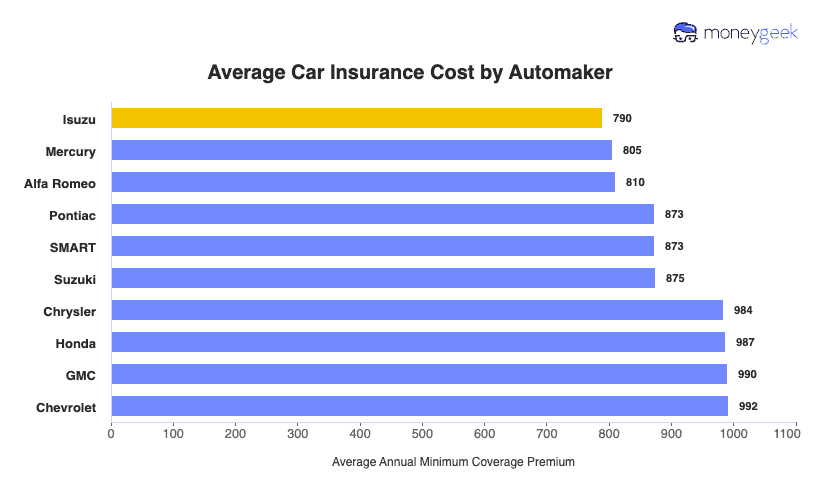
Isuzu costs the least to insure at $66 monthly for minimum coverage and $127 for full coverage, about 25% below the national average. Mercury and Alfa Romeo cost slightly more at $67 for minimum coverage, with full coverage at $129 and $132.

Pontiac, Suzuki and SMART fall in the midrange at $73 monthly for minimum coverage and $140 for full coverage. These brands cost about 13% more than the cheapest options, mainly because of older model availability and replacement parts expenses.

Chrysler and Honda sit near the national average at $82 monthly. GMC and Chevrolet cost $83 for minimum coverage and $160 for full coverage. Repair costs, parts availability and theft rates explain these differences between brands.

Isuzu$66$12725%
Mercury$67$12922%
Alfa Romeo$67$13220%
Pontiac$73$14013%
Suzuki$73$14013%
SMART$73$14013%
Chrysler$82$1590%
Honda$82$1590%
GMC$83$160-1%
Chevrolet$83$160-1%
Buick$83$160-1%
Mazda$84$162-2%
Scion$86$167-5%
Nissan$87$167-6%
Subaru$87$169-6%
Volkswagen$88$170-7%
Lincoln$88$172-8%
Jeep$89$172-8%
Ford$91$175-10%
Mitsubishi$91$175-10%
Hyundai$92$177-11%
Toyota$92$178-11%
Kia$94$182-13%
Volvo$95$184-14%
Acura$96$186-15%
VinFast$97$190-17%
Infiniti$98$190-17%
Hummer$99$192-18%
Lexus$101$197-20%
Fisker$102$200-20%
Cadillac$107$209-24%
Audi$108$212-25%
BMW$109$212-25%
Mercedes$109$213-26%
Dodge$110$213-26%
Jaguar$112$219-28%
Fiat$113$220-28%
Land Rover$119$232-32%
Ram$124$242-34%
Genesis$125$244-35%
Lotus$125$244-35%
Tesla$133$258-39%
Bentley$138$271-41%
Polestar$140$273-42%
Rivian$141$276-43%
Porsche$141$277-43%
Lucid$160$314-49%
Aston Martin$163$321-50%
Mini$166$320-51%
Lamborghini$171$339-53%
Karma$174$342-54%
Maserati$177$348-54%
Mclaren$184$364-56%
Ferrari$224$443-64%
Ineos$256$498-68%
Rolls Royce$435$863-82%
Bugatti$1,811$3,594-96%

Our rate analysis across every automaker shows that repair cost, theft exposure and fleet value affect premiums more than brand prestige. Alfa Romeo and Mercury insurance prices are the same at $67 monthly, despite one being a current Italian luxury brand and the other being discontinued. 

Tesla costs $258 monthly for full coverage, less than Porsche at $277, because Porsche's repair costs and parts run higher despite Tesla's higher sticker price on many models. Bugatti averages $3,594 monthly, more than eight times Ferrari's $443, because Bugatti's insured models include vehicles worth $10 million or more while Ferrari's fleet skews toward the $200,000 to $500,000 range.

Why Insurance Costs Differ Across Vehicle Makes and Models

Insurance companies evaluate dozens of factors when setting premiums for different vehicles. A luxury sedan can cost three times more to insure than a compact car driven by the same person.

But four factors drive most of the premium differences between vehicles.

  • Repair Costs and Parts Availability - Expensive or hard-to-find parts drive up insurance premiums. Luxury brands like BMW, Mercedes-Benz and Audi cost more to insure because replacement parts are pricier and repairs require specialized technicians. Advanced technology (adaptive cruise control, lane-keeping assist or 360-degree cameras) increases premiums because these systems cost more to repair or replace after accidents. Discontinued models from brands like Pontiac, Mercury or Saturn cost less to insure because of lower market values, though scarce parts can increase repair costs over time.

    For example, BMW costs $212 monthly for full coverage, while Honda costs $159. The $53 monthly gap is largely due to parts cost and labor rates rather than vehicle size or theft risk.

  • Theft Rates - High theft risk commands higher insurance premiums. The Honda Civic, Honda Accord and pickup trucks like the Ford F-Series and Chevrolet Silverado consistently appear on most-stolen vehicle lists. Thieves target these vehicles because their parts have strong resale value. Insurers track theft statistics by make, model and year to adjust premiums.

  • Safety Features and Crash Protection - Strong safety ratings from the National Highway Traffic Safety Administration (NHTSA) and the Insurance Institute for Highway Safety (IIHS) earn lower premiums by reducing injury claims. Modern safety features like automatic emergency braking and blind-spot monitoring lower premiums by preventing accidents. But these same features are expensive to repair or recalibrate after collisions, which offsets some savings.

    A Honda CR-V costs $104 monthly for full coverage compared to $101 for the Dodge Stratus, a gap that shows how repair costs for advanced safety systems compress the savings those systems would otherwise produce.

  • Vehicle Characteristics - Body type impacts insurance costs. Sports cars and coupes cost more to insure than sedans or minivans because of associations with riskier driving. Two-door vehicles carry higher premiums than four-door versions. Compact vans have the lowest insurance costs because of their family-oriented use. Newer vehicles cost more to insure than older models because of higher replacement values. A 2025 Honda Accord costs more to insure than a 2015 model. 

    Vehicles with powerful engines also pay higher premiums; a Toyota Camry with a V6 costs more to insure than the four-cylinder version. SUVs cost $24 more per month than sedans for full coverage, adding up to $288 per year for drivers switching between vehicle types.

Auto Insurance by Vehicle: Bottom Line

Your car's brand, body type and model all affect insurance premiums. Costs vary across automakers, vehicle types and specific models.

Shopping for a new car or comparing insurance quotes? Your vehicle choice affects long-term insurance costs. Choosing a sedan over an SUV saves $288 per year on average for full coverage, a gap worth factoring in before you finalize which vehicle to buy.

Auto Insurance Make and Model: FAQ

How do I use insurance costs to compare vehicles before I buy?

Which car model has the cheapest insurance?

Does car insurance follow the vehicle or the driver?

Why does the same brand cost differently across models?

Does the model year affect my insurance rate?

Does car color affect insurance rates?

Can I transfer my car insurance to another vehicle?

How many years old must a vehicle be to qualify for classic car insurance?

Vehicle Insurance Cost: Related Articles

About Mark Fitzpatrick


Mark Fitzpatrick headshot

Mark Fitzpatrick, a Licensed Property and Casualty (P&C) Insurance Producer in Connecticut, is MoneyGeek's resident insurance expert. He has analyzed the insurance market for almost a decade, first with LendingTree and now with MoneyGeek, conducting original research on hundreds of insurance companies and millions of insurance rates for insurance shoppers. 

He writes about economics and insurance on MoneyGeek, breaking down complex topics so people can have confidence in their purchase. Like all MoneyGeek analysts, Mark collects and analyzes independent cost and consumer experience data on insurance companies to provide objective recommendations in our content that are independent of any of MoneyGeek's insurance company partnerships. 

His insights on products ranging from car, home and renters insurance to health and life insurance have been featured in The Washington Post, The New York Times and NPR, among others. 

Mark holds a master’s degree in economics and international relations from Johns Hopkins University and a bachelor’s degree from Boston College. He started his career working in financial risk management at State Street before transitioning to the analysis of the personal insurance market. He's also a five-time Jeopardy champion!