
Car Insurance for SUVs: How Much Does It Cost? (2026)


Updated: February 11, 2026

Advertising & Editorial Disclosure

Key Takeaways
blueCheck icon

State Farm offers the best affordable car insurance for SUVs, with rates starting at $35 monthly.

blueCheck icon

SUV insurance costs range from $426 to $6,510 annually for most drivers, depending on age, SUV type and coverage level.

blueCheck icon

SUVs are often cheaper to insure than sedans, especially compact or non-luxury models with strong safety ratings.

How Much Does SUV Car Insurance Cost?

SUV car insurance costs an average of $2,175 per year for full coverage and $974 per year for minimum coverage.

Your rate depends on more than just the vehicle type. Insurers look at the SUV’s value, repair costs and safety features, along with your age, driving record and location. A luxury SUV will cost more to insure than a compact crossover, while strong crash-test ratings and advanced safety systems can help lower premiums.

Full coverage includes liability, comprehensive and collision coverage. Minimum coverage meets your state’s legal requirements but won’t pay to repair your SUV after most accidents you cause.

SUV Insurance Costs by Make and Model

SUV insurance costs range from $73 to $90 per month for minimum coverage and from $154 to $296 per month for full coverage, depending on the make and model.

The Subaru Forester has the lowest minimum coverage rate at $73 per month. The BMW X7 is the most expensive to insure for full coverage at $296 per month. Luxury and larger SUVs tend to cost more because they have higher replacement values and repair costs. Compact crossovers with strong safety ratings usually cost less.

Subaru Forester$73$156
Volvo XC40$77$199
Mazda CX-5$77$163
Audi Q5$78$194
Honda Pilot$78$165
VW ID.4$78$204
Honda Passport$78$178
Hyundai Kona$78$182
Honda CR-V$78$154
Kia Niro$78$187
VW Tiguan$79$163
Ford Escape$80$159
Chevy Equinox$80$164
Mercedes GLA 250$80$196
Honda HR-V$80$166
Kia Soul$80$165
BMW X3$80$190
Acura MDX$81$174
Audi Q7$81$209
Toyota Highlander$81$163
Kia Soul EV$81$182
Toyota RAV4$81$164
Ford Expedition$81$180
Audi E Tron$81$243
Ford Explorer$82$168
BMW X5$82$227
Nissan Rogue$83$169
Jeep Wrangler$83$158
Chevy Tahoe$83$174
Dodge Journey$84$167
Nissan Pathfinder$85$176
Nissan Juke$87$174
Jeep Cherokee$87$177
Jeep Grand Cherokee$88$176
Jeep Patriot$88$159
BMW X7$90$296

SUV Insurance Costs by Category

Compact SUVs are the cheapest SUV type to insure, with full coverage averaging $170 per month. Luxury SUVs are the most expensive at $220 per month for full coverage.

Minimum coverage rates are more consistent across categories, ranging from $80 to $83 per month. The biggest price differences appear with full coverage because higher-end SUVs cost more to repair or replace.

Luxury models have higher replacement values and specialized parts, which increases comprehensive and collision costs. Compact SUVs tend to cost less because they’re smaller, less expensive and often have strong safety ratings.

Compact SUV$80$961$170$2,034
Luxury Compact SUV$80$963$193$2,316
Luxury SUV$81$975$220$2,645
SUV$83$994$171$2,053

Cheapest SUV Car Insurance Companies

State Farm and GEICO offer the cheapest car insurance for SUV drivers overall. Drivers between the ages of 35 and 45 typically see the lowest rates. Among SUV models, the Subaru Forester is the most affordable to insure.

State Farm and GEICO’s competitive pricing and wide availability help keep premiums low for many SUV owners. Drivers in their late 30s and early 40s often pay less because they’re seen as lower risk by insurers. The Subaru Forester stands out for its strong safety ratings and reasonable repair costs, both of which contribute to lower insurance rates.

State Farm$35$94
GEICO$39$99
Travelers$44$112
Nationwide$48$114
Progressive$51$127
Allstate$53$130
Farmers$55$138

Cheapest SUVs to Insure by Make and Model

The Subaru Forester is the cheapest SUV to insure, with rates ranging from $44 to $94 per month (or $525 to $1,129 annually) for minimum or full coverage. On the other end, the Volvo XC40 is the most expensive among the cheapest available rates, costing between $46 and $119 per month (or $548 to $1,423 annually) for the same coverage levels.

Subaru Forester$44$94
Volvo XC40$46$119
Mazda CX-5$46$98
Audi Q5$46$115
Honda Pilot$47$100

How to Get Cheap Insurance for an SUV

Drivers can lower their SUV insurance costs by making smart coverage choices and taking advantage of discounts. These steps can help you get a better rate without losing the protection you need.

  1. 1
    Compare quotes from multiple companies

    Insurance rates can vary by hundreds of dollars between providers. Use online tools or independent agents to compare at least three quotes before buying a policy.

  2. 2
    Raise your deductible

    Choosing a higher deductible, like $1,000 instead of $500, can reduce your monthly cost. Just make sure you can afford to pay that amount if you have an accident.

  3. 3
    Bundle your policies

    Many insurers offer discounts if you bundle auto and home or renters insurance. This can save you up to 25% on your SUV policy.

  4. 4
    Drive safely and avoid claims

    A clean driving record with no accidents or tickets over the last few years helps lower your premium. Some insurers also give discounts after just one claim-free year.

  5. 5
    Look for discounts based on your SUV’s features

    SUVs with anti-lock brakes, airbags and anti-theft devices can qualify for safety or anti-theft discounts.

  6. 6
    Ask about usage-based or low-mileage programs

    If you don’t drive often, some insurers offer savings for putting fewer miles on your SUV. Others offer telematics programs that reward safe habits like smooth braking and slow acceleration.

  7. 7
    Take a defensive driving course

    Some companies offer small discounts if you complete an approved course, which is especially helpful for teen or senior drivers.

Additional SUV Car Insurance Coverage

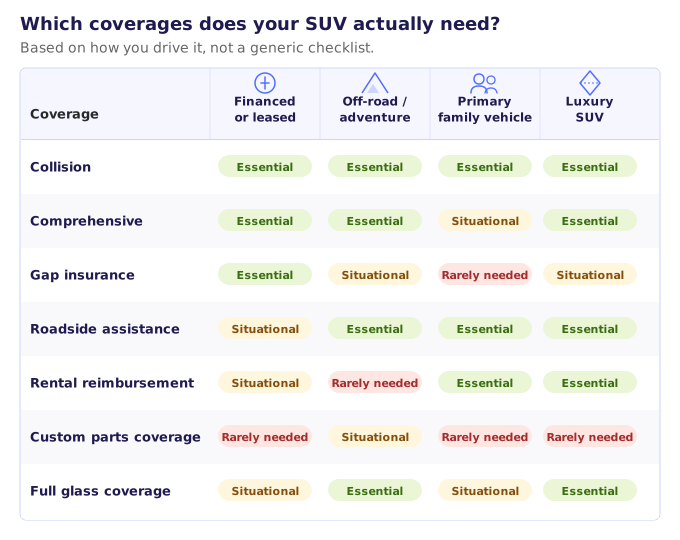
State minimum coverage only pays for damage to other people and their property. It doesn’t protect your SUV. If you want more protection (especially for a higher-value or newer SUV) consider adding these coverages.

Coverage
Description

Collision coverage

Pays for damage to your SUV if you hit another car or object. This is helpful for larger SUVs that may cost more to repair after an accident.

Comprehensive coverage

Covers non-crash events like theft, fire, flooding, falling trees or animal damage — all common risks for SUVs parked outdoors or used in rural areas.

Gap insurance

If your SUV is leased or financed, gap coverage helps pay the difference between what you owe and what the SUV is worth if it gets totaled. This is especially useful for newer or luxury SUV models that depreciate quickly.

Roadside assistance

Larger SUVs can be harder and more expensive to tow. Roadside coverage gives you access to towing, flat tire help and battery jump-starts if your vehicle breaks down.

Rental reimbursement

SUVs are often the primary family or utility vehicle. If yours is in the shop after a covered event, this coverage pays for a rental car, so you’re not left without transportation.

Adding these options can raise your premium, but they offer more protection for your SUV — especially if it’s new, customized or used for more than just daily commuting.

Auto Insurance for SUVs: Bottom Line

SUV insurance costs vary based on age, model and coverage. Compact SUVs and non-luxury models usually offer the best value. In this article, we discussed the best rates, coverages and policies so you can find the right policy that fits your budget and lifestyle.

SUV Insurance: FAQ

Below are our expert answers to common questions about SUV car insurance.

Is car insurance for an SUV more expensive than a Sedan?

Which SUV is the cheapest to insure?

What affects the cost of SUV insurance?

Best Car Insurance for SUVs: Our Rating Methodology

To find the best car insurance for SUVs, we built a weighted scoring system that balances price with service quality and financial strength. Insurance isn’t just about the lowest premium. It’s about how well a company handles claims, how stable it is and what coverage options it offers.

We reviewed 80,676 quotes from seven companies using a standard driver profile (male, 40 years old, single, clean record) while adjusting for age, location and driving history.

Car Insurance for SUVs: Related Articles

About Mark Fitzpatrick


Mark Fitzpatrick headshot

Mark Fitzpatrick, a Licensed Property and Casualty (P&C) Insurance Producer in Connecticut, is MoneyGeek's resident insurance expert. He has analyzed the insurance market for almost a decade, first with LendingTree and now with MoneyGeek, conducting original research on hundreds of insurance companies and millions of insurance rates for insurance shoppers. 

He writes about economics and insurance on MoneyGeek, breaking down complex topics so people can have confidence in their purchase. Like all MoneyGeek analysts, Mark collects and analyzes independent cost and consumer experience data on insurance companies to provide objective recommendations in our content that are independent of any of MoneyGeek's insurance company partnerships. 

His insights on products ranging from car, home and renters insurance to health and life insurance have been featured in The Washington Post, The New York Times and NPR, among others. 

Mark holds a master’s degree in economics and international relations from Johns Hopkins University and a bachelor’s degree from Boston College. He started his career working in financial risk management at State Street before transitioning to the analysis of the personal insurance market. He's also a five-time Jeopardy champion!