
Cheapest Car Insurance for 17-Year-Olds


What Is the Cheapest Car Insurance for 17-Year-Olds?

The cheapest car insurance for 17-year-olds is $201 a month with GEICO for minimum coverage, or $224 a month with Nationwide for full coverage, both on a family policy. Every other carrier in the table costs more at both coverage levels. Start quotes with GEICO and Nationwide regardless of which coverage level you choose.

Before defaulting to minimum coverage, consider that teen drivers file claims at a much higher rate than adult drivers. Minimum coverage meets your state's legal requirements, but it leaves your family paying out of pocket for damage to your teen's vehicle and any costs that exceed your liability limits. Those gaps are more likely to come up at 17 than at other ages. Full coverage adds comprehensive and collision protection, the part that actually pays for damage to your teen's own car regardless of fault, so it's worth a serious look before deciding.

$201
$239
$214
$224
$222
$253
$239
$276
$246
$276
$248
$268
$270
$298

WHY TRUST MONEYGEEK RATE DATA

Cheapest Car Insurance for 17-Year-Olds by State

Hawaii has the cheapest minimum coverage for a 17-year-old in our analysis, at $57 a month. Louisiana is the most expensive, at $324. That's more than five times as much for the exact same teen driver, and state is the single biggest reason why.

That gap isn't about which state requires more insurance by law. Louisiana actually requires less coverage. Its minimum is $15,000 per person in injury coverage, while Hawaii's is $40,000 as of January 2026. Louisiana still costs far more. The real reasons are more drivers filing lawsuits after car accidents instead of settling directly with insurers, hurricanes and severe weather that damage cars, and heavy city traffic. Those same reasons make Louisiana expensive for drivers of every age, not just teens. For a 17-year-old, that state cost gets added on top of the extra amount insurers already charge for being a new driver. A teen in Louisiana pays both costs at once. That's why the gap between $57 and $324 is so wide.

The cheapest company changes by state too. Travelers has the lowest rate in Arizona, at $156 a month. GEICO has the lowest rate in both Alabama, at $138, and Alaska, at $174. No company is cheapest everywhere. Get quotes in your own state instead of assuming the national leader will be your cheapest option.

AlabamaGEICO$138
AlaskaGEICO$174
ArizonaTravelers$156
ArkansasAllstate$155
CaliforniaState Farm$215
ColoradoAllstate$172
ConnecticutGEICO$88
DelawareGEICO$188
District of ColumbiaGEICO$144
FloridaGEICO$220
GeorgiaAllstate$137
HawaiiGEICO$57
IdahoState Farm$98
IllinoisTravelers$165
IndianaGEICO$119
IowaAllstate$128
KansasNationwide$118
KentuckyAllstate$158
LouisianaState Farm$324
MaineAllstate$118
MarylandProgressive$159
MassachusettsState Farm$94
MichiganGEICO$216
MinnesotaNationwide$185
MississippiProgressive$64
MissouriGEICO$114
MontanaProgressive$121
NebraskaAllstate$159
NevadaNationwide$191
New HampshireAllstate$136
New JerseyGEICO$161
New MexicoNationwide$152
New YorkProgressive$190
North CarolinaState Farm$94
North DakotaAllstate$123
OhioNationwide$109
OklahomaAllstate$148
OregonNationwide$132
PennsylvaniaTravelers$124
Rhode IslandState Farm$169
South CarolinaState Farm$228
South DakotaAllstate$99
TennesseeNationwide$133
TexasState Farm$171
UtahNationwide$145
VermontState Farm$114
VirginiaNationwide$126
WashingtonAllstate$169
West VirginiaNationwide$141
WisconsinNationwide$117
WyomingAllstate$153

Every state requires a parent or guardian to co-sign a minor's auto policy, since minors generally can't sign a binding contract on their own. The one real exception is an emancipated minor, who can buy a policy independently with proof like a court order.

Rates above reflect minimum coverage family policies. This dataset covers national carriers only. Regional insurers may offer lower rates in some states.

Cheapest Car Insurance for 17-Year-Olds With Driving Violations

State Farm is the cheapest carrier for a 17-year-old with a violation on their record. It leads on at-fault accidents, DUIs, speeding and texting violations, at both coverage levels. A violation hits harder at 17 than most parents expect, since rates are already high before anything goes on the record.

GEICO and Nationwide are the exception on not-at-fault accidents. GEICO charges $211 a month for minimum coverage after a not-at-fault accident, only $10 more than its $201 clean-record rate. Nationwide charges $224 a month for full coverage after the same type of accident, the same as its clean-record rate. Neither carrier penalizes a driver for an accident that wasn't their fault. That's very different from how every carrier treats an at-fault crash.

The DUI figure is worth a closer look. At $296 a month for minimum coverage, State Farm's DUI rate runs 47% above its clean-record rate of $201. Its full coverage DUI rate reaches $334 a month, 40% above its clean full coverage rate of $239. The gap between carriers widens after serious violations. Comparison shopping becomes more important once a mark appears on your teen's record, not less.

At-fault accident ($1,000-$1,999 property damage)
State Farm
$260
State Farm
$296
DUI (BAC ≥ .08)
State Farm
$296
State Farm
$334
Not-at-fault accident ($1,000-$1,999 property damage)
GEICO
$211
Nationwide
$224
Speeding 11-15 MPH over limit
State Farm
$240
State Farm
$274
Texting while driving
State Farm
$244
State Farm
$278

Best Cheap Car Insurance Companies for 17-Year-Olds

Two carriers stand out in our research for 17-year-old drivers, and price is only part of why. GEICO is cheapest for minimum coverage and Nationwide is cheapest for full coverage, but we also weighed claims handling and service quality, since a 17-year-old is more likely to actually file a claim than an adult driver. Both are the right starting point for comparing quotes to get the best rate.

GEICO

GEICO: 4.7/5 MoneyGeek Score

COMPANY HIGHLIGHTS

GEICO has the lowest minimum coverage rate for 17-year-olds in our analysis, at $201 a month. It also carries an A++ AM Best rating, the highest score for financial strength an insurer can get. That means GEICO has the money on hand to pay claims in full, even a large one after a serious accident. Families won't run into issues getting claims paid when it counts. GEICO's online quote system shows your exact first payment upfront, and it offers flexible installment structures, useful for a first-time teen policy where the total cost often comes as a shock.

GEICO also has discounts built specifically for a driver this age. A full-time student with at least a B average can get up to 15% off with the good student discount, available until age 23. A driver's education course can lower the rate further, though GEICO doesn't publish the exact amount. Families can also get loyalty reward earned after about five years accident-free. A first-year 17-year-old driver won't qualify yet. A paid version may be available as an add-on depending on the state.

Nationwide

Nationwide: 4.5/5 MoneyGeek Score

COMPANY HIGHLIGHTS

Nationwide's claims handling scores above average on J.D. Power. Teen drivers file claims more often than adult drivers, and that combination is exactly why claims handling carries more weight at 17 than at most ages. Nationwide also prices full coverage lowest among the carriers in our analysis, at $224 a month, and wins minimum coverage outright in several states. For a 17-year-old's policy, where service quality matters as much as price, Nationwide is the strongest starting point.

Nationwide also has discounts available for 17-year-old drivers. A full-time high school or college student with at least a B average can qualify for the good student discount, available from ages 16 to 24 with proof like a transcript or report card. A defensive driving course can lower the rate too. Accident forgiveness is available as an add-on, and it can be purchased after just six months of coverage.

How Much Is Car Insurance for a 17-Year-Old?

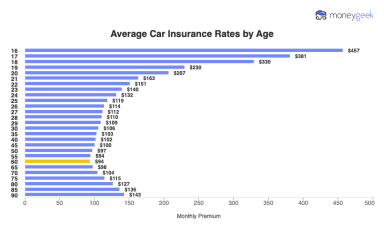
The average cost of car insurance for a 17-year-old is $234 a month for minimum coverage and $262 a month for full coverage on a family policy. Those averages shift by gender. Male 17-year-olds average $245 a month for minimum coverage and $273 for full coverage. Female 17-year-olds average $224 for minimum coverage and $250 for full coverage, about 9% less across both coverage levels. Insurers assign female teen drivers a lower statistical accident risk, which is why the averages split this way.

Families most often get surprised when they assume their quote will land near the national average without accounting for their own state or their teen's gender. Use

How to Get Cheap Car Insurance for 17-Year-Olds

Car insurance for 17-year-olds is expensive, but rates start coming down from their 16-year-old peak. The steps below are the ones that actually lower the cost for this specific age group, based on our research.

  1. 1
    Add your teen to your family policy

    Every state requires a parent or guardian to co-sign for a 17-year-old's car insurance, since minors generally can't sign a binding contract on their own. That makes the family policy the default starting point. It's also the cheaper path in nearly every case we found. Every rate in the tables above already reflects a family policy with the teen added. If you don't have an existing policy yet, starting one still gets you the same numbers shown here. See our full guide to adding a teen driver to your policy.

  2. 2
    Compare quotes from multiple insurers

    Shopping around saves up to 30%. The gap between the cheapest and most expensive national carrier for a 17-year-old exceeds $888 a year for full coverage in our data. Get quotes from at least three carriers, including regional options in your state, before deciding.

  3. 3
    Stack teen discounts

    Good student discounts save 10% to 25% for teens maintaining a 3.0 GPA or higher, since insurers treat grades as a proxy for driving discipline. Defensive driving courses earn 5% to 15% at most major carriers. Usage-based programs that track driving through a smartphone app or plug-in device reward safe driving with discounts of 10% to 30%, and they're worth it specifically at 17 because a new driver has the most room to prove a clean record fast.

  4. 4
    Choose the right vehicle

    The car your teen drives directly affects what you pay. For an older, lower-value car, use the ten-year rule from the coverage section above to check whether minimum coverage actually makes sense for that specific vehicle. For a newer car, full coverage is usually required by your lender anyway, and models with strong safety ratings cost less to insure than sports cars or luxury vehicles. See our guide to the cheapest cars to insure for a teenager for specific model recommendations.

  5. 5
    Adjust coverage based on your situation

    Before dropping to minimum coverage or raising your deductible to save money, keep your liability limits high. That's the part of the policy that protects your family's other assets, your house and savings, if your teen causes a serious accident. It's the one place cutting corners actually costs you if something goes wrong. With that protected, apply the ten-year rule from the coverage section above to decide between minimum and full coverage for your teen's specific car. On a newer car, raising your deductible from $500 to $1,000 cuts premiums by 15% to 20%.

Best Affordable Car Insurance for 17-Year-Olds: Bottom Line

GEICO has the lowest rate for minimum coverage, at $201 a month. Nationwide has the lowest for full coverage, at $224, both on a family policy. Which one applies to you depends on your teen's car, covered in the ten-year rule above. The carrier gap at 17 is wide too. The difference between the cheapest and most expensive national carrier exceeds $888 a year for full coverage in our data, and that gap is why comparison shopping pays off more at this age than it does once your teen gets older and rates settle down.

Start with GEICO and Nationwide, then get quotes from both to confirm the numbers hold for your ZIP code and driving history.

Compare Auto Insurance Rates

Ensure you are getting the best rate for your insurance. Compare quotes from the top insurance companies.

Car Insurance for 17-Year-Olds: FAQ

We've answered frequently asked questions about finding the most affordable car insurance for 17-year-olds to assist you:

Methodology

MoneyGeek analyzed 54,284 quotes from 70 major insurance companies across 1,238 ZIP codes nationwide to determine the most affordable and highest quality car insurance options for 17-year-old drivers.

Our Baseline Profile

Our baseline driver represents a typical 17-year-old with one year of driving experience: a 17-year-old operating a 2012 Toyota Camry LE with a clean record, 12,000 miles driven annually and no established credit score. We chose no credit score because most 17-year-olds have not yet built one, making it the most realistic profile for this audience.

From that baseline we adjusted across six variables including speeding tickets, at-fault accidents and DUIs to show parents what premiums look like both now and if their teen makes a mistake behind the wheel.

Coverage Levels

We analyzed two coverage levels to reflect the different decisions families face.

Minimum coverage uses state required liability limits only. It is the cheapest legal option but leaves families paying out of pocket for damage to their teen's own vehicle.

Full coverage includes comprehensive and collision protection with a $1,000 deductible and 100/300/100 liability limits, meaning $100,000 per person, $300,000 per accident and $100,000 property damage. These limits provide meaningful protection if your teen causes a serious accident.

Quality Scoring

Price is only part of the picture for teen drivers. We scored each insurer on customer satisfaction, claims handling, financial strength and digital experience to produce a MoneyGeek Score out of 100. At 17 the likelihood of filing a claim remains significantly higher than for adult drivers, making service quality an important factor alongside rate.

Data Sources

Rate data comes from Quadrant Information Services and state insurance departments, refreshed monthly. Statistical claims throughout this page draw from the CDC for teen fatality data, IIHS for crash rates and vehicle safety ratings and NHTSA for accident causes and prevention research.

Learn more about MoneyGeek's full methodology.

Cheap Auto Insurance for 17-Year-Olds: Related Articles

About Mark Fitzpatrick


Mark Fitzpatrick, Licensed P&C Insurance Expert, MoneyGeek

Mark Fitzpatrick, a licensed Property and Casualty (P&C) Insurance Producer in Connecticut, is MoneyGeek's resident expert in insurance and economics. He has spent nearly a decade covering the insurance market at LendingTree and MoneyGeek, analyzing hundreds of carriers and millions of rates across auto, home, renters, health and life insurance.

His work has appeared in The Washington Post, The New York Times and NPR. He draws on independent cost and consumer experience data, and no insurance company partnerships affect his recommendations.

Mark studied at Boston College and later earned a master's in economics and international relations from Johns Hopkins University. He worked in financial risk management at State Street before joining MoneyGeek. He's also a five-time “Jeopardy!” champion.


Sources