
Does Car Insurance Go Down at 25?


Key Takeaways
blueCheck icon

Car insurance drops to $148 per month for women and $146 for men at 25, but the largest reductions in the rates by age curve happen at 18 and 21.

blueCheck icon

National General offers the cheapest insurance for 25-year-olds at $149 per month on an individual policy and $152 per month as a family add-on, making it the most affordable option in both categories.

blueCheck icon

Your driving record matters as much as your age at 25. A DUI adds 93% to your premium and stays on your record for five to seven years, which means violations can erase the age-based discount entirely.

How Much Does Car Insurance Cost at 25?

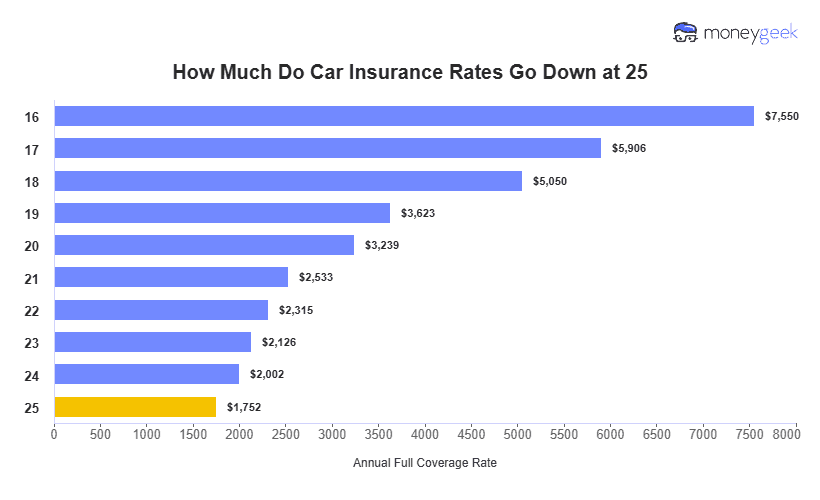
The average car insurance at age 25 costs $146 per month, or $1,752 per year, for full coverage with 100/300/100 liability limits. That rate is $21 per month lower than at age 24. Insurers price 25-year-olds as lower risk than teens and early-20s drivers, but your final premium still depends on your driving record, credit history and coverage level.

Rates drop sharply between ages 16 and 21, then level off by 25. At 16, full coverage averages $7,550 per year. By 21, the average falls to $2,533 per year. At 25, the average is $1,752, which is about 77% lower than at 16. Most age-based savings happen before 25, with smaller reductions each year after that.

Rates are national averages for full coverage with 100/300/100 liability limits and a $1,000 deductible, insuring a 2012 Toyota Camry.

Is 25 Really the Biggest Drop in Car Insurance?

No, the largest age-based reductions happen at 18 and 21, not 25. At 18, rates for women drop $72 per month and rates for men drop $71. The drop from 24 to 25 is $21 per month for men and women, a real reduction but not the largest in the age curve.

What changes at 25 is that insurers reclassify drivers as statistically mature, removing the last surcharge tied purely to youth.

18
-$72
-$71
Exit highest-risk teen bracket
21
-$60
-$59
Leave under-21 surcharge category
25
-$21
-$21
Reach statistical driving maturity
25–30
-$2 to -$3/yr
-$2 to -$3/yr
Continued experience accumulation

Rates come from Quadrant Information Services and state insurance departments. They reflect a 2012 Toyota Camry with full coverage, 100/300/100 liability limits and a $1,000 deductible.

mglogo icon
MONEYGEEK EXPERT TIP

Drivers with an active violation at 25 may not see any rate drop. A speeding ticket raises premiums by 22% and stays on record for three to five years. A DUI raises them by 93% and takes five to seven years to clear. The age-based discount at 25 won't offset either surcharge.

Does Car Insurance Go Down at 25 for Men and Women?

Car insurance rates drop at 25 for men and women, and the gender gap nearly disappears. At 16, girls pay $13 more per month than boys. By 25, that gap shrinks to $2 per month, a $24 annual difference. Car insurance for women costs within $2 of men's rates at this age in most states.

16$642$629$13
17$501$492$9
18$429$421$8
19$306$302$4
20$274$270$4
21$214$211$3
22$195$193$2
23$179$177$2
24$169$167$2
25$148$146$2

Rates shown apply in states that permit gender-based pricing. Seven states prohibit insurers from using gender as a rating factor.

California, Hawaii, Massachusetts, Michigan, Montana, North Carolina and Pennsylvania prohibit gender-based pricing entirely. In those states, insurance for women and men is priced on driving record, credit score and location at every age.

Cheapest Car Insurance for 25-Year-Olds

National General is the cheapest option for 25-year-olds in both policy types. On an individual policy, National General costs $149 per month, $5 less than GEICO at $154. On a family add-on, National General is also the lowest at $152 per month, with Travelers second at $162. The gap between the cheapest and most expensive insurer in our data exceeds $200 per month for identical coverage.

National General$1,819$1,785
Geico$1,973$1,847
Travelers$1,947$2,122
State Farm$2,033$2,367
Amica$2,138$2,467
Kemper$2,130$2,502
Progressive$2,410$2,565
AAA$3,014$2,611
UAIC$3,218$2,883
Nationwide$2,982$2,972
Farmers$3,587$3,269
Chubb$3,011$4,092
Allstate$5,695$5,340
AIG$3,895$5,527

National General costs $149 per month, but the most expensive insurer in this data charges over $400 for the same coverage. Pulling quotes from at least three carriers at renewal is the highest-return action a 25-year-old can take.

mglogo icon
MONEYGEEK TIP

Rates in the cheapest car insurance for young adults category shift by age, so what's cheapest at 22 may not be cheapest at 25. If you're still on a family policy, check whether an individual National General policy now costs less.

Discounts Available for 25-Year-Old Drivers

25-year-olds qualify for more discounts than any younger age group because they can finally meet the clean record thresholds most insurers require. Combine two or three of these discounts to cut your premium by 30% to 50% annually.

Good driver
10%–25%
Most major insurers
Telematics (safe driving program)
10%–30%
GEICO DriveEasy, State Farm Drive Safe & Save
Good student
Up to 25%
State Farm, GEICO, Allstate
Multi-car
Up to 25%
Most major insurers
Bundle (auto + homeowners/renters)
5%–15%
Most major insurers
Defensive driving course
5%–15%
Most major insurers
Low mileage (under 7,500 miles/yr)
5%–10%
Progressive, Nationwide, Allstate
Marriage
15% avg
Most major insurers

How to Lower Your Car Insurance Rate at 25

The most effective strategies at 25 shift away from waiting for age milestones and toward record management and discount stacking.

  1. 1
    Compare quotes at every renewal

    A 25-year-old can pay more than $200/month more for identical coverage depending on the insurer. Shopping at renewal, not just at first purchase, is the fastest way to cut costs.

  2. 2
    Stack available discounts

    Good driver discounts kick in after three to five years without violations. Telematics programs like GEICO DriveEasy and State Farm Drive Safe & Save cut premiums 10% to 30% for safe driving. Completing a defensive driving course adds 5% to 15% in most states, and bundling auto with renters insurance saves another 5% to 25%.

  3. 3
    Raise your deductible

    Going from a $500 to a $1,000 deductible drops your premium 15% to 20%. This makes the most sense if you have three to six months of expenses saved and drive a vehicle worth under $15,000.

  4. 4
    Update your marital status

    If your status changed since your last renewal, update it with your insurer now. The 15% average reduction takes effect at the next billing cycle.

What Affects Your Rate More Than Age at 25?

Once you hit 25, age stops moving the needle much. Your driving record, credit score and marital status carry far more weight from that point on.

    car2 icon
    Driving Record

    One at-fault accident raises your average premium by 53%, and the surcharge stays in place for three to five years. A DUI at 23 still costs you 93% more at 25. The birthday alone won't fix that.

    goodCredit icon
    Credit Score

    In most states, drivers with excellent credit (750 and above) pay 20% to 30% less than drivers with poor credit (below 600). California, Hawaii, Massachusetts and Michigan prohibit insurers from using credit scores in pricing.

    coupleS icon
    Marital Status

    Getting married cuts rates by 15% on average, saving roughly $194 per year. Insurance for married couples costs less because married drivers file fewer claims. Combining policies adds multi-car discounts of up to 25%, plus 5% to 15% more when bundling with homeowners or renters coverage.

    seatbelt icon
    Driving Experience

    Two 25-year-olds with different experience levels pay different rates. Insurers weigh actual years behind the wheel, not just age, which is why new driver insurance cost at 25 is higher than the averages shown here.

Do 25-Year-Old Drivers Pay Less: Bottom Line

Car insurance does go down at 25, with women and men saving $21 per month versus age 24. National General's $149 monthly individual rate and $152 family add-on rate are the lowest available for 25-year-olds.

But insurer choice matters more than the birthday itself: the gap between the cheapest and most expensive option in our data is over $200 per month. Pull quotes from at least three carriers at your next renewal and check whether marriage, a telematics program or a higher deductible can push your rate lower still.

Car Insurance for 25-Year-Olds: FAQ

We answer the most common questions drivers have about car insurance at 25, based on search patterns and what changes at this age milestone.

Does car insurance automatically go down when you turn 25?

How much does car insurance go down at 25?

Does car insurance go down at 25 if you have a ticket?

Is car insurance cheaper at 25 for men than women?

What's the cheapest car insurance for a 25-year-old?

25-Year-Old Car Insurance Cost: Our Methodology

We analyzed data from Quadrant Information Services and state insurance departments, reviewing thousands of quotes across all 50 states to show how car insurance rates change at age 25. Our standardized driver profile uses a 2012 Toyota Camry with full coverage including 100/300/100 liability limits, comprehensive and collision coverage and a $1,000 deductible. 

We controlled for driving record, credit score and location to isolate the effect of age and gender on premiums. Gender-based rate differences reflect states that permit gender-based pricing and don't apply in California, Hawaii, Massachusetts, Michigan, Montana, North Carolina and Pennsylvania, where state law prohibits gender-based pricing.

About Mark Fitzpatrick


Mark Fitzpatrick headshot

Mark Fitzpatrick, a Licensed Property and Casualty (P&C) Insurance Producer in Connecticut, is MoneyGeek's resident insurance expert. He has spent nearly a decade analyzing the market, first at LendingTree and now at MoneyGeek, where he has produced original research on hundreds of carriers and millions of rates across auto, home, renters, health and life insurance.

He writes about economics and insurance on MoneyGeek so people can make coverage decisions with confidence. His insurance insights have been featured in The Washington Post, The New York Times and NPR, among other media outlets.

Like all MoneyGeek analysts, he draws on independent cost and consumer experience data, and no insurance company partnership influences his recommendations.

Fitzpatrick earned his degrees from Johns Hopkins University (M.A. Economics and International Relations) and Boston College (B.A.). He began his career in financial risk management at State Street. He's also a five-time Jeopardy champion!