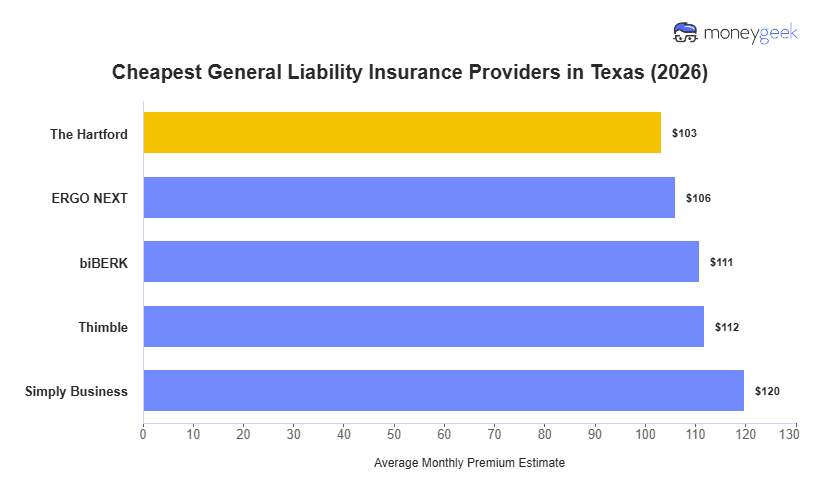

Cheapest Texas General Liability Insurance Companies

We analyzed rates for 408 business types in Texas to identify which insurers most often offer the lowest general liability rates for small businesses across the state. The following providers offer the best pricing in distinct business categories:

  • The Hartford: Lowest rates for professional and creative businesses like accounting firms, financial advisors, web developers, photographers, videographers and art galleries
  • ERGO NEXT: Most affordable for hands-on, customer-facing businesses like beauty salons, dog groomers, mobile bartenders, caterers, handymen and appliance repair shops
  • biBerk: Cheapest for active service and wellness providers like house cleaners, personal trainers, yoga studios and veterinary practices
  • Thimble: Lowest rates for construction trades, including electrical, plumbing, general and drywall contractors

[Click Each Provider to Learn More]

Pricing patterns show where each insurer competes hardest in the Texas market. Your actual premium depends on your location (Houston and Dallas often price differently than smaller cities), your trade risks and your claims history. Compare quotes from your top matches to find your lowest rate.

The Hartford$103$1,23815%
ERGO NEXT$106$1,27313%
biBerk$111$1,3309%
Thimble$112$1,3428%
Simply Business$120$1,4372%
Coverdash$127$1,523-4%
Progressive Commercial$129$1,552-6%
Nationwide$136$1,626-11%
Hiscox$137$1,644-12%
Chubb$138$1,650-13%

How We Determined the Cheapest General Liability Insurance Providers

mglogo icon
CHEAPEST GENERAL LIABILITY INSURANCE IN TEXAS DOESN'T MEAN BEST FIT

Low premiums look attractive until a claim tests your coverage. A Dallas plumbing company saving $200 annually on a budget policy discovered their $1.2 million water damage claim had a $200,000 coverage shortfall. Austin's thriving restaurant scene has parallel challenges: a single patron injury or foodborne illness lawsuit can wipe out years of premium savings when policies exclude key protections or drag out payment timelines.

What you pay matters, but coverage quality determines whether your policy actually protects your business. Our guide to the best general liability insurance providers in Texas evaluates insurers on claims handling and coverage breadth, not just price.

The Hartford

The Hartford: Cheapest for Professional and Creative Businesses

On The Hartford's site
COMPANY HIGHLIGHTS

The Hartford ranks cheapest for 26% across 25 general industries analyzed. It's most often the lowest-cost option for professional services and creative fields, including accounting firms, financial advisors, web developers, photographers and art galleries. Small Texas businesses pay an average of $103 per month with The Hartford, 15% lower than the state average. That saves small business owners $224 annually compared to typical market rates.

Most often cheapest for these business profiles:

  • General industries: Arts, Media and Entertainment, Education, Financial Services, Health Care and Medical, Tech/IT
  • Employee count: One to 49 employees

Not a fit? Jump to: ERGO NEXT or Thimble or biBerk

ERGO NEXT

ERGO NEXT: Cheapest for Service and Customer-Facing Businesses

On ERGO NEXT's site
COMPANY HIGHLIGHTS

Texas businesses usually pay $106 monthly with ERGO NEXT, which runs 13% below the statewide average and saves $188 per year. It ranks as the cheapest across 39% of all industries analyzed, especially for hands-on service providers and customer-facing operations. Beauty salons, dog grooming operations, mobile bartenders, caterers and repair businesses get the most savings compared to the state average, at more than 40%.

Most often cheapest for these business profiles:

  • General industries: Beauty, Body and Wellness Services, Childcare Services, Consulting Services, Food and Beverage, Hospitality, Travel and Tourism, Manufacturing, Marketing and Communications, Other Professional Services, Pet Care Services, Real Estate and Property Services, Repair and Maintenance, Retail and Product Rental, Transportation and Logistics

Not a fit? Jump to: The Hartford or Thimble or biBerk

biBerk

biBerk: Cheapest for Active-Service and Wellness Providers

COMPANY HIGHLIGHTS

biBerk offers the lowest rates for solo operators in Texas, with an average monthly rate of $55, 14% below the statewide average. This makes it competitive for independent service providers like personal trainers, yoga instructors, house cleaning operators and solo veterinary practitioners. Microbusinesses, those with one to four employees, save $131 annually compared to the state average, paying $111 monthly.

Most often cheapest for these business profiles:

  • General industries: Cleaning Services, Fitness Services, Recreation & Sports
  • Employee count: Solo operators

Not a fit? Jump To: The Hartford or ERGO NEXT or Thimble

Thimble

Cheapest for Construction Trades

COMPANY HIGHLIGHTS

Thimble specializes in construction and contracting work, offering the lowest rates for electrical, plumbing, general and drywall contractors. Texas construction businesses pay an average of $112 per month with Thimble, 8% below the state average. Thimble ranks cheapest for only 5% of the Texas industries analyzed, but all of those businesses fall within construction and contracting, making it the top choice for hands-on trades.

Not a fit? Jump to: The Hartford or ERGO NEXT or biBerk

Explore the Cheapest General Liability Insurance in Texas by Industry

What you pay depends heavily on what could go wrong in your line of work. That's why the average cost of general liability insurance in Texas varies: a Dallas web designer might pay $400 annually, while a San Antonio roofer pays $4,000. The difference comes down to physical risk: trades involving ladders, power tools or heavy equipment cost far more to insure than desk-based work. 

Fort Worth's taco trucks fall somewhere between, with kitchen fires and customer injuries pushing rates above those of consulting firms but still well below what contractors pay. Find your industry below to see which insurers offer the most competitive rates for your business type.

Is the Cheapest General Liability Insurance Right for Your Texas Business?

Budget general liability policies cover routine slip-and-fall and property damage claims but often fall short when your business operates in Texas' more demanding commercial environments. Coverage gaps emerge in specific situations:

  • Energy sector vendor requirements: Oil and gas service companies working Permian Basin sites routinely need $5 million aggregate coverage to qualify as approved vendors. Budget policies maxing out at $2 million leave you unable to bid on lucrative contracts.
  • Border logistics certifications: Freight brokers and customs warehouses operating through Laredo or El Paso must meet federal bonding requirements that budget insurers often can't accommodate quickly enough to keep shipments moving across international checkpoints.
  • Severe weather claim handling: When a hailstorm tears through Lubbock or flooding hits Corpus Christi, low-cost carriers may delay inspections for weeks because they lack adjusters stationed in smaller Texas markets. Your business sits idle while competitors with responsive insurers resume operations.
  • Agriculture event liability: Livestock auction facilities and rodeo venues in the Panhandle need coverage for participant injuries that most budget policies explicitly exclude as too high-risk for their pricing model.

Budget coverage serves office-based professionals and low-risk service providers well, but businesses operating in energy, working near international borders, requiring quick storm recovery or hosting ag-related events should verify their policy meets industry-specific requirements before choosing solely on price.

For more details about this coverage type: General liability insurance guide

Is the Cheapest Right for Your Business?

How to Get Cheaper General Liability Insurance in Texas

Lowering your general liability premium doesn't mean accepting weaker coverage. It requires understanding how insurers price policies and making smarter decisions about what you're actually buying.

  • bag icon
    Compare general liability quotes using the same limits

    A quote for $500,000 in coverage costs less than one for $2 million, but that price gap doesn't tell you which insurer offers competitive rates. Ask every carrier to quote the same per-occurrence and aggregate limits, whether that's the $1 million your Fort Worth office lease requires or the $2 million your Midland oilfield service contract demands. Without identical coverage amounts, you're comparing prices on completely different products.

  • hammer icon
    Ensure your business classification (class code) is correct

    Your class code determines your base rate, and the wrong one can add hundreds to your annual premium. A mobile welding shop serving Beaumont's refineries coded as general fabrication pays for factory-floor risks they don't have, while an Amarillo pressure washing business misclassified as industrial cleaning gets charged for chemical exposure and confined space work. Pull up your current policy and verify the description matches what you actually do on job sites.

  • insurance2 icon
    Only pay for general liability coverage limits you actually need

    Review your lease agreements and client contracts to identify the actual coverage minimums they require: many Plano office leases specify $1 million while TxDOT highway projects often demand $2 million or higher. Buying more than those documented requirements wastes premium dollars on coverage no one's asking you to carry. If you're considering higher limits, make sure it's because you're pursuing a bigger contract or protecting against real exposure, not just assuming more is automatically safer.

  • money2 icon
    Use general liability deductibles and payments strategically

    Raising your deductible from $500 to $2,500 might cut your premium by 15% to 20%, but only makes sense if you can afford to pay $2,500 out of pocket when a claim hits. A Tyler restaurant with $5,000 in cash reserves can handle a higher deductible and pocket the monthly savings, while a startup with thin margins should keep deductibles low to avoid a financial crunch during a slip-and-fall claim. Match your deductible to your actual cash position, not just the premium discount.

  • coins2 icon
    Bundle general liability insurance when it lowers your total cost

    Bundling general liability with property coverage in a business owner's policy (BOP) can save money, but not always. A Wichita Falls retail shop might pay less for a BOP than buying general liability and property separately, while a mobile consultant with no physical location wastes money on property coverage they don't need. Check the average cost of a BOP against standalone GL pricing for your situation before assuming a bundle saves you money.

  • falling icon
    Lower your claim risk in ways Texas insurers reward

    Insurers discount premiums for businesses that document efforts to prevent claims. Ask your agent which specific practices your carrier rewards with rate credits, then focus on the ones that move your premium:

    • Employee safety training: Laredo warehouse workers trained in forklift operation and heat-stress prevention show lower injury risk than untrained crews.
    • Incident documentation: Lubbock contractors who log near-misses and corrective actions demonstrate active risk management that insurers reward with better rates.
    • Equipment maintenance records: Odessa oilfield service companies maintaining inspection schedules for pressure equipment and vehicles qualify for safety-based discounts.
    • Customer safety protocols: Waco event venues using liability waivers, posted warnings and staff briefings reduce slip-and-fall exposure insurers price into premiums.

    Not every safety measure translates to premium savings, so verify what your insurer counts before building new programs.

Affordable General Liability Insurance in Texas: Bottom Line

No single insurer consistently delivers the lowest rates across all Texas industries. A Longview manufacturer needs different coverage than a Brownsville logistics broker, and what works for an Austin tech startup won't fit a Permian Basin energy contractor. Your goal is securing affordable coverage that matches your actual risk while meeting the requirements your contracts or leases impose.

Use this page to identify insurers who price your industry competitively, then request quotes with identical terms to see who charges least for the protection you need.

If you're ready to get quotes: Get matched

Cheapest General Liability Insurance in Texas Chart

Cheap General Liability Insurance in Texas: Next Steps

If you're ready to lock in rates, request quotes from your top matches using identical coverage limits and any endorsements your contracts require. Specify your actual work location, since a Texarkana contractor and a Galveston hospitality business get quoted differently even within the same industry. This way, you see real pricing instead of broad estimates.

If you're still deciding, use this page to see which insurers consistently rank cheapest for businesses like yours, then compare how their coverage terms and service features stack up. The lowest monthly premium matters, but so does whether that policy actually handles your contract requirements and claim scenarios without leaving you underinsured.

How We Determined the Cheapest General Liability Insurance Providers in Texas

To identify the cheapest general liability insurers for Texas businesses, we analyzed real pricing data from 10 major providers and modeled a large set of standardized pricing estimates across common small business profiles in Texas.

Dataset scope and assumptions

  • Providers analyzed: 10 major insurance providers
  • Industries covered: 408 industries
  • Employee count bands: Zero, one to four, five to nine, 10 to 19, 20 to 49 employees
  • Policy baseline: Standard $1 million per occurrence/$2 million aggregate general liability policy
  • Pricing estimates modeled: Over 20,000

We also incorporated modeled average revenues and payrolls across Texas business profiles to improve pricing accuracy.

How we determined which provider was "cheapest"

We used this dataset to determine which insurers were most often the lowest-cost option across different Texas business profiles. Our "cheapest" rankings include both:

  • General Recommendation: Provider rankings based on average estimated pricing for a standardized business profile of one to four employees across all industries in Texas.
  • Factor Combination Recommendations: Provider rankings based on which insurer was most often cheapest within specific business factor combinations. For example:
    • Industry-specific pricing across Texas was compared using a standardized profile of one to four employees
    • Employee count affordability was derived by comparing aggregated pricing trends across industries in Texas

These results represent standardized pricing estimates, not personalized quotes. Actual pricing can vary based on your Texas business classification, revenue/payroll, claims history and the specific limits, deductibles and endorsements you choose. For the most accurate cheapest-provider answer, we recommend comparing quotes apples-to-apples using the same coverage limits.

About Angelique Palenzuela-Cruz


Angelique Palenzuela-Cruz, Business Insurance Writer, MoneyGeek

Angelique Palenzuela-Cruz is a Business Insurance Content Writer at MoneyGeek, where she specializes in general liability, workers’ compensation and professional liability insurance. Her work helps small business owners understand how these policies apply to coverage, including risks like customer injuries, employee injuries, professional mistakes, client contract terms and industry-specific coverage requirements.
She primarily covers service-based businesses where liability and employee coverage decisions are especially important, including cleaning, consulting, beauty and wellness, childcare, education, fitness, food service, pet care, repair and maintenance, and other professional services.
Before joining MoneyGeek, Angelique spent nearly 12 years at Guthrie-Jensen Consultants, one of Southeast Asia’s largest management training firms, where she advanced from Training Consultant to Managing Consultant. In that role, she worked with business clients to assess operational needs, develop training programs and present performance analyses to executive decision-makers. She also helped establish Gladwin Training Consultancy, where she served in learning solutions and client service roles.
Her background gives her practical context for writing about how businesses operate, manage client expectations, structure teams and make risk decisions. At MoneyGeek, she applies that experience to business insurance content, connecting coverage to actual business needs.

LinkedIn: linkedin.com/in/ma-angela-cruz

Email Contact: angelique.palenzuela@moneygeek.com