
Key Takeaways
blueCheck icon

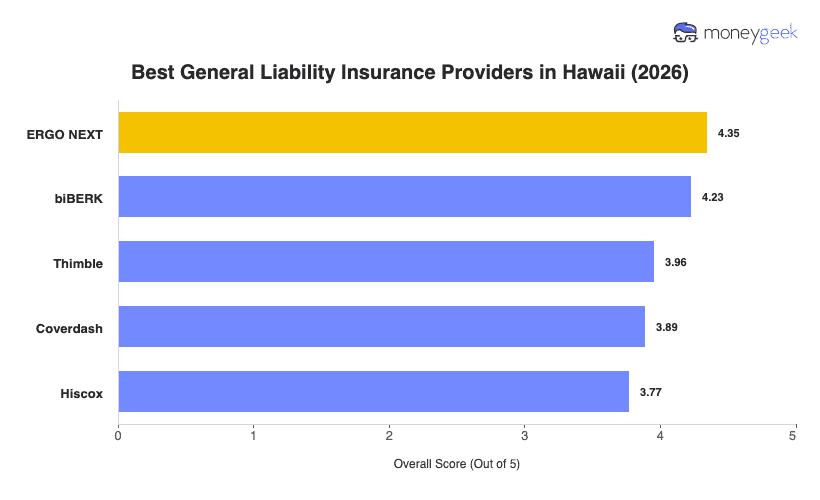
ERGO NEXT ranks as Hawaii's best general liability insurance provider, earning top scores for affordability and customer experience.

blueCheck icon

ERGO NEXT offers the cheapest general liability insurance in Hawaii at $141 per month, saving businesses $18 monthly (12% less).

blueCheck icon

Look for a provider with rate stability, responsive service and flexible coverage: the best options perform consistently across all three areas.

Best General Liability Insurance Companies for Small Businesses in Hawaii

Small businesses in Hawaii have distinct coverage needs, whether running tours or operating a storefront. After analyzing 10 general liability insurers at $1 million per occurrence/$2 million aggregate limits, these five ranked as the best and most affordable options for local businesses.

  1. ERGO NEXT: Best Overall, Best for Tourism and Service Industries
  2. biBerk: Best for Health Care and Fitness Industries
  3. Thimble: Best for Short-Term and Project-Based Coverage
  4. Coverdash: Best for Coverage Options
  5. Hiscox: Best for Financial Services

Whether you operate a food truck in Kailua or manage a landscaping crew on the Big Island, the table below shows each provider's rates and rankings. Your ideal match may shift based on coverage needs and budget, so review the details to compare.

ERGO NEXT4.35$14114
biBERK4.23$15133
Thimble3.96$15245
Coverdash3.89$17351
Hiscox3.77$18022

For our Hawaii general liability insurance ratings, we analyzed pricing, coverage options and customer experience across 408 industries within the state. Our analysis focuses on one-to-four-person businesses, which represent a large share of Hawaii's small business market, while weighting results to ensure broader industry and location representation across Honolulu County, Maui County, Hawaii County and smaller markets throughout the state.

To do this, we evaluated over 20,000 business profiles, more than 400 customer experience data points and performed in-depth analysis of coverage contracts and endorsements to compare how insurers serve Hawaii businesses consistently across different industries and regions. 

We then rated each company across categories of affordability (50%), customer experience (30%) and coverage options and terms (20%) to form an overall rating. For a detailed breakdown of the metrics, scoring methodology and pricing analysis specific to Hawaii, see our full methodology.

95%

% of Small Businesses Covered

Over 20,000

Business Profiles Studied

424

Customer Experiences Analyzed

ERGO NEXT

ERGO NEXT

Best Overall, Best for Tourism and Service Industries
On ERGO NEXT's site

ERGO NEXT is the best and cheapest general liability insurer in Hawaii, earning top marks for both affordability and customer experience. Its fully digital buying process lets Hawaii business owners get quotes and bind coverage in under 10 minutes, with no phone calls or agent appointments required. Policy management is similarly fast, with 24/7 certificate of insurance generation and an easy-to-use online portal. Claims handling is mid-pack, with policyholders reporting slow communication during complex claims and frustration with settlement outcomes, making ERGO NEXT a weaker fit for businesses that anticipate frequent claims.

In Hawaii, businesses in hospitality and tourism, beauty and wellness and retail see the most savings, ranging from 23% to 35%. ERGO NEXT offers standard $1M/$2M limits with common endorsements like additional insured and waiver of subrogation, but customization is limited compared to traditional carriers. Businesses with complex or high-risk exposures may find options too standardized.

Where ERGO NEXT performs best:

  • Hawaii businesses wanting fast, self-service quoting
  • Teams of one to 49 employees seeking lower rates
  • Tourism, retail or wellness operations prioritizing savings
  • Owners comfortable managing policies online

Where ERGO NEXT performs less competitively:

  • Health care, fitness or education businesses (rates above benchmark)
  • Operations expecting hands-on claims support
  • Businesses needing highly customized endorsements

Learn More: ERGO NEXT Review

biBerk

biBerk

Best for Health Care and Fitness Industries

biBerk ranks second overall for general liability insurance, offering competitive rates and flexible coverage to Hawaii small businesses. Health care businesses save 23%, fitness operations save 19% and education providers save 17%. Cleaning services, real estate and pet care operations also save 15% to 17%.

Every biBerk policy is backed by Berkshire Hathaway's A++ financial rating, providing settlement security that smaller insurers cannot match. Standard $1 million/$2 million limits are available, along with lower $500,000/$1 million options for smaller operations. The buying process is simpler, with accessible phone support and clear underwriting questions. However, both policy management and claims handling are mid-pack, with users reporting slower certificate requests, longer wait times for policy changes and slow initial assignment.

Where biBerk performs best:

  • Health care, fitness or education businesses in Hawaii
  • Mid-sized teams of 20 to 49 employees
  • Solo operators prioritizing affordability over digital tools
  • Owners valuing Berkshire Hathaway's financial backing

Where biBerk performs less competitively:

  • Construction or beauty and wellness businesses looking for lower rates
  • Operations needing fast certificate turnaround
  • Owners expecting polished self-service digital tools

Learn More: biBerk Review

Thimble

Thimble

Best for Short-Term and Project-Based Coverage

Thimble ranks third among Hawaii general liability insurers, with high marks for affordability and a straightforward buying experience. It doesn't lead any Hawaii industry, but it's a runner-up in 10. Construction businesses see the largest savings at 15%, followed by agriculture (9%) and beauty and wellness, fitness, health care and education (5% to 6% each).

Coverage flexibility is Thimble's main advantage: policies are available by the hour, day, week or month, which suits Hawaii's seasonal tourism contractors and project-based operators. The buying process ranks second overall, with users citing fast quotes and instant certificate generation through the mobile app. Policy management and claims are weaker spots, as billing options are limited, claims handling ranks last among competitors, and customer reviews cite slow processing and difficulty reaching adjusters.

Where Thimble performs best:

  • Project-based or seasonal Hawaii contractors
  • Construction businesses looking for a runner-up option
  • Owners who need hourly or daily coverage
  • Businesses that rarely file claims

Where Thimble performs less competitively:

  • Hospitality or tourism operations seeking affordable coverage
  • Businesses expecting reliable claims support
  • Operations needing broad endorsement options

Learn More: Thimble Review

Coverdash

Coverdash

Best for Coverage Options

Fourth overall for general liability insurance in Hawaii, Coverdash leads the field on coverage options. As a brokerage platform, it connects Hawaii businesses with multiple carriers, including Chubb and CNA, with access to limits up to $2 million per occurrence, expanded endorsements and placement for risks that standard digital insurers often decline.

The trade-off is a slower buying process. Getting coverage means comparing quotes across carriers and, in some cases, waiting for underwriting approval. Policy management and claims handling also vary by carrier. On affordability, only retail businesses see savings (5%), while hospitality and tourism operations pay 22% above average and construction businesses pay 15% more.

Where Coverdash performs best:

  • Businesses needing higher limits or specialty endorsements
  • Risks that standard digital insurers decline
  • Owners who prioritize carrier choice over speed
  • Retail operations seeking broad coverage at lower rates

Where Coverdash performs less competitively:

  • Price-sensitive businesses across most industries
  • Owners wanting fast, fully digital quoting
  • Hospitality or construction operations prioritizing affordability

Learn More: Coverdash Review

Hiscox

Hiscox

Best for Financial Services

Competitive coverage options and a customer experience tailored to professional service businesses places Hiscox fifth overall for Hawaii general liability insurers. The buying process works well for consultants, IT firms and financial advisors, with online quotes available and phone support for complex risks. Policy management and claims handling are less competitive, with customer reviews citing slow response times for certificate requests, difficulty reaching adjusters and limited billing flexibility.

Hiscox allows you to bundle professional liability coverage with general liability, with the possibility of a discount of up to 5%. While it’s only cheapest for financial services (8% savings), it’s an affordable alternative for businesses in consulting and wholesale distribution (9% savings) and mid-sized teams of 20 to 49 employees. Most other industries pay well above Hawaii’s average, with food and beverage and retail businesses paying 26% more than average.

Where Hiscox performs best:

  • Financial services firms seeking the lowest rates
  • Consultants or IT professionals bundling GL and E&O
  • Mid-sized professional service teams (20 to 49 employees)
  • Office-based businesses prioritizing coverage over price

Where Hiscox performs less competitively:

  • Retail, food or fitness businesses
  • Operations needing fast certificate turnaround
  • Businesses expecting responsive claims communication

Learn More: Hiscox Review

Progressive

Progressive

Best for Wholesale and Distribution

Progressive Commercial ranks fifth overall for general liability insurance in Hawaii, with competitive rates in several industries and above-average claims handling relative to its overall placement. GL policies include liquor liability, EPLI and inland marine as add-on endorsements, giving food, hospitality and contractor businesses more customization options. One gap is the unavailability of excess and surplus lines (E&S) coverage in the state, so high-risk businesses will need to source that coverage elsewhere.

Buying a general liability coverage from Progressive requires working with an agent to complete the purchase, which adds a step compared to fully digital competitors. Claims are handled well, as it has one of the lowest complaint rates in the reviewed field. Manufacturing businesses see meaningful savings at 26%, as well as those in hospitality (24%).

Where Progressive Commercial performs best:

  • Hawaii food, beverage and hospitality businesses needing liquor liability as a GL add-on
  • Manufacturing businesses where rates run 26% below the Hawaii average
  • Businesses that prioritize claims outcomes over buying convenience
  • Wholesale businesses where it ranks top overall in Hawaii

Where Progressive Commercial performs less competitively:

  • High-risk Hawaii businesses that need E&S coverage
  • Businesses that want a fully digital GL buying experience without agent involvement
  • Hawaii businesses prioritizing affordability

Learn More: Progressive Commercial Review

Explore the Best General Liability Insurance in Hawaii by Industry

Premiums reflect how insurers view your specific line of work. A Honolulu yoga studio and a Kona construction contractor carry different risk profiles, so their quotes will look nothing alike. The tables below go beyond statewide averages to show how providers price coverage for your business type and where policy terms differ.

What Determines the Best General Liability Insurance for Hawaii Businesses

A Lahaina restaurant rebuilding after wildfire damage and an Oahu food manufacturer managing supplier contracts have different priorities, but both need general liability insurance in Hawaii that accounts for the state's unique operating environment. These four factors separate insurers that look good on paper from those that actually work in practice.

  • coins2 icon
    Affordability without pricing volatility

    Hawaii's small business margins are already stretched by shipping costs, imported materials and GET obligations. A snorkel operation in Kona or a Lanai gift shop can't absorb surprise premium jumps on top of those fixed expenses.

    The initial quote matters less than what happens over the life of your policy. Several factors drive what you pay:

    • Industry classification: Ocean recreation, construction and ag-tourism operations pay more than office-based consulting or retail.
    • Revenue and payroll: Insurers use these figures to estimate exposure. Seasonal tourism swings can trigger midterm audits and adjustments.
    • Claims history: A single slip-and-fall at a Poipu resort shop can raise your rates for three to five years.
    • Location and terrain: Lava zones on the Big Island, flood-prone valleys on Kauai and high-density visitor areas carry different rate loadings.

    Unpredictable pricing forces you to guess at next year's budget and may push you toward coverage gaps when renewal costs land higher than expected.

  • talk icon
    Responsive service throughout your policy term

    Hawaii's reliance on mainland carriers means service quality varies widely. Some insurers staff local adjusters and understand island logistics, while others route everything through offices three to six time zones away.

    Look for responsiveness at the moments that count:

    • Certificate requests: Military base contracts at Pearl Harbor or Schofield and resort vendor agreements at Princeville or Kapolei often require same-day COIs. Mainland carriers unfamiliar with Hawaii's pace may fall short.
    • Policy changes: Adding a second location on a neighbor island or adjusting coverage mid-season should happen online, not through a week-long back-and-forth.
    • Claims handling: Adjusters who understand volcanic soil damage, salt-air corrosion and hurricane-related disputes resolve claims faster than mainland teams learning on the fly.
    • Renewal communication: Clear, early notice of rate changes lets you plan around Hawaii's already tight operating margins.

    When service breaks down, you spend hours chasing paperwork instead of running your business. That's time you can't afford when your next hotel contract depends on proof of coverage.

  • insurance2 icon
    Coverage options that fit common small business risks

    Hawaii businesses often carry exposures that mainland-designed policies don't address out of the box. A charter fishing captain operating under Jones Act requirements has different risks than a Kailua event planner, yet both need coverage reflecting their actual operations.

    Two things matter: limit options high enough to satisfy resort, military and state agency contracts, and endorsements available as your business grows. Watercraft liability, hired and non-owned auto for inter-island travel, and liquor liability are common add-ons. Not every mainland carrier writes them in Hawaii, so confirm availability before committing.

  • building icon
    Why consistency across all three areas matters most

    An insurer with competitive rates but adjusters unfamiliar with hurricane claims creates problems when a Kona coffee farm needs fast resolution. Another carrier with responsive service but no watercraft endorsements leaves a Hanalei surf school exposed the moment a guest gets injured.

    Hawaii's limited local market means fewer fallback options if your provider underperforms. Switching carriers mid-policy takes longer here, and coverage gaps can cost you contracts requiring uninterrupted proof of insurance. Choose a provider reliable across pricing, service and coverage, not just one area.

How to Choose the Best General Liability Insurance in Hawaii

Finding the right general liability provider takes more than comparing prices. The steps below give you a structured way to narrow options, weigh tradeoffs and land on a provider that fits your Hawaii business.

  1. 1
    Optimize your payment and coverage structure

    Before comparing providers, get clear on how much general liability coverage you actually need and how you want to pay for it. Hawaii's high operating costs, geographic isolation and contract-heavy business environment all shape these decisions.

    Ask yourself:

    • Do contracts with hotels, military bases, or state agencies require set liability limits?
    • Does your work involve physical risk from ocean activities, volcanic terrain, or heavy equipment?
    • Do you operate across multiple islands, expanding your exposure footprint?
    • Can you absorb a higher deductible to offset Hawaii's above-average premium rates?

    Most Hawaii small businesses start with $1 million per occurrence/$2 million aggregate limits. A Kona coffee farm selling direct to visitors may find that baseline sufficient. A dive operator running charters off Maui likely needs higher limits and watercraft endorsements. On payment, annual billing usually costs less overall, but monthly payments help businesses with tighter margins keep cash flow steady alongside GET obligations and inter-island shipping costs.

  2. 2
    Choose your primary priority

    No single insurer wins across every category, so knowing your priority upfront breaks ties when two or three providers score similarly.

    • Prioritize affordability if you operate a high-overhead business where shipping costs, imported goods or island-rate labor already squeeze margins. Predictable premiums make budgeting easier around expenses you can't control.
    • Customer experience is the right focus if your work depends on fast certificate turnaround. Vendors supplying Pearl Harbor contractors, resort event companies or film productions that need proof of coverage within hours will feel slowdowns most.
    • Coverage depth is what counts for businesses with specialized exposure: helicopter tours, commercial fishing or ag-tourism operations where standard general liability limits can leave gaps. Endorsement flexibility is especially important when mainland-designed policies don't account for island-specific risks.
  3. 3
    Shortlist two to three providers

    A full review of every insurer wastes time. Most providers overlap on basics, so the goal is to narrow down to two or three that fit your priority and meet your baseline coverage needs.

    Filter first for providers familiar with Hawaii's market. A Honolulu marketing agency and a Big Island excavation contractor have different risk profiles, and not every mainland insurer underwrites both well. Confirm that Hawaii general liability costs from your shortlist fit your budget before moving into detailed comparisons.

  4. 4
    Double-check for dealbreakers before investing more time

    A dealbreaker found now saves hours later. Before moving into detailed comparisons, confirm each finalist clears your non-negotiables.

    • Industry exclusions: Some insurers won't cover ocean charters, cannabis cultivation or lava-zone construction, all of which are standard Hawaii operations.
    • Multi-island coverage: If you operate on more than one island, confirm the policy covers all locations without requiring separate filings.
    • Certificate turnaround: Military base contracts and hotel vendor agreements often require same-day COIs. Slow delivery can cost you the job.
    • Claims handling proximity: Insurers without adjusters familiar with Hawaii may delay resolution on weather-related property claims or volcanic damage disputes.
  5. 5
    Compare your finalists using the same three lenses

    Even after settling on a priority, run your shortlist through all three areas to avoid blind spots.

    • Affordability: Look beyond the initial quote. Check whether the insurer has a history of sharp renewal increases, how premium audits handle seasonal fluctuations and whether rate changes are communicated before they appear on your books.
    • Customer experience: Evaluate COI turnaround times, ease of online policy changes and claims responsiveness. Portal quality is especially relevant for businesses coordinating coverage across islands or with mainland offices in different time zones.
    • Coverage options: Review available per occurrence and aggregate limits, endorsement flexibility for Hawaii-specific risks and whether the insurer offers tools like audit support or loss-prevention resources.
  6. 6
    Use quotes as the final confirmation step

    A quote brings together your business details, coverage selections and pricing into one picture. Use it to confirm that the numbers match your expectations and the policy terms fit your actual operations, not a generic mainland profile.

    Request general liability insurance quotes from your top two or three finalists. Compare them side by side, paying attention to how each insurer handles Hawaii-specific variables like location risk zones, inter-island operations and industry classifications. Before binding coverage, check any general liability insurance exclusions that could leave gaps for island-specific risks.

Best Small Business General Liability Insurance in Hawaii: Bottom Line

ERGO NEXT, biBerk and Thimble lead the rankings for general liability insurance in Hawaii, but the right fit depends on your industry, business size and whether you operate on a single island or across neighbor islands. The best choice balances pricing stability, service responsiveness for COI requests and coverage depth. Defaulting to the lowest quote risks a policy built around a generic mainland profile, not Hawaii's actual operating conditions.

Best General Liability Insurance For Small Business in Hawaii Chart

Best General Liability Insurance for Small Businesses in Hawaii: Next Steps

Accurate comparisons depend on using the same coverage assumptions across your top choices. If you're ready to move forward, narrow to one or two providers and confirm pricing and availability for your industry, size and whether you operate on Oahu or across neighbor islands.

Keep premium costs manageable over time

Match your coverage limits to your business risks

Review quotes before choosing a provider

How We Chose the Best General Liability Insurance Companies

To identify the best general liability insurance companies for Hawaii small businesses, we evaluated insurers across pricing, customer experience and coverage options using a standardized, data-driven approach. Our goal was not to identify the cheapest option in every scenario, but to determine which providers offer the most consistent overall value across common Hawaii small business profiles.

Our best recommendations reflect insurers that perform well across multiple dimensions and remain competitive across industries and business sizes in Hawaii.

Data and Analysis Scope

We based our analysis on standardized estimates designed to represent the majority of Hawaii small businesses:

  • Providers analyzed: 10 major insurers serving Hawaii
  • Industries covered: 408 industries
  • Employee counts: Zero to 49 employees
  • Policy baseline: $1 million per occurrence / $2 million aggregate general liability policy
  • Pricing modeled: Over 20,000 standardized estimates for Hawaii businesses

Modeled average revenues and payrolls were incorporated to improve pricing accuracy across Hawaii's business environment.

Our Scoring Model

Each insurer received a composite score based on the weighted categories below.

  • Affordability (50%): Reflects how competitively and consistently an insurer prices general liability coverage across all Hawaii business profiles studied.
  • Customer experience (30%): Measures how well insurers support Hawaii businesses throughout the policy lifecycle, from purchase to claims. We scored each stage separately: buying, policy management and claims handling.
  • Coverage options (20%): Captures how well insurers address common Hawaii small business risks and allow for flexibility as businesses grow or change.

Read our full business insurance methodology.

About Connor Bolton


Connor Bolton, Senior SEO and Content Manager (Business & Pet), MoneyGeek

Connor Bolton is Senior SEO and Content Manager at MoneyGeek, where he leads the business and pet insurance editorial teams. He sets the research framework, data standards and content structure for his team. All content goes through his accuracy review before publication. Connor also writes in-depth guides and has spent more than four years covering insurance products across personal, commercial and specialty lines.

The research infrastructure Connor built covers auto, home, renters, life, health, business and pet insurance across pricing analysis, carrier research, customer experience and coverage evaluation. It includes over 6 million data points for business insurance across 408 industry areas, all 50 states and 16 vehicle types. The pet insurance side covers over 5 million profiles across 18 major providers, 100+ breeds and ages up to 20 years. Connor’s insurance research and his team's work has been cited by the U.S. Chamber of Commerce, Allstate, Liberty Mutual, CBS News, Forbes and LegalZoom.

Connor also talks with underwriters and carrier liaisons at Ethos, The Hartford, ERGO NEXT, Nationwide and State Farm, and monitors business and pet owner communities on Reddit. Those sources shape how his team evaluates carriers, structures rate analysis and writes for human buyers rather than search engines.

For questions about MoneyGeek's business and pet insurance content, contact him at connor@moneygeek.com or on LinkedIn.