How Much Does Commercial Auto Insurance Cost for Vans?

The average commercial auto insurance cost for vans is $189 per month ($2,272 a year) for minimum coverage, based on my analysis of 22 general industry areas and all states (including D.C.). It's $26 per month higher than the overall national benchmark for commercial auto policies. The higher rates are caused by the broader range of work that vans can take on, the cargo they can carry and the number of passengers they can accommodate.

However, the rates in my report should be treated as a general benchmark, and they do not represent quotes tailored to your business and vehicle profile. Your actual rates will vary widely depending on what you do with your vehicles, where you operate and how many you have within your fleet.

Van Commercial Auto Insurance Cost Calculator

Use the commercial auto insurance calculator below to get an estimate for your van based on your business profile.

Estimate Van Insurance Costs

Select your general industry category and state to get a commercial auto insurance cost estimate for your van. The rate you'll see will be for minimum coverage. Once you're ready, click Get Quotes to get matched to a provider that best fit your operation.

Select General Industry
Select State
Average monthly rate for Vans

To estimate average commercial auto insurance costs for vans, I analyzed pricing estimates from five major commercial auto providers and modeled standardized premium estimates across common business van profiles. These modeled results give a consistent national benchmark and show how premiums shift by industry and location.

Dataset Scope and Assumptions

Our cost modeling uses standardized inputs for comparable results across van-operating businesses.

  • Providers analyzed: five major commercial auto providers
  • Industries covered: 22 general industry categories
  • Location: all 50 states including Washington, D.C.
  • Coverage baseline: minimum coverage commercial auto policy (the market standard for benchmark comparisons)

How We Calculated Average Commercial Auto Insurance Costs for Vans

My published averages represent modeled premiums for standardized van business profiles, aggregated two ways. Each figure isolates one variable at a time so you can see where your costs land relative to the national benchmark of $215 per month.

  • National Benchmark Average: The national average reflects the modeled premium for a minimum coverage policy across all vehicle types, industries and states in the dataset. This single figure covers all 51 states and territories and gives you a starting reference point before accounting for your specific business profile.
  • Segment Averages: To show how costs shift, I calculated average modeled premiums isolated by one variable at a time, covering general industry category and state. Segment averages aggregate modeled pricing trends across the full dataset so you can compare how premiums change across business types and regions. A consulting firm operating a van in New Hampshire will see a very different number than a medical transport service in Michigan.

To learn more, read our methodology.

What Factors Affect Commercial Auto Insurance Costs for Vans?

Insurance companies rate commercial van policies by estimating how likely you are to file a claim and how much that claim will cost them. Every factor they look at speaks to one or both of those two questions.

    driverLicense icon
    Driver History

    Driver history is the first thing underwriters pull when evaluating a commercial van policy. Every driver listed on your policy gets a motor vehicle record (MVR) check, and what's on those records, including at-fault accidents, DUIs, moving violations and prior claims, tells the insurer how likely a future claim is before they look at anything else. A single high-risk driver on your policy can raise your overall premium, and a pattern of incidents across multiple drivers signals a broader fleet management problem that carriers price accordingly.

    car2 icon
    Van Type

    Underwriters rate the type of van you run and how you use it together because the same vehicle can carry very different risk depending on the operation behind it. A full-size Sprinter used for daily medical transport is a fundamentally different risk than the same vehicle used for occasional equipment hauls. They look at vehicle size and value, what it carries or who it transports, how frequently it runs and the operating radius. Whether your routes are local (under 50 miles), intermediate (51 to 200 miles) or long-distance, the further and more frequently your van runs, the more exposure it accumulates and the higher your rate.

    building icon
    General Industry Category

    Industry classification tells underwriters how intensively your van gets used and what kind of work it supports. Underwriters use your classification to estimate annual mileage, cargo type, passenger exposure and the likelihood of multiple drivers operating the vehicle. The broader and more demanding your industry's typical van use, the higher the claims frequency and severity underwriters expect, and your premium is priced to reflect that.

    pin icon
    Geographic Location

    Where your van is garaged determines your rating territory, and that territory captures the population density, traffic patterns, crime rates and court award tendencies specific to your area. Urban-heavy states generate more claims and larger payouts, which pushes rates up. If your operation regularly crosses into higher-cost states, some carriers will factor that into your rate as well.

    shield icon
    Coverage Level

    Coverage level determines how much financial risk your insurer carries versus how much you absorb. The more coverage you carry and the lower your deductibles, the higher your premium. The right coverage level depends on what your business can actually absorb out of pocket if something goes wrong. A business that depends on its van every day to generate revenue has a very different risk tolerance than one that uses it a few times a week.

Average Commercial Auto Insurance Costs for Vans by Industry

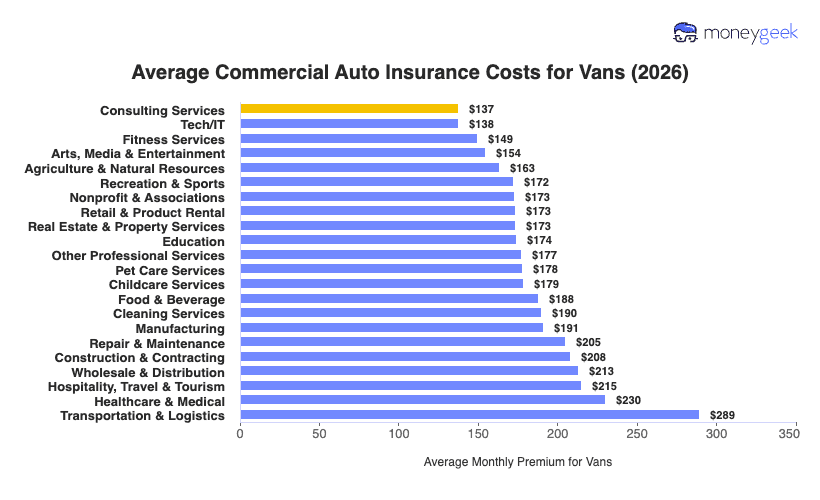
Across 22 general industry categories, monthly rates run from $137 for Consulting Services to $289 for Transportation & Logistics.

Here's a breakdown of how specific industries cost compared to the average commercial van insurance cost of $189 per month:

  • Lower-Cost Industries (20%+ Below Average): Covers 14% of general industries studied including Consulting Services, Tech/IT and Fitness Services
  • Mid-Cost Industries (Within 20% of Average): Covers 77% of general industries studied including Arts, Media & Entertainment; Agriculture & Natural Resources; Recreation & Sports; Nonprofit & Associations; Retail & Product Rental; Real Estate & Property Services; Education; Other Professional Services; Pet Care Services; Childcare Services; Food & Beverage; Cleaning Services; Manufacturing; Repair & Maintenance; Construction & Contracting; Wholesale & Distribution; and Hospitality, Travel & Tourism
  • Higher-Cost Industries (More Than 20% Above Average): Only 9% of general industry categories: Healthcare & Medical and Transportation & Logistics

Looking at the distribution, 64% of industries fall at or below the $189 average, with most clustering in a narrow band between $137 and $215 per month. That concentration reflects how most businesses use vans as a supporting operational tool rather than a primary one, keeping mileage, driver exposure and cargo risk predictable enough for underwriters to price them similarly. The real gap is at the top end, where Healthcare & Medical ($230) and Transportation & Logistics ($289) are the only two industries that break past the 20% above-average threshold. These operations use vans more frequently and in ways that compound risk at every level, with high daily mileage, multiple drivers, time-sensitive routes and either passengers or high-value cargo on board.

Data filtered by:
Select
Agriculture & Natural Resources$163$1,960
Arts, Media & Entertainment$154$1,853
Childcare Services$179$2,144
Cleaning Services$190$2,281
Construction & Contracting$208$2,494
Consulting Services$137$1,649
Education$174$2,090
Fitness Services$149$1,792
Food & Beverage$188$2,257
Healthcare & Medical$230$2,758
Hospitality, Travel & Tourism$215$2,581
Manufacturing$191$2,289
Nonprofit & Associations$173$2,071
Other Professional Services$177$2,126
Pet Care Services$178$2,134
Real Estate & Property Services$173$2,078
Recreation & Sports$172$2,066
Repair & Maintenance$205$2,462
Retail & Product Rental$173$2,078
Tech/IT$138$1,651
Transportation & Logistics$289$3,473
Wholesale & Distribution$213$2,558
mglogo icon
GENERAL INDUSTRY CATEGORY IS JUST THE STARTING POINT

Your specific business type within a general industry category can move your rate dramatically. Within Healthcare & Medical alone, Ambulance Services pays $340 per month while a Physical Therapy Practice pays $164. Use the table below to find your business type and see where you land within your industry.

We put together detailed commercial auto insurance cost guides for various general industry categories below.

Average Commercial Auto Insurance Cost for Vans by State

Commercial insurance for vans are shaped by state-mandated coverage minimums, local accident frequency and how aggressively courts in that jurisdiction tend to award damages. Urban-heavy states like New York ($249), California ($238) and Florida ($269) run well above the national average, while lower-density states like Iowa ($111), Idaho ($120) and Wisconsin ($138) tend to come in well below it.

Find your state in the table below to see what commercial van insurance costs where you operate.

Alabama$160$1,922
Alaska$314$3,772
Arizona$173$2,075
Arkansas$173$2,072
California$238$2,858
Colorado$191$2,290
Connecticut$222$2,660
Delaware$157$1,881
Florida$269$3,232
Georgia$183$2,193
Hawaii$101$1,212
Idaho$120$1,441
Illinois$211$2,527
Indiana$178$2,142
Iowa$111$1,334
Kansas$167$1,998
Kentucky$182$2,181
Louisiana$209$2,509
Maine$213$2,552
Maryland$231$2,773
Massachusetts$230$2,765
Michigan$362$4,340
Minnesota$188$2,261
Mississippi$176$2,113
Missouri$218$2,611
Montana$153$1,831
Nebraska$157$1,882
Nevada$190$2,276
New Hampshire$135$1,618
New Jersey$238$2,851
New Mexico$149$1,782
New York$249$2,982
North Carolina$188$2,250
North Dakota$146$1,749
Ohio$183$2,191
Oklahoma$169$2,024
Oregon$182$2,190
Pennsylvania$95$1,135
Rhode Island$236$2,827
South Carolina$188$2,261
South Dakota$210$2,522
Tennessee$169$2,024
Texas$257$3,079
Utah$170$2,040
Vermont$104$1,250
Virginia$201$2,410
Washington$179$2,148
Washington DC$258$3,094
West Virginia$180$2,163
Wisconsin$138$1,659
Wyoming$162$1,948

For a deeper look at what commercial van insurance costs in your state, the guides below break down rates, coverage requirements and key pricing factors by location.

How to Lower Commercial Auto Insurance Costs for Vans Without Removing the Coverage You Need

Although your industry category, location and van type are largely fixed, there are cost factors you can directly influence to lower your commercial van insurance premiums. Some adjustments affect your rate at your next renewal, while others take a cycle or two to compound.

Quick Commercial Auto Cost-Lowering Methods

These are the fastest levers to pull without changing your coverage.

    insurance2 icon
    Get Your Underwriting Details Right From the Start

    Vague answers about your annual mileage, vehicle use and driver job titles push underwriters toward worst-case assumptions. Be specific about how far your van travels annually, what it hauls or who it carries, which drivers operate it and what their driving records look like. Insurers won't ask for the detail that benefits you since it gives them grounds to charge more, so you need to provide it upfront.

    building icon
    Bundle Commercial Auto With Your GL or BOP Policy

    Multi-policy discounts don't show up on standalone quotes. Ask each carrier what bundling does to your commercial van insurance rate, and you can expect savings from 5% to 10%.

    coins2 icon
    Pay Annually Instead of Monthly

     Paying in full saves 3% to 8% and cuts installment fees. If your cash flow allows it, it's the simplest discount available.

    money2 icon
    Raise Deductibles if Your Fleet Has a Clean History

    A higher deductible means you pay more out of pocket when you file a claim, and your insurer pays less. Moving from $500 to $1,000 on collision and comprehensive can cut that portion of your premium by 15% to 25%. Only make that move if your cash reserves can handle the difference

Long-Term Commercial Auto Cost-Lowering Methods

These strategies take longer to lower your rate but change how your insurer prices your risk at every renewal going forward.

Commercial Auto Insurance Cost for Vans: Bottom Line

What you actually pay for commercial van insurance depends on your business's specific risk profile, not so much that you are driving a van. Before you start comparing quotes, I recommend that you get these three things figured out:

  • What does your operation actually look like? The type of van you run, your industry and the state you operate in all shape your baseline rate.  
  • How much risk are you willing to carry? Your deductible is the most direct cost lever you have. The right answer depends on what your business can absorb out of pocket if something goes wrong.
  • Are you shopping for the first time or optimizing an existing policy? First-time buyers should focus on getting the coverage right before worrying about price. If you're already insured and coming up on renewal, you have more leverage than you think, especially if your loss history is clean. 

Getting van insurance right is less about finding the cheapest rate and more about making sure your coverage matches the risks that your van and business actually face.

Commercial Auto Insurance Cost for Vans (2026) Chart

Commercial Auto Insurance Cost for Vans: Next Steps

The fastest next move for most businesses is comparing providers directly. MoneyGeek's cheapest and best pages give you a starting point based on what other van businesses are actually paying.

Recommended: If You're Ready to Compare Providers

Rates vary enough by carrier that the right provider for your operation can make a real dollar difference. Start with these:

If You Want to Learn About Costs From Other Coverage Types

If You Want to Learn More About Commercial Auto Insurance Coverage

About Mark Flores


Mark Flores, Business Insurance Writer, MoneyGeek

Mark Flores is a Business Insurance Content Writer at MoneyGeek. He covers commercial auto, commercial property, cyber and specialty insurance so business owners can understand what a policy covers, what it excludes and how to choose a provider beyond the standard pitch.

Before MoneyGeek, Mark spent over a year at Clutch.co as a Senior Content Writer. He produced structured B2B reviews and provider analyses from client interviews and service evaluations. The approach mirrors how commercial insurance teams build content: research companies, analyze performance data and turn findings into objective comparisons. Mark has also spent nearly four years as a digital marketing specialist for small business clients in home services, manufacturing and education. That work put him inside the operational decisions behind commercial insurance.

At MoneyGeek, he put in nearly five years in the credit cards vertical before moving to business insurance. That research and editorial grounding runs through his coverage guides, provider comparisons and cost analyses.

Linkedin: https://www.linkedin.com/in/mark-jason-flores-7844634a/

Contact Email: mark.flores@moneygeek.com