




My commercial van insurance rankings are based on three things: what businesses actually pay for coverage, what happens when they need support and whether the policy holds up when a claim is filed. I rated providers across affordability (50%), customer experience (30%) and coverage options (20%) because price is where most businesses start the search, but it's rarely where the decision should end. For a full breakdown, see our methodology.
Best Commercial Insurance for Vans
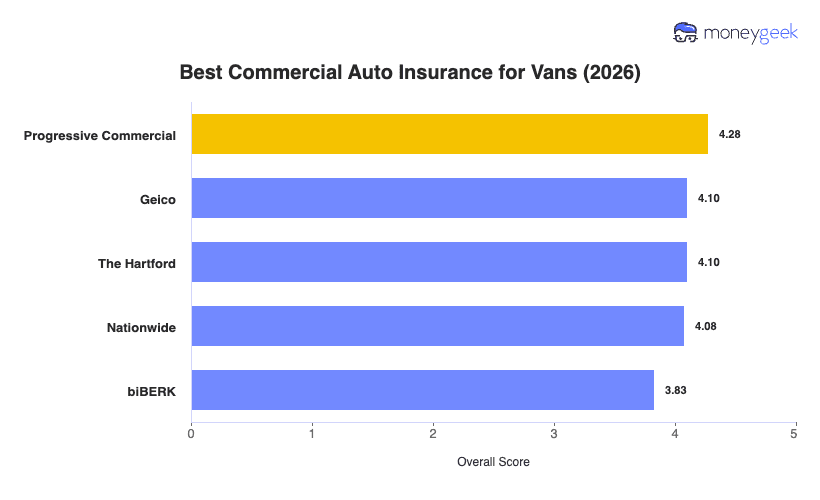
Progressive Commercial, GEICO and The Hartford are the best commercial auto insurance providers for vans, based on my analysis of affordability, customer experience and coverage depth.
Progressive Commercial ranks first overall for van commercial auto insurance, but the right fit for you depends on your industry, location and what your business actually needs from a policy.
Get matched to the best commercial auto insurer for your van and get quotes in minutes using MoneyGeek's tool below.
Select state
Updated: August 13, 2026
Advertising & Editorial Disclosure
How I Built These Best Small Business Insurer Rankings
Top Picks: Best Commercial Auto Insurance Companies for Vans
My analysis of the data shows that no single insurer stands out as the “right” commercial auto insurance provider for every van. Progressive Commercial has the highest overall score, but the best commercial auto insurance provider for you depends on three things: how your van is used, what a serious accident or cargo claim would actually cost and how much claims support your business needs when something goes wrong. Those factors play out differently for every operation, which is why the right answer for a solo florist running one cargo van looks nothing like the right answer for a healthcare company managing a fleet of passenger vans.
I picked each provider below for a specific reason, and that reason matters more than the overall ranking when your business has a particular risk profile or set of priorities:
- Progressive Commercial: Best Overall, Best for Fleet Operations
- GEICO: Best for Low-Risk Business Areas
- Nationwide: Best for Agricultural and Specialty Fleets
- The Hartford: Best for Coverage Depth
- biBerk: Best for Simple Coverage Needs
The table below shows how they ranked in this analysis for a side-by-side view.
| Progressive Commercial | 4.28 | 1 | 1 | 4 |
| Geico | 4.10 | 3 | 2 | 3 |
| The Hartford | 4.10 | 4 | 2 | 1 |
| Nationwide | 4.08 | 2 | 5 | 2 |
| biBERK | 3.83 | 5 | 4 | 5 |
I created summaries below to help you identify whether the provider is a good fit or if you need to look elsewhere. Overall rankings mean nothing if a provider doesn't match your specific operation type, industry or coverage need.

Progressive
Best Overall, Best for Fleet Operations
Progressive Commercial provides the best rates while having top marks on customer service, making it my pick as the overall best commercial auto insurance for vans. It's the largest commercial auto insurer in the U.S. by written premium and has held that position for over a decade, backed by a fully digital purchase experience, same-day coverage and a fleet telematics platform. Averaging $159 per month, it's 16% below the market average across 20 of 22 industry categories. The rate advantage thins out in agriculture, consulting and tech, where Progressive prices above the market average, and its coverage options rank fourth of five, so businesses that need deep policy customization will want to look at The Hartford.
Learn More: Progressive Business Insurance Review

GEICO
Best for Low-Risk Business Areas
GEICO is my pick for small business owners who want to get their vans covered quickly, manage everything digitally and never have to call an agent. Its entire experience is built around self-service: full online quoting, same-day coverage, instant certificates of insurance and an app that handles policy changes, driver updates and claims filing from a phone. It averages $193 per month, 2% above the market average overall, but prices 6% to 16% below average in cleaning services, hospitality, education, transportation and other professional services. It's less competitive in real estate, childcare and healthcare, where rates run 21% to 31% above average and Progressive Commercial is the better option.

Nationwide
Best for Agricultural and Specialty Fleets
Nationwide is my pick for van operations in agriculture, contracting and specialty fleet work where its combination of competitive pricing and strong coverage structure gives it a real edge. Founded in 1926 as Farm Bureau Mutual, it still has a dedicated agribusiness division with commercial auto programs built specifically for farm and agricultural operations. It averages $164 per month for van coverage, 13% below the market average, and ranks first in affordability for agriculture, consulting, recreation and other professional services. Its coverage ranks second, so it's the strongest option on policy structure outside of The Hartford. The trade-off is customer experience, where it ranks last of the five providers, and its purchase process requires an agent to finalize rather than completing entirely online. Tech and fitness businesses also see rates run well above average, where Progressive Commercial or GEICO are better fits.
Learn More: Nationwide Commercial Auto Insurance Review

The Hartford
Best for Coverage Depth
The Hartford is the strongest option for van operations that need the most comprehensive policy structure available, even at a higher price. It ranks first in coverage options and second in customer experience, and it is the only carrier in MoneyGeek's analysis with a dedicated risk engineering team built into its fleet management program. With over 200 years in commercial insurance, The Hartford brings claims specialists, a self-service COI portal and written repair guarantees through its preferred network. At $220 per month on average, it runs 16% above the market average and ranks fourth on affordability, so businesses where price is the primary driver will find better value with Progressive Commercial. The Hartford ranks first overall in agriculture and consulting van coverage, where its coverage structure outweighs the rate premium for the right operation.
Learn More: The Hartford Business Insurance Review

biBerk
Best for Simple Coverage Needs
biBerk is my pick for fitness, tech and IT businesses who need basic commercial coverage fast and want no broker involvement. Founded in 2015 as a Berkshire Hathaway direct-to-business brand, it's built entirely around speed. A full commercial van policy can be quoted, purchased and issued with a certificate of insurance in under 10 minutes, with 24/7 self-service for adding vehicles, updating drivers and managing billing. However, biBerk averages $212 per month, 12% above the market average overall, and ranks last on both affordability and coverage. It prices well in fitness (26% below average) and tech and IT (22% below average), but runs 20% to 37% above average in healthcare, construction, repair and maintenance, hospitality and wholesale distribution. It's also only available in 21 states.
Learn More: biBerk Business Insurance Review
Best Commercial Auto Insurance for Vans by Industry
I rank Progressive Commercial first overall in 20 of 22 industries I've analyzed, but that ranking reflects a combination of affordability, customer experience and coverage scores. In tech, recreation and professional services, Progressive actually runs above the market average, but its strong customer service still makes it the best option in those industries. In agriculture and consulting, The Hartford ranks first overall. The table below shows my picks for the best commercial van auto insurer by industry, their average monthly rate and the top provider's rate for that industry.
| Agriculture & Natural Resources | The Hartford | 2 | 2 | 1 |
| Arts, Media & Entertainment | Progressive Commercial | 4 | 1 | 4 |
| Childcare Services | Progressive Commercial | 1 | 1 | 4 |
| Cleaning Services | Progressive Commercial | 1 | 1 | 4 |
| Construction & Contracting | Progressive Commercial | 1 | 1 | 4 |
| Consulting Services | The Hartford | 4 | 2 | 1 |
| Education | Progressive Commercial | 1 | 1 | 4 |
| Fitness Services | Progressive Commercial | 3 | 1 | 4 |
| Food & Beverage | Progressive Commercial | 1 | 1 | 4 |
| Healthcare & Medical | Progressive Commercial | 1 | 1 | 4 |
| Hospitality, Travel & Tourism | Progressive Commercial | 1 | 1 | 4 |
| Manufacturing | Progressive Commercial | 1 | 1 | 4 |
| Nonprofit & Associations | Progressive Commercial | 1 | 1 | 4 |
| Other Professional Services | Progressive Commercial | 3 | 1 | 4 |
| Pet Care Services | Progressive Commercial | 1 | 1 | 4 |
| Real Estate & Property Services | Progressive Commercial | 1 | 1 | 4 |
| Recreation & Sports | Progressive Commercial | 3 | 1 | 4 |
| Repair & Maintenance | Progressive Commercial | 1 | 1 | 4 |
| Retail & Product Rental | Progressive Commercial | 1 | 1 | 4 |
| Tech/IT | Progressive Commercial | 3 | 1 | 4 |
| Transportation & Logistics | Progressive Commercial | 1 | 1 | 4 |
| Wholesale & Distribution | Progressive Commercial | 1 | 1 | 4 |
The best commercial auto insurance for vans depends heavily on what your business does. These pages break it down by industry:






What Determines the Best Commercial Auto Insurance for Vans for You
The best commercial auto insurance for vans is not defined by a single factor. The right provider balances affordability across the specific industry, offers coverage that matches how the van is actually used and features a claims process that holds up when it matters most. Three areas matter most when evaluating which insurer fits the operation.
 Affordability Across Your Industry and Use Case
Van commercial auto pricing varies significantly by industry category, and the gap between the most and least expensive carrier for the same type of business can be substantial. In wholesale and distribution, rates range from $146 to $293 per month across the five providers in MoneyGeek's analysis. Transportation and logistics, repair and maintenance and healthcare operations show similar gaps of $100 or more per month between the most and least competitive carriers. Pulling quotes from multiple providers before committing is particularly important for businesses in these industries.
 Coverage That Matches Your Fleet's Risks
Commercial van insurance should reflect what the insured vehicle actually does and carries. A cargo van hauling equipment for a contractor carries different coverage requirements than a passenger van transporting clients, and a fleet of healthcare vans running daily routes presents different risk exposure than a single vehicle used for occasional deliveries. These factors deserve close attention when evaluating policies:
- Liability limits: State minimums are a starting point, but actual needs depend on the specific risk profile. For passenger vans, a single serious accident with multiple occupants generates a separate bodily injury claim from each person in the vehicle simultaneously, and a policy at minimum limits can be exhausted before the first claimant is fully paid out.
- Vehicle use classification: How the van is used and what it carries affects both eligibility and pricing. The carrier should be confirmed to cover the specific use, whether service calls, deliveries, passenger transport or cargo hauling, before binding coverage.
- Cargo and equipment protection: Tools, goods and specialized equipment inside the van are not covered by commercial auto insurance. When the operation depends on what's in the van, inland marine or motor truck cargo coverage should be part of the coverage review.
- Hired and non-owned auto: When employees use personal vehicles or rented vans for business purposes, this coverage extends liability to those vehicles. It is one of the most commonly skipped endorsements and one of the most frequently needed.
- Deductible structure for fleets: Most van policies apply a deductible per vehicle per incident. When multiple vans are involved in the same accident, the deductible applies multiple times. Whether the carrier offers a fleet deductible structure should be confirmed, along with whether newly added vans are covered automatically for 30 days after purchase. Most carriers include that window, but the carrier must be notified to extend coverage beyond it.
- Passenger liability: Vans used for shuttle services, non-emergency medical transport or any passenger-carrying use carry per-passenger bodily injury exposure. Each person in the van at the time of a serious accident is a potential claim, which affects how much liability coverage the operation actually requires.
- Customer Experience and Claims Support
Commercial van claims work differently from personal auto coverage, and the service quality gap between carriers shows up most clearly when a vehicle is out of commission and the business is waiting on a repair or a settlement. Check whether the claims team is available around the clock or only during business hours, whether your claim gets a dedicated commercial adjuster or goes through a general call center, and whether you'll have a consistent point of contact throughout the process. NAIC complaint ratios give you an unbiased benchmark, but it's also a good idea to check provider reviews from forums on Reddit and Facebook.
How to Choose the Best Commercial Auto Insurance for Vans
Van operators who overpay for coverage often make the mistake of describing the operation incorrectly at the quote stage and getting placed in the wrong risk category. The steps below lead to the right policy at the right price.
- 1Define Your Risk Profile
Each van in operation should be categorized as owned, leased or employee-owned but used for business purposes. The primary use of each van, annual mileage per vehicle and the driving records of all operators should be recorded. Mileage is a meaningful underwriting factor because carriers tier rates by annual miles driven, and the gap between 10,000 and 25,000 miles per year on the same van can move the operation into a higher pricing bracket with some underwriters. For businesses in healthcare, construction, transportation and cleaning services, use classification warrants careful attention, since how the van is used and what it carries directly shapes both pricing and which carriers will write the policy.
- 2Determine Your Coverage Requirements
Once the risk profile is in place, determining which coverage types the operation requires beyond the state minimum is the logical next step. For van operations, that determination typically covers:
- Vans hauling goods or cargo for third parties require motor truck cargo coverage. The need applies to healthcare supply delivery, wholesale distribution and any operation where freight in transit is the primary function.
- Financed or leased vans must carry collision and comprehensive coverage. Without it, a total loss leaves the operator exposed to a balance owed to the lender that exceeds the insurance payout.
- When employees operate personal or rented vans for business purposes, hired and non-owned auto coverage is required. Without it, the employee's personal auto policy is the sole line of defense during a work errand in a personal vehicle, and personal policies routinely exclude business use.
- Passenger vans used for for-hire transport, shuttle services or non-emergency medical transport may activate higher state minimum liability requirements and, for interstate operations, FMCSA minimums of $1.5 million for 15 or fewer passengers. A cleaning company transporting its own employees doesn't cross that threshold, but a shuttle service charging fares does.
- 3Research Providers by Industry and Vehicle Type
Not all carriers price van risk the same way, and the classification conversation happens before the quote. Shortlisted carriers should be contacted directly to confirm how they classify the specific van use: service, delivery, passenger transport or cargo hauling. The same operation gets classified differently by different underwriters, and that classification drives the premium more than any other single factor. Carriers that have demonstrated pricing strength in the relevant industry, using the data earlier on this page, should be identified first, then their classification treatment confirmed before investing time in a full quote.
- 4Evaluate Coverage Quality and Policy Terms
Comparing premiums reveals what a policy costs, but comparing policy terms reveals what the coverage actually delivers. For each shortlisted provider, the standard versus endorsement-only coverages, available liability limits and exclusions that could affect a claim should all be reviewed. How the policy handles mid-term additions should also be confirmed. Most carriers include a 30-day automatic coverage window when a van is added, but the carrier must be notified before that window closes or the new vehicle is not covered.
- 5Get Quotes to Confirm
Quotes should be requested only after narrowing the options through research. A quote validates whether a provider's pricing holds for the specific fleet, location and coverage requirements. When a quote comes back higher than expected, the vehicle use classification submitted should be reviewed before ruling out the carrier. Listing a delivery van as a service vehicle is one of the most common reasons quotes reprice significantly at underwriting, and correcting it early saves time on both sides.
- 6Confirm Filing Requirements Before the Policy Binds
When it is unclear whether the operation triggers federal filing requirements, the carrier should be asked whether the specific van use requires additional filings before the policy binds. Most standard van operations don't cross the threshold, but two situations consistently do:
- Vans used in interstate commerce with a gross vehicle weight rating over 10,001 pounds require a U.S. Department of Transportation number and a federal insurance endorsement that makes the policy a direct obligation to injured members of the public.
- Vans carrying passengers for compensation may require state-level for-hire operating authority depending on the state and passenger count.
A carrier with full knowledge of the operation upfront can confirm whether filings apply and incorporate them into the policy correctly from day one.
Best Commercial Auto Insurance for Vans: Bottom Line
Selecting the right commercial auto insurance for a van starts with three questions: what the van actually does for the business, which industry it operates in and what a serious accident would actually cost. Those answers narrow the field faster than any rate comparison, because pricing and coverage fit vary more by use case and industry. These factors deserve careful consideration before a single premium is reviewed.
Not every provider fits every business, and the lowest-premium policy isn't always the best value when it leaves gaps in coverage. The service model also matters: a fully digital, self-service experience suits operations that prefer to manage everything online, while agent-supported guidance works better for accounts that benefit from direct contact. Two or three quotes then confirm whether the right fit on paper holds up for the specific fleet and requirements.
Best Commercial Van Insurance: Next Steps
For most van operations, the right starting point is pulling quotes from Progressive Commercial and GEICO. Progressive Commercial is the strongest overall option, leading in affordability and customer experience across the widest range of industries and use cases. GEICO is the better fit for smaller, service-oriented operations seeking a fully digital, self-service experience without an agent. When the van operation involves agriculture, consulting or complex coverage needs, The Hartford is worth adding to the shortlist.
Recommended: If You're Ready to Get Quotes Now
By this point you should know your fleet composition, your coverage requirements and which providers match your industry and van use case. Request quotes from at least three providers and compare both price and policy terms before committing. If a quote comes back higher than expected, check your coverage selections and vehicle use classification before ruling out a provider.
If You Want to Confirm Cost Before Deciding
Pricing for commercial van insurance varies a lot by industry and use case. A wholesale distribution van and a consulting firm's cargo van can price out very differently with the same carrier. Use the resources below to ground your cost expectations before reaching out to any provider.
If You're Unsure What Coverage Your Fleet Needs
Start by mapping your actual exposure: what vans you operate, how they're used, what they carry and whether employees use personal vehicles for business. Each factor points to a specific coverage type, and missing one creates a real gap in financial protection.
If You Have Specialized Filing Requirements
Passenger-carrying vans used for for-hire transport, shuttle services or non-emergency medical transport may require state-level operating authority and higher minimum liability limits before a standard commercial auto policy is sufficient. Vans operating in interstate commerce with a gross vehicle weight rating over 10,001 pounds trigger federal filing requirements including a U.S. Department of Transportation number and a federal insurance endorsement. Confirm with your carrier whether your operation falls into either category before the policy binds.
How We Chose the Best Commercial Van Insurance Companies
Our goal was to identify which providers deliver the most consistent overall value across the three dimensions that matter most to business owners: what they pay, how well they're covered and how the carrier performs when they need support. Five providers made the cut for our van analysis: Progressive Commercial, GEICO, The Hartford, Nationwide and biBerk. We analyzed all five across 22 general industry categories covering transportation, healthcare, construction, cleaning services, food and beverage, agriculture and 17 other specific industry areas.
Scoring Model
Each of the five providers was scored across three weighted categories that combine into an overall score out of 5.
- Affordability (50% of overall score): Measures how competitively and consistently each provider prices van commercial auto coverage across industries and states, benchmarked against average rates.
- Customer Experience (30% of overall score): Evaluates how well each provider supports businesses across the full policy lifecycle, including buying, policy management and claims handling.
- Coverage Options (20% of overall score): Assesses how well each provider addresses common van fleet risks and how much flexibility it allows across coverage types and endorsements.
Learn more about our methodology.
About Mark Flores

Mark Flores is a Business Insurance Content Writer at MoneyGeek, where he focuses on commercial auto, commercial property, cyber and specialty business insurance coverage. His work simplifies coverage terms, gives business owners a strong baseline for expected costs, and narrows down policies and providers tailored to your operation, regardless of complexity.
Before joining MoneyGeek’s business insurance team, Mark worked as a Senior Content Writer at Clutch.co, where he produced structured B2B reviews and provider analyses based on client interviews, company research and service evaluation. That experience shaped his approach to business insurance content, especially when comparing insurers, explaining coverage differences and translating complex policy features into practical guidance for small business owners.
Mark also spent nearly 4 years as a digital marketing specialist serving small-business clients across industries such as home services, manufacturing and education. That background gives him practical context for how businesses evaluate vendors, manage operational needs and make purchasing decisions.
At MoneyGeek, he applies this research and evaluation experience to build guides that help transportation sectors, those with complex property-related risks (such as hotels and retail stores), and those most at risk of a cyberattack get the coverage they need at a reasonable price.
Linkedin: https://www.linkedin.com/in/mark-jason-flores-7844634a/
Contact Email: mark.flores@moneygeek.com