
Cheapest Pennsylvania General Liability Insurance Companies

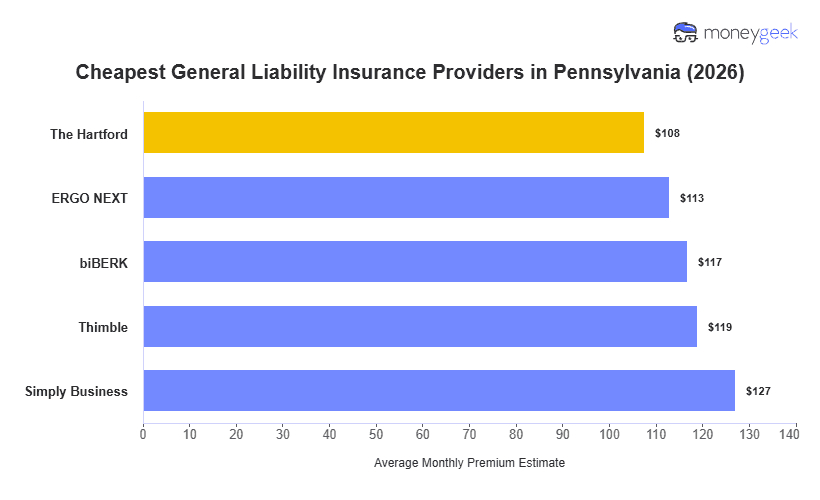
Pennsylvania small businesses, from Philadelphia storefronts to Pittsburgh service providers, can find the cheapest general liability insurance through these four insurers:

  • The Hartford: Cheapest for creative professionals and storefront retail (photography, dance studios, physical therapy, clothing stores)
  • ERGO NEXT: Most affordable for hands-on trades and personal services (handyman services, painting contractors, massage therapy, catering)
  • biBERK: Lowest rates for service-based operations and specialized care (janitorial services, gyms, dental practices, sports coaching)
  • Thimble: Cheapest for heavy construction and specialized trades (concrete contractors, HVAC, electrical work, welding)

[Click Each Provider to Learn More]

Your actual rate depends on what your business does, where you operate in Pennsylvania and your coverage limits. A catering company in Harrisburg won't pay the same as an HVAC contractor in Erie. Use these industry patterns as your starting point when comparing quotes.

The Hartford$93$1,12116%
ERGO NEXT$96$1,15214%
biBERK$102$1,2199%
Thimble$103$1,2378%
Simply Business$109$1,3082%
Progressive Commercial$117$1,399-4%
Coverdash$117$1,406-5%
Hiscox$126$1,512-13%
Nationwide$126$1,513-13%
Chubb$128$1,539-15%

How We Determined the Cheapest General Liability Insurance Providers

mglogo icon
CHEAPEST GENERAL LIABILITY INSURANCE IN PENNSYLVANIA DOESN'T MEAN BEST FIT

Saving on premiums makes sense until you need to file a claim. An Allentown contractor might pay $200 less per year for basic coverage, but have a $200,000 gap when a defect claim hits $1.2 million. Pennsylvania restaurants risk similar exposure: one slip-and-fall or liquor liability lawsuit can erase years of savings if your insurer delays payments or excludes critical coverage.

Price matters, but so does what you're actually buying. Our guide to the best general liability insurance providers in Pennsylvania compares quality and service beyond just rates.

The Hartford

The Hartford: Cheapest for Creative Professionals and Retail

On The Hartford's site
COMPANY HIGHLIGHTS

The Hartford ranks cheapest across the widest range of Pennsylvania business types, ranking lowest for 31% of the industries analyzed. Creative professionals like photographers and dance studios, as well as storefront retailers such as clothing stores and gift shops, see strong savings. Small businesses with one to four employees pay around $108 monthly with The Hartford. That's 14% below the Pennsylvania average, saving about $254 per year.

Most often cheapest for these business profiles:

  • General industries: Arts, Media and Entertainment, Education, Financial Services, Health Care and Medical, Marketing and Communications, Retail and Product Rental, Tech/IT
  • Employee count: One to 49 employees

Not a fit? Jump to: NEXT, Thimble or biBerk

ERGO NEXT

ERGO NEXT: Cheapest for Trades and Personal Services

On ERGO NEXT's site
COMPANY HIGHLIGHTS

Hands-on trades and personal service businesses get the lowest rates with ERGO NEXT. Handyman services, painting contractors, massage therapists and catering companies consistently pay less here than with other insurers. Operations spend an average of $113 monthly, saving about $191 annually compared to typical Pennsylvania rates. ERGO NEXT ranks as the cheapest for 30% of the business types we analyzed across the state.

Most often cheapest for these business profiles:

  • General industries: Beauty, Body and Wellness Services, Childcare Services, Manufacturing, Other Professional Services, Pet Care Services, Transportation and Logistics

Not a fit? Jump to: The Hartford, Thimble or biBerk

biBerk

biBERK: Cheapest for Service Operations and Specialized Care

COMPANY HIGHLIGHTS

Cleaning companies, fitness centers and dental practices find some of their lowest rates with biBERK. The insurer ranks cheapest for 23% of Pennsylvania business types, with particularly strong savings in real estate services, hospitality and recreation industries. Solo operators benefit especially as biBERK comes out cheapest for businesses with zero employees. Most small businesses in the state pay about $117 per month, $144 less per year than the Pennsylvania average.

Most often cheapest for these business profiles:

  • General industries: Cleaning Services, Fitness Services, Real Estate and Property Services, Repair and Maintenance
  • Employee count: Solo operators

Not a fit? Jump to: The Hartford, ERGO NEXT or Thimble

Thimble

Thimble: Cheapest for Heavy Construction Trades

COMPANY HIGHLIGHTS

Small construction businesses spend about $119 per month ($1,428 annually) for general liability coverage with Thimble. This translates to about $117 annual savings compared to the state average. Heavy trades, which make up about 4% of Pennsylvania business types, see better rates: tile contractors, concrete work, electrical installations and welding operations consistently save 30% or more.

Not a fit? Jump to: The Hartford, ERGO NEXT or biBerk

Explore the Cheapest General Liability Insurance in Pennsylvania by Industry

Insurers price policies based on what goes wrong in each line of work, which is why the cost of general liability insurance in Pennsylvania swings across industries. Physical risk drives the biggest differences: businesses operating heavy equipment or working at height, like construction crews in the Lehigh Valley or roofing contractors in Erie, pay more than office-based consultants in Pittsburgh who rarely file injury claims. Food service falls somewhere in the middle, with slip-and-fall exposure and kitchen hazards pushing rates higher than pure desk work but lower than trades involving power tools or ladders.

Compare industry-specific pricing to find which providers consistently rank cheapest for your business type.

Is the Cheapest General Liability Insurance Right for Your Pennsylvania Business?

Low-cost general liability policies cover basic slip-and-fall and property damage claims. They may not work for Pennsylvania businesses bidding state contracts or leasing commercial space. The gaps show up in different ways:

  • PennDOT project deadlines: Highway contracts require proof of insurance within 48 hours. Some budget carriers take up to six days to issue certificates.
  • Philadelphia lease requirements: Center City landlords require $2 million in coverage. Budget policies capping at $1 million cost you $100 to $175 extra for endorsements.
  • Construction project limits: Pittsburgh redevelopment work and Lehigh Valley warehouse projects need three to five insured parties added per job. Budget options cap you at two or three total.
  • Poconos seasonal closures: Ski lodges and lake rentals close from November through March. Most low-cost carriers won't pause coverage or waive premiums during off-months.

The cheapest option works for home-based consultants and simple service businesses. Contractors on public projects, retailers in downtown Philadelphia or seasonal Poconos operators risk gaps that cost more later.
For more details about this coverage type: General liability insurance guide

Is the Cheapest Right for Your Business?

How to Get Cheaper General Liability Insurance in Pennsylvania Without Sacrificing Protection

  • bag icon
    Compare general liability quotes using the same limits

    Requesting quotes with different liability limits won't show you who actually charges the least. One insurer might quote $500 annually for $1 million in coverage, while another quotes $450 for $500,000 in coverage. The second quote looks cheaper until you realize you're getting half the protection. Pick the coverage limits you need, whether that's $1 million per occurrence or $2 million, then request that exact amount from every insurer you compare. This shows you the true cost difference without the guesswork.

  • hammer icon
    Ensure your business classification (class code) is correct

    Insurers assign class codes based on your primary business activity, and the wrong code can increase your rate. A Philadelphia handyman doing light repairs and fixture installations might get classified as a general contractor working on commercial builds, which costs much more because general contractors face higher injury risks from heavy equipment, scaffolding and structural work. 

    Pennsylvania has a strong construction and trades presence, so misclassification happens often when insurers see "contractor" and default to the highest-risk category. Check your quote paperwork to confirm how the insurer categorized your business. If it doesn't match your actual daily work, ask them to reclassify before buying.

  • insurance2 icon
    Only pay for general liability coverage limits you actually need

    Higher liability limits cost more, so buying $2 million in coverage when you only need $1 million wastes money every month. Base your limits on what could realistically go wrong in your work and what your contracts require. 

    A home-based consultant working remotely for Philadelphia tech clients rarely needs more than $1 million per occurrence since injury and property damage risks are minimal. A contractor installing HVAC systems in Pittsburgh's older commercial buildings or warehouses along the I-78 corridor might need $2 million because landlords and general contractors require it in lease agreements and because aging infrastructure increases the risk of costly accidents during installation work.

  • money2 icon
    Use general liability deductibles and payments strategically

    Raising your deductible cuts your premium by 15% to 25% annually, but only works if you can cover that amount when a claim happens. An established accounting firm in Harrisburg with steady billings and cash reserves might save $400 yearly by moving from a $500 to $2,500 deductible. A new catering company in Erie building its client base may run into trouble with the same strategy. Scrambling to find $2,500 after a kitchen fire while still booking your first wedding season creates financial stress that cancels out any rate reduction.

  • coins2 icon
    Bundle general liability insurance when it lowers your total cost

    A business owner's policy (BOP) bundles general liability with property insurance, and it usually costs less than buying each separately. If you own a coffee roaster in Strip District with expensive equipment and beans stored on-site, you'll save money with a BOP since you need both coverage types. If you're a life coach in State College who meets clients at coffee shops or via Zoom, you don't have any commercial property to protect. Compare the cost of a BOP against standalone policies to see if it actually saves you money.

  • falling icon
    Lower your claim risk in ways Pennsylvania insurers reward

    Insurers price policies based on how likely you are to file claims, so demonstrating lower risk can cut your premium by 10% to 15%. Pennsylvania businesses can show insurers they're reducing claim exposure through:

    • Winter safety protocols: Document snow removal schedules and sidewalk treatment for Pittsburgh storefronts or Philadelphia row home businesses. Slip-and-fall claims spike during Pennsylvania's ice season.
    • Equipment maintenance logs: Keep records of HVAC system inspections, kitchen hood cleanings or machinery servicing, especially important for older buildings common across Allentown and Reading.
    • Employee safety training: Train construction crews on fall protection for multi-story projects in Harrisburg, or warehouse workers on proper lifting techniques in Lehigh Valley distribution centers.
    • Chemical handling procedures: Maintain pesticide application logs for Lancaster County landscapers or cleaning solution protocols for janitorial companies serving state office buildings.

    These aren't just paperwork. They prevent the actual claims that drive up costs for everyone operating in Pennsylvania.

Affordable General Liability Insurance in Pennsylvania: Bottom Line

There's rarely one insurer that offers the lowest rate for every Pennsylvania business. What's cheapest for a Pittsburgh contractor working on commercial projects differs from what's cheapest for a Philadelphia consultant meeting clients remotely. The challenge is finding affordable coverage that still handles your actual exposure and meets requirements tied to your work, like contract limits for prevailing wage projects or certificate turnaround for municipal bids. 

Narrow your options to insurers that usually rank as the cheapest for businesses like yours. Comparing quotes using identical coverage terms shows who actually charges the least for the protection your Pennsylvania operation needs.

If you're ready to get quotes: Get matched

Cheapest General Liability Insurance in Pennsylvania Chart

Cheap General Liability Insurance in Pennsylvania: Next Steps

If you want to confirm which insurer is cheapest for your business, compare quotes using the same coverage limits and endorsement requirements. Getting matched based on your industry and Pennsylvania location shows you actual rates instead of generic estimates.

Rates vary by industry, and factors like claims history and coverage limits drive costs for Pennsylvania businesses. Weighing those tradeoffs helps you decide whether the cheapest policy fits your work.

How We Determined the Cheapest General Liability Insurance Providers in Pennsylvania

To identify the cheapest general liability insurers for Pennsylvania businesses, we analyzed real pricing data from 10 major providers and modeled a large set of standardized pricing estimates across common small business profiles in Pennsylvania.

Dataset scope and assumptions

  • Providers analyzed: 10 major insurance providers
  • Industries covered: 408 industries
  • Employee count bands: Zero, one to four, five to nine, 10 to 19 and 20 to 49 employees
  • Policy baseline: Standard $1 million per occurrence/$2 million aggregate general liability policy
  • Pricing estimates modeled: Over 20,000

We also incorporated modeled average revenues and payrolls across Pennsylvania business profiles to improve pricing accuracy.

How we determined which provider was "cheapest"

We used this dataset to determine which insurers were most often the lowest-cost option across different Pennsylvania business profiles. Our "cheapest" rankings include both:

  • General recommendation: Provider rankings based on average estimated pricing for a standardized one-to-four employee business profile across all industries in Pennsylvania.
  • Factor Combination Recommendations: Provider rankings based on which insurer was most often cheapest within specific business factor combinations. For example:
    • We compared industry × Pennsylvania pricing using a standardized one-to-four employee profile
    • We derived employee count affordability by comparing aggregated pricing trends across industries in Pennsylvania

These results represent standardized pricing estimates, not personalized quotes. Actual pricing can vary based on your Pennsylvania business classification, revenue/payroll, claims history and the specific limits, deductibles and endorsements you choose. For the most accurate cheapest-provider answer, we recommend comparing quotes apples-to-apples using the same coverage limits.

About Angelique Palenzuela-Cruz


Angelique Palenzuela-Cruz, Business Insurance Writer, MoneyGeek

Angelique Palenzuela-Cruz is a Business Insurance Content Writer at MoneyGeek, where she specializes in general liability, workers’ compensation and professional liability insurance. Her work helps small business owners understand how these policies apply to coverage, including risks like customer injuries, employee injuries, professional mistakes, client contract terms and industry-specific coverage requirements.
She primarily covers service-based businesses where liability and employee coverage decisions are especially important, including cleaning, consulting, beauty and wellness, childcare, education, fitness, food service, pet care, repair and maintenance, and other professional services.
Before joining MoneyGeek, Angelique spent nearly 12 years at Guthrie-Jensen Consultants, one of Southeast Asia’s largest management training firms, where she advanced from Training Consultant to Managing Consultant. In that role, she worked with business clients to assess operational needs, develop training programs and present performance analyses to executive decision-makers. She also helped establish Gladwin Training Consultancy, where she served in learning solutions and client service roles.
Her background gives her practical context for writing about how businesses operate, manage client expectations, structure teams and make risk decisions. At MoneyGeek, she applies that experience to business insurance content, connecting coverage to actual business needs.

LinkedIn: linkedin.com/in/ma-angela-cruz

Email Contact: angelique.palenzuela@moneygeek.com