
Best General Liability Insurance Companies for Small Businesses in Connecticut

MoneyGeek's analysis of general liability insurance in Connecticut identified five providers that stand out for small business coverage across the state's industries, from hospitality venues near the coast to manufacturing operations in Naugatuck Valley:

  1. The Hartford: Best Overall, Best for Professional Services
  2. ERGO NEXT: Top for Customer Experience
  3. Simply Business: First-ranked for Comparing Multiple Carriers
  4. biBERK: Best for Service Businesses with Straightforward Needs
  5. Thimble: The best choice for Short-Term and On-Demand Coverage

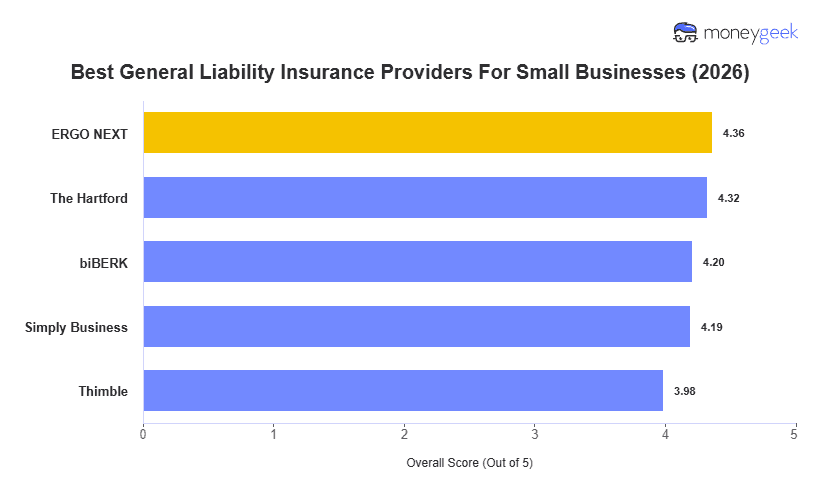
The top insurers understand Connecticut's regulatory environment and business needs. The comparison below shows what sets each one apart:

The Hartford
4.38
Best overall balance of affordability and coverage flexibility, with top-ranked policy management and the strongest value for Connecticut professional service businesses.
ERGO NEXT
4.36
Provides instant digital quotes and top-rated policy management tools, making it well-suited for Connecticut businesses that prioritize speed and self-service over agent relationships.
Simply Business
4.19
Its broker platform compares quotes from multiple carriers in a single application, making it ideal for Connecticut businesses that prioritize choice and flexibility.
biBERK
4.18
Its streamlined coverage and fast digital buying experience suit Connecticut service businesses with straightforward risks.
Thimble
3.98
Offers hourly, daily and monthly coverage with instant digital quotes, serving Connecticut gig workers, freelancers and businesses needing flexible project-specific insurance.

For our Connecticut general liability insurance ratings, we analyzed pricing, coverage options, and customer experience across 408 industries within the state. Our analysis focuses on 1-to-4-person businesses, which represent nearly half of Connecticut's small businesses, while weighting results to ensure broader industry and location representation across Hartford, Fairfield County, New Haven, and coastal and inland markets throughout the state.

To do this, we evaluated over 20,000 business profiles, more than 1,000 customer experience data points and performed in-depth analysis of coverage contracts and endorsements to compare how insurers serve Connecticut businesses consistently across different industries and regions. We then rated each company across categories of affordability (50% of overall score), customer experience (30% of overall score) and coverage options and terms (20% of overall score) to form an overall rating. For a detailed breakdown of the metrics, scoring methodology, and pricing analysis specific to Connecticut, see our full methodology.

95%

% of Small Businesses Covered

Over 20,000

Business Profiles Studied

1,061

Customer Experiences Analyzed

The Hartford
Best Overall, Best for Professional Services

The Hartford

On The Hartford's site

The Hartford tops MoneyGeek's Connecticut general liability rankings on affordability and coverage options. Connecticut businesses pay 15% below the state benchmark on average, with professional services like tech and education paying more than 20% less. Its local agent network supports strong claims handling and policy management, with in-state agents consistently outperforming national call centers on response time.

The tradeoff is quote speed. The Hartford's detailed risk review process takes longer than competitors, which makes it a poor fit for businesses that need coverage quickly.

Where The Hartford works best:

  • Professional service firms across Connecticut, including tech, consulting and financial services
  • Businesses with 1 to 49 employees that need scalable coverage
  • Operations that prefer working with an agent over self-service quoting
  • Connecticut contractors needing liquor liability or additional insured endorsements

Where The Hartford falls short:

  • Seasonal or inventory-heavy businesses such as hospitality and wholesale distribution
  • Buyers who need instant online quotes

The Hartford Business Insurance Review

ERGO NEXT
Best for Customer Experience

ERGO NEXT

On ERGO NEXT's site

ERGO NEXT ranks second overall in MoneyGeek's Connecticut general liability analysis, leading on customer experience with competitive affordability. Connecticut businesses pay $139 per month on average, 13% below the state benchmark. High-risk sectors like wholesale distribution, hospitality, construction and repair save the most. Its digital platform handles instant quotes, certificate generation and account access without agent involvement.

The tradeoff is coverage depth. ERGO NEXT's streamlined approach suits straightforward risks but doesn't include liquor liability or professional services endorsements that some Connecticut businesses need.

Where ERGO NEXT works best:

  • Solo operators and very small businesses across Connecticut industries
  • High-risk sectors including construction, hospitality and wholesale distribution
  • Buyers who prefer instant digital quotes over working with an agent
  • Businesses comfortable managing policies through an app

Where ERGO NEXT falls short:

  • Operations needing liquor liability or professional services endorsements
  • Businesses expecting frequent or complex claims requiring negotiation
  • Connecticut companies that need phone support or flexible billing options

Learn More: ERGO NEXT Insurance Review

Simply Business
Best for Comparing Multiple Carriers

Simply Business

Simply Business ranks third overall for Connecticut general liability insurance. It is an insurance broker that lets you compare quotes from multiple carriers with one application. It offers competitive customer experience with decent quote speed and pricing accuracy. You'll save 4% on average at $155 monthly, though affordability ranks mid-pack compared to other Connecticut options.

Where Simply Business performs best:

  • Buyers wanting to compare multiple insurance companies
  • Connecticut businesses wanting to look at different policy structures side-by-side
  • Operations prioritizing carrier choice
  • Businesses in food service or retail  

Where Simply Business performs less competitively:

  • Professional services firms in marketing, tech or consulting industries looking for affordable coverage
  • Buyers needing a coverage consultation during the quote process

Learn More: Simply Business Review

biBerk
Best for Service Businesses with Straightforward Needs

biBerk

biBerk averages $147 per month ($1,763 per year) for Connecticut general liability coverage. Service-oriented businesses in hospitality and healthcare save up to 32% below the state benchmark, while most other Connecticut businesses save around 9%, placing biBerk fourth on affordability statewide. Its digital platform provides fast quotes with transparent underwriting and optional agent support for businesses that want guidance during the buying process.

Post-purchase service is a weak spot. Policy management and claims handling rank mid-pack, with slower endorsement processing and adjuster assignment than The Hartford or ERGO NEXT. Coverage options are limited to straightforward risks with few specialty add-ons.

Where biBerk works best:

  • Solo operators and service businesses across Connecticut industries
  • Personal services, including fitness, pet care and cleaning
  • Professional services such as real estate and tech firms
  • Buyers who want fast digital quotes with the option to speak to an agent

Where biBerk falls short:

  • Beauty and wellness businesses, which pay around 30% above the state benchmark
  • High-risk sectors like construction and wholesale distribution
  • Operations that need same-day endorsements or specialty coverage add-ons

biBerk Business Insurance Review

Thimble
Best for Short-Term and On-Demand Coverage

Thimble

Thimble ranks fifth overall. It specializes in short-term, on-demand coverage by the hour, day or month. The insurer gives instant quotes and transparent pricing, and has competitive affordability at $145 monthly. You'll save just 3% on average compared to the Connecticut benchmark, though construction businesses save up to 23%.

Coverage options rank last because its on-demand model limits endorsements and traditional annual policies. Claims handling also ranks lower, with slow adjuster assignment and conservative settlements.

Where Thimble is the right fit:

  • Gig workers and freelancers needing project-specific coverage in Connecticut
  • Event vendors, photographers and consultants on short-term contracts
  • Businesses that need hourly, daily or monthly coverage flexibility
  • Operations that handle policy management through digital self-service tools

Where Thimble isn't the right fit:

  • Hospitality and entertainment businesses, which pay up to 28% above the state benchmark
  • Operations that need contract-required endorsements, such as additional insureds or waivers
  • Companies that want annual policies with phone support

Thimble Business Insurance Review

Explore The Best General Liability Insurance in Connecticut By Industry

If you want more personalized general liability insurance provider recommendations for your Connecticut business, we've provided industry-level resources below, from contractors and consultants to retail shops, tech startups, food businesses and more.

What Determines the Best General Liability Insurance for Connecticut Businesses

Choosing general liability insurance in Connecticut requires evaluating more than just premium costs. You need insurers that respond quickly when you're bidding on contracts, adjust coverage as your business changes, and maintain predictable pricing through growth cycles.

Four factors separate reliable insurers from those that create problems when you actually need coverage. Use these criteria to find providers that match how Connecticut businesses operate.

    coins2 icon
    Affordability without pricing volatility

    Your premiums shouldn't spike just because your Connecticut business is growing. Stable pricing matters when you're hiring staff to handle increased demand or expanding into new markets.

    Connecticut's coastal economy creates distinct seasonal patterns. A shoreline restaurant might earn most of its annual revenue during peak summer months between Memorial Day and Labor Day, then face quiet winter periods. Hartford's insurance and financial services firms maintain steadier billing cycles but still need rate stability when adding staff or opening new offices. Choose insurers that adjust coverage as you grow without surprise premium increases at renewal, especially if your revenue follows Connecticut's seasonal tourism patterns or professional services cycles.

    talk icon
    Responsive service throughout your policy term

    Connecticut businesses need insurers that respond quickly when finalizing contracts or managing urgent coverage changes. When contractors bid on projects or event planners book venues, they need proof of coverage immediately, not in three business days. Mobile vendors expanding service routes can't wait days for policy updates, so look for insurers that provide:

    • Certificate of insurance issued same-day or within hours when you book new work
    • Policy adjustments processed quickly as you add locations, employees or services
    • Clear answers about coverage without requiring you to decode insurance jargon

    Choose insurers that match your business timeline because slow responses may cost you opportunities when clients need immediate proof of coverage.

    insurance2 icon
    Coverage options that fit common small business risks

    Strong insurers let you customize general liability coverage and add endorsements as your business evolves. General liability covers basic risks like customer injuries and property damage, but Connecticut businesses often need additional protection: professional liability for consultants, liquor liability for restaurants or product liability for manufacturers. Look for insurers that let you:

    • Adjust liability limits as your client base shifts from residential to commercial contracts
    • Add endorsements when you expand services or enter higher-risk markets
    • Scale coverage when opening additional locations or hiring seasonal workers

    Build your policy around actual exposures, not generic packages that leave coverage gaps.

    building icon
    Why consistency across all three areas matters most

    Insurers must perform well on pricing, service speed and coverage flexibility. A weakness in any area undermines the others: low rates don't help when slow certificate processing costs you contracts, or when coverage gaps leave you exposed after a customer injury claim.

    Connecticut's competitive insurance market gives you options, so test all three criteria during shopping. Ask about certificate turnaround times for project bids, request sample policy language to review exclusions and compare how premiums adjust when you add seasonal staff or expand to a commercial location.

How to Choose the Best General Liability Insurance in Connecticut

Finding the right general liability insurance in Connecticut means matching coverage to how your business actually operates. A retail shop on the shoreline faces different seasonal patterns than a Hartford consulting firm with steady year-round clients. A landscaping company managing nor'easter cleanup has different risk exposures than a home-based graphic designer. These six steps help you identify providers that understand your specific situation rather than pushing generic packages.

  1. 1
    Optimize your payment and coverage structure

    Start by mapping the real risks your business creates. Think through the situations where customers, clients or their property could be injured or damaged through your work.

    A few questions worth considering:

    • Do customers visit your location in winter when icy walkways raise slip-and-fall risk?
    • Do you work inside client properties where equipment damage or water leaks could trigger a claim?
    • Do you provide services at venues hosting waterfront weddings or corporate events?
    • Does outdoor work leave you exposed when storms cause water damage at job sites?

    Most Connecticut small businesses carry $1 million per occurrence and $2 million aggregate limits, though the right amount depends on your industry. Contractors bidding on commercial projects often need higher limits. Home-based consultants may need lower limits paired with professional liability coverage. Set your baseline coverage before you start comparing insurers.

  2. 2
    Choose your primary priority

    Once you know your risk exposure, decide what matters most when comparing insurers.

    • Affordability: Steady premiums matter most if your revenue peaks during summer tourism months and slows in the off-season
    • Customer experience: Fast responses matter if you bid on time-sensitive contracts or need quick claim support after coastal storms
    • Coverage flexibility: Customization matters if you're moving from solo work to hiring employees or taking on commercial contracts

    Your top priority gives you a consistent filter when insurers look similar on paper.

  3. 3
    Shortlist two to three providers

    Match insurers to both your priority and your business type. If fast certificate turnaround matters for contract work, focus on providers known for quick processing in Connecticut's professional services market. If affordability drives the decision for a retail or hospitality operation, narrow to insurers with competitive rates for customer-facing businesses. Working with two or three well-matched options is more practical than evaluating every available provider.

  4. 4
    Double check for dealbreakers before investing more time

     Before going deeper on any insurer, confirm it clears your non-negotiables:

    • Do they offer limits high enough for your largest contracts or client engagements?
    • Can they issue certificates within hours when you're bidding on Connecticut state projects or responding to urgent client requests?
    • Do they offer the service model you need, whether that's a local agent or a digital self-service platform?

    Screening out poor fits early saves time you'd otherwise spend on detailed comparisons that go nowhere.

  5. 5
    Compare your finalists using the same three lenses

     Run each remaining provider through the same three criteria: cost stability, service quality and coverage options.

    • Affordability: Ask for premium projections that reflect realistic growth, such as adding summer staff for tourism season or opening a second Connecticut location
    • Customer experience: Find out how quickly they process certificates for time-sensitive bids and how they handle claims after nor'easters or winter storms
    • Coverage flexibility: Confirm they offer the endorsements you'll need as your business grows, including higher liability limits for commercial work or seasonal adjustments

    Compare responses side by side to find the best overall fit, not just the lowest price.

  6. 6
    Use quotes as the final confirmation step

    Get formal quotes from your final two or three providers. A New Haven cafe gets priced differently than a Fairfield County marketing firm even with identical coverage limits, since your industry, location and claims history all factor into your actual premium. Real quotes side by side remove the guesswork and show which provider offers the best value for your business.

Best Small Business General Liability Insurance in Connecticut: Bottom Line

The Hartford, NEXT and Simply Business lead our Connecticut rankings for general liability coverage. The right insurer varies by business type and what you prioritize. A Fairfield County consultant needs different coverage than a New Haven restaurant or a shoreline landscaping company. Use our top insurer as baselines and confirm which matches your needs best depends on your actual risk exposure and matters most for your business.

Best General Liability Insurance for Small Businesses in Connecticut: Next Steps

If you're ready to move forward, narrow to one or two insurers based on what matters most for your Connecticut business. Seasonal operations tied to coastal tourism need premium stability, businesses bidding on time-sensitive contracts need fast certificate processing, and growing operations expanding from home offices to commercial spaces need flexible coverage. Request quotes using identical limits so you can compare pricing and terms directly.

If you want to confirm cost before deciding

Connecticut pricing varies by business type and risk profile. A home-based consultant pays different rates than a restaurant or contractor. Knowing typical ranges helps you identify competitive quotes.

If you’re unsure how much coverage you need

Contract requirements in Connecticut often exceed standard $1 million limits, especially for commercial projects or corporate clients. Understanding actual requirements prevents coverage gaps and overpaying for unnecessary protection.

If you’re ready to check quotes now

After narrowing to insurers that fit your needs, quotes show how each evaluates your risk factors: industry type, seasonal revenue patterns and claims history.

  • Request general liability quotes with identical coverage limits to compare pricing accurately
  • Review policy exclusions and terms before finalizing your decision

How We Chose the Best General Liability Insurance Companies

To identify the best general liability insurance companies for Connecticut small businesses, we evaluated insurers across pricing, customer experience, and coverage options using a standardized, data-driven approach. Our goal was not to identify the cheapest option in every scenario, but to determine which providers deliver the most consistent overall value across common Connecticut small business profiles.

Our best recommendations reflect insurers that perform well across multiple dimensions and remain competitive across industries and business sizes in Connecticut.

Data and Analysis Scope

Our analysis is based on standardized estimates designed to represent the majority of Connecticut small businesses:

  • Providers analyzed: 10 major insurers serving Connecticut
  • Industries covered: 408 industries
  • Employee counts: 0–49 employees
  • Policy baseline: $1M per occurrence / $2M aggregate general liability policy
  • Pricing modeled: Just over 20,000 standardized estimates for Connecticut businesses

Modeled average revenues and payrolls were incorporated to improve pricing accuracy for Connecticut's business landscape.

Our Scoring Model

Each insurer received a composite score based on the weighted categories below.

  • Affordability (50% of overall score): Affordability reflects how competitively and consistently an insurer prices general liability coverage across all Connecticut business profiles studied.
  • Customer experience (30% of overall score): Customer experience measures how well insurers support Connecticut businesses throughout the policy lifecycle from purchase to claims. We also studied at each level of buying, policy management and claims sub-parts of the process that make it easier and more reliable within each as well for accuracy and comprehensive understanding.
  • Coverage options (20%): Coverage options reflect how well insurers support common Connecticut small business risks and allow for flexibility as businesses grow or change.

About Connor Bolton


Connor Bolton headshot

Connor Bolton is Senior SEO and Content Manager at MoneyGeek, where he leads the business and pet insurance editorial teams. As editorial lead for both verticals, Connor sets the research framework, data standards, and content structure that his writers execute, directly authoring in-depth guides himself and reviewing all team content for accuracy and practical value before it goes live. With over four years evaluating insurance products across personal, commercial, and specialty lines, he brings cross-vertical knowledge to every guide the team produces.

Connor architected MoneyGeek's insurance research infrastructure across all major verticals including auto, home, renters, life, health, business, and pet, building systems for pricing analysis, provider-level research, customer experience evaluation, and coverage analysis with AI support. The infrastructure includes over 6 million data points for business insurance across 408 industry areas, all 50 states, and 16 vehicle types, and over 5 million pet insurance profiles across 18 major providers and hundreds of breed and age combinations. Connor's insurance cost research and his team's work has been cited by the U.S. Chamber of Commerce, Allstate, Liberty Mutual, CBS News, Forbes and LegalZoom.

Beyond the data, Connor stays connected to how the market actually operates, drawing on direct conversations with underwriters and carrier liaisons at Ethos, The Hartford, NEXT Insurance, Nationwide, and State Farm, and monitoring business and pet owner communities including Reddit, to inform how he interprets findings and frames guidance for real buyers.

He is the direct editorial contact for methodology questions at connor@moneygeek.com and can be found on LinkedIn.