
Cheapest Car Insurance in Florida for 2026


Florida ranks as the most expensive state for car insurance, with full coverage averaging $243/month. Travelers, State Farm, Metropolitan Group, and UAIC are the cheapest insurers in Florida, depending on your driver profile:

Cheapest in Florida by coverage type

Cheapest by driver age

Cheapest by driving record and credit score

Cheapest Minimum & Full Coverage Car Insurance in Florida

Travelers is the cheapest for minimum coverage in Florida at $44 per month, but State Farm is only $1 more per month. State Farm is the lowest cost for full coverage at $127 per month. Rates between insurers in the state vary more than most states, and choosing State Farm over GEICO for full coverage saves $71 per month or $852 per year.

Both Travelers and State Farm cost less than the other insurers in this analysis and rank higher for customer service and claims, with Travelers at 4.89 out of 5 and State Farm at 4.53. Travelers and State Farm also top MoneyGeek's best car insurance in Florida, where service and claims scores are weighed alongside price.

4.89/5
$44
$131
4.53/5
$45
$127
4.27/5
$59
$198
3.85/5
$59
$166
4.38/5
$60
$171

Florida Rates Are Expensive: How to Get Cheaper Rates

Florida is the most expensive state for car insurance. A 20% uninsured driver rate and frequent weather-related claims push rates above the national average. Six actions can reduce your car insurance rate:

  • Compare at least three quotes. The gap between Travelers at $131 per month and Allstate at $380 per month for identical full coverage is $3,000 per year. No other single action saves more based on our analysis.
  • Raise your deductible if you live inland. Moving from a $500 to $1,000 deductible reduces what you pay for comprehensive and collision coverage.
  • Re-shop when violations age off. Most violations affect your rate for 3 to 7 years in Florida depending on severity, per the Florida Department of Highway Safety and Motor Vehicles. Shopping after this window will get you lower standard rates.
  • Improve your credit score before renewal. Carriers use credit-based insurance scoring in Florida, and a better score can lower your rate.
  • Enroll in a telematics program. Travelers IntelliDrive and State Farm Drive Safe & Save are offered in Florida and will lower the rate of low-mileage drivers. Both programs track mileage and driving habits through your phone. See our guide to usage-based and pay-per-mile car insurance.
  • Bundle home and auto. Most carriers offer a discount when you combine policies. Florida's higher base rates mean those savings add up to more dollars per year than in lower-cost states.

Cheapest Car Insurance by City in Florida

Travelers is the cheapest provider in six of the ten cities we analyzed. State Farm leads in the four most expensive markets: Miami, Hialeah, Fort Lauderdale and Tampa. Cape Coral is the cheapest city at $112 per month and Hialeah is the most expensive at $219 per month, a $107 per month or $1,284 per year gap within the same state for the same coverage level. Rate estimates personalized to your city and coverage level are available in MoneyGeek's Florida car insurance calculator.

Cape Coral
Travelers
$112
Fort Lauderdale
State Farm
$177
Hialeah
State Farm
$219
Travelers
$118
State Farm
$212
Orlando
Travelers
$129
Pembroke Pines
Travelers
$198
St. Petersburg
Travelers
$139
Tallahassee
Travelers
$114
Tampa
State Farm
$169

South Florida consistently produces the highest rates in the state. Miami, Hialeah and Fort Lauderdale all top $175 per month. High traffic density and weather risk push rates up, and fraud rates and uninsured driver concentration in these areas run above the statewide average. North and inland Florida costs less. Tallahassee at $114 per month and Jacksonville at $118 per month reflect lower population density and fewer weather and fraud-related claims. Orlando at $129 per month runs higher than both but still well below any South Florida market.

mglogo icon
MONEYGEEK EXPERT TIP: FLORIDA ZIP CODES

“Florida is the only state in this series where your ZIP code alone can swing your rate by an average of $110 a month with the same insurer and same coverage. That's $1,320 a year purely based on where you live within the state. If you're moving anywhere in Florida, re-shop before you sign a lease. Hialeah and Cape Coral are an hour apart by car and $92 a month apart on your insurance bill. Most drivers don't realize the city-level gap is bigger here than the provider gap in most other states.”

Mark Fitzpatrick, Licensed Property and Casualty (P&C) Insurance Producer in Connecticut

Cheapest Car Insurance by Age in Florida

Age is one of the biggest factors in what you pay for car insurance in Florida. Teen drivers pay the most but rates fall steadily through your 20s and reach their lowest point in middle age. Rates in Florida increase slowly over time for seniors after the age of 65 due to increased risk of accident as drivers age.

Teen Drivers (16, Female, Family Policy Add-On)
$595
Teen Drivers (16, Male, Family Policy Add-On)
$707
40-Year-Old Drivers
$127
Seniors (65+)
$159

Cheapest in Florida for Drivers With Violations

Travelers is cheapest for speeding tickets ($143/month) and at-fault accidents ($150/month). State Farm is cheapest for DUI ($145/month) and texting while driving ($145/month). UAIC, a specialty nonstandard insurer, is cheapest for bad credit at $148/month, a rate most standard carriers can't match for drivers with poor credit history.

According to the Florida Department of Highway Safety and Motor Vehicles, traffic violations remain on your driving record for 3 or 7 years, based on the severity of the violation. After this period, your rates in Florida will start to decrease and it's a good time to comparison shop for insurance.

Drivers with multiple violations can see additional options in Florida's high-risk car insurance market.

Violation
Cheapest Provider
Monthly Rate

DUI

$145

Texting While Driving

$145

Speeding Ticket

$143

At-Fault Accident

$150

Bad Credit

$148

Should You Buy the Cheapest Minimum Coverage in FL?

Buying the cheapest minimum coverage in Florida won't protect the assets of most drivers and it won't protect your car unless you add comprehensive and collision. Instead, determine the coverage you need and then find the cheapest insurer for that coverage. MoneyGeek's coverage guide walks through how to match your coverage level to your assets and risk before you start comparing prices. 

Florida's Minimum Car Insurance Requirement

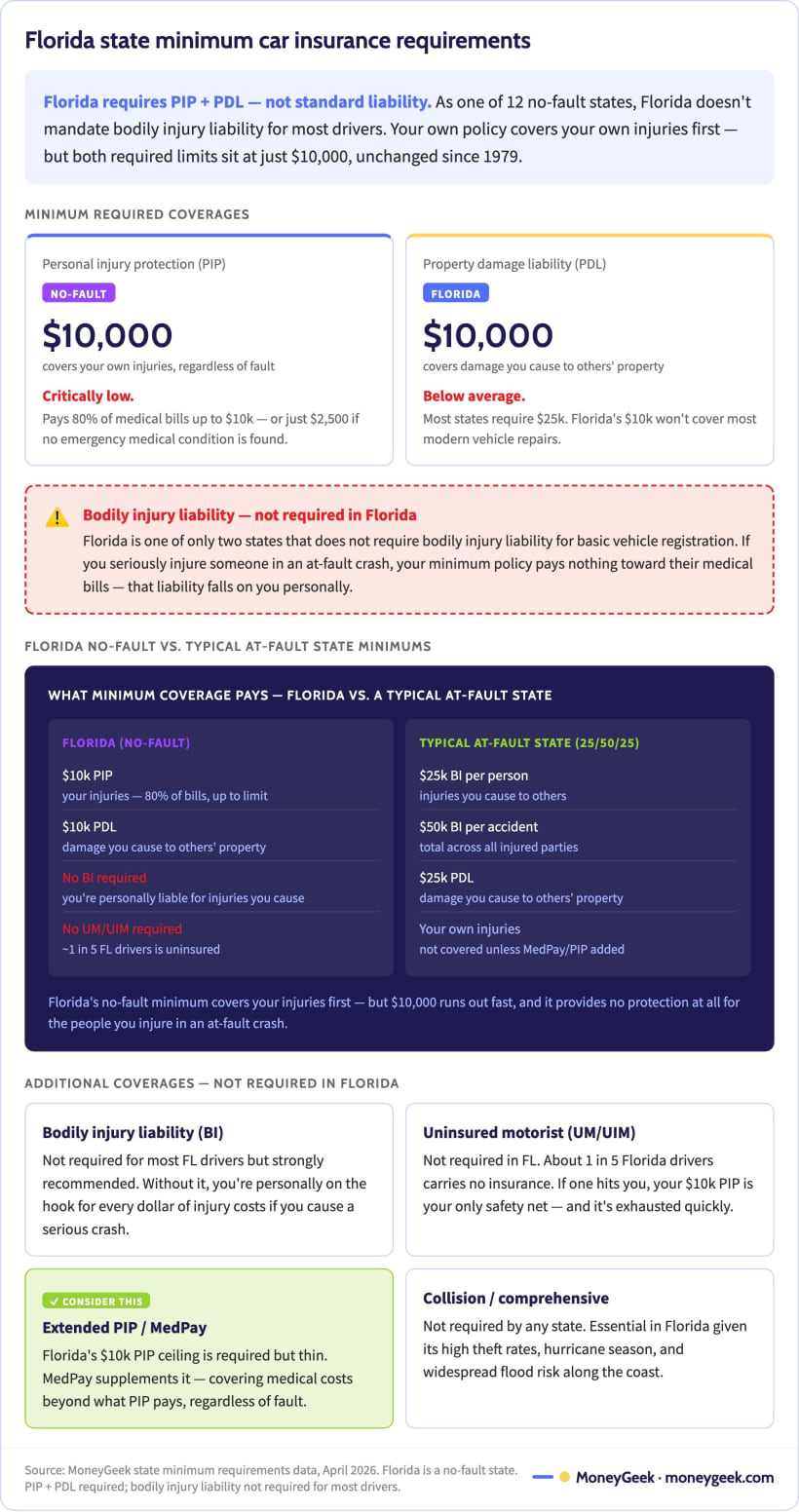
Florida has extremely low minimum coverage requirements. It requires every driver to carry $10,000 in Personal Injury Protection and $10,000 in property damage liability. Property damage liability covers damage you cause to other vehicles or property.

What Florida does not require is bodily injury liability, which is the coverage that pays for injuries you cause to other people in an accident you cause. "Most Florida drivers do not realize their minimum policy offers essentially no protection for the person they injure," says Mark Friedlander, Property and Casualty Insurance expert. “In a state with a 20% uninsured driver rate and no bodily injury requirement, carrying only the minimum is one of the riskiest financial decisions a driver can make.”

An image showing how Florida's state minimum coverage compares to other states and an explanation of what is covered and where you are left unprotected.

MoneyGeek analyzed 11 auto insurance providers across all Florida ZIP codes. Rate data was sourced from Quadrant Information Services. All rates are ZIP code averages; individual quotes vary.

Sample Florida driver profile (baseline):

  • 40-year-old male driver
  • Clean driving record
  • Good credit
  • 100/300/100 full coverage with a $1,000 deductible

Additional profiles analyzed:

  • Young drivers: ages 16 to 25, analyzed separately by gender for both standalone policies and family policy add-ons
  • Seniors: age 65 to 90
  • Drivers with violations: speeding ticket, at-fault accident, DUI conviction and texting while driving
  • Drivers with poor credit

Florida Coverage levels analyzed:

100/300/100 means:

  • $100,000 bodily injury liability per person
  • $300,000 bodily injury liability per accident
  • $100,000 property damage liability

Florida minimum coverage means:

  • $10,000 personal injury protection (PIP)
  • $10,000 property damage liability (PDL)
  • Bodily injury liability is not required for most Florida drivers

Deductibles applied: none (minimum coverage), $1,000 (full coverage baseline)

State-specific notes:

  • Florida is a no-fault state; PIP covers first-party medical costs regardless of fault
  • Gender is a rating factor in Florida; young driver rates reflect separate male and female profiles
  • Two young driver data series are included: standalone policies and family policy add-ons, both sourced from Quadrant Information Services 2026 dataset
  • UAIC is a specialty nonstandard insurer included for the bad credit profile
  • Metropolitan Group is included in the full competitive set
  • DUI surcharges affect rates for longer than three years in Florida
  • FR-44 filing required after a DUI conviction in Florida
  • A 2026 proposal (SB 522) to eliminate PIP and shift to an at-fault system died in committee as of March 31, 2026; current minimums remain in effect 

See our full methodology.

About Mark Fitzpatrick


Mark Fitzpatrick headshot

Mark Fitzpatrick, a Licensed Property and Casualty (P&C) Insurance Producer in Connecticut, is MoneyGeek's resident insurance expert. He has spent nearly a decade analyzing the market, first at LendingTree and now at MoneyGeek, where he has produced original research on hundreds of carriers and millions of rates across auto, home, renters, health and life insurance.

He writes about economics and insurance on MoneyGeek so people can make coverage decisions with confidence. His insurance insights have been featured in The Washington Post, The New York Times and NPR, among other media outlets.

Like all MoneyGeek analysts, he draws on independent cost and consumer experience data, and no insurance company partnership influences his recommendations.

Fitzpatrick earned his degrees from Johns Hopkins University (M.A. Economics and International Relations) and Boston College (B.A.) and began his career in financial risk management at State Street. He's also a five-time Jeopardy champion!


Sources