
How Much Does General Liability Insurance Cost in Massachusetts?

The average cost of general liability insurance in Massachusetts is $169 per month, or $2,027 annually, for businesses with one to four employees with policy limits of $1 million per occurrence/$2 million aggregate. This exceeds the national average by $46 monthly, ranking Massachusetts as the third most expensive state for general liability coverage nationwide.

The state sits at the high end of Northeast pricing. Among regional peers, only New York exceeds Massachusetts at $180 monthly, while Maine ($112), Vermont ($122), Rhode Island ($130), New Hampshire ($135) and Connecticut ($159) all come in below the state average. The spread shows a $57 gap between the lowest and highest regional costs, with Massachusetts positioned near the top of that range.

Use the state average as a reference point rather than a quote. Your actual premium depends on industry risk, business size and the coverage limits you select, all of which are factors that shift costs considerably even within Massachusetts.

To estimate average general liability insurance costs in Massachusetts, we analyzed quote data from major U.S. small business insurance providers and modeled standardized premium estimates across common business profiles. These modeled results are designed to provide a consistent state benchmark and show how premiums vary by key baseline factors including business size, industry and location within Massachusetts.

Dataset Scope and Assumptions

Our cost modeling uses standardized inputs for consistent comparisons across Massachusetts businesses.

  • Providers analyzed: 10 major insurance providers
  • Industries covered: 25 general industry categories relevant to Massachusetts's business landscape
  • Employee count bands: zero, one to four, five to nine, 10 to 19 and 20 to 49 employees
  • Policy baseline: standard general liability policy with $1 million per occurrence / $2 million aggregate limits
  • Total estimates modeled: over 20,000 standardized pricing estimates across Massachusetts industry and employee count combinations

We also incorporated modeled average revenue and payroll personalized across all combinations of Massachusetts regions, industry and employee counts to improve the accuracy of pricing. To model these assumptions against our cost factors, we used data from these sources:

  • CBP (for employee size class density in Massachusetts by NAICS)
  • QCEW (for wage/payroll intensity by industry in Massachusetts)
  • Economic Census / SUSB (for receipts/output intensity by industry)
  • Calibrated against:
    • Private comp databases
    • IRS SOI totals

How We Calculated Average General Liability Costs in Massachusetts

Our published averages represent modeled premiums for standardized business profiles and were aggregated in two ways:

  • Massachusetts state average: The Massachusetts average cost reflects the modeled premium for a standardized one to four-employee small business across all industries included in our dataset for a standard general liability policy.
  • Segment averages: To show how costs vary within Massachusetts, we calculated average modeled premiums for our state base profile and isolated for variables, including:
    • Employee count (business size ranges)
    • General industry categories

Segment averages were produced by aggregating modeled pricing trends across the full dataset so readers can compare how premiums shift across business types and regions within Massachusetts.

What Factors Affect General Liability Insurance Costs Massachusetts?

The cost of general liability insurance in Massachusetts reflect both universal underwriting principles and state-specific conditions. Insurers weigh operational characteristics that apply nationwide alongside Massachusetts's distinct legal climate, economic structure and catastrophe risk profile when setting premiums.

Massachusetts Agnostic General Liability Insurance Cost Factors

Certain cost drivers affect general liability pricing regardless of location. Business size and industry type shape premiums nationwide because they reveal operational scale and the physical risks inherent to the work.

    smallBusiness icon
    Business size

    In Massachusetts, sole proprietors pay 51% less than the average, while operations with 20 to 49 employees pay 1,914% more. Employee count shapes general liability pricing because larger workforces signal greater exposure: more customer interactions, higher work volume and increased claim probability. Insurers adjust premiums to reflect the operational complexity and loss potential that grow with headcount.

    contractor icon
    Industry classification

    Tech and IT businesses in Massachusetts run 81% below the state average, reflecting minimal physical exposure and office-based operations. Construction and contracting premiums sit 208% above that benchmark, driven by worksite hazards, equipment use and elevated injury risk.

    Industry type drives general liability pricing because operational exposure varies across business models. Insurers weigh physical risk, worksite conditions, customer interaction patterns and claim potential. These create contrasts between low-risk desk work with hands-on operations involving equipment, customer locations or hazardous conditions.

Massachusetts-Specific General Liability Insurance Cost Factors

Massachusetts's regulatory environment, catastrophe exposure and economic composition create cost pressures distinct from national patterns. These state-level factors layer onto standard underwriting variables, shifting premium benchmarks relative to markets with different legal frameworks and industry concentrations.

    checkList icon
    Massachusetts's Papadopoulos Rule (2010 Snow/Ice Liability Law)

    The state abolished the "natural accumulation" defense for slip-and-fall accidents, holding property owners liable for all snow and ice regardless of origin. This significantly increases winter liability exposure for businesses, driving premiums higher due to elevated claim frequency during the state's harsh winters with 100+ inches of annual snowfall in some areas.

    winterStorm icon
    Massachusetts's Winter Weather Severity

    Severe winter conditions including nor'easters, ice storms and freeze-thaw cycles create hazardous walking surfaces for customers and visitors. Winter months produce the highest volume of third-party slip-and-fall claims at retail stores, restaurants and commercial properties. Insurers price for this seasonal spike in premises liability risk, particularly affecting businesses with exterior walkways, parking lots or public-facing operations.

    congress icon
    Massachusetts's Strong Consumer Protection Laws (Chapter 93A)

    The state's consumer protection statute allows triple damages for unfair or deceptive business practices. Good faith settlement standards require insurers to settle claims where liability is "reasonably clear," creating higher claim payouts and increased litigation risk. Insurers factor these elevated costs into premiums across all industries.

    massachusetts icon
    Massachusetts's Urban Density and High Foot Traffic

    Boston, Cambridge, Worcester and Springfield feature dense commercial districts with elevated pedestrian activity. Higher foot traffic increases slip-and-fall exposure, particularly during winter months when ice and snow create hazardous conditions. Businesses in urban areas face more frequent premises liability claims, driving premiums higher than rural or suburban locations.

    driverLicense icon
    Massachusetts's Construction Licensing and Regulatory Requirements

    Contractors must obtain Construction Supervisor Licenses (CSL) and Home Improvement Contractor (HIC) registration for projects exceeding $1,000 on residential properties. These mandatory requirements, enforced by the Office of Public Safety and Inspections, increase compliance costs and create additional liability exposure for businesses operating without proper credentials or insurance documentation.

    hurricane icon
    Massachusetts's Hurricane and Coastal Storm Exposure

    Massachusetts has experienced 45 confirmed billion-dollar weather disasters from 1980 through 2024, including nine tropical cyclones and 15 severe storms. Coastal businesses face elevated property damage and liability risk from hurricanes, nor'easters and flooding. Atlantic hurricane season runs June through November, with peak activity creating construction delays, equipment damage and storm-related liability claims.

    business icon
    Massachusetts's Business Risk Doctrine in Court Rulings

    State courts exclude defective workmanship from coverage under standard general liability policies, treating faulty work as an uninsurable business risk rather than a covered accident. This interpretation increases exposure for contractors who may assume their GL policy covers all work-related claims, creating gaps that drive demand for additional professional liability coverage.

Average General Liability Insurance Costs in Massachusetts by Business Size

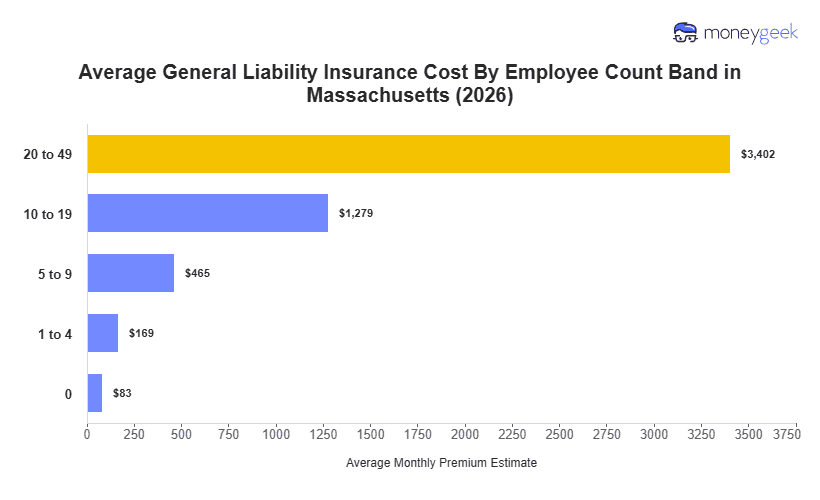
General liability premiums in Massachusetts scale with workforce size, ranging from $83 monthly for sole proprietors to $3,402 monthly for businesses with 20 to 49 employees. The steepest percentage increase occurs when adding a fifth employee, with premiums jumping 175%. It reflects how crossing small thresholds introduces disproportionate exposure to workplace and customer-facing liability claims. 

The table breaks down monthly and annual costs for each employee count bracket:

Massachusetts General Liability Insurance Cost Chart

Average General Liability Insurance Costs in Massachusetts by Industry

Massachusetts general liability insurance costs show a split market. Most industries pay well below the state average of $169 monthly, while a small group of high-risk sectors pushes costs significantly higher. Four patterns explain this distribution:

  • Most Massachusetts businesses pay far less than the state average. Eighty-one percent of industries fall below $169 monthly, with a median of $109. Construction ($519) and health care ($284) pull the average upward, but the typical business in professional services, retail, or other services pays $32 to $162 monthly.
  • Construction is an extreme outlier that distorts the market picture. At $519 monthly, 208% above average and nearly twice the cost of the second-highest industry (health care at $284, construction and contracting represents a fundamentally different risk profile than other industries. This single sector makes statewide averages misleading for the 75% of businesses operating in lower-risk industries.
  • Massachusetts's economic growth concentrates in its lowest-cost insurance sectors. Tech and IT ($32), professional services ($35 to $110), and financial services ($64) contribute over 40% of state GDP while representing the cheapest general liability coverage. Fast-growing industries also cluster in this $32 to $162 range, creating favorable conditions for entrepreneurship.
  • The cost spectrum reveals three distinct business ecosystems. Knowledge workers and professional services (32% of industries) pay under $65 monthly. Service and retail businesses (64% of industries) pay $76 to $200. High-touch sectors serving vulnerable populations or involving physical hazards pay $188 to $519, with construction standing alone at the extreme.
Data filtered by:
Select
Agriculture & Natural Resources$136$1,63619%
Arts, Media & Entertainment$52$62169%
Beauty, Body & Wellness Services$58$70065%
Childcare Services$201$2,409-19%
Cleaning Services$150$1,80511%
Construction & Contracting$519$6,233-208%
Consulting Services$35$42579%
Education$62$74163%
Financial Services$64$76462%
Fitness Services$125$1,49826%
Food & Beverage$188$2,257-11%
Healthcare & Medical$284$3,412-68%
Hospitality, Travel & Tourism$163$1,9544%
Manufacturing$105$1,25838%
Marketing & Communications$39$46477%
Nonprofit & Associations$81$96752%
Other Professional Services$110$1,31835%
Pet Care Services$91$1,09246%
Real Estate & Property Services$58$69866%
Recreation & Sports$76$91555%
Repair & Maintenance$115$1,38232%
Retail & Product Rental$125$1,50326%
Tech/IT$32$38781%
Transportation & Logistics$94$1,13044%
Wholesale & Distribution$162$1,9394%

Use these resources to explore costs for your industry.

How to Lower General Liability Insurance Costs Without Sacrificing Coverage

After finding the cheapest general liability insurance in Massachusetts, businesses maintain affordability through active cost management. Premium reduction strategies separate into immediate policy modifications and sustained operational improvements, each offering distinct timelines and savings potential for different business situations.

Quick General Liability Cost Lowering Methods

Massachusetts businesses can lower general liability costs through immediate policy adjustments and purchasing decisions. These changes require no waiting period and take effect as soon as you implement them during your next renewal or coverage modification.

    insurance2 icon
    Provide clean, accurate underwriting information

    A Cambridge software consultant misclassified as a construction firm could face premiums 15 times higher than necessary. Insurers base rates on precise industry codes, revenue, employee count, and loss history, which means even small inaccuracies carry consequences. Worcester manufacturing businesses underreporting employee counts risk coverage denials when winter slip-and-fall claims occur. Similarly, Cape Cod restaurant owners switching from seasonal to year-round operations must update revenue projections immediately to avoid mid-policy rate adjustments.

    shoppingCart icon
    Compare multiple insurers

    Massachusetts insurers price general liability coverage differently based on industry specialization and risk appetite. Worcester breweries receive quotes ranging from $95 to $380 monthly for identical coverage since one carrier specializes in food and beverage operations while another focuses primarily on construction. Boston biotech startups working with life sciences specialists often secure rates 40% lower than generalist insurers.

    Request quotes from at least three carriers experienced in your industry. Springfield retailers and Berkshire tourism operators discover substantial savings when comparing insurers who account for seasonal revenue patterns against those pricing continuous year-round exposure.

    building icon
    Bundle general liability into business owner's policies (BOP)

    A business owner's policy bundles general liability with commercial property coverage at 15% to 25% lower cost than purchasing policies separately. Cambridge coffee shops protecting espresso machines and inventory, Northampton retail stores covering merchandise and fixtures, and Worcester restaurants insuring kitchen equipment all have physical locations and could benefit from this packaging. Compare the typical cost of a BOP against purchasing separate policies to confirm if it leads to savings.

    coins2 icon
    Pay annually instead of monthly

    Annual payment eliminates installment fees that add 5% to 10% to total premiums. Cape Cod bed-and-breakfasts and Berkshire ski lodges timing annual payments to peak summer and winter revenue seasons avoid cash flow strain while capturing discounts. Lowell manufacturing plants and New Bedford fishing operations with predictable cash flow can align annual payments with fiscal planning cycles. 

    However, Quincy tech startups and Salem retail shops experiencing unpredictable monthly revenue should maintain monthly payments despite higher costs to preserve working capital flexibility.

    money2 icon
    Increase your deductible (if you can afford it)

    Raising your deductible from $500 to $2,500 reduces premiums 15% to 25%. Newton professional services firms and Marlborough tech companies with strong cash reserves and minimal claims history benefit most from higher deductibles.

    However, avoid raising deductibles if you operate Lynn childcare centers or Revere food trucks where slip-and-fall claims occur frequently, or if covering a $2,500 loss would strain your operating budget. New businesses like Brookline consulting firms and Peabody software developers experiencing their first policy year should establish claims patterns before increasing deductibles.

    loanReview icon
    Adjust your coverage limits

    Purchasing $2 million in coverage when contracts require only $1 million wastes premium dollars. Amherst consulting firms serving small nonprofits and Pittsfield medical practices treating Medicare patients should match coverage to actual contract requirements rather than industry defaults. Review your client contracts and Massachusetts licensing requirements annually to determine how much general liability coverage you need, though Brockton construction firms bidding on large commercial projects need elevated limits and should not reduce coverage.

Long-Term General Liability Cost Lowering Methods

Massachusetts businesses can achieve deeper premium reductions through operational changes that improve their risk profile over time. These strategies require consistent implementation across multiple policy periods but deliver compounding savings as claims history strengthens.

General Liability Insurance Cost in Massachusetts: Bottom Line

General liability premiums vary by industry classification, employee count, and location risks. The national average of $123 monthly serves as a reference point, not a prediction for Massachusetts businesses.

Use this report's cost breakdowns to position your business within the state's pricing landscape. Consider three questions when evaluating general liability costs:

  1. Where does your business fall within the benchmark? Massachusetts businesses with 1 to 4 employees average $169 monthly, but industry type creates wider variation—tech consultants pay $32 while construction firms pay $519.
  2. Which baseline factors drive your rate? Industry classification and employee count establish your starting premium, while coverage limits, deductibles, and payment structure determine final costs.
  3. What actions change your premium? Immediate adjustments like bundling policies or raising deductibles reduce costs at renewal; sustained claims prevention and documented risk controls compound savings over multiple policy periods.

Your premium reflects Massachusetts's combination of industry mix, state-specific liability laws, and your operational risk profile, not simply whether you exceed or fall below averages.

General Liability Insurance Cost in Massachusetts: Next Steps

Use this report to establish baseline premium expectations for your Massachusetts business based on employee count and industry classification, then evaluate providers based on your priorities:

Request quotes using identical business details and coverage terms so differences reflect actual pricing variation. Separate baseline risk factors from coverage design choices when interpreting quotes.

Get Personalized General Liability Insurance Quotes in Massachusetts

Select your industry and state to get a customized Massachusetts general liability quote.

Industry
State

About Angelique Palenzuela-Cruz


Angelique Palenzuela-Cruz headshot

Angelique Palenzuela-Cruz is a Content Writer at MoneyGeek specializing in business insurance. She focuses on general liability, workers' compensation and professional liability coverage, helping small business owners cut through policy jargon and understand what they're actually buying.

Angelique has spent over five years reporting on personal finance, with deep experience in both insurance and lending markets. Her psychology background also gives her a unique understanding of how people actually process difficult financial decisions, allowing her to meet readers where they are, simplify complex concepts and build decision making frameworks that give them confidence. Whether you're learning about policies, comparing providers or trying to figure out requirements, Angelique does the legwork, digging into regulations, analyzing policy language and testing her explanations against agent-level standards so you get straight answers without fluff.


sources
Copyright © 2026 MoneyGeek.com. All Rights Reserved