What Is Financial Services Business Insurance?

Financial services businesses need business insurance because the work itself creates consistent exposure: the advice you give, the client financial data you store, the errors that can surface months after a filing or report is complete, and the staff you employ to do it.

Those exposures include:

  • A tax preparer's filing error that triggers IRS penalties a client holds you responsible for
  • A bookkeeper's reconciliation mistake that causes a small business client to misstate financials to their lender
  • A data breach exposing the Social Security numbers, bank account details and income records of every client in your system
  • A financial advisor's investment recommendation that a client claims was unsuitable for their risk tolerance
  • A payroll processor's withholding error that generates IRS notices across multiple client accounts simultaneously

What we've found is that most financial services businesses are more exposed on professional liability and cyber than on general liability. A bookkeeping error from eight months ago or a data breach no one noticed for weeks can generate a claim long after the work was done and the client moved on. 

If you want guidance specific to your type of financial services practice, the resources below break it down by business model.

What Types of Insurance Do Financial Services Need?

Financial services businesses need multiple coverages because the liability surface is layered in ways most service industries aren't. Your work gets documented in tax filings, investment recommendations, payroll runs, loan applications and client financial reports, and those documents become evidence if something goes wrong. Add the volume of sensitive client data you handle, any employees you bring on, and a physical office, and you're dealing with professional, cyber, employer and property exposures a single policy won't cover.

The coverages most relevant to financial services businesses are:

  • Professional liability insurance (since your work produces documented advice, reports or filings that clients rely on financially)
  • Cyber insurance (since you store and transmit client financial data, including Social Security numbers, bank account details and tax records, that creates breach exposure regardless of business size)
  • General liability insurance (if you meet clients in a physical office or are required to carry it under a commercial lease or client contract)
  • Workers' compensation insurance (if you have employees, since most states require it from the first hire)
  • Commercial property insurance (if you lease office space or own equipment, furniture or technology your business depends on)
  • Commercial auto insurance (if you or your employees drive to client sites, property visits or field appointments regularly)

Our analysis found that the coverage picture in financial services shifts more by business model than by business size. A solo virtual bookkeeper and a four-person tax firm may look similar on paper, but their exposure diverges sharply: the bookkeeper's risk concentrates almost entirely in professional liability and cyber, while the tax firm adds workers' comp obligations, office property coverage and potentially higher E&O limits from serving commercial clients. The profiles below are built around those operational differences, not headcount alone.

How Much Does Financial Services Business Insurance Cost?

Financial services business insurance costs an average of $64 per month or $765 per year, though what you pay depends on which coverages you carry, your client type, your claims history and any licensing requirements tied to your practice. Cyber tops our cost list because financial services businesses handle some of the most sensitive client data of any small business type. Commercial auto is close behind, but is only relevant if you're a field-based advisor or mortgage broker driving to property visits and client meetings on a personal policy that excludes business use. 

Our data shows the priciest coverage types aren't always your most urgent ones, since professional liability is where most financial services businesses start. At $91 per month, it's a manageable starting point given that E&O claims you'd face in this industry can reach six figures. If you're a solo tax preparer or bookkeeper, E&O matters more than cyber or commercial auto and costs less, and the figures below show exactly how wide that gap is: 

How did we determine business insurance rates for financial services?

The averages above tell you what financial services businesses pay across coverage types, but your number moves based on factors the averages can't capture. The type and volume of clients you serve affects your E&O premium more than headcount alone. Your claims-made policy's retroactive date, your state's licensing requirements and whether you handle client funds directly all shift the calculation. The financial services business insurance calculator builds an estimate around your specific practice.

Estimate Your Monthly Financial Services Insurance Cost

Enter your coverage type, state, number of employees and type of vehicle (if you need commercial auto coverage) to get a pricing estimate that fits your business. We do not collect any personal information, and all rates are aggregated for all 50 states and Washington D.C. Workers' comp rate estimates are provided on a per employee basis and all coverage types assume standard industry limit recommendations for most businesses.

Select Coverage Type
Select State
Select Employee Count
Select Vehicle Type
Average Monthly Cost

Best Financial Services Business Insurance Companies

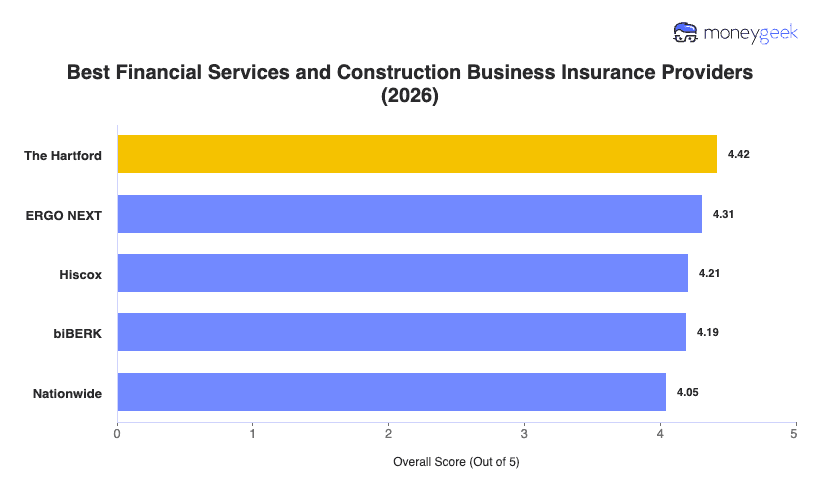
The provider that works best for you as a solo bookkeeper buying E&O and cyber coverage won't necessarily be the right fit if you run a mortgage brokerage needing commercial auto, a surety bond and higher professional liability limits. Our analysis identified The Hartford, ERGO NEXT and Hiscox as the top three, each performing well across premium competitiveness, claims handling quality and coverage depth for businesses in this category.

What stands out in our rankings is that The Hartford leads on both pricing and coverage breadth. If you need E&O and cyber coverage in the same policy structure, that pairing means you're not trading coverage quality for a lower premium. At $57 per month, The Hartford's rate runs 11% below financial services industry average.

The Hartford4.42$5721
ERGO NEXT4.31$6613
Hiscox4.21$6146
biBERK4.19$6374
Nationwide4.05$6932
Thimble4.01$7357
Progressive Commercial3.93$7465

How to Choose the Right Financial Services Business Insurance

Choosing the right coverage for your financial services business is less about finding the cheapest policy and more about building the right structure. We've seen that the most common gap in this industry isn't missing coverage entirely. It's buying a policy that doesn't match how your business actually operates. To get business insurance right for your practice, follow these five steps:

  1. 1
    Understand your risk profile and what coverage it requires

    Your practice faces professional liability exposure for the advice and documents you produce, cyber exposure from the sensitive client data you store and transmit, workers' comp obligations the moment you hire, and general liability if clients visit your office or your contracts require it. Before you buy anything, map which of these exposures actually apply to how you operate. Then separate what your state or licensing body legally requires from what clients will ask for in contracts, and from what your practice genuinely needs regardless of either.

  2. 2
    Choose the right coverage limits

    Don't treat a $1 million E&O limit as your ceiling just because it's the default. Your worst-case claim isn't a minor administrative error. It's the tax filing you submitted that cost your client $80,000 in penalties, the investment recommendation your client says didn't match their risk tolerance, or the payroll run that triggered IRS notices across your employer accounts. Set your limits based on the dollar value of the decisions you're making, not the minimum your insurer will write.

  3. 3
    Evaluate providers who understand finacial services businesses

    When you're evaluating insurers, not every provider writes financial services E&O. Among those that do, look closely at how well they understand claims-made structure, retroactive date requirements and the specific needs of advisors, brokers and billing services. Prioritize balanced performance across pricing, claims handling responsiveness and coverage options rather than defaulting to the lowest quote. A provider that's cheap but slow to respond to your E&O claim leaves you managing a complex professional dispute without adequate support.

  4. 4
    Get compliance-ready

    Once you have coverage, make sure you can prove it before a client or regulator asks. For most financial services businesses that means having a certificate of insurance ready for client contracts, proof of E&O on file for RIA or NMLS licensing, and a state-required surety bond in place if you're a mortgage broker or notary. If you work with commercial clients, they may also require you to carry an additional insured endorsement before work begins. Know what's required before you sign any engagement agreement.

  5. 5
    Revisit your coverage as your financial services business grows

    Don't treat the coverage you buy today as a permanent decision. If you add a licensed advisor or loan officer, move from individual to commercial clients, expand into a new service line or cross a state licensing threshold, your coverage picture changes. Review your E&O limits, cyber coverage and workers' comp obligations at least annually and before any significant business change. The coverage structure that works for your practice today may leave real gaps by year three.

Get Financial Services Business Insurance Quotes

The right insurer depends on what you do and who you serve, and the provider that prices E&O and cyber well for you as a solo virtual bookkeeper won't be the same one that fits a mortgage brokerage needing commercial auto, a surety bond and higher limits. Your coverage mix, client type and licensing obligations all shape which insurer prices your profile best. Request business insurance quotes to find which providers match your practice.

About Connor Bolton


Connor Bolton headshot

Connor Bolton is Senior SEO and Content Manager at MoneyGeek, where he leads the business and pet insurance editorial teams. As editorial lead for both verticals, Connor sets the research framework, data standards, and content structure that his writers execute, directly authoring in-depth guides himself and reviewing all team content for accuracy and practical value before it goes live. With over four years evaluating insurance products across personal, commercial, and specialty lines, he brings cross-vertical knowledge to every guide the team produces.

Connor architected MoneyGeek's insurance research infrastructure across all major verticals including auto, home, renters, life, health, business, and pet, building systems for pricing analysis, provider-level research, customer experience evaluation, and coverage analysis with AI support. The infrastructure includes over 6 million data points for business insurance across 408 industry areas, all 50 states, and 16 vehicle types, and over 5 million pet insurance profiles across 18 major providers and hundreds of breed and age combinations. Connor's insurance cost research and his team's work has been cited by the U.S. Chamber of Commerce, Allstate, Liberty Mutual, CBS News, Forbes and LegalZoom.

Beyond the data, Connor stays connected to how the market actually operates, drawing on direct conversations with underwriters and carrier liaisons at Ethos, The Hartford, NEXT Insurance, Nationwide, and State Farm, and monitoring business and pet owner communities including Reddit, to inform how he interprets findings and frames guidance for real buyers.

He is the direct editorial contact for methodology questions at connor@moneygeek.com and can be found on LinkedIn.