
What Is Bookkeeper Business Insurance?

Bookkeeper business insurance is a bundle of coverages protects you from risks your work creates: the financial data you hold for clients, the professional judgments you make on their behalf and the written work product those judgments produce. As part of financial services business insurance, your bookkeeping coverage addresses the exposures that come with handling other people's money, even when you never touch it directly.

Your exposures include:

  • You file a payroll tax deposit for the wrong period, then your client receives an IRS penalty notice and looks to you for the cost
  • You reconcile accounts monthly but miss a pattern of small unauthorized charges your client later discovers and attributes to your oversight
  • Your system is breached and client bank account numbers, vendor payment details and employee payroll records are exposed
  • You initiate a duplicate vendor payment while managing accounts payable and affect your client's cash position before it can be reversed
  • Your client acts on a cash flow projection you provided informally and disputes the outcome when the numbers don't hold

Most of the claims you face as a bookkeeper won't come from physical incidents. They'll come from your written work product (reconciliations, reports, payroll runs) that surfaces as evidence months or years after your engagement ends. That lag is why claims-made policy structure matters for your practice: the policy in force when your client files a claim is the one that responds, not the one you held when you did the work.

What Types of Insurance Do Bookkeepers Need?

Bookkeeping sits at the intersection of financial data, professional judgment and ongoing client relationships, and that combination means your insurance needs don't reduce to a single policy. The coverage types that matter for your practice depend on what services you provide, whether you have employees, where you work and how much client data you handle:

Our analysis shows that professional liability and cyber coverage form the core of almost every practice, regardless of business size or client volume. Everything else shifts based on what your specific setup creates: a solo virtual bookkeeper's biggest risks are a data breach and a client claiming a reconciliation error, while a small firm with staff, a leased office and contract clients adds workers' comp obligations, property exposure and liability requirements that the solo operator doesn't have. The profiles below are built around those differences.

How Much Does Bookkeeper Business Insurance Cost?

The average cost of bookkeeper business insurance runs $46 per month ($551 annually) across all coverage types, but that figure reflects a wide range depending on what your practice actually needs. Cyber insurance and commercial auto are the highest-cost policies, but for different reasons. Cyber premiums reflect the credential and data breach exposure your work creates by holding client financial system access, while commercial auto costs reflect vehicle use that you're unlikely to have if you work remotely.

Our analysis shows that the two coverage types that matter most for bookkeeping businesses sit at opposite ends of this cost list. Professional liability at $50 per month is essential and accessible, while cyber insurance is the most expensive at $93 per month and is what bookkeepers most often defer. If you can carry only one, start with professional liability. If you can carry both, you've covered your two core exposures for under $150 per month. The breakdown below shows what each policy runs for bookkeeping businesses:

How did we determine business insurance rates for bookkeepers?

If you do reconciliation work for a handful of clients, you'll pay less for professional liability than a bookkeeper running payroll and quarterly tax deposits for 20, because those two service profiles carry different claim scenarios. Your cyber premium also moves with the number of client systems you hold credentials for, not just the limit you select. Our bookkeeper business insurance calculator builds an estimate around your actual service scope and client volume rather than a broad industry average.

Estimate Your Monthly Bookkeeper Insurance Cost

Enter your coverage type, state, number of employees and type of vehicle (if you need commercial auto coverage) to get a pricing estimate that fits your business. We do not collect any personal information, and all rates are aggregated for all 50 states and Washington D.C. Workers' comp rate estimates are provided on a per employee basis and all coverage types assume standard industry limit recommendations for most businesses.

Select Coverage Type
Select State
Select Employee Count
Select Vehicle Type
Average Monthly Cost—

Best Bookkeeper Business Insurance Companies

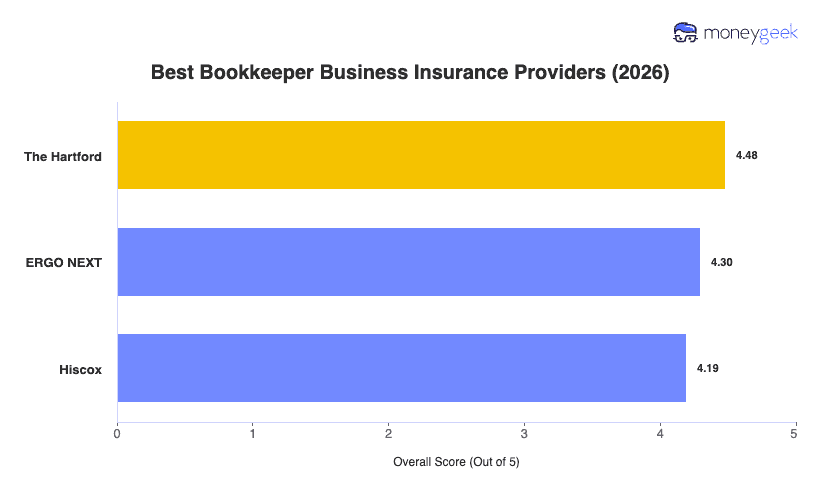
Our analysis identified The Hartford, ERGO NEXT and Hiscox as the top three carriers for bookkeeping businesses, each performing well across premium cost, claims and service experience and coverage flexibility. The Hartford ranks first on both affordability and coverage breadth, making it the strongest fit for bookkeeping firms that need multiple policy types and want to consolidate with one carrier without paying a premium for the convenience. ERGO NEXT ranks first on customer experience, which matters most if you need to get insured quickly, manage your policy through an app and produce a COI instantly when a new client asks for one before signing.

You can find the performance of all seven carriers in our study in the table below:

The Hartford4.48$2821
ERGO NEXT4.30$5113
Hiscox4.19$4835
biBERK4.09$4576
Nationwide4.02$5062
Thimble3.98$5547
Progressive Commercial3.93$5554

How to Choose the Right Bookkeeper Business Insurance

Your bookkeeping insurance won't be right if you treat it as a single purchase decision rather than a sequence of choices that builds on itself. Our experience reviewing bookkeeper claims shows that most coverage gaps don't come from skipping insurance entirely. Instead, they come from buying a policy that doesn't cover what you actually do. If you want to get business insurance right the first time, start here:

  1. 1
    Understand your risk profile and what coverage it requires

    Your risk profile as a bookkeeper is shaped by what services you provide, not just how big your practice is. If you hold client financial data and produce work product clients rely on, professional liability and cyber belong in your coverage stack regardless of your practice size. The moment you hire one employee, workers' comp becomes a legal requirement in most states. Whether you need GL and property comes down to a single question: do you have a leased office or meet clients anywhere other than virtually? Map your exposures before you compare policies since the coverage you need depends on what your practice does, not what other bookkeepers do.

  2. 2
    Choose the right coverage limits

    Your professional liability limit should reflect the financial position of your largest client, not a generic default. If your largest client runs a $2 million business, your exposure in a dispute is meaningfully larger than if you serve freelancers, and a $250,000 limit may not be enough to cover it. For cyber, your limit should reflect the total number of client credentials you hold and the notification cost across every affected individual if a breach exposes their data.

  3. 3
    Evaluate providers who understand bookkeeping services

    If your carrier leads on affordability but excludes payroll tax services from its E&O policy, you'll have a gap the moment a client files an IRS penalty claim. If your carrier scores high on customer experience but offers limited coverage flexibility, you may find it can't add the endorsements your practice needs as you grow. Look for balanced performance across premium cost, coverage scope and service quality because a gap in any one area tends to show up at the worst possible moment.

  4. 4
    Get compliance-ready

    No state licensing board requires bookkeepers to carry insurance, but your clients increasingly do, through engagement letters, vendor agreements and direct requests before signing. Once you have coverage, organize your certificate of insurance so you can produce it on short notice. If a client requires a fidelity bond or additional insured status, confirm your policy supports those requirements before your next engagement starts.

  5. 5
    Revisit your coverage as your bookkeeping service business grows

    Your bookkeeping insurance needs shift when you add payroll processing or tax-adjacent services, take on a significantly larger client, hire your first employee, move to a leased office or switch E&O carriers. Each of those changes either adds a new exposure or triggers a coverage gap if your policy hasn't kept pace. Review your coverage at least annually and before any contract renewal as a policy that fit your practice last year may not reflect what you're actually doing now.

Get Bookkeeper Business Insurance Quotes

What your bookkeeping practice pays and which carrier fits depends on how your business is set up. If you're a solo virtual bookkeeper whose coverage needs start with professional liability and cyber, your carrier options and rates will look different from those of a bookkeeping firm with staff, a leased office and clients who require certificates of insurance before signing. Request business insurance quotes from multiple providers to see which one prices and covers your specific practice best.

About Connor Bolton


Connor Bolton headshot

Connor Bolton is Senior SEO and Content Manager at MoneyGeek, where he leads the business and pet insurance editorial teams. As editorial lead for both verticals, Connor sets the research framework, data standards, and content structure that his writers execute, directly authoring in-depth guides himself and reviewing all team content for accuracy and practical value before it goes live. With over four years evaluating insurance products across personal, commercial, and specialty lines, he brings cross-vertical knowledge to every guide the team produces.

Connor architected MoneyGeek's insurance research infrastructure across all major verticals including auto, home, renters, life, health, business, and pet, building systems for pricing analysis, provider-level research, customer experience evaluation, and coverage analysis with AI support. The infrastructure includes over 6 million data points for business insurance across 408 industry areas, all 50 states, and 16 vehicle types, and over 5 million pet insurance profiles across 18 major providers and hundreds of breed and age combinations. Connor's insurance cost research and his team's work has been cited by the U.S. Chamber of Commerce, Allstate, Liberty Mutual, CBS News, Forbes and LegalZoom.

Beyond the data, Connor stays connected to how the market actually operates, drawing on direct conversations with underwriters and carrier liaisons at Ethos, The Hartford, NEXT Insurance, Nationwide, and State Farm, and monitoring business and pet owner communities including Reddit, to inform how he interprets findings and frames guidance for real buyers.

He is the direct editorial contact for methodology questions at connor@moneygeek.com and can be found on LinkedIn.