
What Is Accountant & CPA Business Insurance?

Accountant and CPA business insurance is a bundle of policies that address the exposure your work actually produces like tax returns clients file, financial statements lenders rely on, audit opinions that outlive the engagement and client records your systems hold year-round. The risks that follow are less visible than a fire or a vehicle accident, but they're no less real:

  • A CPA firm issues a clean audit opinion and a lender extends credit based on it. The client later defaults and the lender sues the firm.
  • A tax preparer applies the wrong deduction, triggering an IRS audit and penalty assessment the client holds the preparer responsible for
  • A bookkeeper miscategorizes expenses across several months, producing financial statements that mislead the client in a business sale
  • A ransomware attack during tax season encrypts client files (Social Security numbers, payroll records and returns) for your entire client roster
  • A client visiting your office for a tax appointment slips and falls in the waiting area

In our analysis, what makes accounting firms different from most small businesses is that your liability doesn't end when the client leaves. A return, a report or a statement you prepared can be relied on and disputed by people you never met, months or years after you completed the work. That's the exposure financial services business insurance for accountants covers.

What Types of Insurance Do Accountants & CPAs Need?

Your accounting practice creates liability through your professional work product, the client data you store and the physical space where you operate. A missed deduction and a data breach both create claims but land in completely different policies, and neither covers a client who slips in your waiting room or a staff member who files a workers' comp claim. The coverage types most relevant to your accounting firm are:

  • Professional liability (since your written work, including returns, audits and financial statements, creates claims exposure that can surface years after the engagement ends)
  • Cyber insurance (since your systems hold Social Security numbers, tax returns and financial records for every client you serve)
  • General liability (if your clients visit your office or you occasionally work at a client's location)
  • Workers' comp (if you have employees, including part-time or seasonal tax preparers)
  • Commercial property (if you lease or own office space and carry equipment, servers or client files on-site)
  • Commercial auto (if you or your staff drive to client meetings, audit fieldwork or bank runs)

In our analysis, your coverage mix shifts more by what you do than by how large your practice is. If you hold a CPA license and perform audits for corporate clients, your professional liability exposure is typically higher than a five-person bookkeeping firm's, even though that firm has more employees and more property to insure. What you're licensed to do, who your clients are and whether your work product gets relied on by third parties matters more to your coverage structure than headcount does.

How Much Does Accountant and CPA Business Insurance Cost?

Your accountant business insurance costs will depend on the coverages you carry, but the average across all coverage types runs $59 a month or $707 a year. Cyber insurance and commercial auto are the two most expensive coverages in your accounting firm's insurance picture, for reasons grounded in how accounting work creates risk: your systems hold client tax returns, financial statements and payroll records that cybercriminals actively pursue, and audit fieldwork requires regular travel to client locations that personal auto policies won't cover.

Professional liability is where most accounting practices start, and at $70 a month on average, it's likely where your coverage costs begin. What you pay depends on your credential type, the services you perform, your client base and your claims history. Our analysis found that cyber insurance carries the highest average cost on this list, more than professional liability, even though it's one of the coverages you're most likely to overlook. If your firm holds tax returns, payroll records and financial statements for dozens of clients, that gap is worth understanding before you decide what to carry. These are your likely starting costs by coverage type:

How did we determine business insurance rates for accountants?

What your accounting practice pays in premiums shifts based on factors the coverage type alone doesn't capture. Whether you perform audit or attest work typically raises your professional liability premium above what a tax-only practice pays. Your client base compounds that further: serving business clients rather than individual filers changes the limits your engagements require and the volume of sensitive data your systems store. The accountants business insurance calculator can build an estimate based on your practice profile and seasonal staffing.

Estimate Your Monthly Accountant & CPA Insurance Cost

Enter your coverage type, state, number of employees and type of vehicle (if you need commercial auto coverage) to get a pricing estimate that fits your business. We do not collect any personal information, and all rates are aggregated for all 50 states and Washington D.C. Workers' comp rate estimates are provided on a per employee basis and all coverage types assume standard industry limit recommendations for most businesses.

Select Coverage Type
Select State
Select Employee Count
Select Vehicle Type
Average Monthly Cost

Best Accounting & CPA Firm Business Insurance Companies

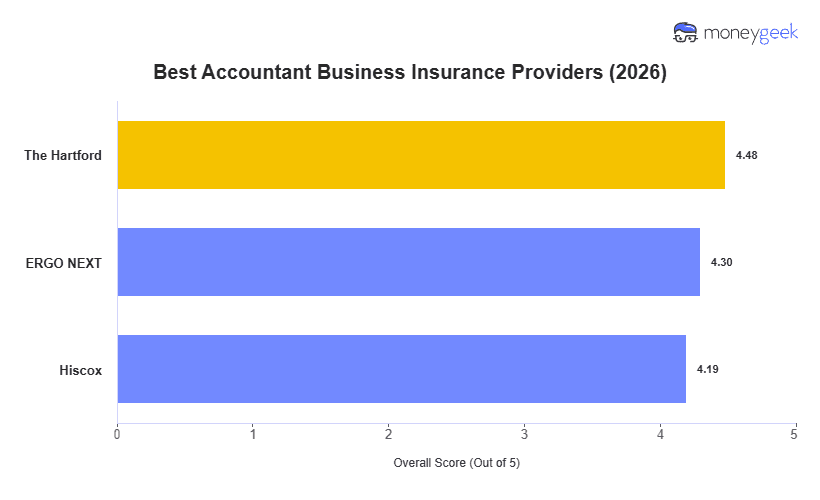
The right CPA insurance for your practice depends on what kind of accounting work you do. A solo enrolled agent who handles individual returns has different coverage priorities and limit requirements than a small firm that manages corporate audits. Our analysis evaluated accounting firm insurers on premium competitiveness, claims responsiveness and coverage depth, and identified The Hartford, ERGO NEXT and Hiscox as the top three providers for accounting firms

What our analysis found is that The Hartford is the only provider that leads on both affordability and coverage depth, an unusual combination that matters for accounting firms that need adequate professional liability and cyber limits at a price that reflects their actual practice size. Whether cost, claims handling or coverage range is the bigger priority for your practice determines which of the three is the right fit.

The Hartford4.48$4121
ERGO NEXT4.30$6213
Hiscox4.19$5934
biBERK4.11$5776
Nationwide4.02$6462
Thimble4.01$6847
Progressive Commercial3.93$6955

How to Choose the Right Accountant Business Insurance

Your accountant insurance decisions work best in sequence, not all at once. In our experience, when you skip straight to comparing premiums, you often end up with limits that reflect your practice as it was, not as it currently operates or as your next engagement will require. For your accounting firm, getting business insurance right means following these steps:

  1. 1
    Understand your risk profile and what coverage it requires

    Your risk profile starts with what you're licensed to do. If you hold a CPA license and perform audits, your professional liability exposure is higher than a bookkeeper's or unlicensed preparer's, because your credential sets the professional standard clients and courts measure you against. Map your services, client types and whether any state-mandated coverage requirements apply before you evaluate any policy. The distinction between what's legally required, what your clients contractually require and what's practically essential given your work is the foundation all your other coverage decisions build on.

  2. 2
    Choose the right coverage limits

    Your limits should reflect your worst-case claim, not the minimum required or what firms your size typically carry. For your practice, that worst case is usually a business client whose financial decisions relied on your work: a disputed audit, a missed tax position or a bookkeeping error that surfaced in a business sale. If you serve individual filers, your worst case looks different than it does if your clients include corporations whose lenders or investors could also bring claims. Set limits to match your actual client profile.

  3. 3
    Evaluate providers who understand accounting firms

    Not every insurer writes professional liability for the attest work your firm performs, and not every carrier prices cyber coverage competitively for the volume of client data your systems hold. Look for balanced performance across affordability, claims responsiveness and coverage flexibility. Choosing a carrier that prices well but handles professional liability claims poorly costs you more over time than one that charges slightly more and resolves those disputes well. Verify that any carrier you consider specifically covers the services you perform.

  4. 4
    Get compliance-ready

    Your policy satisfies your coverage obligation, but it doesn't complete your compliance picture. Your business clients will often require a certificate of insurance before your engagement begins, and some engagement contracts specify minimum limits or name you as an additional insured on their own policy. If your firm is incorporated or structured as an LLP in a state that mandates professional liability coverage, confirm your policy meets those minimums. Keep your COIs current and understand what documentation your client relationships require before work begins.

  5. 5
    Revisit your coverage as your accounting firm grows

    Your coverage structure should evolve with your practice, not sit static between renewals. If you move from individual tax clients to business clients, add staff who sign or review work, incorporate your firm or begin audit or attest services, each of those changes shifts your professional liability exposure materially. Review your coverage at least annually and before any change in your service mix, client base or firm structure. Don't wait for a contract requirement or a claim to prompt the review.

Get Accountant & CPA Business Insurance Quotes

Where you land on the pricing spectrum for accounting firm insurance depends on the kind of practice you run. A solo enrolled agent handling individual returns has different coverage priorities and limit requirements than a small CPA firm managing business client audits, and those differences change which provider offers the best fit for your situation. Requesting business insurance quotes through our comparison tool matches your accounting practice with providers based on how your firm actually operates.

About Connor Bolton


Connor Bolton headshot

Connor Bolton is Senior SEO and Content Manager at MoneyGeek, where he leads the business and pet insurance editorial teams. As editorial lead for both verticals, Connor sets the research framework, data standards, and content structure that his writers execute, directly authoring in-depth guides himself and reviewing all team content for accuracy and practical value before it goes live. With over four years evaluating insurance products across personal, commercial, and specialty lines, he brings cross-vertical knowledge to every guide the team produces.

Connor architected MoneyGeek's insurance research infrastructure across all major verticals including auto, home, renters, life, health, business, and pet, building systems for pricing analysis, provider-level research, customer experience evaluation, and coverage analysis with AI support. The infrastructure includes over 6 million data points for business insurance across 408 industry areas, all 50 states, and 16 vehicle types, and over 5 million pet insurance profiles across 18 major providers and hundreds of breed and age combinations. Connor's insurance cost research and his team's work has been cited by the U.S. Chamber of Commerce, Allstate, Liberty Mutual, CBS News, Forbes and LegalZoom.

Beyond the data, Connor stays connected to how the market actually operates, drawing on direct conversations with underwriters and carrier liaisons at Ethos, The Hartford, NEXT Insurance, Nationwide, and State Farm, and monitoring business and pet owner communities including Reddit, to inform how he interprets findings and frames guidance for real buyers.

He is the direct editorial contact for methodology questions at connor@moneygeek.com and can be found on LinkedIn.