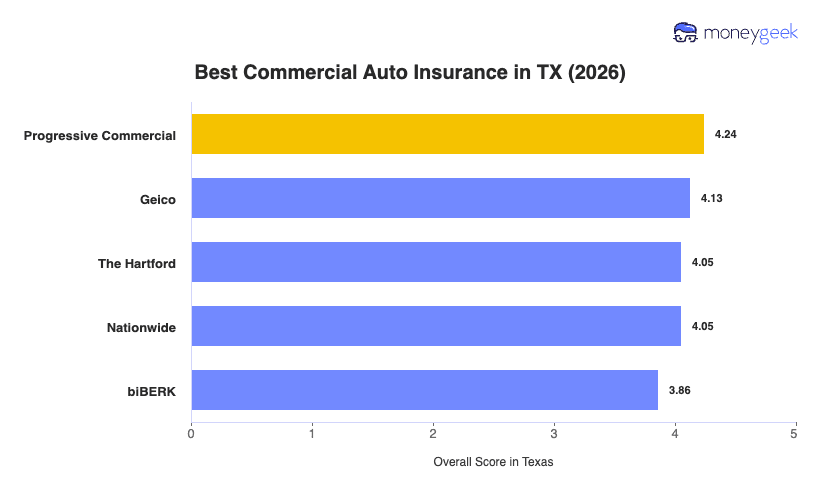
Top Picks: Best Commercial Auto Insurance Companies in Texas

MoneyGeek analyzed rates, coverage options and customer satisfaction scores to find the best commercial auto insurance in Texas. Most businesses will find the right fit among these companies:

  1. Progressive Commercial: Best Overall, Best for Fleet Operations
  2. GEICO: Best for Low-Risk Business Areas
  3. The Hartford: Best for Coverage Depth
  4. Nationwide: Best for Agricultural and Specialty Fleets
  5. biBerk: Best for Simple Coverage Needs

These five insurers cover the most common needs Texas businesses face, from single-vehicle contractors to multi-vehicle fleets operating across the state. Your best pick depends on your vehicle type, industry and the coverage depth your operation actually requires.

Progressive Commercial
4.24
Leads all five Texas providers in affordability and customer experience, with average monthly rates 13% below the Texas average and the top customer experience score in our analysis.
GEICO
4.13
Prices 6% below the Texas average across most vehicle types and earns the second-highest affordability rank among Texas providers, making it a strong fit for low-risk, office-based operations.
The Hartford
4.05
Posts the highest coverage score of any Texas provider in our analysis, with broad policy options suited for businesses that need deeper liability terms and stronger endorsement flexibility.
Nationwide
4.05
Prices 7% below the Texas average overall and earns its strongest marks in agricultural and specialty fleet categories, where it ranks second in coverage among the five providers.
biBerk
3.86
Built for Texas small businesses that need straightforward commercial auto coverage fast, with a fully digital quote and purchase process that works well for single-vehicle operations.

For our commercial auto insurance ratings, we analyzed pricing, coverage options and customer experience across 5 providers, 385 industries and 8 vehicle types. Our analysis covers 92% of U.S. small businesses, with coverage levels personalized to vehicle type, industry and state to reflect the real cost conditions facing most business operators.

To build our ratings, we evaluated rate data across more than 60,000 business profiles and over 15,000 customer experience data points. We also performed an in-depth analysis of coverage contracts and endorsements across minimum, mid-level and high-level coverage tiers to compare insurers consistently. We then rated each provider across affordability (50% of overall score), customer experience (30%) and coverage options (20%) to produce an overall rating out of 5. For a detailed breakdown of our scoring methodology, see our full methodology.

92%

% of Small Businesses Covered

Over 60,000

Business Profiles Studied

Over 15,000

Customer Experiences Analyzed

Company Image
Best Overall, Best for Fleet Operations

Progressive

Progressive Commercial ranks first overall for commercial auto insurance in Texas, leading all five providers in both affordability and customer experience. Its pricing advantage is most pronounced on high-exposure vehicle types common across Texas, including taxis, limousines and food trucks, where it prices well below the state average. For Texas businesses running multi-vehicle fleets or operating in complex, high-mileage industries, no other provider in our analysis matched its combination of rate competitiveness and service quality.

Progressive Commercial also earns the top customer experience score among Texas providers. Its Snapshot ProView telematics platform gives Texas fleet operators GPS tracking, driver scoring and a centralized fleet dashboard built for active fleet management. The buying process is fully digital, with same-day coverage and instant certificates of insurance available upon payment. The main caveat: coverage ranks fourth among the five providers, so Texas businesses needing deep policy customization or broad endorsement flexibility may want to weigh The Hartford as an alternative.

Where Progressive Commercial Performs Best:

  • For-hire truckers, owner-operators and motor carriers  
  • Multi-vehicle fleet operations in construction, delivery and food service
  • New Texas businesses or operators with prior violations 

Where Progressive Commercial Performs Less Competitively:

  • Texas businesses running mostly sedans or SUVs
  • Operations needing deep coverage customization, specialty endorsements or dedicated risk engineering support 

Learn More: Progressive Business Insurance Review

Company Image
Best for Low-Risk Business Areas

GEICO

GEICO ranks second overall for commercial auto insurance in Texas, earning the second-highest affordability score among the five providers. Its pricing advantage is strongest on sedans, SUVs, farm tractors and pickup trucks. For Texas businesses running low-mileage, low-exposure operations, GEICO delivers competitive rates with a fully digital experience.

GEICO's DriveEasy Pro telematics platform gives fleet operators GPS tracking, driver scoring and a dashcam option. Its online portal and mobile app rank among the strongest in the industry for ease of use. The trade-off is coverage depth: GEICO ranks third among Texas providers on coverage options, and its specialty trucking appetite is more limited than Progressive Commercial's. Businesses with heavy trucks or complex fleet compositions should confirm vehicle eligibility before committing.

Where GEICO Performs Best:

  • Texas professional services, consulting, financial services and fitness businesses
  • Light commercial fleets running sedans, SUVs and pickup trucks
  • Texas businesses that prioritize a streamlined online quote process and instant certificate of insurance access

Where GEICO Performs Less Competitively:

  • Heavy truck operators and for-hire carriers
  • Texas businesses needing the deepest coverage customization or specialty endorsements
Company Image
Best for Coverage Depth

The Hartford

The Hartford ranks fourth overall for commercial auto insurance in Texas, but leads all five providers in coverage depth. It's the strongest choice for businesses in regulated or high-liability industries that need the broadest policy structure available, with several coverage features the other four Texas providers don't match.

Its weakest area is affordability, pricing above the Texas average across every industry and vehicle type in our analysis. It's best suited for businesses where coverage depth and specialist support matter more than rate competitiveness.

Where The Hartford performs best:

  • Businesses in regulated or high-liability industries that need the deepest coverage structure available
  • Texas nonprofits and associations
  • Fleet operators that value hands-on specialist support

Where The Hartford performs less competitively:

  • Price-sensitive Texas businesses across virtually every category
  • High-volume vehicle types including taxis and farm tractors
  • Small single-vehicle Texas operations

Learn More: The Hartford Business Insurance Review

The Hartford ranks third overall for commercial auto insurance in Texas, earning the highest coverage score among all five providers. Where it pulls ahead is policy depth, offering broader endorsement options, stronger liability terms and dedicated mid-market underwriting. However, its pricing runs above the Texas average across most vehicle types.

Claims handling is The Hartford's clearest differentiator among Texas providers. Its commercial claims specialists are available 24/7, and businesses using its preferred repair network receive written repair guarantees. Its FleetAhead program pairs telematics data with dedicated risk engineering consultants, giving Texas mid-size fleet operators active support in reducing losses over time. The trade-off is digital experience: the online quote process typically requires a follow-up call to complete.

Where The Hartford Performs Best:

  • Texas mid-size fleets that want active risk management support  
  • Businesses in construction, contracting and trades
  • Texas operations where claims quality and policy depth matter more than finding the lowest rate

Where The Hartford Performs Less Competitively:

  • Texas businesses that need a fast, fully digital buying experience
  • High-exposure vehicle categories like taxis and limousines 

Learn More: The Hartford Business Insurance Review

Company Image
Best for Agricultural and Specialty Fleets

Nationwide

Nationwide ranks fourth overall for commercial auto insurance in Texas, tied with The Hartford on overall score. Its strongest case is coverage quality for trade contractors, agribusiness operators and delivery businesses — three industries with deep roots across Texas. Where Nationwide separates itself from most providers is upfitted vehicle coverage: it provides clearer total loss valuation for vehicles with permanently installed equipment like shelving systems, lift gates and mounted service tools, a gap that leaves many Texas contractors underinsured with standard carriers.

Nationwide's Vantage 360 Fleet program gives Texas fleet managers driver scoring, route mapping and a driver rewards system where safe driving earns points redeemable for gift cards. Qualifying policies can earn up to 10% off commercial auto premiums through the program. One firm limitation: Nationwide does not cover semi-trucks or Class 8 tractor-trailers. Texas businesses running heavy long-haul operations should look at Progressive Commercial or The Hartford instead.

Where Nationwide Performs Best:

  • Texas trade contractors, plumbers, electricians and HVAC businesses running vehicles with permanently installed equipment
  • Agribusiness operators across rural Texas who need commercial auto bundled with farm property coverage
  • Delivery and direct store delivery businesses that want fleet telematics with an active driver rewards component

Where Nationwide Performs Less Competitively:

  • Texas businesses operating semi-trucks or Class 8 tractor-trailers, which fall outside Nationwide's underwriting appetite entirely
  • Operations needing a fully digital, self-service buying experience, where Progressive Commercial and GEICO move faster from quote to coverage

Learn More: Nationwide Business Insurance Review

Company Image
Best for Simple Coverage Needs

biBerk

biBerk ranks fifth overall for commercial auto insurance in Texas, but it earns its place on this list for a specific type of Texas business: sole proprietors, owner-operators and small operations that need coverage fast, without broker involvement. Built by Berkshire Hathaway as a direct-to-business insurer, it offers the fastest path from quote to active policy of any provider in our analysis. For eligible businesses in Texas, the entire purchase can be completed online in under 10 minutes with a certificate of insurance available immediately after payment.

The trade-offs are real. biBerk has no dedicated telematics or fleet management platform, its underwriting is fully automated with no manual review path if declined, and its claims handling runs through a call center rather than specialized commercial teams. It also covers commercial auto in 21 states, which makes it one of the more geographically limited providers reviewed here. For Texas small businesses with straightforward coverage needs and a single vehicle or small light-commercial fleet, it works well. For complex fleets, heavy trucks or businesses needing active risk management support, Progressive Commercial, The Hartford or Nationwide are stronger fits.

Where biBerk Performs Best:

  • Texas sole proprietors and owner-operators who need a certificate of insurance immediately for a job site or client requirement
  • Small Texas businesses in light-commercial, service and courier industries with straightforward vehicle types and no complex endorsement needs
  • New Texas businesses without prior commercial auto history that want a simple, fast online purchase without a broker

Where biBerk Performs Less Competitively:

  • Texas fleet operators who need telematics, driver scoring or active risk management tools, where Progressive Commercial and The Hartford offer far stronger programs
  • Businesses with complex vehicle compositions, FMCSA filing requirements or specialty endorsement needs, where biBerk's automated underwriting has clear limits

Learn More: biBerk Business Insurance Review

Best Texas Commercial Auto Insurance by Vehicle Type

Progressive Commercial ranks first across six of eight vehicle types in Texas, leading on affordability for high-exposure operations and customer experience across the board. Its strongest rate advantages come from taxi and limousine fleets, where its rates run 31% below the Texas average. For businesses running primarily sedans or farm tractors, GEICO offers better value, pricing 14% and 19% below the Texas average respectively on those vehicle types.

Farm TractorProgressive Commercial214
Food TruckProgressive Commercial114
LimousineProgressive Commercial114
Pickup TruckProgressive Commercial114
SUVProgressive Commercial314
SedanProgressive Commercial414
TaxiProgressive Commercial114
VanProgressive Commercial114

Vehicle type is one of the biggest pricing factors in commercial auto insurance. MoneyGeek's analysis of the top Texas insurers shows how rates vary across vehicle types:

Best Commercial Auto Insurance in Texas by Industry

Progressive Commercial leads in 21 of 25 industries in Texas, with its strongest affordability advantages in manufacturing, wholesale and distribution and transportation and logistics, where it prices 28%, 26% and 26% below the Texas average respectively. GEICO ranks first in the remaining four industries, including financial services and consulting services, where it holds the top affordability score among all five Texas providers.

Agriculture & Natural ResourcesProgressive Commercial314
Arts, Media & EntertainmentProgressive Commercial514
Beauty, Body & Wellness ServicesProgressive Commercial314
Childcare ServicesProgressive Commercial114
Cleaning ServicesProgressive Commercial114
Construction & ContractingProgressive Commercial114
Consulting ServicesGeico223
EducationProgressive Commercial114
Financial ServicesGeico123
Fitness ServicesGeico223
Food & BeverageProgressive Commercial114
Healthcare & MedicalProgressive Commercial114
Hospitality, Travel & TourismProgressive Commercial114
ManufacturingProgressive Commercial114
Marketing & CommunicationsProgressive Commercial514
Nonprofit & AssociationsProgressive Commercial114
Other Professional ServicesProgressive Commercial114
Pet Care ServicesProgressive Commercial314
Real Estate & Property ServicesProgressive Commercial314
Recreation & SportsProgressive Commercial114
Repair & MaintenanceProgressive Commercial114
Retail & Product RentalProgressive Commercial114
Tech/ITProgressive Commercial314
Transportation & LogisticsProgressive Commercial114
Wholesale & DistributionProgressive Commercial114

MoneyGeek covers commercial auto insurance by industry, so you can find the best fit for your business.

What Determines the Best Commercial Auto Insurance in Texas for You

The best commercial auto insurance in Texas isn't defined by a single factor. Affordability, coverage depth and customer experience each play a role, and the right balance depends on your vehicle type, industry and how your Texas operation actually runs.

Three areas matter most when evaluating which insurer fits your business.

    money2 icon
    Affordability Across Your Vehicle Type and Industry

    Commercial auto insurance pricing in Texas varies more by vehicle type and industry than most Texas business owners expect. Taxi and limousine fleets see the widest rate gaps among providers, with spreads of up to 31% between the most and least competitive carriers. Texas businesses in manufacturing, construction and transportation and logistics tend to see the most meaningful savings by comparing providers rather than defaulting to a single carrier. The best value for your operation depends on your specific vehicle mix and industry, not the statewide average.

    insurance2 icon
    Coverage That Matches Your Fleet's Risks

    Texas requires minimum commercial auto liability of $30,000 per person, $60,000 per occurrence and $25,000 for property damage for most commercial vehicles. Those minimums rise for for-hire carriers operating under TxDMV authority, and FMCSA minimums apply to interstate operations based on vehicle weight and cargo type. Pay close attention to the following when evaluating policies:

    • Liability limits offered: Texas minimums are a legal floor, not a recommended coverage level. High-risk industries like transportation, construction and food service should look for providers with liability ceilings that cover their most likely claim triggers.
    • Breadth of vehicles covered: Some providers cover pickup trucks, cargo vans and specialty vehicles common across Texas while others exclude heavy trucks or high-exposure vehicle types. Confirm eligibility for your specific fleet composition before committing.
    • Standard vs. endorsement coverage: One provider may include roadside assistance and rental reimbursement as standard while another charges extra for both.
    • Hired and non-owned auto coverage: Whether employee-owned or rented vehicles used for business are covered varies by carrier, which is relevant for Texas real estate, healthcare and professional services businesses where employees regularly drive their own vehicles on company time.
    • Cargo and equipment protection: Texas construction, manufacturing and wholesale and distribution businesses should confirm whether tools and cargo coverage are included or treated as a separate inland marine policy.
    • Exclusions and policy language: Driver eligibility rules, vehicle use restrictions and geographic limits differ between carriers. Texas is not a no-fault state, so injury claims are handled under the standard tort system.
    • Deductible flexibility: Features like diminishing deductibles or waived deductibles on a total loss are carrier-specific and can have real financial impact at claim time.
    • Coverage for fleet growth: Some policies make it easy to add vehicles mid-term while others require policy rewrites.
    talk icon
    Customer Experience and Claims Support

    Claims handling for commercial auto policies works differently than personal coverage, so check provider performance on commercial claims in Texas. Look at whether the claims team is available 24/7 or only during business hours, whether your claim gets a dedicated commercial adjuster or goes through a general call center, and whether your account will have a consistent industry-specialized agent over time. Digital tools matter too: carriers with self-service portals and instant certificate of insurance generation give Texas contractors and fleet operators an operational advantage that extends well beyond the buying experience.

How to Choose the Best Commercial Auto Insurance in FL

Choosing the right commercial auto insurance in Texas requires more than comparing premiums. These steps allow you to make the most informed decision for your business.

  1. 1
    Define Your Risk Profile

    Start by documenting the full scope of your exposure in Texas. Catalog every vehicle in operation, including owned, leased and employee-owned vehicles used for business. Document their primary use, how frequently they are on the road and the driving records of everyone behind the wheel. Texas businesses in construction, transportation and logistics, and food and beverage operating pickup trucks, cargo vans and commercial trucks should pay particular attention to mileage and load type, as these directly affect pricing and eligibility.

  2. 2
    Determine Your Coverage Requirements

    With your risk profile in hand, identify which coverage types your operations actually require beyond Texas's minimum liability of $30,000 per person, $60,000 per occurrence and $25,000 for property damage. Texas does not require PIP, so medical payments coverage is optional but worth evaluating for operations with frequent passenger transport. For example:

    • Texas businesses transporting goods need cargo coverage, which is particularly relevant for wholesale and distribution, manufacturing and food and beverage operations.
    • Financed or leased vehicles require collision and comprehensive coverage.
    • Operations relying on employee-owned vehicles need hired and non-owned auto coverage, which is common in Texas real estate, healthcare and professional services industries.
    • For-hire carriers operating under TxDMV authority face higher liability minimums than the state baseline. Texas businesses operating vehicles over 26,000 lbs in interstate commerce must meet FMCSA liability thresholds, which start at $750,000 for non-hazardous freight.
  3. 3
    Research Providers by Industry and Vehicle Type

    Not all carriers price every risk the same way in Texas. Some specialize in high-exposure operations like transportation, construction and food service while others are better suited to standard light-commercial vehicles common in Texas professional services and retail businesses. Identify which carriers have demonstrated strength in your industry and vehicle category before comparing them on price.

  4. 4
    Evaluate Coverage Quality and Policy Terms

    Comparing premiums tells you what a policy costs. Comparing policy terms tells you what you're actually buying. For each shortlisted provider, check which coverages are standard versus endorsement-only, what liability limits are available above Texas's $30,000/$60,000/$25,000 minimums and what exclusions could void a claim. Confirm how easily the policy handles mid-term fleet changes, since adding vehicles during a policy period creates temporary coverage gaps with some carriers.

  5. 5
    Get Quotes to Confirm

    Request quotes only after you have narrowed your options through research. A quote should validate whether a provider's pricing holds for your specific fleet, location and coverage requirements rather than serve as the primary basis for deciding who to consider. Texas pricing varies meaningfully by vehicle type and industry: the gap between the most and least competitive provider reaches 31% for taxi fleets and 28% for manufacturing businesses, so a quote from a single carrier rarely reflects your actual best option.

  6. 6
    Confirm Texas-Specific Filing Requirements

    Verify whether your Texas operation triggers any additional filing requirements before purchasing. For-hire carriers operating under TxDMV authority must maintain operating authority and file proof of insurance directly with the state. Texas businesses operating commercial motor vehicles in interstate commerce that meet FMCSA weight thresholds must file an MCS-90 endorsement and maintain a valid DOT number. Passenger carriers operating vehicles with 16 or more seats face federal minimums of $5,000,000 in liability coverage. Confirm your specific requirements with TxDMV and the FMCSA before finalizing coverage.

Best Commercial Auto Insurance in Texas: Bottom Line

The right commercial auto insurance in Texas comes down to three questions: What vehicles do you operate, what industry are you in, and what would a serious claim cost your business? Your answers narrow the field faster than any rate comparison, because pricing and coverage depth vary more by vehicle type and industry than most Texas businesses expect. Start there before comparing providers.

Not every provider fits every operation, and the lowest-priced policy isn't always the best value if it leaves gaps in coverage your business actually needs. Think about whether you want a fully digital, self-service buying experience or agent-supported guidance with more hands-on help at claim time, because that shapes which providers are worth your time. From there, getting two or three quotes confirms whether the right fit on paper holds up for your specific fleet and location in Texas.

Best Commercial Auto Insurance: Next Steps

For most Texas businesses, the right starting point is getting quotes from Progressive Commercial and GEICO. Progressive Commercial leads on affordability and customer experience across the widest range of Texas vehicle types and industries, making it the strongest first quote for most operations. GEICO is the best starting point for Texas businesses in professional services, consulting and financial services, where it holds the top affordability score among the five providers. If your business operates under TxDMV authority, runs heavy trucks or needs deeper coverage customization, add The Hartford to your list.

Recommended: If You're Ready to Get Quotes Now

Request quotes from at least three providers and compare policy terms alongside price. A lower premium that excludes a coverage your operation actually needs isn't a better deal. If a quote comes back higher than expected, check your coverage selections and driver records before ruling out a provider.

If You Want to Confirm Cost Before Deciding

If You're Unsure What Coverage Your Fleet Needs

If You Operate Taxis, Limousines or Passenger Transport Vehicles in Texas

How We Chose the Best Texas Commercial Auto Insurance Companies

Our goal was to identify which providers deliver the most consistent overall value across the three dimensions that matter most to business owners: what they pay, how well they're covered and how the carrier performs when they need support. Five providers made the cut for our Texas analysis: Progressive Commercial, GEICO, The Hartford, Nationwide and biBerk. We analyzed all five across all eight vehicle types and 25 general industry categories covering more than 400 specific industry areas.

Our Scoring Model

We scored each of the five providers across three weighted categories that combine into an overall score out of 5.

  • Affordability (50% of overall score): We measured how competitively and consistently each provider prices commercial auto coverage across vehicle types, industries and states, benchmarked against national average rates.
  • Customer Experience (30% of overall score): We evaluated how well each provider supports businesses across the full policy lifecycle — buying, policy management and claims handling.
  • Coverage Options (20% of overall score): We assessed how well each provider addresses common commercial fleet risks and how much flexibility it allows across coverage types and endorsements.

Learn more about our methodology.

About Mark Flores


Mark Flores headshot

Mark Flores is a Business Insurance Content Writer at MoneyGeek, specializing in commercial auto, commercial property, cyber, and specialty insurance coverage. He focuses on helping business owners understand what coverage actually does in practice, what it pays for, what it excludes, and how to evaluate providers past the basics.

Before joining MoneyGeek's business insurance team, Mark spent over a year at Clutch.co as a Senior Content Writer, producing structured B2B reviews and provider analyses based on client interviews and service evaluation. Clutch's model, researching companies, analyzing performance data, and translating findings into objective comparisons, directly parallels how commercial insurance content is built, and that experience informs how he approaches provider evaluation and coverage analysis. Alongside his content work, he has spent nearly four years as a digital marketing specialist serving small business clients across home services, manufacturing, and education, giving him firsthand exposure to the operational contexts in which commercial insurance decisions get made.

At MoneyGeek, he spent nearly five years producing personal finance content in the credit cards vertical before transitioning to business insurance, building familiarity with the data-driven research framework and editorial standards that underpin the team's work. His current focus spans commercial auto, commercial property, cyber liability, and specialty coverage.

Linkedin: https://www.linkedin.com/in/mark-jason-flores-7844634a/

Contact Email: mark.flores@moneygeek.com