
Average Car Insurance Rates by Age and Gender


Key Takeaways
blueCheck icon

Age is a major factor in determining car insurance costs, with younger drivers paying more. Sixteen-year-olds pay the highest monthly premiums at $436 for girls and $478 for boys.

blueCheck icon

Gender affects rates most for teens. Sixteen-year-old boys pay $495 more yearly than girls due to higher accident frequency. The difference decreases to only $33 per year after drivers turn 25.

blueCheck icon

The difference in car insurance rates between genders narrows as drivers age. At age 60, men and women both pay an average of $94 per month.

Compare Auto Insurance Rates

Ensure you are getting the best rate for your insurance. Compare quotes from the top insurance companies.

Average Car Insurance Rates by Age

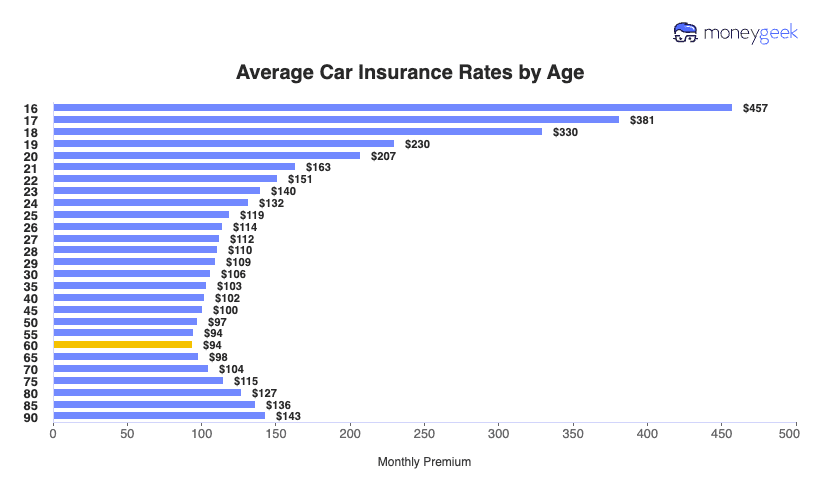
Car insurance rates vary widely by age, with teens averaging $230 to $457 monthly nationwide. Young drivers ages 20 to 25 see rates drop to $152 monthly, while middle-aged drivers enjoy the lowest costs around $101 monthly. Seniors face 32% increases to $125 monthly.

16$457$5,486
17$381$4,578
18$330$3,956
19$230$2,761
20$207$2,481
21$163$1,958
22$151$1,810
23$139$1,674
24$132$1,582
25$119$1,426
26$114$1,367
27$112$1,343
28$110$1,326
29$109$1,311
30$106$1,268
35$103$1,240
40$102$1,220
45$100$1,204
50$97$1,165
55$94$1,131
60$94$1,125
65$98$1,175
70$104$1,252
75$115$1,380
80$127$1,525
85$136$1,637
90$143$1,718

Rates shown are national averages and your actual costs may vary significantly based on location, driving record, vehicle type, credit score and other factors.

Average Car Insurance Cost Per Month by Age and State

State location affects insurance costs across all age groups. Teens might pay $30 monthly for minimum coverage in Indiana versus over $100 in Louisiana, with full coverage gaps widening further. Young drivers ages 20 to 25 pay $25 to $40 monthly in low-cost states versus $70 to $90 in expensive markets. Middle-aged drivers still see three to four times higher costs in expensive states. States with higher minimum requirements show smaller minimum-to-full coverage gaps, so consider location and coverage choices for savings.

Data filtered by:
25
Minimum Coverage
25Alabama$38$454
25Alaska$42$501
25Arizona$55$662
25Arkansas$39$471
25California$61$738
25Colorado$47$565
25Connecticut$76$915
25Delaware$97$1,164
25District of Columbia$54$654
25Florida$78$931
25Georgia$49$589
25Hawaii$30$363
25Idaho$32$381
25Illinois$39$468
25Indiana$35$416
25Iowa$27$321
25Kansas$42$503
25Kentucky$47$569
25Louisiana$67$803
25Maine$38$460
25Maryland$65$777
25Massachusetts$42$504
25Michigan$85$1,018
25Minnesota$48$580
25Mississippi$43$515
25Missouri$60$726
25Montana$31$366
25Nebraska$40$478
25Nevada$84$1,003
25New Hampshire$63$759
25New Jersey$73$874
25New Mexico$40$486
25New York$111$1,338
25North Carolina$38$460
25North Dakota$31$372
25Ohio$40$484
25Oklahoma$41$492
25Oregon$59$711
25Pennsylvania$39$463
25Rhode Island$58$696
25South Carolina$69$827
25South Dakota$30$366
25Tennessee$36$436
25Texas$61$737
25Utah$53$642
25Vermont$30$356
25Virginia$46$552
25Washington$63$761
25West Virginia$45$545
25Wisconsin$42$499
25Wyoming$24$288

Average Car Insurance Rates by Gender

Teen boys pay $42 more monthly than teen girls at age 16, creating a $504 annual difference due to higher accident statistics among young male drivers. At 19, men still pay $241 versus $219 for women, but by age 25, the gap narrows to just $2 monthly.

Gender differences nearly disappear by age 30, with rates stabilizing around $106 monthly for both men and women. Women briefly pay $1 to $2 more monthly during middle age, but men again pay more as senior drivers, with the gap widening to $12 monthly by age 90. Overall, men pay more annually than women when averaged across all ages due to higher teen and senior premiums.

16$478$436$41
17$401$362$39
18$345$314$31
19$241$219$22
20$216$198$18
21$170$157$13
22$156$146$9
23$143$136$8
24$135$129$6
25$120$118$3
26$115$113$2
27$113$111$2
28$111$110$1
29$110$109$1
30$105$106$-1
35$102$104$-2
40$101$103$-2
45$99$101$-2
50$97$98$-1
55$94$94$0
60$94$94$0
65$98$97$1
70$106$103$2
75$118$112$5
80$132$122$9
85$142$131$11
90$149$137$12

How to Save Money on Car Insurance Based on Age

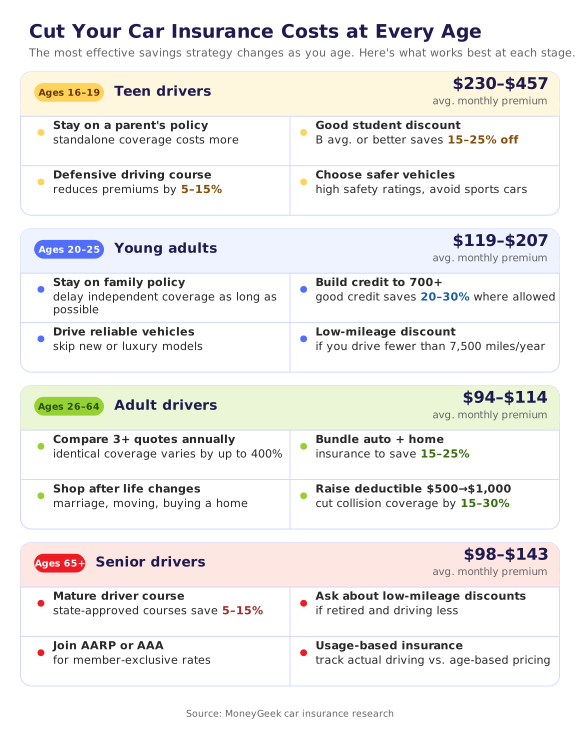
Regular comparison shopping, taking advantage of discounts and maintaining a clean driving record can lower your auto insurance costs by hundreds or even thousands of dollars each year.

Teen Drivers: Maximize Available Discounts

Teen drivers’ premiums average $350 monthly, over 200% higher than adult rates. Multiple discount strategies can lower teens' premiums:

  • Academic excellence: Good student discounts offer 10% to 15% savings for maintaining a B average or higher. For a teen paying $4,200 annually, this means $420 to $630 in yearly savings.
  • Defensive driving courses: Defensive driving programs offer premium reductions of 5% to 10% while promoting safer driving habits. Many insurers accept online courses, making this discount both convenient and valuable.
  • Family policy benefits: Adding teens to existing family policies costs significantly less than buying separate coverage. You'll also stack multiple discounts this way—your teen can benefit from your multi-car discount, homeowner discount and loyalty discounts simultaneously.
  • Vehicle choice: The car your teen drives directly impacts their rates. A Honda Civic or Toyota Camry will cost less to insure than a sports car or luxury vehicle.
  • Away-at-school discount: Full-time college students who attend school more than 100 miles from home without a car can qualify for discounts of 10% to 25%.

Young Adult Drivers (Ages 20-25): Transition to Independence

Young adults moving off family policies or establishing their first independent coverage have different savings opportunities compared to teens:

  • Stay on family policies longer: Even if you're living independently, staying on a family policy usually costs less than buying your own coverage until age 25 or 26.
  • Graduate from college: Many insurers automatically reduce rates when you complete a degree, viewing education as a marker of responsibility. You might see premium drops of 5% to 10%.
  • Build credit intentionally: Your credit score starts affecting insurance rates more heavily once you leave your parents' policy. A better credit score can result in a 20% to 30% reduction in premiums.
  • Choose your first car wisely: Sports cars, luxury brands and vehicles with high theft rates can double or triple your premiums. A reliable sedan or compact SUV will cost significantly less to insure.
  • Leverage employer benefits: Some employers offer group auto insurance rates or payroll deduction programs that provide modest discounts of 5% to 10%.

Adult Drivers: Shop Smart and Compare Multiple Quotes

Adult drivers benefit most from comparison shopping, as identical coverage can vary by over 400% between providers. To save the most money:

  • Shop annually without loyalty bias: Comparing quotes annually keeps you from overpaying due to rate increases or missing better deals from competitors. Insurers often offer better rates to new customers than long-term policyholders.
  • Increase deductibles as wealth grows: Increasing deductibles from $500 to $1,000 can reduce premiums by 15% to 20%. This strategy works particularly well for drivers with clean records who haven't filed claims in years.
  • Update after major life changes: Marriage, home ownership, career changes and improved credit scores can all trigger rate reductions. Getting married alone can result in a 5% to 15% reduction in premiums.
  • Drop unnecessary coverage on paid-off vehicles: Once your car's value drops below $3,000 to $4,000, consider dropping collision and comprehensive coverage.

Senior Drivers (Age 65+): Combat Rising Rates

Rates begin climbing at age 65, with drivers 65 and older paying an average of $125 monthly—32% more than middle-aged drivers. Senior-specific strategies can offset these increases:

  • Mature driver courses: AARP and AAA offer defensive driving courses that can reduce premiums by 5% to 15%. Courses typically cost $15 to $25 and can be completed online in four to eight hours.
  • Safety feature credits: Vehicles equipped with automatic emergency braking, lane departure warnings and blind spot monitoring can qualify for discounts of 5% to 10%.
  • Group memberships: Organizations like AARP and AAA often negotiate group insurance rates for members, providing savings of 5% to 15%.
  • Revisit liability limits upward: Maintaining robust liability coverage becomes increasingly important as medical costs from accidents rise with age, even while dropping collision coverage on older vehicles.

Universal Money-Saving Tips

Certain strategies work for all drivers to reduce insurance costs:

  • Multi-car discounts: Insuring multiple vehicles on the same policy can reduce premiums by 10% to 25%. This discount applies whether you're insuring two cars for yourself or adding a teen driver's vehicle to your family policy.
  • Multi-policy discounts: Bundle strategically but verify savings. Combining auto, home and other coverage can reduce premiums by 15% to 25%. However, always verify that bundled rates beat individual policy shopping—sometimes separate policies from different insurers cost less.
  • Pay annually: Most insurers charge processing fees for monthly payments. Annual payment eliminates these fees and often includes additional discounts of 5% to 10%.
  • Low-mileage discounts: If you drive less than 7,500 miles annually, you qualify for discounts of 5% to 20%. Many insurers now offer usage-based programs that track actual mileage through smartphone apps or plug-in devices.
  • Usage-based insurance programs: These monitor driving behavior and reward safe habits, such as avoiding hard braking, maintaining safe speeds, and limiting nighttime driving. Safe drivers can see reductions of 15% to 30%.
  • Maintain clean records: Moving violations and claims affect rates for three to five years. Safe driving protects both your safety and your wallet.
  • Consider regional differences: Insurance costs vary by state and even by ZIP code within cities. When relocating, factor insurance costs into your housing decisions.

How Age and Gender Affect Car Insurance Rates

Your age has a large impact on what you'll pay for car insurance because crash statistics show dramatic differences across age groups. Teen drivers have the highest crash rates, with 16- to 17-year-olds experiencing 1,432 crashes per 100 million miles driven according to AAA Foundation data. These rates drop to 730 crashes for 18- to 19-year-olds and 572 for drivers aged 20 to 24, which explains why young drivers aged 16 to 25 pay 127% more than middle-aged drivers.

At age 25, most insurers consider you fully mature for risk assessment purposes—this age brings the biggest rate drop you'll see. Middle-aged drivers enjoy the lowest rates from ages 26 to 50, thanks to strong safety records: crash rates fall to just 328 per 100 million miles for drivers in their 30s and 314 for those in their 40s. Senior rates begin to increase at age 65 due to slower reflexes, changes in vision, and increased severity of injuries in accidents.

Age Group
Average Monthly Cost
Average Annual Cost
Age Related Impact

16–17

$419

$5,032

Baseline

18–19

$280

$3,358

33% decrease

20–25

$152

$1,822

46% decrease

26–30

$110

$1,323

28% decrease

31–50

$101

$1,207

8% decrease

51–60

$95

$1,144

6% decrease

65+

$125

$1,502

32% increase

Gender plays the biggest role in pricing for young drivers. Boys aged 16 to 19 are almost twice as likely to die in car accidents according to the CDC, so 16-year-old boys pay more monthly than girls. The gender gap narrows as you gain experience—your driving history and location become more important than gender. Rates stay nearly equal through middle age before widening again for seniors. Ninety-year-old men pay more monthly because they drive more miles in riskier conditions than women the same age.

Seven states (California, Hawaii, Massachusetts, Michigan, Montana, North Carolina and Pennsylvania) prohibit gender-based insurance pricing.

Car Insurance by Age: Bottom Line

Age affects car insurance rates most, with 16-year-olds paying the highest monthly premiums of $436 for girls and $478 for boys.

The biggest rate difference between genders occurs among teenagers. Due to higher accident rates, 16-year-old boys pay about $495 more annually than girls their age. This premium gap between genders narrows as drivers age.

Compare Auto Insurance Rates

Ensure you are getting the best rate for your insurance. Compare quotes from the top insurance companies.

Average Car Insurance Rates by Age Chart

Car Insurance Rates by Age: FAQ

We answered common questions about how age and gender affect car insurance costs.

At what age is car insurance the cheapest?

Which age group pays the most for car insurance?

At what age do car insurance rates decrease the most?

Why do teen boys pay more than teen girls for car insurance?

Which states have the biggest car insurance rate differences by age?

When do gender differences in car insurance rates disappear?

Which states don't allow gender-based car insurance pricing?

Car Insurance Rates by Age Charts: Our Review Methodology

Age and gender dramatically affect your car insurance costs, but most drivers don't know exactly how much these factors matter or when rates finally drop. This nationwide rate data across all age groups and genders shows you what to expect at each life stage and helps you identify the best times to shop for better rates.

We gathered data from Quadrant Information Services and state insurance departments, analyzing thousands of quotes across all 50 states to isolate how age and gender affect pricing independently of other factors like location and coverage choices.

Our standardized driver profile: We collected nationwide car insurance data for different age and gender groups driving a 2012 Toyota Camry. We analyzed rates by the driver's age and gender while controlling for all other variables to show the pure impact of these demographic factors on your premiums.

Coverage standards: Average rates reflect full coverage policies with 100/300/100 liability limits and comprehensive and collision coverage, each with a $1,000 deductible.

A 100/300/100 policy means $100,000 in bodily injury liability per person, $300,000 in bodily injury liability per accident and $100,000 in property damage liability per accident.

A $1,000 deductible is what you pay before your insurance covers vehicle damage. Higher deductibles mean lower premiums. Comprehensive and collision deductibles can differ, with comprehensive usually lower than collision. Liability coverage has no deductible.

This approach reveals the true cost of age and gender factors across your driving life, helping you understand when rates will decrease and how much you can save as you age.

Car Insurance Cost: Related Pages

About Mark Fitzpatrick


Mark Fitzpatrick headshot

Mark Fitzpatrick, a Licensed Property and Casualty Insurance Producer, is MoneyGeek's resident Personal Finance Expert. With over five years of experience analyzing the insurance market, he conducts original research and creates tailored content for all types of buyers. His insights have been featured in publications like CNBC, NBC News and Mashable.

Fitzpatrick holds a master’s degree in economics and international relations from Johns Hopkins University and a bachelor’s degree from Boston College. He's also a five-time Jeopardy champion!

He writes about economics and insurance, breaking down complex topics so people know what they're buying.


sources
Copyright © 2025 MoneyGeek.com. All Rights Reserved