How Much Does Business Insurance Cost in Texas?

What you pay for business insurance in Texas depends on which coverages your business needs, not on a single average. Each policy is priced on its own, so your real cost is the sum of the lines you carry. The Texas average of $116 a month, or $1,396 a year, is just a blended benchmark across every industry and business size in our data, not a quote for any one business.

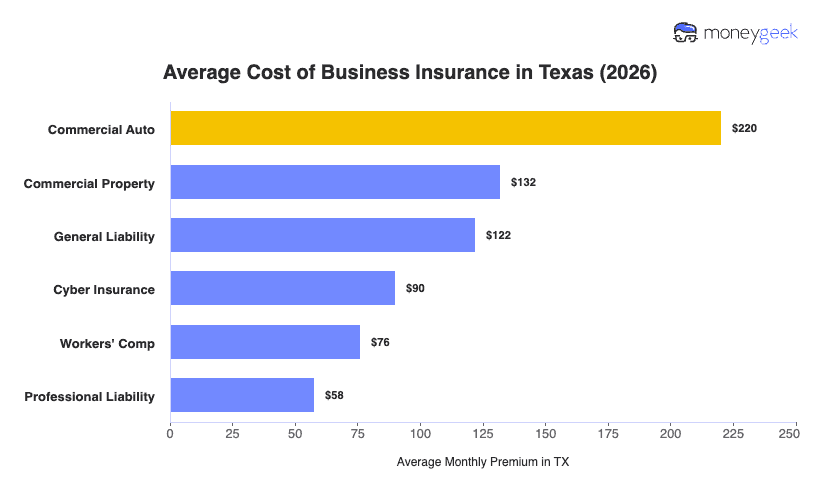
Say a small cleaning company signs a client contract requiring general liability and also runs a work van, so it needs commercial auto. In Texas that pairing runs about $98 per month for the general liability and $257 per month for the van, roughly $355 before anything else. A solo consultant with no vehicle or storefront would pay a fraction of that, while a contractor adding workers' comp and property coverage would pay more. Here's what each policy costs on average in Texas, what it covers and when you need it:

Workers' Compensation
$76/mo ($914/yr)
Medical bills and lost wages when an employee is hurt on the job
Optional for most private employers in Texas, but expected once you have staff and often required by clients or government contracts
Commercial Auto
$220/mo ($2,644/yr)
Damage, injuries and liability from vehicles your business owns or uses for work
When your business owns vehicles or employees drive for work, since personal auto policies exclude business use
General Liability
$122/mo ($1,462/yr)
Customer injuries and property damage you're legally responsible for
When clients, landlords or licensing boards require proof, which covers most businesses
Commercial Property
$132/mo ($1,585/yr)
Repair or replacement of your building, equipment and inventory after a covered loss
When you own or lease space, hold inventory or rely on equipment to operate
Cyber Insurance
$90/mo ($1,081/yr)
Costs from data breaches, ransomware and recovery after a cyberattack
When you store customer data or process card payments online
Professional Liability
$58/mo ($692/yr)
Claims that your advice, service or work caused a client financial loss
When you sell professional services, advice or design work

Our Methodology

Our team collected standardized business insurance cost data across coverage types, industries and business sizes, then I analyzed it to produce comparable average rates for Texas and every other state. Holding the inputs consistent lets us isolate what each factor does to price, so a difference between two industries or two business sizes reflects the risk being priced, not a change in how the numbers were gathered.

Dataset Scope and Assumptions

The analysis covers six coverage types: general liability, workers' compensation, commercial auto, commercial property, professional liability and cyber insurance. It spans 25 general industries and more than 400 sub-industries, five business-size bands running from no employees up to 49 employees, and all 50 states plus Washington, D.C. Figures reflect standardized business profiles rather than any single company's quote.

How We Calculated

The national average is the mean monthly premium across all states, which gives one reference point for comparing Texas with everywhere else. Segment averages isolate a single variable at a time, so the coverage figures hold industry and size steady, the industry figures hold coverage and size steady, and so on. These are modeled estimates built from standardized profiles, not quotes, so your own premium will differ based on your claims history, the limits you carry and your insurer.

Texas Commercial Insurance Cost Calculator

Enter your details into MoneyGeek's small business insurance calculator below to get a rate estimate based on your business profile. You can adjust the coverage type, industry and number of employees to see how each one moves your cost.

TX Small Business Insurance Cost Estimate Calculator

Set your coverage type, industry and employee count in the calculator to get an average monthly and annual rate for a business like yours in Texas. Treat it as a budgeting baseline, not a quote, since your real premium also depends on your claims history and coverage limits. Once you've got a number to work from, hit Get Quotes to compare real offers from a few insurers.

Select General Industry Category
Select Coverage Type
Select Employee Count
Average monthly rate in TX

Average Business Insurance Costs in Texas by Industry

Business insurance is bought in layers, not as a single product, and you add each policy as your business demands it. I built the breakdowns below for a dozen common industry categories in Texas, starting with the coverage you can't skip and working outward. Each assumes one to four employees, plus the work vehicle typical for trades that drive, and every total is the sum of the exact policies listed, not a blended average.

I grouped the coverage into three tiers: 

  • Minimum is what a business genuinely can't operate without
  • Recommended adds the next layer most owners in that field carry, usually workers' comp once there's staff
  • Comprehensive rounds out the package with the risk-specific lines that fit the trade

Select your industry below to see its coverage breakdown and what each tier costs:

What Affects Business Insurance Costs in Texas?

Some of what you pay for business insurance in Texas is fixed by your trade and your location, and some of it you control through the choices you make about coverage and risk. Knowing which is which tells you where there's room to lower a premium and where there isn't.

  • graph icon
    Your Industry and the Risk It Carries

    Your industry is the single biggest driver of what you pay, because it sets both how often claims happen and how costly they are. A Texas roofing contractor or trucking operation carries far more physical risk than an accountant, so it pays more across nearly every line. This is why a consulting firm can be fully covered for under $100 a month while a small freight operation clears $1,500 per month.

  • smallBusiness icon
    How Many Employees You Have

    Headcount moves your premium as much as almost anything, mostly through workers' comp, which is priced on payroll. A Texas business with no employees averages about $51 a month, but that nearly doubles to $96 once you hire your first one to four workers, and it climbs to roughly $637 a month in the 20-to-49 range, based on MoneyGeek's Texas data. Each hire adds payroll to insure and, past a point, pushes you toward coverage a smaller business could skip.

  • stackOfBooks icon
    What Texas Requires You to Carry

    Texas mandates less business coverage than most states, which shapes where owners spend. It's one of the few states that doesn't require most private employers to carry workers' compensation, according to the Texas Department of Insurance. Commercial auto is the main exception, since any business vehicle must carry at least 30/60/25 liability limits under the Texas Transportation Code. Beyond that, most of what Texas businesses buy is driven by client contracts and commercial leases rather than state law.

  • umbrella icon
    Your Coverage Limits and Deductibles

    Two businesses in the same field can pay very different premiums based on how they set their limits and deductibles. A policy with a $1 million liability limit costs more than one at $500,000, and raising your deductible lowers your premium in exchange for paying more out of pocket when a claim hits. Contracts often dictate the floor here, since a client or landlord may require a $1 million general liability limit before signing.

  • pin icon
    Your Location Within Texas

    Where you operate inside the state changes your rate, because risk isn't uniform across Texas. A business on the Gulf Coast faces hurricane and flood exposure that raises property costs well above the same business in Dallas or Austin, and dense urban areas tend to see more theft and liability claims than rural counties. Crime rates, weather exposure and even local traffic all feed into what insurers charge by ZIP code.

  • userProfile icon
    Your Claims History

    Insurers price partly on your track record, so a business that files frequently pays more than one with a clean history. A few years without claims signals lower risk and can steadily bring your premium down, while a serious claim, especially a liability suit or a large workers' comp payout, can raise it for years. Texas sits mid-pack nationally at about $116 a month, cheaper than California ($160) or New York ($162) but above neighbors like Oklahoma ($98) and Louisiana ($110), and your claims record is one of the few levers you control on your own rate.

How to Lower Your Business Insurance Costs in Texas

Lowering your premium isn't about buying less coverage, it's about buying it efficiently and giving insurers fewer reasons to charge you more. These six strategies do that without leaving your business exposed.

  1. 1
    Compare Quotes on Identical Coverage Terms

    The same business can get very different prices from different insurers, so quotes are worth gathering, but only if you hold the terms steady. Ask each insurer for the same limits, deductibles and coverages, or you'll be comparing a cheap quote against a more complete one and mistaking less coverage for a better deal. In a state like Texas with a large, competitive insurer market, the spread between quotes can be substantial.

  2. 2
    Bundle General Liability and Property Into a Business Owner's Policy

    A business owner's policy (BOP) combines general liability and commercial property into one package, and insurers typically price it below what the two policies would cost bought separately. It's built for small and mid-sized businesses that need both, which describes most Texas retailers, restaurants and offices. A BOP won't hold your workers' comp or commercial auto, though, so those stay separate.

  3. 3
    Classify Your Business and Payroll Accurately

    Insurers rate your business on its industry classification and, for workers' comp, on your payroll by job type. Misclassifying a low-risk role as a high-risk one, or overstating payroll, means paying for risk you don't carry. Review your class codes with your agent, especially if your business has changed what it does since the policy was written.

  4. 4
    Raise Your Deductible Where It Makes Sense

    A higher deductible lowers your premium because you're agreeing to absorb more of a smaller claim yourself. This works best when you have the cash reserves to cover that deductible comfortably and you rarely file small claims. Run the math on the premium savings against the out-of-pocket risk before raising it.

  5. 5
    Manage Risk to Keep Your Claims History Clean

    Your claims record follows you, and a clean one is among the few levers that steadily lowers your own rate over time. Safety training, documented procedures and prompt hazard fixes reduce the incidents that turn into claims, which matters most in Texas's higher-injury trades like construction, trucking and manufacturing. Fewer claims filed today means lower renewals for years.

  6. 6
    Reassess Your Coverage After Any Real Change

    Business insurance isn't set-and-forget, and the wrong coverage costs you whether it's too much or too little. After hiring, buying a vehicle, signing a lease or landing a contract with new insurance requirements, revisit your policies so you're paying for what you actually have. A yearly review also catches coverage you've outgrown or duplicated across policies.

Average Cost of Commercial Insurance in Texas: Bottom Line

Good coverage starts with an honest look at what could go wrong in your business and what it would actually cost you to recover. Three questions get you most of the way there:

  • What am I actually required to carry? In Texas, only commercial auto liability at 30/60/25 for business vehicles is mandated, plus workers' comp where a client or contract demands it, since the state doesn't require it of most private employers.
  • What would genuinely put me out of business? A customer injured on your property, an employee hurt on a job site, a warehouse fire, an at-fault truck wreck or a breach of client data are the losses worth insuring fully, because any one can end an uncovered small business.
  • What can I afford to absorb myself? Smaller risks like a cracked screen or a minor repair aren't worth a claim, so choosing higher deductibles on those lowers your premium while you reserve coverage for losses you couldn't write a check for.

Answer those three honestly and you're no longer guessing at a number, you're buying against real risk, which is the only way to know you're neither overpaying nor underinsured.

Average Cost of Business Insurance in Texas (2026) Chart

Texas Business Insurance Costs: Next Steps

Knowing the average cost is useful for budgeting, but no business pays the average. To see real numbers for a business like yours, compare what individual insurers quote. The best and cheapest guides below rank Texas providers on price and claims handling, so you can tell which ones are worth getting a quote from.

Recommended: If You're Ready to Compare Providers

These pages rank insurers by what they charge and how they handle claims, so you can see who's worth a quote.

If You Want to Know What Other Coverage Costs

If You Want to Understand the Coverage Itself

About Connor Bolton


Connor Bolton, Senior SEO and Content Manager (Business & Pet), MoneyGeek

Connor Bolton is Senior SEO and Content Manager at MoneyGeek, where he leads the business and pet insurance editorial teams. He sets the research framework, data standards and content structure for his team. All content goes through his accuracy review before publication. Connor also writes in-depth guides and has spent more than four years covering insurance products across personal, commercial and specialty lines.

The research infrastructure Connor built covers auto, home, renters, life, health, business and pet insurance across pricing analysis, carrier research, customer experience and coverage evaluation. It includes over 6 million data points for business insurance across 408 industry areas, all 50 states and 16 vehicle types. The pet insurance side covers over 5 million profiles across 18 major providers, 100+ breeds and ages up to 20 years. Connor’s insurance research and his team's work has been cited by the U.S. Chamber of Commerce, Allstate, Liberty Mutual, CBS News, Forbes and LegalZoom.

Connor also talks with underwriters and carrier liaisons at Ethos, The Hartford, ERGO NEXT, Nationwide and State Farm, and monitors business and pet owner communities on Reddit. Those sources shape how his team evaluates carriers, structures rate analysis and writes for human buyers rather than search engines.

For questions about MoneyGeek's business and pet insurance content, contact him at connor@moneygeek.com or on LinkedIn.