
Cheapest Small Business Insurance in Texas

I analyzed Texas business insurance premiums across seven providers and more than 400 sub-industries, from construction and healthcare to restaurants and gyms. The cheapest insurer depends on what your business does, so I've broken my picks down by the type of business each one quotes the lowest:

  • Choose If You Run a Food, Trade or Service Business: ERGO NEXT
  • Choose If You Run a Fitness, Wellness or Personal-Service Business: biBerk
  • Choose If You Run a Healthcare or Specialized Practice: The Hartford
  • Choose If You Run a Seasonal, Event or Recreation Business: Thimble
  • Choose If You Run a Professional, Consulting or Office-Based Business: Hiscox

To find the cheapest business insurance in Texas, I ranked providers on price, comparing what each one charges against the average for the same type of business rather than a single statewide figure, since a fair rate for a restaurant isn't a fair rate for a consultant.

My analysis reflects the needs of small Texas businesses with one to four employees and draws on pricing data from more than 6 million business profiles and policy information across 25 industries in all 50 states and Washington, D.C. I compared seven providers across those industries and more than 400 sub-industries to identify the cheapest option overall, by coverage type and by industry.

These are comparison estimates, not quotes. Your actual premium depends on your class code, payroll, revenue, employee count, claims history, coverage limits, deductibles and location. For the full breakdown of how these figures are built, see MoneyGeek's methodology.

ERGO NEXT

ERGO NEXT: Cheapest for Food, Trade and Service Businesses

On ERGO NEXT's site
COMPANY HIGHLIGHTS

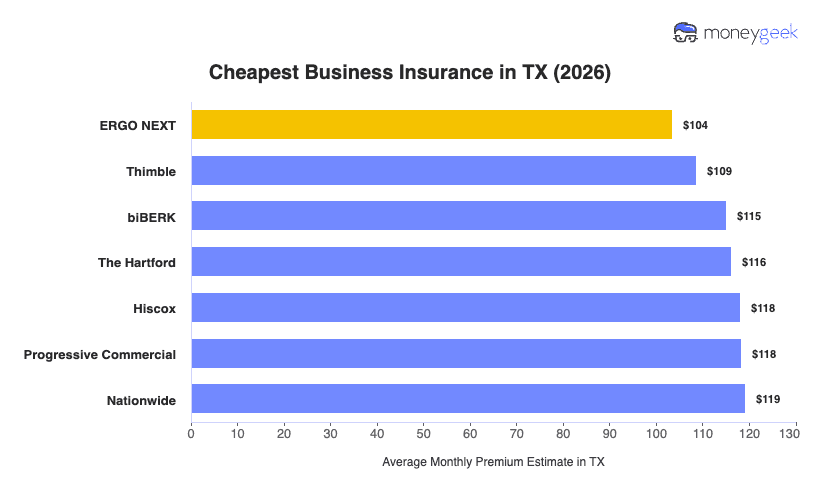
ERGO NEXT is the cheapest business insurance in Texas for food and beverage businesses, at about $92 per month, roughly 18% below what restaurants, cafes and caterers typically pay. Its pricing beats the average across every food-service category in the data, with the deepest discounts for mobile and event operations like caterers and food trucks. The savings extend to trade and service work too, where contractors and cleaning companies come in under average. ERGO NEXT also posts the lowest average rate of any provider statewide, at about $104 per month, so it's a strong first quote even outside those industries.

Learn More: ERGO NEXT Business Insurance Review

biBerk

biBerk: Cheapest for Fitness, Wellness and Personal-Service Businesses

COMPANY HIGHLIGHTS

biBerk is the cheapest business insurance in Texas for fitness businesses, at about $64 per month, roughly 13% below what gyms, studios and trainers typically pay. It prices below the average across every fitness category in the data, from solo personal trainers and yoga instructors to full gyms and climbing facilities. The savings carry into other low-risk service work too, where beauty and wellness shops save around $5 a month and marketing firms about $4 against their category averages. For owners who are comfortable managing coverage online, biBerk pairs those low rates with a self-serve buying process.

Learn More: biBerk Business Insurance Review

The Hartford

The Hartford: Cheapest for Healthcare and Specialized Practices

On The Hartford's site
COMPANY HIGHLIGHTS

The Hartford is the cheapest business insurance in Texas for healthcare businesses, at about $134 per month, roughly 10% below what medical practices typically pay. The savings are largest for higher-cost clinical work, where surgical specialists, dermatology and optometry practices, and urgent care and dental offices come in 15% to 29% under the category average. It also prices below average for financial services firms, which save about $4 a month, and for tech and IT businesses. The Hartford is the option to compare when your work carries real risk and you want a full-service carrier behind the low rate.

Learn More: The Hartford Business Insurance Review

Thimble

Thimble: Cheapest for Seasonal, Event and Recreation Businesses

COMPANY HIGHLIGHTS

Thimble is among the cheapest business insurance options in Texas for camps, youth programs and recreation businesses, and its discounts here are some of the largest on the page. Day camps and small amusement parks pay around $111 per month, roughly 57% below the going rate for those activities, and youth sports leagues come in near $103. The savings extend to event and community organizations, where churches and religious groups pay about $90 a month. Thimble's on-demand, pay-when-you-work coverage fits businesses that run seasons or events rather than operating year-round.

Learn More: Thimble Business Insurance Review

Hiscox

Hiscox: Cheapest for Professional, Consulting and Office-Based Businesses

COMPANY HIGHLIGHTS

Hiscox is the cheapest business insurance in Texas for financial services businesses, at about $64 per month against a $71 industry average. The advantage is widest for notaries, who pay around $30 a month, and holds for financial advisors and bail bondsmen, though accounting and bookkeeping firms tend to find lower rates elsewhere. Hiscox is also a consistent low-cost option across professional and office work more broadly, coming in a few dollars under average for tech, consulting and real estate firms. It's a strong first quote for low-risk businesses that mostly need general and professional liability.

Learn More: Hiscox Business Insurance Review

lightbulb icon
CHEAPEST DOESN'T ALWAYS MEAN BEST

The lowest rate only helps if the policy carries the coverage your business needs. Before you choose on price, compare the liability limits, the coverages included, what's excluded and how well the insurer handles claims. A policy that saves you a few dollars a month isn't a deal if it caps out below what a real claim would cost or leaves out a risk central to your work. If coverage and service matter as much as price, compare the best business insurance in Texas alongside the cheapest.

Is the Cheapest Business Insurance the Best Choice in Texas?

Cheap policies are usually cheap for a reason, whether it's lower limits, higher deductibles or narrower coverage. The cheapest option can still be the right one, but only if it clears three checks first.

  • It meets your requirements: If you own business vehicles, Texas requires at least 30/60/25 in commercial auto liability. General liability and workers' compensation aren't mandated by the state, so those requirements usually come from your contracts instead. Between state law and what your leases and clients demand, the cheapest policy is only worth it if it covers everything you're actually required to carry.
  • It covers your most likely financial risks: The right coverage depends on what actually threatens your business, and in Texas that often means weather, since a standard property policy excludes flood and a Gulf Coast storm can leave an uninsured shop with nothing. Match the coverage to your real exposure, whether that's hurricane and hail risk on the coast or liquor liability for a bar that serves alcohol.
  • Its service and support fit your needs: A low premium loses its value if the insurer is slow to pay or hard to reach when you file a claim. Look at how the company handles claims and how quickly it issues certificates of insurance, which you may need the same day a client or landlord asks for proof.

How to Find the Cheapest Business Insurance in Texas

Once you know what coverage you need, a few moves consistently bring the price down. These are the levers that actually move your premium in Texas.

  • umbrella icon
    Bundle into a business owner's policy

    A business owner's policy, or BOP, packages general liability and commercial property into one policy that costs less than buying them separately. If your business needs both, ask for a BOP quote first, since it's usually the largest single saving available to a small business.

  • wallet icon
    Raise your deductible

    A higher deductible means a lower premium. If your business could cover a larger out-of-pocket cost on a claim, moving the deductible up cuts the monthly rate directly, as long as you pick an amount you could actually afford to pay when something happens.

  • signupBonus icon
    Combine your policies with one insurer

    Carriers often discount when you place more than one policy with them, such as commercial auto alongside your BOP. Consolidating coverage with a single insurer can lower the total and leaves you with one renewal to manage instead of several.

  • stackOfBooks icon
    Lower your risk profile

    Insurers price on risk, so reducing it pays off. A documented safety program, a clean claims history, and, for Texas businesses in hail and windstorm zones along the Gulf Coast, storm-resistant roofing or shutters can all support a lower rate over time.

  • discount2 icon
    Ask about discounts you might qualify for

    Beyond the standard ones, insurers offer credits that many owners never claim, including discounts for paying annually instead of monthly, for going claims-free, or for membership in a trade or professional association. Ask each insurer what you qualify for before you buy.

  • calendar icon
    Reshop at renewal

    Your rate is not fixed. Carriers change their pricing every year and your business changes too, so getting fresh quotes at renewal rather than letting the policy auto-renew keeps you from overpaying as the market shifts.

Cheap Commercial Insurance in Texas: Bottom Line

Cheap business insurance is worth buying only when "cheap" still means covered. A low rate on a policy that leaves out a risk central to your work isn't a saving, it's a bill you haven't gotten yet.

I recommend you settle what you need first, make a shortlist of at least three providers, then let price decide among your options. That order matters. Start from coverage and let cost break the tie, not the other way around.

Before you compare a single quote, answer three questions:

  • What am I legally required to carry in Texas, and what do my contracts demand?
  • What would actually go wrong in my line of work, and would this policy pay for it?
  • If I had to file a claim tomorrow, do I trust this insurer to handle it?

Once you can answer those, price becomes the easy part. See how the cheapest options compare and get matched to the cheapest business insurance in Texas for your business.

Cheapest Business Insurance in Texas Chart

Cheap Texas Commercial Insurance: Next Steps

Price is the easiest thing to compare and the last thing you should decide on. A quote only means something once you know the coverage behind it fits how your business runs, so line up the requirements, limits and coverages first, then let cost settle it.

Recommended: Compare the Best Providers

Price tells you what a policy costs, not what it's worth. A cheap insurer that underpays claims or drops a coverage you rely on can cost you far more than the few dollars a month you saved. After you've settled the coverage your business needs, look at the insurers that pair a low rate with claims service and coverage you can count on, and let that shortlist guide the decision.

If You Want to Confirm Cost Before Deciding

If You're Still Learning About Business Insurance

How I Determined The Cheapest Business Insurance Providers in Texas

To find the cheapest business insurance in Texas, I analyzed rates from seven providers across 25 industry categories and more than 400 sub-industries, using standardized business profiles so the comparison holds from one insurer to the next. That approach surfaces the cheapest option three ways: overall, by coverage type and by industry, since the lowest-priced insurer for a consultant is rarely the lowest for a contractor.

Savings figures compare each provider's rate against the relevant average, either the state average or the average for a given industry. Workers' compensation is measured per employee rather than as a whole policy, and cyber liability is benchmarked against the national average because it's priced by industry. These are comparison estimates, not quotes. Your actual premium depends on your class code, payroll, revenue, employee count, claims history, coverage limits, deductibles and location, so treat these figures as a starting point for comparison rather than a price you'll be charged.

About Connor Bolton


Connor Bolton, Senior SEO and Content Manager (Business & Pet), MoneyGeek

Connor Bolton is Senior SEO and Content Manager at MoneyGeek, where he leads the business and pet insurance editorial teams. He sets the research framework, data standards and content structure for his team. All content goes through his accuracy review before publication. Connor also writes in-depth guides and has spent more than four years covering insurance products across personal, commercial and specialty lines.

The research infrastructure Connor built covers auto, home, renters, life, health, business and pet insurance across pricing analysis, carrier research, customer experience and coverage evaluation. It includes over 6 million data points for business insurance across 408 industry areas, all 50 states and 16 vehicle types. The pet insurance side covers over 5 million profiles across 18 major providers, 100+ breeds and ages up to 20 years. Connor’s insurance research and his team's work has been cited by the U.S. Chamber of Commerce, Allstate, Liberty Mutual, CBS News, Forbes and LegalZoom.

Connor also talks with underwriters and carrier liaisons at Ethos, The Hartford, ERGO NEXT, Nationwide and State Farm, and monitors business and pet owner communities on Reddit. Those sources shape how his team evaluates carriers, structures rate analysis and writes for human buyers rather than search engines.

For questions about MoneyGeek's business and pet insurance content, contact him at connor@moneygeek.com or on LinkedIn.