


Jump to the section that meets your needs best below:
Average Pressure Washing Business Insurance Cost (2026 Report)
Pressure washing business insurance costs range from $74 per month for a starting bundle to $505 per month for a full-service coverage mix.
If you want pricing now, MoneyGeek can match you to the insurer that meets your pressure washing business's coverage needs.
Select state
Updated: September 11, 2026
Advertising & Editorial Disclosure
How Much Does Pressure Washing Business Insurance Cost?
The starting bundle for pressure washing business insurance costs $74 per month, and it includes a business owner's policy that packages general liability and commercial property together. It covers the two exposures almost every pressure washer hits first, damage you cause to a client's property, such as a cracked window or etched siding from high-pressure work, and damage to your own equipment, the washer, surface cleaner and trailer your income depends on.
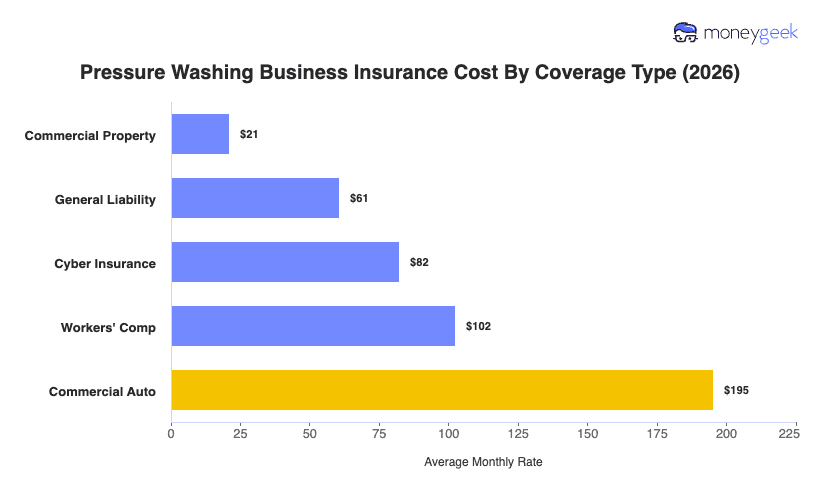
What you actually pay depends on which coverages you add on top of that base. Pressure washing has more moving parts than most solo trades, since a truck on the road, a crew on the payroll and chemical runoff each call for their own policy, which is why a pressure washing operation tends to land on the higher end of the average cost of cleaning business insurance. The good news is you can start with the base bundle and layer coverage on as you take on vehicles, employees and commercial contracts. The table below breaks down what each bundle includes and who it fits.
Starting Bundle | BOP (general liability + commercial property) | $74 | Owner-run residential washers just getting started |
Recommended Bundle | Starting bundle + commercial auto | $269 | Solo owners running a truck and trailer |
Team-Operated Bundle | Recommended bundle + workers' comp | $371 | Operations with W-2 employees on the payroll |
Full-Service Bundle | Team-operated bundle + cyber insurance + contractors' pollution liability | $505 | Larger crews taking commercial, chemical-intensive contracts |
We analyzed quote data from major U.S. commercial insurance providers and modeled standardized premium estimates across business profiles representing around 95% of the market. The figures on this page are consistent national benchmarks showing how premiums vary by business size, coverage type, state and vehicle type for operations that run commercial vehicles. Our published averages come from modeled premiums for standardized profiles, aggregated three ways.
National benchmark average
The national figure for each coverage reflects the modeled premium for a standardized one-to-four-employee pressure washing business across all states in our dataset, at standard policy limits.
State averages
To show how location moves your rate, we isolated the national base profile by state, including Washington, D.C. Where a specialized policy wasn't in the main dataset, we applied state-level pricing patterns to the national estimate to produce state figures.
Bundle averages
The bundles follow clear operating thresholds. The starting and recommended bundles fit an owner-operated washer running a single truck. Hiring W-2 employees moves the business into the team-operated bundle by adding workers' comp, and taking on commercial, chemical-intensive contracts moves it into the full-service bundle, which folds in cyber and contractors' pollution liability.
These figures are planning benchmarks, not quotes. Your actual premium shifts with your crew size, chemical use, equipment value, vehicles and state, so use them to frame what you see, not to predict it. For the full details behind our modeling, see our business insurance methodology.
Get Pressure Washing Business Insurance Cost Estimates
Enter your coverage type, state, employee count and vehicle type in our business insurance cost calculator to see estimates built around your operation. Select Get Quotes to be matched with providers in our network.
Before you begin:
- The calculator collects no personal information
- Workers' comp is estimated for each employee
- Commercial auto results vary with the vehicle type you choose
Get Pressure Washing Insurance Cost Estimates
Select Coverage Type
Select State
Select Employee Count
Select vehicle_type
Monthly Rate Estimate—
Select Coverage Type
Monthly Rate Estimate—
Select State
Select Employee Count
Select vehicle_type
Factors Affecting Pressure Washing Business Insurance Costs
What you pay for pressure washing business insurance swings more than most owners expect, and our analysis found a wide gap between the lowest and highest quotes in this trade. The work you take on, the equipment you run, how your crew is structured and where you operate each move what insurers charge.
 Services you take on
Residential driveway and house washing carries less risk than commercial flat work on parking garages or industrial degreasing. As you move up the commercial ladder, the clients, surfaces and chemical demands get heavier, and insurers price that added exposure into your policies. A business built on high-rise or industrial jobs will pay more than one washing homes.
 Equipment and trailer value
The washer, surface cleaner, buffer tank and chemical injector you run are all replacement costs if they're stolen or wrecked on a job. Higher-spec machines carry more insurable value, and hot-water rigs especially, so the more your setup is worth, the more your property coverage costs. That value flows straight into your premium.
 Crew size and worker classification
Adding employees raises your total cost, and how you classify them matters just as much. W-2 employees get priced into workers' comp based on payroll, while subcontractors can lower that exposure but may open gaps in your general liability if their work isn't covered under your policy. A misclassified crew can cost you at both ends.
 Chemical use
Bleach-based roof treatments, heavy degreasers and rust removers push you into pollution and property-damage exposure that ordinary surface cleaning doesn't carry. The chemicals you use, and how you store and transport them, shape how insurers judge your contamination risk. This is where a contractors' pollution liability policy earns its place.
 Vehicles and hauling
Every trip your truck makes puts commercial auto on the hook for that drive. Longer service areas, heavier trailer setups and extra vehicles in the fleet each widen what the insurer covers on the road, separate from what the equipment inside the trailer is worth. More miles and more trucks mean a higher rate.
 Where you operate
Your state does a lot of the work in setting your rate, especially on general liability, workers' comp and commercial auto. Litigation climate, jury awards, benefit levels and traffic density vary widely, which is why the same operation can pay two or three times as much in one state as another. Commercial property is the exception, staying fairly flat wherever you are.
How to Lower Pressure Washing Business Insurance Costs
Pressure washing carries more coverage types than most solo trades, which means more levers to pull on your premium. The biggest savings come from a mix of moves you can make before your next renewal and habits that improve how insurers see your operation over time. Finding affordable business insurance as a pressure washer starts with knowing which levers actually move your rate.
 Compare quotes using the same coverage limits
Rates for pressure washing businesses vary more between insurers than most owners expect, especially on commercial auto and workers' comp. Shopping only helps if every quote uses the same limits and deductibles, otherwise you're comparing coverage levels, not prices. Get at least three quotes before each renewal on one consistent profile.
 Right-size your coverage
The limits you set when you started may not fit the business you run now. If you've added crew, moved into commercial accounts or dropped residential work, your coverage may be higher or lower than your actual exposure warrants. Review it every year against what the operation looks like today, not what it looked like when you first bought the policy.
 Bundle general liability and property into a BOP
Most pressure washing businesses carry at least general liability, commercial auto and workers' comp, and splitting those across insurers usually costs more. Putting them with one carrier typically unlocks a multi-policy discount and simplifies claims that touch more than one policy, like a slip-and-fall that pulls in both general liability and workers' comp at once.
 Raise your deductible where it makes sense
A higher deductible lowers your premium, and it's worth considering on equipment coverage if your cash flow is steady. Minor property losses, a damaged surface cleaner or a cracked hose reel, are often cheaper to absorb yourself. Raising your commercial property deductible while keeping liability deductibles low trims fixed costs without taking on meaningful new exposure.
 Build a documented risk-management track record
The claims you generate, slip-and-falls on wet surfaces, chemical overspray on a client's property, equipment shifting in transit, feed straight into what you pay at renewal. Insurers reward documented controls, and a steady record of fewer claims builds real pricing leverage over time. A few habits worth putting in writing:
- Train your crew on wet-surface protocols before each job, especially on inclined driveways and commercial walkways where slip risk is highest
- Keep a written chemical log recording the products used, dilution ratios and application method for every job
- Inspect trailer hitches, tie-downs and equipment mounts before every route to cut damage claims from gear shifting in transit
- Photograph each job site before and after work so any property-damage dispute has a clear record
Pressure Washing Business Insurance Cost: Bottom Line
The recommended pressure washing bundle averages $269 per month, or $3,228 per year, and covers a business owner's policy plus commercial auto, the base a solo owner with a truck and trailer realistically needs. Treat it as a reference point, not a target price. Where your own premium lands depends on a few things specific to how you operate. Three questions help put any quote you get in context:
- Which bundle matches how you run today? You'll stay near the recommended bundle if you own the business, run one truck and take mostly residential work. Add employees and you move toward the team-operated bundle with workers' comp; take on commercial, chemical-heavy contracts and you're into the full-service range.
- Is your quote in line with your risk profile? A quote above the benchmarks for your state and services usually traces back to one or two drivers, your chemical use, your fleet, your crew size. Knowing which one is pushing your rate tells you more than the total on its own.
- Which cost drivers actually apply to you? Not every factor weighs the same for every operation. A solo owner on residential driveways faces a different pricing profile than a crew running industrial degreasing jobs, even at the same head count. Match the drivers to your own setup before you judge a number as high or low.
About Angelique Palenzuela-Cruz

Angelique Palenzuela-Cruz is a Business Insurance Content Writer at MoneyGeek, where she specializes in general liability, workers’ compensation and professional liability insurance. Her work helps small business owners understand how these policies apply to coverage, including risks like customer injuries, employee injuries, professional mistakes, client contract terms and industry-specific coverage requirements.
She primarily covers service-based businesses where liability and employee coverage decisions are especially important, including cleaning, consulting, beauty and wellness, childcare, education, fitness, food service, pet care, repair and maintenance, and other professional services.
Before joining MoneyGeek, Angelique spent nearly 12 years at Guthrie-Jensen Consultants, one of Southeast Asia’s largest management training firms, where she advanced from Training Consultant to Managing Consultant. In that role, she worked with business clients to assess operational needs, develop training programs and present performance analyses to executive decision-makers. She also helped establish Gladwin Training Consultancy, where she served in learning solutions and client service roles.
Her background gives her practical context for writing about how businesses operate, manage client expectations, structure teams and make risk decisions. At MoneyGeek, she applies that experience to business insurance content, connecting coverage to actual business needs.
LinkedIn: linkedin.com/in/ma-angela-cruz
Email Contact: angelique.palenzuela@moneygeek.com
Sources
- North Dakota Workforce Safety & Insurance (State of North Dakota). "Agency Overview & History." Accessed October 12, 2026.