
How Much Does General Liability Insurance Cost in Hawaii?

The average cost of general liability insurance nationally runs $123 per month for businesses with one to four employees. Hawaii's benchmark sits at $159 per month or $1,913 per year, about 30% above that figure, placing the state 46th in affordability out of 50 states and the District of Columbia.

Hawaii isn't an outlier within its region, it's the norm. Every Pacific state is above the national average, ranging from $138 in Oregon to $190 in California, with Alaska, Washington and Hawaii grouped in the $151 to $159 range. Geographic isolation, a higher cost of doing business and a less competitive insurance market likely account for Hawaii's position within that elevated range.

Hawaii's figure is a state average, not a rate prediction. The more useful question isn't how close your quote lands to that number, it's what's driving your cost in the first place. A more personalized cost estimate is available through the Hawaii general liability insurance cost calculator below.

To estimate average general liability insurance costs in Hawaii, we analyzed quote data from major U.S. small business insurance providers and modeled standardized premium estimates across common business profiles. These modeled results are designed to provide a consistent state benchmark and show how premiums vary by key baseline factors including business size, industry and location within Hawaii.

Dataset Scope and Assumptions

Our cost modeling uses standardized inputs for consistent comparisons across Hawaii businesses.

  • Providers analyzed: 10 major insurance providers
  • Industries covered: 25 general industry categories relevant to Hawaii's business landscape
  • Employee count bands: zero, one to four, five to nine, 10 to 19 and 20 to 49 employees
  • Policy baseline: standard general liability policy with $1 million per occurrence / $2 million aggregate limits
  • Total estimates modeled: over 20,000 standardized pricing estimates across Hawaii industry and employee count combinations

We also incorporated modeled average revenue and payroll personalized across all combinations of Hawaii regions, industry and employee counts to improve the accuracy of pricing. To model these assumptions against our cost factors, we used data from these sources:

  • CBP (for employee size class density in Hawaii by NAICS)
  • QCEW (for wage/payroll intensity by industry in Hawaii)
  • Economic Census / SUSB (for receipts/output intensity by industry)
  • Calibrated against:
    • Private comp databases
    • IRS SOI totals

How We Calculated Average General Liability Costs in Hawaii

Our published averages represent modeled premiums for standardized business profiles and were aggregated in two ways:

  • Hawaii state average: The Hawaii average cost reflects the modeled premium for a standardized one to four-employee small business across all industries included in our dataset for a standard general liability policy.
  • Segment averages: To show how costs vary within Hawaii, we calculated average modeled premiums for our state base profile and isolated for variables, including:
    • Employee count (business size ranges)
    • General industry categories

Segment averages were produced by aggregating modeled pricing trends across the full dataset so readers can compare how premiums shift across business types and regions within Hawaii.

Read our full business insurance methodology.

Business Insurance Rates by State and Industry

Select your general industry and employee count for a personalized general liability insurance cost estimate for your Hawaii business. Estimates are based for a $1 million per occurrence and $2 million aggregate policy.

Select Industry
Select Employee Count
Average Monthly Rate—

What Factors Affect General Liability Insurance Costs Hawaii?

General liability insurance in Hawaii responds sharply to headcount. Businesses with no employees come in 50% below the state average, while operations with 20 to 49 employees run 1,902% above it. The spread reflects how insurers treat payroll and workforce size as direct signals of exposure, with more people typically meaning more interaction, more risk surface and higher expected claim frequency.

Industry classification follows a different logic. Hazard profile and third-party exposure drive the range more than size or revenue do. Tech firms and consulting practices sit 80% and 78% below the state average; contractors run 195% above it. The gap between those endpoints captures differences in claim likelihood and severity potential across operation types.

These two factors set the baseline, but Hawaii-specific conditions can shift where a business lands within those ranges:

    pin icon
    Hawaii's Geographic Isolation and Market Concentration

    Hawaii's distance from the mainland limits the number of insurers actively writing GL policies in the state. Fewer competitors reduce pricing pressure, and higher reinsurance costs for carriers operating in an isolated market push premiums upward, contributing to Hawaii's position well above the national average.

    Loading...
    Hawaii's Tourism-Driven Liability Exposure

    Tourism anchors Hawaii's economy, and the numbers reflect it. The state recorded 9,657,607 visitor arrivals in 2023. Businesses serving that volume of visitors carry elevated third-party liability exposure by default, which insurers factor into GL pricing across hospitality, food service and activity-based industries.

    money2 icon
    Hawaii's High Cost of Doing Business

    The U.S. Bureau of Economic Analysis placed Hawaii's Regional Price Parity index at 110.0 in 2024, second highest in the nation. Higher labor, real estate and import costs raise the severity of potential claims, since repair, replacement and medical costs all run above national norms, and insurers build those elevated severity estimates into GL pricing.

    hurricane icon
    Hawaii's Natural Disaster Exposure

    FEMA records 70 federal disaster declarations for Hawaii in total, with an average of three per year over the most recent five-year period. Volcanic activity, hurricanes, flooding and wildfires create a heightened risk environment that affects how insurers assess overall market conditions, particularly for outdoor operations, construction and tourism-adjacent businesses.

    hotel icon
    Hawaii's Workforce Composition and Seasonal Labor

    Hawaii's Leisure and Hospitality sector ranks as one of the state's largest employers. The sector's workforce tends to fluctuate with visitor demand across the year, and businesses with variable staffing levels may be assessed differently by underwriters evaluating operational stability and liability exposure.

Average General Liability Insurance Costs in Hawaii by Business Size

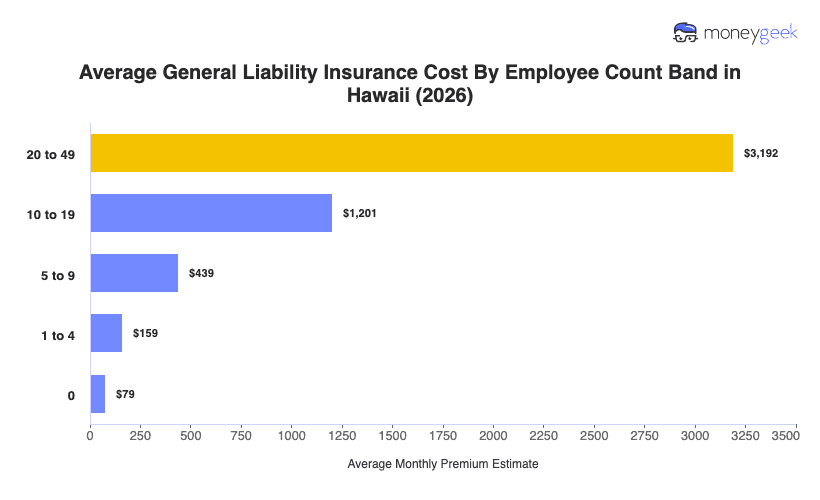
Monthly premiums for Hawaii general liability insurance range from $79 for businesses with no employees to $3,192 for those with 20 to 49 employees. The steepest relative jump occurs between the fourth and fifth employees, where costs rise 175%. After that point, the rate of increase moderates at each subsequent band transition, even as the absolute dollar gaps widen considerably.

The breakdown by employee band shows average monthly and annual premiums at each tier. Focus on the transitions between bands, not just the endpoints.

Hawaii General Liability Insurance Cost Chart

Average General Liability Insurance Costs in Hawaii by Industry

Monthly premiums range from $31 for tech firms to $471 for contractors, the widest industry spread in Hawaii's general liability market. The crossover point falls between Hospitality, Travel & Tourism and Food & Beverage, where costs shift from just below the state average to above it. 

Beyond Food & Beverage, only four more general industries sit above Hawaii's average, but that tier carries the steepest premiums, with Construction topping the list at 195% above the benchmark. The industry breakdown shows where each classification falls relative to the state average, so pay attention to which side of the crossover your industry lands on.

Data filtered by:
Select
Agriculture & Natural Resources$134$1,61316%
Arts, Media & Entertainment$52$62267%
Beauty, Body & Wellness Services$58$69864%
Childcare Services$201$2,411-26%
Cleaning Services$142$1,70211%
Construction & Contracting$471$5,653-195%
Consulting Services$35$42378%
Education$70$83956%
Financial Services$59$70563%
Fitness Services$130$1,56018%
Food & Beverage$169$2,033-6%
Healthcare & Medical$284$3,408-78%
Hospitality, Travel & Tourism$154$1,8513%
Manufacturing$86$1,03546%
Marketing & Communications$38$45476%
Nonprofit & Associations$81$97249%
Other Professional Services$105$1,26334%
Pet Care Services$78$93451%
Real Estate & Property Services$55$66665%
Recreation & Sports$60$71663%
Repair & Maintenance$110$1,31831%
Retail & Product Rental$125$1,50421%
Tech/IT$31$37380%
Transportation & Logistics$98$1,18138%
Wholesale & Distribution$173$2,075-8%

Use these resources to explore costs for your industry.

How to Lower General Liability Insurance Costs Without Sacrificing Coverage

Hawaii's GL premiums run considerably higher than the national average, a gap driven largely by market conditions outside any individual business owner's control. Affordable general liability coverage in Hawaii is worth pursuing actively, but the strategies that move the needle are specific. These five methods can lower costs without reducing the financial protection your business depends on:

    shoppingCart icon
    Compare Multiple Insurers

    A Honolulu accounting firm that accepts its first GL quote from an existing insurer takes on more pricing risk than it might realize. Hawaii's carrier market is less competitive than the mainland, which means individual insurers price with less external pressure. Requesting general liability quotes from at least three carriers gives you a meaningful spread to work with. Review general liability exclusions across each quote, since a lower premium with broader exclusions may leave gaps that cost more to fill later.

    building icon
    Bundle General Liability Into a Business Owner's Policy

    A Kauai vacation rental management company carrying GL and commercial property coverage as separate policies misses the bundling discount that comes with combining them. A BOP packages both into a single policy, and insurers typically price that package below what each coverage costs on its own. The cost of a BOP makes it one of the more direct savings levers for Hawaii businesses where property and liability exposure regularly overlap.

    loanReview icon
    Adjust Your Coverage Limits

    A Maui wedding planning business still carrying $2 million in GL limits set by a venue contract years ago may be paying for coverage that no longer matches its actual exposure. Reviewing general liability limits against current contracts and operations identifies where overbuying has occurred. Use how much general liability you need as the benchmark, not the highest limit a past contract required.

    barChart icon
    Improve Your Loss Profile Over Time

    A North Shore surf school that files two minor general liability claims in three years, one for equipment damage and one for a slip near board storage, may not think much of either incident individually. But together, those claims build a loss profile that follows the business into every renewal conversation.

    Reducing claim frequency over multiple policy cycles signals lower risk to underwriters and creates leverage at renewal. For small operators in Hawaii's outdoor instruction and recreation sector, even modest improvements in loss history can move the pricing conversation in a better direction over time.

    stackOfBooks icon
    Strengthen Risk Controls Insurers Care About

    A Waikiki food tour operator leading groups of 10 to 15 visitors through multiple vendor stops daily carries layered exposure, with unfamiliar customers, outdoor environments, food handling and vendor variability all in a single operation. Underwriters price that exposure based on observable signals, and documented risk controls provide the evidence they look for.

    Protocols like vendor vetting, allergy disclosure procedures and route safety checks reduce incident likelihood and signal active exposure management. For Hawaii businesses in experiential tourism and food service, where third-party interactions are frequent and varied, that signal can influence how underwriters assess risk at renewal.

General Liability Insurance Cost in Hawaii: Bottom Line

Hawaii's statewide average gives businesses a reference point for where general liability insurance costs land under typical conditions. That figure reflects a specific profile and represents the midpoint of a wide distribution rather than a prediction for any individual business. Three questions can help put your own cost in context:

  1. How does my quote compare to the state average, and what does that gap tell me? A quote above or below the state average isn't meaningful on its own, since the gap only makes sense relative to your industry tier and headcount band. Locating yourself within the distribution tells you whether your cost reflects your risk profile or something worth investigating further.
  2. How much of my cost reflects where I operate, not just what I do? Hawaii's market conditions, including fewer carriers, higher claim severity and elevated business costs, create a cost floor that applies regardless of industry or operations. Understanding how much of your premium traces back to Hawaii-specific conditions versus your own risk profile helps set realistic expectations for what's changeable.
  3. Which parts of my cost are within my control? Coverage limits, loss history, bundling structure and risk controls all respond to decisions you make. Identifying which levers apply to your situation, and which costs are structural, gives you a clearer picture of where cost management is realistic and where it isn't.

Hawaii's tourism-driven, service-heavy economy produces a wide range of risk profiles under a single statewide average. For most businesses, understanding which cost drivers apply to their operation matters more than closing the gap to the monthly average of $159.

General Liability Insurance Cost in Hawaii: Next Steps

With a clearer picture of what drives GL costs in Hawaii, the logical next step is putting that context to work. For businesses focused on cheaper options, the most reliable path in Hawaii's market runs through bundling, limit adjustment and loss profile improvement rather than carrier shopping alone.

For those ready to compare providers or request quotes, consistency matters most, with the same coverage limits, same business details and same policy terms across every request. Provider pricing responds to industry classification and employee count, so quotes built on different inputs won't give you a reliable comparison. Confirm your current limits and loss history before approaching carriers, and treat the state average as a reference point rather than a target.

Get Personalized General Liability Insurance Quotes in Hawaii

Select your industry and state to get a customized Hawaii general liability quote.

Industry
State

About Angelique Palenzuela-Cruz


Angelique Palenzuela-Cruz headshot

Angelique Palenzuela-Cruz is a Content Writer at MoneyGeek specializing in business insurance. She focuses on general liability, workers' compensation and professional liability coverage, helping small business owners cut through policy jargon and understand what they're actually buying.

Angelique has spent over five years reporting on personal finance, with deep experience in both insurance and lending markets. Her psychology background also gives her a unique understanding of how people actually process difficult financial decisions, allowing her to meet readers where they are, simplify complex concepts and build decision making frameworks that give them confidence. Whether you're learning about policies, comparing providers or trying to figure out requirements, Angelique does the legwork, digging into regulations, analyzing policy language and testing her explanations against agent-level standards so you get straight answers without fluff.


sources