
Key Takeaways
blueCheck icon

Florida businesses pay about $128 per month ($1,538 per year) for business insurance, roughly $17 above the $111 national average. That ranks Florida 43rd of 51 states for affordability and makes it the most expensive state in the Southeast, well above Georgia at $108, North Carolina at $104 and South Carolina at $103.

blueCheck icon

Your rate depends on your industry, headcount, location, the coverage limits you carry and your claims history. But in Florida, increased risk from hurricane and coastal exposure makes commercial property and commercial auto more expensive than in most other states.

blueCheck icon

I recommend that you compare quotes from at least three insurers on identical coverage terms before you buy, since the spread between Florida's cheapest and priciest carriers is wide. I'd also bundle general liability and commercial property into a business owner's policy (BOP) where you qualify, and reassess your limits after you hire, buy equipment or sign a lease.

How Much Does Business Insurance Cost in Florida?

The cost of business insurance in Florida is $128 per month on average, or $1,538 a year. That figure is a composite average across all six coverage types, 25 industries and every business size in our data, so treat it as a benchmark for comparison, not a quote for your own business. What you actually pay depends on which coverages you carry and the limits you set on each.

Two of those coverages scale with the size of your operation instead of sitting at a flat rate. Workers' compensation is priced per employee, so it climbs as you add staff, and commercial auto is priced per vehicle, so a business running a fleet pays far more than one with a single van. The rest are quoted as flat monthly averages. Here's what each policy costs in Florida, what it covers and when your business needs it.

Commercial Auto
$230/mo ($2,763/yr)
Injuries and property damage from an accident involving a work vehicle.
Required for any vehicle your business owns or uses for work.
General Liability
$144/mo ($1,732/yr)
Customer injuries and property damage you're legally responsible for.
When clients, landlords or licensing boards require proof, which is most businesses.
Commercial Property
$140/mo ($1,682/yr)
Your building, equipment and inventory against fire, theft and similar losses.
When you own or lease space, or hold equipment and inventory worth protecting.
Workers' Comp
$103/mo ($1,237/yr)
Medical bills and lost wages when an employee is hurt on the job.
Required in Florida once you have four or more employees, or one or more in construction.
Cyber Insurance
$90/mo ($1,080/yr)
Breach response, data recovery and the liability costs of a cyberattack.
When you store customer data or take card payments.
Professional Liability
$61/mo ($731/yr)
Claims of mistakes, bad advice or missed deadlines in your professional work.
When you sell advice or services, like consultants, agents and clinics.

Our Methodology

To build these Florida figures, our team collected standardized commercial insurance cost data, then I analyzed it to produce comparable averages by coverage type, industry and business size. Every cost on this page comes from that dataset, which lets us compare Florida with other states on the same basis.

Dataset Scope and Assumptions

  • Six coverage types: general liability, workers' compensation, commercial auto, commercial property, professional liability and cyber insurance.
  • 25 general industries and more than 400 sub-industries, from consulting to construction.
  • Five business-size bands, from no employees up to 49.
  • All 50 states plus Washington, D.C.

How We Calculated

The national average is the mean monthly premium across all 50 states and Washington, D.C., which gives one reference point for judging whether a state runs high or low. Segment averages isolate a single variable at a time, one cut for coverage type, one for industry and one for business size, so you can see what each factor does to cost on its own. These are modeled estimates built on standardized assumptions, not quotes, so your own price will change once an insurer prices your actual risk.

Florida Commercial Insurance Cost Calculator

Use this small business insurance calculator to estimate what your business might pay in Florida by entering your general industry category, coverage type and employee count. It returns a modeled estimate rather than a quote, so once you have a number, get quotes to compare real pricing for your business.

FL Small Business Insurance Cost Estimate Calculator

Set your coverage type, industry and employee count to get an average monthly and annual rate for a business like yours in Florida. Treat it as a budgeting baseline, not a quote, since your real premium also depends on your claims history and the coverage limits you carry. Once you have a number to work from, hit Get Quotes to compare real offers from a few insurers.

Select General Industry Category
Select Coverage Type
Select Employee Count
Average monthly rate in FL

Average Business Insurance Costs in Florida by Industry

The $128 statewide average is a composite average, not a bill any real business receives, since what you actually pay is the sum of the coverages your industry carries. Construction shows how wide that spread runs. A small Florida contractor with a few employees pays anywhere from about $567 to $1,150 a month. At the low end, that buys general liability and commercial property to cover injury claims and the tools on site, and at the high end it adds workers' comp for the crew and commercial auto for a work van. The table below breaks cost down by coverage for Florida's most common industries, based on a business with one to four employees and a commercial van.

Agriculture & Natural Resources
$112
$169
$125
$56
$232
Arts, Media & Entertainment
$42
$95
$43
$27
$77
$220
Beauty, Body & Wellness Services
$50
$15
$36
$28
$89
$136
Childcare Services
$148
$38
$178
$25
$79
$254
Cleaning Services
$116
$123
$20
$29
$71
$271
Construction & Contracting
$421
$287
$92
$146
$81
$296
Consulting Services
$34
$21
$55
$15
$108
$196
Education
$63
$68
$80
$58
$79
$248
Financial Services
$49
$15
$98
$29
$123
$128
Fitness Services
$133
$67
$33
$36
$82
$213
Food & Beverage
$147
$42
$78
$88
$327
Healthcare & Medical
$252
$52
$47
$310
$126
$327
Hospitality, Travel & Tourism
$129
$44
$56
$236
$116
$306
Manufacturing
$81
$146
$532
$78
$271
Marketing & Communications
$34
$16
$42
$15
$103
$127
Nonprofit & Associations
$62
$59
$41
$49
$61
$245
Other Professional Services
$87
$24
$52
$58
$105
$253
Pet Care Services
$79
$65
$34
$34
$83
$253
Real Estate & Property Services
$52
$22
$78
$14
$82
$246
Recreation & Sports
$89
$118
$55
$64
$61
$245
Repair & Maintenance
$89
$76
$60
$86
$292
Retail & Product Rental
$115
$56
$252
$97
$246
Tech/IT
$29
$44
$80
$38
$169
$196
Transportation & Logistics
$96
$313
$74
$65
$409
Wholesale & Distribution
$126
$187
$538
$73
$303

The tiers below group these coverages into the packages a real business in each field tends to carry. Minimum is what you can't operate without, Recommended adds the next expected layer once you have staff, and Comprehensive fills in the risk-specific lines that fit your industry category.

How Business Insurance Scales With Your Business in Florida

Business insurance in Florida climbs steadily as you add people, because a bigger operation means more payroll to insure, higher liability limits that clients and lenders expect, and new policies for risks a solo owner never carried. A Florida business with no employees pays about $55 a month, while one with 20 to 49 employees pays around $736, roughly 13 times as much. These are benchmark averages by headcount, not quotes for your business, since two companies the same size can pay very different rates depending on industry and coverage.

0$55$656
1 to 4$108$1,292
5 to 9$188$2,258
10 to 19$347$4,166
20 to 49$736$8,831

I breakdown how your coverage needs change at each stage of growth:

What Affects Business Insurance Costs in Florida?

No two Florida businesses pay the same premium, because insurers price each one on its specific risk. Five factors move your cost the most, and knowing where you land on each explains why your quote differs from the state average.

  • graph icon
    Your Industry and the Risk It Carries

    Your industry is the strongest single predictor of cost, because it sets the type and severity of claims an insurer expects. A Florida roofing contractor pays around $473 a month while an interior designer pays about $86, even though both fall under construction, because one works at height in storm-exposed conditions and the other does not. Higher-risk fields carry more expensive general liability and workers' comp, so the same coverage costs a contractor or an ambulance service far more than a consultant or accountant.

  • umbrella icon
    The Coverages and Limits You Choose

    Your coverage choices are the part of the price you control. Florida is an expensive state for the two coverages that drive most bills, with commercial auto the third priciest in the country and commercial property the seventh, so any business that drives or holds physical space pays more here than it would elsewhere. On each policy, you also set the terms. A higher limit, the most an insurer will pay on a claim, costs more, while a higher deductible, the amount you pay yourself before coverage kicks in, costs less.

  • smallBusiness icon
    Your Headcount and Payroll

    Payroll drives cost because workers' comp is priced per employee and larger teams carry higher liability limits. A solo Florida business averages about $55 a month, while one with 20 to 49 employees averages around $736, since every hire adds payroll to insure and often triggers coverage a smaller business skipped. Two businesses with the same headcount can still diverge widely, because a payroll of high-wage professionals is priced differently from a crew of manual laborers doing riskier work.

  • locationPin icon
    Where You Operate in Florida

    Location shapes property and auto costs more in Florida than in most states. Coastal and hurricane-exposed areas carry higher commercial property premiums, which is a large part of why Florida ranks 45th of 51 for property cost, and businesses in dense metro areas like Miami, Orlando and Tampa face higher commercial auto rates tied to traffic and claim frequency. A business inland and away from the coast generally pays less for the same property coverage than one a block from the water.

  • insurance2 icon
    Your Claims History and Track Record

    Insurers read your past to price your future, so a clean claims record earns lower premiums and repeated claims raise them. A Florida business with several liability or workers' comp claims in recent years pays more than a comparable one with none, and newer businesses without an established record often start at higher rates until they build history. Keeping claims down and documenting safety practices is one of the few cost levers fully within your control.

How to Lower Your Business Insurance Costs in Florida

You cannot change that Florida is an expensive state for commercial auto and property, but you can control how you buy coverage. The steps below reduce what most Florida businesses pay without stripping out protection they need.

  1. 1
    Compare Multiple Quotes

    Insurers price the same business differently, and the gap between the cheapest and priciest carrier in Florida is wide. Comparing at least three quotes with matching limits and deductibles is the most reliable way to find a lower rate.

  2. 2
    Bundle Into a Business Owner's Policy

    A business owner's policy, or BOP, combines general liability and commercial property, the two coverages most small businesses carry. It usually costs less than buying each policy separately, and most low-risk businesses qualify.

  3. 3
    Raise Your Deductible

    A higher deductible means you pay more out of pocket on a claim and pay a lower premium in return. This lever does more in Florida than in most states because property and auto premiums start from a higher base.

  4. 4
    Match Limits to Your Risk

    Carrying more coverage than your contracts and assets require wastes money every month. Carrying too little leaves you exposed on a large claim. Review what your leases and client agreements actually demand before you set your limits.

  5. 5
    Pay Your Premium Annually

    Many insurers add a service charge to monthly installments. Paying once a year is often cheaper for businesses that can manage the cash flow.

  6. 6
    Report Payroll and Job Classes Accurately

    Workers' compensation is priced on payroll and job classification. Placing a worker in a higher-risk class than the job warrants inflates the premium, and correcting it at your annual audit can lower the bill.

  7. 7
    Keep Claims Down

    A clean claims record earns lower renewal rates over time. Written safety procedures and incident logs give insurers a reason to price you as a lower risk.

Average Cost of Commercial Insurance in Florida: Bottom Line

Choosing coverage starts with an honest look at what could go wrong in your business and what it would cost you to recover.

  • What am I legally required to carry? In Florida, that mainly means workers' compensation once you reach the state's employee threshold, and commercial auto for any vehicle your business owns. Start there, because these are not optional.
  • What single event could actually shut me down? For a Florida contractor it might be a worker falling from a roof, and for a restaurant a kitchen fire or a customer illness claim. Insure the failure that would end the business first, then work down to the smaller risks.
  • What can I afford to absorb myself? Anything a bad month could cover out of pocket belongs in your deductible, not your premium. Raising the deductible on losses you could self-fund is one of the clearest ways to cut what you pay every month.

Answered honestly, those questions tell you how much coverage to carry. Buy enough to survive your worst day, match your limits to what your leases and contracts demand, and only then compare quotes on identical terms to get a fair price. Treat this as a decision you revisit, not one you make once. The coverage that fits you today will fall short the moment you hire, add a vehicle or take on bigger work.

Average Cost of Business Insurance in Florida (2026) Chart

Florida Business Insurance Costs: Next Steps

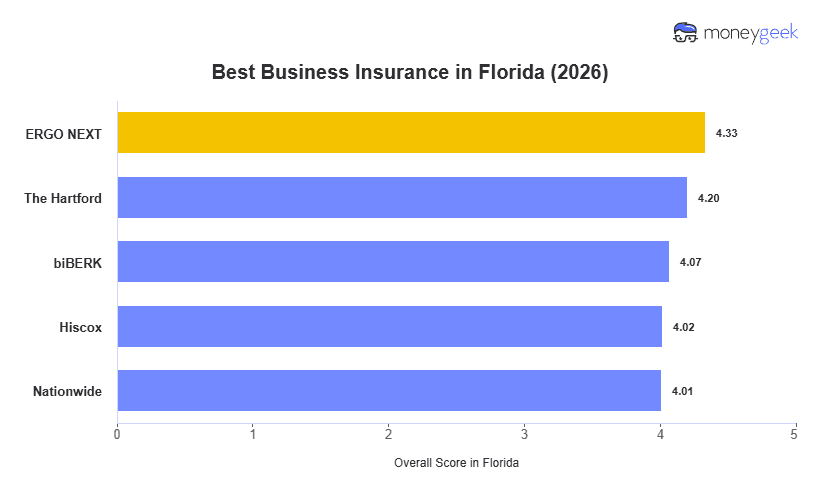
Once you have a sense of what business insurance costs in Florida, the next move is to see what specific insurers will actually charge you. Our best and cheapest pages are a good place to start, since they show what other Florida businesses are paying and which carriers fit different needs.

Recommended: If You're Ready to Compare Providers

You have the cost picture, so the next move is to see which Florida insurers fit your budget and your risk.

If You Want to Know What Other Coverage Costs

If You Want to Understand the Coverage Itself

About Connor Bolton


Connor Bolton, Senior SEO and Content Manager (Business & Pet), MoneyGeek

Connor Bolton is Senior SEO and Content Manager at MoneyGeek, where he leads the business and pet insurance editorial teams. He sets the research framework, data standards and content structure for his team. All content goes through his accuracy review before publication. Connor also writes in-depth guides and has spent more than four years covering insurance products across personal, commercial and specialty lines.

The research infrastructure Connor built covers auto, home, renters, life, health, business and pet insurance across pricing analysis, carrier research, customer experience and coverage evaluation. It includes over 6 million data points for business insurance across 408 industry areas, all 50 states and 16 vehicle types. The pet insurance side covers over 5 million profiles across 18 major providers, 100+ breeds and ages up to 20 years. Connor’s insurance research and his team's work has been cited by the U.S. Chamber of Commerce, Allstate, Liberty Mutual, CBS News, Forbes and LegalZoom.

Connor also talks with underwriters and carrier liaisons at Ethos, The Hartford, ERGO NEXT, Nationwide and State Farm, and monitors business and pet owner communities on Reddit. Those sources shape how his team evaluates carriers, structures rate analysis and writes for human buyers rather than search engines.

For questions about MoneyGeek's business and pet insurance content, contact him at connor@moneygeek.com or on LinkedIn.