Key Takeaways
blueCheck icon

ERGO NEXT ranks first among Oregon's best general liability insurance providers, scoring highest for both affordability and customer experience.

blueCheck icon

At $117 per month, The Hartford has the lowest general liability insurance rates in Oregon, saving businesses $21 monthly or 15%.

blueCheck icon

The strongest providers combine rate stability, responsive service and flexible coverage. Prioritize companies that perform consistently across all three areas.

Best General Liability Insurance Companies for Small Businesses in Oregon

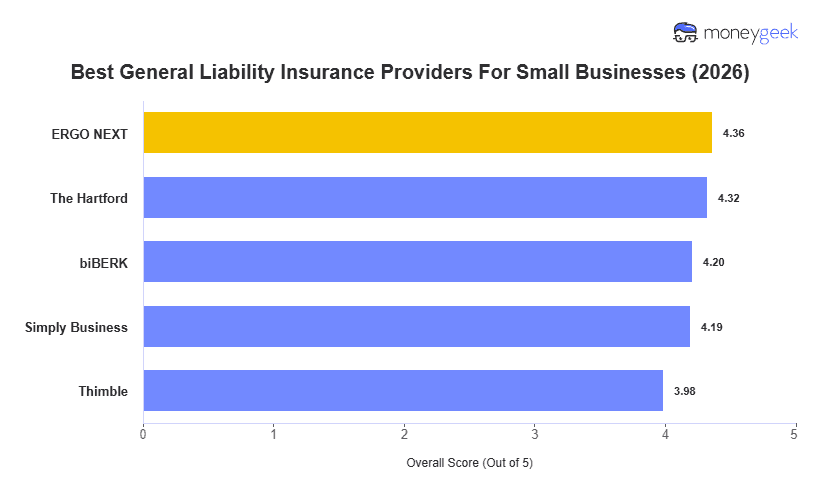
Every Oregon business has different coverage needs, so we reviewed 10 major general liability insurers across 25 industries to find the strongest performers. The five companies listed below offer the best and most affordable coverage in the state, based on quotes at $1 million per occurrence/$2 million aggregate limits:

  1. ERGO NEXT: Best Overall, Best for Higher-Risk and Hands-On Industries
  2. The Hartford: Best Cheap General Liability Insurance
  3. Simply Business: Best for Varied Coverage Options
  4. biBerk: Best for Active Service Businesses
  5. Thimble: Best for Seasonal and Project-Based Businesses

Running a fishing guide service on the Columbia River and rebuilding homes after wildfire season call for very different coverage. The table below breaks down each provider's rates and rankings so you can spot the right fit for your operations and budget. Review individual provider details further down the page to dig deeper.

ERGO NEXT4.39$11718
The Hartford4.29$11782
Simply Business4.2$13424
biBERK4.16$12947
Thimble3.99$128610
Coverdash3.98$14592
Progressive Commercial3.92$14579
Hiscox3.87$15336
Chubb3.86$15751
Nationwide3.76$155105

For our Oregon general liability insurance ratings, we analyzed pricing, coverage options and customer experience across 408 industries within the state. Our analysis focuses on one-to-four-person businesses, which represent a large share of Oregon's small business market, while weighting results to ensure broader industry and location representation across Multnomah County, Lane County, Washington County and rural markets across the state.

To do this, we evaluated over 20,000 business profiles, more than 1,258 customer experience data points and performed in-depth analysis of coverage contracts and endorsements to compare how insurers serve Oregon businesses consistently across different industries and regions. We then rated each company across categories of affordability (50%), customer experience (30%) and coverage options and terms (20%) to form an overall rating. For a detailed breakdown of the metrics, scoring methodology and pricing analysis specific to Oregon, see our full methodology.

95%

% of Small Businesses Covered

Over 20,000

Business Profiles Studied

1,258

Customer Experiences Analyzed

Company Image
Best Overall, Best for Higher-Risk and Hands-On Industries

ERGO NEXT

ERGO NEXT offers the best general liability insurance in Oregon, ranking first in customer experience and ranking second for affordability. Its buying process is fast and simple: quotes take about 10 minutes, coverage starts immediately after payment and certificates of insurance are available instantly through the app or online portal. Adding additional insureds is free and self-service, so Oregon contractors can get COIs fast to secure projects. Digital account tools handle certificates and endorsements, though users score billing flexibility and human support responsiveness lower. Claims handling ranks lower, with BBB complaints citing adjuster communication gaps and settlement disputes.

Solo operators and small businesses with less than 10 employees get the best value from ERGO NEXT, and higher-risk industries see the biggest savings: hospitality and manufacturing (36% each), repair and maintenance (33%) and food and beverage (31%). The insurer ranks first in 16 of 24 Oregon industries, including construction, agriculture, tech and professional services. Policy limits reach $1 million per occurrence and $2 million aggregate, though you can increase these to $2 million/$4 million with umbrella coverage. Business owners can get a waiver of subrogation, primary and non-contributory, and CG2010 endorsements for completed work included, but ERGO NEXT doesn’t offer specialized add-ons like liquor liability, and its rented premises sublimits are lower than traditional carriers.

Where ERGO NEXT performs best:

  • Solo operators and micro-businesses that need quick, affordable coverage
  • Oregon contractors who need instant COIs and endorsements ready for contracts
  • Hospitality, manufacturing and repair and maintenance businesses looking to lower costs
  • Digital-first buyers who prefer to manage policies on their own without an agent

Where ERGO NEXT performs less competitively:

  • Businesses expecting frequent claims or needing responsive dispute resolution
  • Food and beverage operations requiring liquor liability coverage
  • Health care, education or fitness businesses

Learn More: ERGO NEXT Review

Company Image
Best Cheap General Liability Insurance

The Hartford

Being the top option for five industries in Oregon, The Hartford ranks second overall for general liability insurance. It offers the most affordable rates on average and ranks second for coverage breadth. The Hartford has the lowest rates for businesses of all sizes, regardless of whether they have a single employee or 49. Professional or institutional fields also see double-digit savings: health care and medical (30%), education (28%), arts/media/entertainment (17%) and financial services (16%). The buying process is slower than digital-first competitors, since quotes require working with an independent agent and COIs must be requested rather than generated instantly. 

The Hartford has top-ranked endorsement processing, billing flexibility and human support responsiveness. It also received 22% fewer state regulator complaints than expected for its market share between 2022 and 2024. Users rate claims handling second, scoring well for settlement fairness, communication and resolution speed. Coverage is broader than most competitors: a $1 million rented premises sublimit, liquor liability as a GL endorsement, data breach and EPLI add-ons, and defense costs paid on top of policy limits rather than eroding them.

Where The Hartford performs best:

  • Growing Oregon businesses with five or more employees
  • Health care, education and financial services operations looking for low-cost coverage
  • Owners who value responsive human support over self-service speed
  • Food and beverage businesses needing liquor liability within their general liability policy

Where The Hartford performs less competitively:

  • Buyers who need instant quotes and self-service COI generation
  • Beauty, real estate or personal care businesses that value affordability
  • Solo operators prioritizing the lowest possible premium

Learn More: The Hartford Review

Company Image
Best for Varied Coverage Options

Simply Business

Ranking third overall for general liability insurance in Oregon, Simply Business earns second place for customer experience. It works as a broker rather than a single carrier, connecting Oregon businesses with 18 or more insurers, including Hiscox, Travelers, Liberty Mutual and Markel. You can compare general liability options from multiple providers in about 10 minutes. Trustpilot reviewers praise the quote comparison speed, though some report difficulty reaching support by phone and slow responses to policy change requests. 

Policy management and claims run through the underlying carrier, not Simply Business, so your service after purchase depends entirely on who underwrites your policy. Coverage ranks lower, but the marketplace model gives Oregon businesses access to specialty insurers that single-carrier options often can't match. The Amazon Insurance Accelerator and Etsy seller partnerships make Simply Business a fit for Oregon e-commerce operations that need policies meeting platform requirements. Pricing lands in the mid range, with businesses in retail, beauty and wellness, and repair and maintenance saving 16% to 19%.

Where Simply Business performs best:

  • Oregon e-commerce sellers whose platforms require specialty coverage
  • Businesses turned down by single-carrier insurers
  • Buyers comparing GL quotes across multiple carriers at once
  • Retail, beauty and repair businesses after lower rates

Where Simply Business performs less competitively:

  • Owners who want consistent post-purchase support from a single carrier
  • Construction, wholesale or transportation businesses prioritizing low rates
  • Teams of 20 or more employees

Learn More: Simply Business Review

Company Image
Best for Active Service Businesses

biBerk

biBerk, backed by Berkshire Hathaway's A++ AM Best financial strength rating, ranks fourth overall in Oregon. Trustpilot reviewers repeatedly praise individual advisors by name, and a guided online quote process suggests policies based on your business details without requiring you to know what coverage you need. After purchasing coverage, the experience is less competitive: adding an additional insured can take several days, and reviews say policy changes require multiple phone calls over two weeks or more. biBerk also received far more state regulator complaints than expected for its market share between 2022 and 2024.

Customer-facing, active service businesses find the most value from biBerk, and several industries see considerable savings. These include hospitality, which saves the most at 30%, and beauty and wellness practices, which save up to 28%. Coverage is lower since rented premises sublimits cap at $100,000, despite liquor liability, cyber liability and hired/non-owned auto endorsements being available.

Where biBerk performs best:

  • Cleaning, fitness and recreation businesses
  • First-time buyers who want guided, advisor-supported quotes
  • Oregon businesses needing liquor liability or cyber endorsements on GL policies
  • Owners who rarely update policies or file claims after purchase

Where biBerk performs less competitively:

  • Businesses needing fast additional insured or endorsement changes
  • Beauty, construction or consulting operations looking for affordable coverage
  • Tenants needing high rented premises sublimits for commercial leases

Learn More: biBerk Review

Company Image
Best for Seasonal and Project-Based Businesses

Thimble

In fifth place overall is Thimble, which offers competitive rates and is the only provider on this list offering flexible coverage terms. You can buy general liability coverage by the hour, day, month or year and pause it when you're not working. That flexibility carries tradeoffs, though, since savings is niched to select industries: construction (20%) and manufacturing (21%).

Thimble provides a positive experience, with quotes in under five minutes, instant COIs through the mobile app and a certificate manager that tracks subcontractor documents on a project dashboard. Trustpilot reviewers praise the speed and the ability to turn coverage on and off between seasons. Despite the flexible terms, coverage depth is weaker. Sublimits are lower than competitors, with equipment coverage capped at $5,000, and no liquor liability or EPLI available to business owners.

Where Thimble performs best:

  • Seasonal Oregon businesses that pause coverage during slow months
  • Contractors needing project-based general liability with instant COIs
  • Construction and manufacturing operations looking for affordable rates

Where Thimble performs less competitively:

  • Businesses expecting to file claims or needing reliable dispute resolution
  • Hospitality, childcare or wholesale operations wanting low-cost coverage
  • Owners needing liquor liability, EPLI or equipment coverage above $5,000

Learn More: Thimble Review

Explore the Best General Liability Insurance in Oregon by Industry

General liability premiums reflect how often businesses in your field file claims and how much those claims cost. A logging contractor in Clatsop County or a craft brewery in Hood River carries more risk than a graphic designer working remotely from Corvallis, so insurers price accordingly.

The tables below show provider rankings and estimated monthly rates by industry. Find your business type to compare pricing and identify which providers are worth quoting first.

What Determines the Best General Liability Insurance for Oregon Businesses

Look beyond price when comparing general liability insurance in Oregon. A marine mechanic in Astoria has different needs than an environmental consultant in Bend, and both need coverage that holds up when claims happen. Four factors separate insurers that perform well on quotes from those that perform well over time.

    coins2 icon
    Affordability without pricing volatility

    A low first-year premium means little if rates spike at renewal. Oregon businesses running on tight margins, like nursery operations in Clackamas County or fishing charter operators out of Newport, need predictable costs they can budget around year after year.

    Rate increases often follow:

    • Filing a storm damage claim after a Pacific windstorm downs a client's fence during a landscaping job
    • Expanding service territory from the Portland metro into coastal or rural counties where loss data is thinner
    • Shifting from lower-risk work like residential cleaning to higher-exposure contracts like post-fire debris removal in Southern Oregon
    • Adding crew during harvest season for hops, cannabis or blueberries without notifying your insurer first

    Before binding a policy, ask how the insurer has handled renewals for similar Oregon businesses and what usually triggers increases.

    talk icon
    Responsive service throughout your policy term

    Responsive service matters most when something goes wrong. Oregon businesses should prioritize insurers who make these interactions seamless:

    • Getting same-day COIs when a timber company in Roseburg requires proof before subcontractors can enter the site
    • Reaching a live agent when a visitor trips over equipment at your Pendleton farm supply store
    • Updating your policy midterm after bringing on seasonal pickers for pear harvest in the Rogue Valley
    • Resolving billing disputes before coverage lapses during peak rafting season on the Deschutes

    Test responsiveness before you buy, call the support line with a question and note how long it takes to reach someone who can actually help.

    insurance2 icon
    Coverage options that fit common small business risks

    Most commercial contracts in Oregon require at least $1 million per occurrence/$2 million aggregate, though larger projects often demand more. Contractors bidding on public works jobs or subcontracting for major developers in the Portland metro may need $2 million per occurrence or higher to qualify. Confirm your insurer can adjust limits without forcing you to shop elsewhere. Beyond limits, look for endorsements that match Oregon-specific exposures. 

    Hired and non-owned auto coverage matters if your solar installation crew drives personal trucks from Bend to job sites in Prineville and Redmond, or if your catering staff uses their own vehicles to drop off orders across the Tualatin Valley. Equipment breakdown endorsements make sense for breweries relying on fermentation systems or machine shops running CNC equipment. As your business grows, adding locations, taking larger contracts or expanding into adjacent services, your insurer should offer add-ons that grow with you rather than forcing you to piece together coverage from multiple carriers.

    building icon
    Why consistency across all three areas matters most

    An insurer with competitive rates but slow claims handling creates problems when a lawsuit lands. A wildland firefighting support contractor in Klamath Falls who waits three weeks for a claims adjuster after a client alleges property damage can lose future contracts while the dispute lingers. Likewise, responsive service means little if your policy excludes the exact exposure that triggered the claim, something a kayak tour operator in the Columbia Gorge might learn too late if endorsement gaps weren't caught at purchase.

    Oregon's mix of seasonal work, weather-driven risks and region-specific contract requirements means small gaps compound quickly. Look for insurers who perform consistently across pricing, support and coverage, then verify that balance before you bind.

How to Choose the Best General Liability Insurance in Oregon

Choose the right general liability provider by looking beyond a quick quote comparison. Use the six steps below to narrow your options in a clear order so you can make a confident decision without second-guessing it later.

  1. 1

    Optimize your payment and coverage structure

    Before you compare providers, define your risk profile and identify any contract or client requirements. Oregon businesses that work with port authorities, timber operations or municipal agencies often must meet specific coverage thresholds.

    Ask yourself:

    • Do contracts or clients require coverage above standard policy limits?
    • Does your work involve physical risk, like excavation, roofing or heavy equipment operation?
    • Do you bring on seasonal workers for harvest, tourism or storm cleanup who need to be covered under your policy?
    • Would paying annually cut your total premium compared to monthly payments?
    • Could a higher deductible bring your monthly costs down?

    Most Oregon small businesses carry $1 million/$2 million limits, though a demolition contractor in Multnomah County may need higher coverage. If you’re unsure how much general liability coverage you need, base your decision on your highest-risk contracts and largest potential claims. After you set your limits, choose a payment structure that fits your cash flow, then lock in both before you compare providers.

  2. 2

    Choose your primary priority

    Your business situation determines what matters most right now. A company managing tight cash flow has different priorities than one pursuing larger contracts or handling time-sensitive work. Identify your priority, then use it as your tiebreaker when providers perform similarly.

    • Affordability: Focus here if your margins are tight and predictable costs matter more than extras. A mobile mechanic working rural routes in Umatilla County or a solo massage therapist in Albany operating on slim margins should weigh long-term rate stability over add-ons.
    • Customer experience: Focus here if your work depends on fast documentation or direct support. Electrical subcontractors who need same-day COIs to access Intel supplier sites in Washington County, or food vendors rotating between farmers markets in Hood River and The Dalles, benefit from responsive service teams.
    • Coverage options: Put this first if your business is growing into new services or pursuing larger contracts. A plumbing company in Eugene moving from residential repairs to commercial tenant improvements, or an agritourism operator near Mt. Hood adding zipline tours, needs an insurer that can adjust general liability limits and endorsements without a full policy rewrite.
  3. 3

    Shortlist two to three providers

    Skip the wide search. Most insurers don't write policies for every trade, region or business size, so casting a broad net wastes time and pulls in quotes that don't apply to your situation. Filter first for insurers that write policies in your industry and region. A janitorial service contracting with school districts in Salem needs a different coverage structure than a custom furniture builder selling to boutiques in Lake Oswego. 

    Narrow your list to two or three providers that match your priority from step two and know the contract requirements common in your line of work. From there, check Oregon general liability costs as a reference point to gauge whether their pricing falls within a reasonable range.

  4. 4

    Double-check for dealbreakers before investing more time

    Confirm each shortlisted provider meets your non-negotiables before you move forward. Dealbreakers vary by business, but common ones for Oregon companies include:

    • No coverage for your trade, such as hemp processing, marine repair or forestry support services
    • No ability to issue same-day certificates when required for port facilities or timber sites
    • Exclusions for water damage or landslide-related claims, which affect contractors and landscapers on the coast and in the West Hills
    • No option for hired and non-owned auto coverage when technicians drive personal vehicles between service calls in Central Oregon

    Remove providers that miss these basics before you compare details.

  5. 5

    Compare your finalists using the same three lenses

    Evaluate your final two or three providers across all three areas, not only your main priority. Weakness in one area can offset strengths in another.

    • Affordability: Review how the insurer handles renewals for Oregon businesses with similar risk profiles. Ask whether rates increase after a claim, how premium audits work for seasonal operations such as U-pick pumpkin patches or holiday tree lots and how far in advance they communicate rate changes.
    • Customer experience: Check how quickly they issue COIs, how easily you can update your policy when you add staff or take on new work and whether claims support remains accessible. See if their online portal lets you manage documents without contacting an agent.
    • Coverage options: Review per occurrence and aggregate limits and confirm whether endorsements you may need, such as equipment breakdown for manufacturing shops in Tualatin or professional liability for engineering consultants, come without requiring a separate policy.
  6. 6

    Use quotes as the final confirmation step

    A quote for general liability coverage turns your research into real numbers for your business. Request quotes from your two or three finalists using the same coverage details and compare them side by side. A cider house in the Gorge or a climbing gym in Gresham may see real price differences even among similarly rated insurers.

    Read each quote document line by line for general liability exclusions that could leave gaps in your coverage. Watch for carve-outs tied to alcohol service, water-adjacent activities or participant waivers, which can catch Oregon recreation and hospitality businesses off guard. The quote stage is your last chance to catch mismatches before you bind.

Best Small Business General Liability Insurance in Oregon: Bottom Line

ERGO NEXT, The Hartford and Simply Business rank highest for general liability insurance in Oregon. The right match depends on your industry, business size and where you operate, whether that's the coast, Central Oregon or anywhere in between. Rate stability, responsiveness on policy changes and COIs, and room to grow your coverage all matter more than who quotes lowest.

Best General Liability Insurance for Small Businesses in Oregon: Next Steps

If you're ready to move forward, narrow your options to one or two providers and confirm pricing and availability using the same coverage limits and business details for each quote. This approach avoids misleading comparisons and shows which insurer offers the best mix of rate stability and policy features, whether your work takes you across Multnomah County or serves clients from Medford to Astoria.

If cost is still your main deciding factor

If you’re unsure how much coverage you need

If you’re ready to check quotes now

How We Chose the Best General Liability Insurance Companies

To identify the best general liability insurance companies for Oregon small businesses, we evaluated insurers across pricing, customer experience and coverage options using a standardized, data-driven approach. Our goal was not to find the cheapest option in every scenario, but to determine which providers offer the most consistent overall value across common Oregon small business profiles.

Our best recommendations reflect insurers that perform well across multiple dimensions and remain competitive across industries and business sizes in Oregon.

Data and Analysis Scope

We base our analysis on standardized estimates that represent the majority of Oregon small businesses:

  • Providers analyzed: 10 major insurers serving Oregon
  • Industries covered: 408 industries
  • Employee counts: Zero to 49 employees
  • Policy baseline: $1 million per occurrence / $2 million aggregate general liability policy
  • Pricing modeled: Over 20,000 standardized estimates for Oregon businesses

Modeled average revenues and payrolls were incorporated to improve pricing accuracy across Oregon's small business market.

Our Scoring Model

Each insurer received a composite score based on the weighted categories below.

  • Affordability (50%): Affordability reflects how competitively and consistently an insurer prices general liability coverage across all Oregon business profiles studied.
  • Customer experience (30%): Customer experience measures how well insurers support Oregon businesses throughout the policy lifecycle from purchase to claims. We also studied at each level of buying, policy management and claims sub-parts of the process that make it easier and more reliable within each as well for accuracy and comprehensive understanding.
  • Coverage options (20%): Coverage options reflect how well insurers support common Oregon small business risks and allow for flexibility as businesses grow or change.

Read our full business insurance methodology.

About Connor Bolton


Connor Bolton headshot

Connor Bolton is Senior SEO and Content Manager at MoneyGeek, where he leads the business and pet insurance editorial teams. As editorial lead for both verticals, Connor sets the research framework, data standards, and content structure that his writers execute, directly authoring in-depth guides himself and reviewing all team content for accuracy and practical value before it goes live. With over four years evaluating insurance products across personal, commercial, and specialty lines, he brings cross-vertical knowledge to every guide the team produces.

Connor architected MoneyGeek's insurance research infrastructure across all major verticals including auto, home, renters, life, health, business, and pet, building systems for pricing analysis, provider-level research, customer experience evaluation, and coverage analysis with AI support. The infrastructure includes over 6 million data points for business insurance across 408 industry areas, all 50 states, and 16 vehicle types, and over 5 million pet insurance profiles across 18 major providers and hundreds of breed and age combinations. Connor's insurance cost research and his team's work has been cited by the U.S. Chamber of Commerce, Allstate, Liberty Mutual, CBS News, Forbes and LegalZoom.

Beyond the data, Connor stays connected to how the market actually operates, drawing on direct conversations with underwriters and carrier liaisons at Ethos, The Hartford, NEXT Insurance, Nationwide, and State Farm, and monitoring business and pet owner communities including Reddit, to inform how he interprets findings and frames guidance for real buyers.

He is the direct editorial contact for methodology questions at connor@moneygeek.com and can be found on LinkedIn.