



Jump to the section that meets your needs best below:
Average Tree Service Business Insurance Cost (2026 Report)
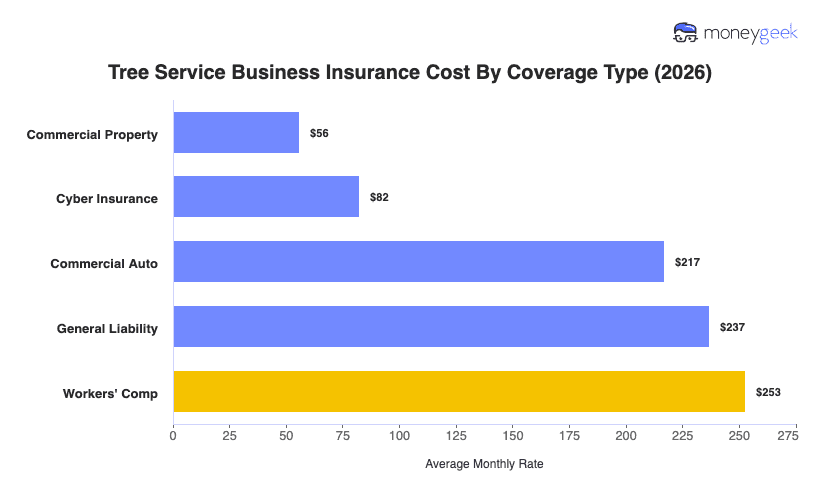
A recommended insurance bundle for tree service businesses cost an average of $747 monthly, and includes GL, tools coverage, commercial auto and workers' comp. Individual coverages range from $32 to $480 per month, though what should be in your policy mix depends on the services you offer and your business size.
Use MoneyGeek’s matching tool to find insurers that fit your tree service coverage needs before getting quotes and compare costs.
Select state
Updated: September 9, 2026
Advertising & Editorial Disclosure
How Much Does Tree Service Contractor Insurance Cost?
The cost of contractor insurance for tree service businesses is between $277 for a minimum starting bundle to $1,114 for expanded operations. I determined these costs using our dataset on tree service businesses with less than five employees, but your actual rate may vary depending on factors like your services, location, claims history and coverage limits. If you regularly handle routine pruning and removals, your coverage mix will look very different from that of a business with employees, commercial vehicles and higher-risk operations such as crane-assisted or storm-damaged tree removal.
The table below can help you figure our which bundle suits your business best.
Minimum Starting Bundle | General liability, tools and equipment | $277 | Owner-operated businesses handling pruning and smaller jobs |
Recommended Bundle | Minimum starting bundle + commercial auto + workers’ comp | $747 | Tree services with work vehicles and field crews |
Specialized Services Bundle | Recommended bundle + pesticide applicator coverage + pollution liability | $1,035 | Companies offering chemical treatments and plant health care |
Expanded Operations Bundle | Recommended bundle + commercial property + equipment breakdown, + business interruption + commercial umbrella + cyber insurance | $1,114 | $13,368 |
Tree service insurance does not price like a simple office business. The work can involve crews at height, trucks and trailers on the road, portable tools moving between jobs and expensive machinery used near homes, roads or power lines. We built our cost estimates around those operating realities using modeled premiums from 10 major U.S. commercial insurers.
- National benchmark average: We used small tree service profiles with fewer than five employees to create a broad monthly and annual cost reference. The modeled businesses reflect common tree service needs, including liability, employee, vehicle and equipment-related coverage.
- State averages: We held the business profile steady and changed only the location. This lets you see how much state-level pricing affects the same tree service without mixing in changes to payroll, crew size, services or machinery.
- Bundle averages: We grouped policies around recognizable operating setups, from a basic owner-operated business to a company with employees, work vehicles and more complex jobs. Where our main dataset did not include a specialized policy, we used outside cost estimates and added them only to bundles where that coverage made sense.
These figures are modeled estimates, not live quotes. Use them as a starting point for budgeting and comparison, then look at how your services, employees, vehicles and equipment move your actual price.
See our full business insurance methodology.
Get Tree Service Business Insurance Cost Estimates
If you want a more personalized estimate, use our business insurance cost calculator before comparing rates.
Get Tree Service Insurance Cost Estimates
Select Coverage Type
Select State
Select Employee Count
Select Vehicle Type
Monthly Rate Estimate—
Select Coverage Type
Monthly Rate Estimate—
Select State
Select Employee Count
Select Vehicle Type
Factors Affecting Tree Service Business Insurance Costs
Several factors affect your tree service insurance cost. Most are tied to your actual work, such as the complexity of your job or the area you service, but others affect all types of businesses, not just yours.
 Services Offered
Insurers find routine pruning and small removals easier to price than storm cleanup, land clearing or plant health care. The latter can involve unstable trees, rushed conditions or chemical use, which can lead to more serious claims. The wider your service mix, the higher your rates become since insurers have to account for more risks.
 Typical Job Conditions
“Tree removal” can mean taking down a healthy tree in an open yard or removing a storm-damaged tree wedged between a house and a power line. Those jobs carry very different stakes, which reflects in your premium. Expect higher rates when crews work in narrow spaces, around unstable trees or close to nearby property.
 Customer and Contract Mix
A homeowner who hires you for seasonal trimming usually asks for less than a municipality awarding a roadside clearing contract. Commercial, utility and government clients may require larger coverage amounts or extra policy documents. Those requirements can raise your cost even before the work begins.
 Crew Structure
Costs change when you go from doing the work yourself to running several crews. Climbers, ground workers and seasonal hires add more people who could be injured on the job. Subcontractors can also affect your rate, especially when they don’t carry their own insurance.
 Machinery Used in Daily Operations
Chainsaws and climbing gear do not create the same financial risk as chippers, stump grinders, bucket trucks and cranes. Heavy machinery costs more to repair or replace, and an accident involving it can cause far more damage. If you run a machine-heavy operation, you’ll spend more for coverage than if you only use portable tools.
 Service Area and Travel Demands
When you operate locally, you stay within one town and spend less time moving crews and equipment than a company covering several counties. Longer routes and more time on the road increase the chance of a vehicle accident or damage in transit, which can push your rates higher.
How to Lower Tree Service Business Insurance Costs
The average cost of insurance for tree service contractors can quickly add up as your operations become more complex and as you accept larger contracts. These strategies can help you find more affordable coverage rates without cutting coverage your business needs.
 Compare quotes using the same coverage limits
Make sure to request business insurance quotes from several insurers. Ask each carrier to use the same policies, coverage limits and deductibles using the same payroll, vehicles, equipment values and services. A lower price may come from a smaller liability limit, less equipment coverage or a higher deductible, not from a better rate.
 Right-size your coverage
Tree service operations change throughout the year. You could sell a truck, replace a chipper, hire seasonal ground workers or start taking larger removal jobs. Update those details so you are not still paying to cover equipment you sold or relying on a policy that no longer reflects the work you perform.
 Bundle policies with the same provider
Most insurers give you a discount when you place several policies with them. For a tree service, that could mean keeping your liability, work vehicles, employees and equipment under one provider. Compare the full package price with separate quotes to make sure the discount translates to substantial savings.
 Lower your risk profile
Repeated fence damage, backing accidents, crew injuries and equipment losses can make your business look more expensive to insure. Reducing those incidents gives insurers a stronger claims record to review at renewal, which can help keep future rate increases in check.
 Invest in risk management practices
You can reduce the kinds of claims that make tree service insurance more expensive by tightening how your crews plan jobs, move equipment and maintain machinery. Focus on the points where mistakes are most likely to injure someone, damage property or stop work. I suggest starting with these:
- Before you start cutting, walk the property and mark fences, roofs, parked cars and overhead lines.
- Make sure your climbers and ground crew agree on signals before lowering limbs or changing the drop zone.
- Check your trailer connection, brakes, lights and tie-downs before you leave for your next job.
- Pull damaged climbing gear or machinery from use instead of trying to finish the job with it.
Tree Service Business Insurance Cost: Bottom Line
Use the $747 per month average cost of a recommended bundle as a starting point for your budget, not an estimate of exactly what you will pay. Once you begin requesting quotes, ask yourself these questions to help put them in context:
- Are you comparing the same policies? One quote may look cheaper because it leaves out workers’ compensation, commercial auto or equipment coverage. Compare the same policies, limits and deductibles before deciding which insurer offers the lower price.
- Which parts of your business are moving the cost? A solo operator with one truck, lower payroll and mostly routine pruning may fall below the benchmark. Several crews, more vehicles, higher equipment values or work such as storm cleanup and crane-assisted removals can push the bundle above it.
- Does the bundle still fit your business? You may need a smaller package if you work alone and handle routine pruning. A larger operation with several crews, heavy machinery or bigger contracts may need more coverage than the recommended bundle includes.
The useful question is not whether your quote matches the average exactly. It's why your price differs and whether those reasons match your actual business setup.
About Connor Bolton

Connor Bolton is Senior SEO and Content Manager at MoneyGeek, where he leads the business and pet insurance editorial teams. He sets the research framework, data standards and content structure for his team. All content goes through his accuracy review before publication. Connor also writes in-depth guides and has spent more than four years covering insurance products across personal, commercial and specialty lines.
The research infrastructure Connor built covers auto, home, renters, life, health, business and pet insurance across pricing analysis, carrier research, customer experience and coverage evaluation. It includes over 6 million data points for business insurance across 408 industry areas, all 50 states and 16 vehicle types. The pet insurance side covers over 5 million profiles across 18 major providers, 100+ breeds and ages up to 20 years. Connor’s insurance research and his team's work have been cited by the U.S. Chamber of Commerce, Allstate, Liberty Mutual, CBS News, Forbes and LegalZoom.
Connor also talks with underwriters and carrier liaisons at Ethos, The Hartford, ERGO NEXT, Nationwide and State Farm, and monitors business and pet owner communities on Reddit. Those sources shape how his team evaluates carriers, structures rate analysis and writes content for real pet owners.
Questions about MoneyGeek's business or pet insurance content? Reach him at connor@moneygeek.com or on LinkedIn.