



Jump to the section that meets your needs best below:
Average Roofing Business Insurance Cost (2026 Report)
Roofing business insurance costs range from $873 to $1,729 per month, depending on the bundle you choose.
If you want pricing now, MoneyGeek can match you to the insurer that meets your roofing business's coverage needs.
Select state
Updated: September 9, 2026
Advertising & Editorial Disclosure
How Much Does Roofing Business Insurance Cost?
Most roofers pay about $989 per month for business insurance. That is my recommended bundle, which combines general liability, commercial auto, and commercial property to cover a roofing crew from the shop to the rooftop. It handles the liability that comes with working at height, the trucks that move your crew and materials, and the tools and gear you carry.
The cost of contractor business insurance for roofers depends on the coverages you include, so you can start with the starting bundle and add protection as your operation grows. The table below breaks down various insurance bundles for roofers, what they include, and what they cost.
Starting | General liability + commercial auto | $873 | A solo roofer or small crew that needs to satisfy client and licensing requirements and run a work truck. |
Recommended | Starting + commercial property | $989 | An operation with tools, equipment, and materials worth protecting on the job and in transit. |
Growing | Recommended + cyber insurance | $1,076 | Any roofer using estimating software, digital payments, or stored client records. |
Comprehensive | Growing + workers' compensation + commercial umbrella | $1,729 | A staffed roofing business that also needs higher liability limits for commercial or GC contracts. |
We analyzed quote data from 10 major U.S. commercial insurance providers and modeled standardized premium estimates for roofing business profiles across all states including Washington, D.C., with employee counts from solo operators to 49-employee operations.
Our published averages represent modeled premiums for standardized business profiles and were aggregated in three ways.
- National benchmark average: The national average reflects the modeled premium for a standardized one-to-four-employee roofing business across all 50 states and D.C. at standard industry-recommended policy limits.
- State averages: To show how costs vary, we calculated average modeled premiums for our national base profile and isolated them for each state and D.C.
- Bundle averages: We added the individual policy premiums together, before any discounts, to get each bundle total. This matches how the per-state bundle totals in the state table were computed. Where the Comprehensive bundle includes commercial umbrella, we added it at its flat national estimate rather than a state-specific rate.
Other coverage costs, including commercial umbrella, inland marine, and surety bonds, were gathered externally, and typical rates for most small roofing businesses were presented.
See our full business insurance methodology.
Get Roofing Business Insurance Cost Estimates
The roofing business insurance cost calculator below gives you a more personalized estimate so you can compare rates. Once you have a baseline, you can pull a quote from your top provider based on the details you enter.
Get Roofing Insurance Cost Estimates
Select Coverage Type
Select State
Select Employee Count
Select vehicle_type
Monthly Rate Estimate—
Select Coverage Type
Monthly Rate Estimate—
Select State
Select Employee Count
Select vehicle_type
Factors Affecting Roofing Business Insurance Costs
What you pay for roofing business insurance tracks more closely with the nature of your work than with headcount. In our analysis, your job type, crew structure, and equipment profile matter more to your premium than business size alone.
 Type of Roofing Work
Commercial and industrial work carries higher premiums than residential-focused operations, as job scale, structural complexity and liability exposure all increase with project type. The same pattern applies to pitch, as steep-slope and high-pitch work typically commands higher rates than flat or low-slope roofing. When the portfolio spans multiple project types, insurers typically price to the highest-risk segment.
 Subcontractor Use
When subcontractors are hired without requiring them to carry their own insurance and name the business as an additional insured, their claims can fall back on the policy. When the operation relies heavily on uninsured subs, that gap tends to show in the premium.
 Height and Access Requirements
Your rates increase if your crews work above two stories, use aerial lifts, or regularly set up scaffolding. Elevation raises the chance and severity of both injury and property damage claims, and insurers price that exposure directly into your premium.
 Crew Composition and Payroll
Your workers' comp premium is calculated directly from payroll, which means a larger crew means a higher base cost, regardless of claims history. If your crew includes licensed journeymen rather than general laborers, you'll typically see lower surcharges for the same work.
 Materials and Equipment Value
The materials crews work with, from shingles and membrane systems to metal panels and underlayment, accumulate quickly on job sites and in transit. Adding tools and safety equipment raises the insurable value further. The higher that combined value, the more property-related premiums reflect it.
How to Lower Roofing Business Insurance Costs
Much of what you pay for roofing insurance reflects correctable gaps rather than unavoidable exposure. Some of these methods lower your cost at the next renewal, while others reshape how your underwriter prices you over time. Both are worth doing if you want more affordable business insurance.
 Compare quotes using the same coverage limits
If you're comparing business insurance quotes across carriers, you may be reviewing genuinely different coverage without realizing it. GL limits, workers' comp classifications, and deductible structures all vary, and a quote at $1 million per occurrence isn't the same product as one at $2 million. Pin down your limits first and compare what each carrier charges for identical terms.
 Right-size your coverage
If your work has shifted toward residential re-roofs since you last set your limits, you may be carrying more GL coverage than your current jobs actually require. Limits built around a commercial contract don't scale down on their own. Reviewing your coverage at renewal, any time your project mix has changed materially, is worth the conversation with your broker.
 Increase your deductible strategically
A higher deductible on your commercial property or commercial auto coverage brings your premium down immediately. The tradeoff is straightforward: if a tools theft or vehicle claim would strain your cash flow, the savings won't hold. Size the deductible to what you can realistically absorb out of pocket before you commit to a higher one.
 Bundle policies with the same provider
If you carry general liability, commercial auto and tools or equipment coverage across separate insurers, you may pay more than you need to. Carriers typically offer lower combined rates when you bring multiple lines to one account, because your full risk profile is more attractive to price than any single policy. A bundled quote at renewal shows you the difference.
 Invest in risk management practices
Falls, property damage at client sites, and subcontractor incidents are the claim types most likely to drive your long-term premiums up, and they're also the most responsive to documented risk controls. When your underwriter can see evidence that you manage those exposures actively, it changes how they price your renewal over time. The practices that tend to move the needle:
- Keep your fall protection plan current and run documented crew training before each job, especially on steep-slope or multi-story work.
- Require subcontractor certificates of insurance before any work begins and keep a dated log available at your next underwriting audit.
- Log near-miss incidents and toolbox talk attendance by date and crew member so your underwriter sees active safety management, not just claims history.
- Keep your OSHA compliance records current, since documented violations can trigger surcharges across your workers' comp and general liability lines.
Roofing Business Business Insurance Cost: Bottom Line
Most roofers land around $989 a month for the recommended bundle, but what you actually pay depends on which policies your operation needs and the state you work in. The estimates on this page are a starting point, not a quote. Use these three questions to check your bundle against your operation.
- Does your bundle include the right policies? Start with what the job requires and add from there. The Starting bundle covers the general liability and commercial auto that clients, contracts, and licensing boards expect. Add commercial property once you have tools and equipment worth protecting, cyber if you run estimates and payments through software, workers' comp the moment you hire a crew, and a commercial umbrella if a general contractor requires higher limits. A bundle that carries a policy you don't need costs you every month, and one that's missing a policy you do need leaves a gap.
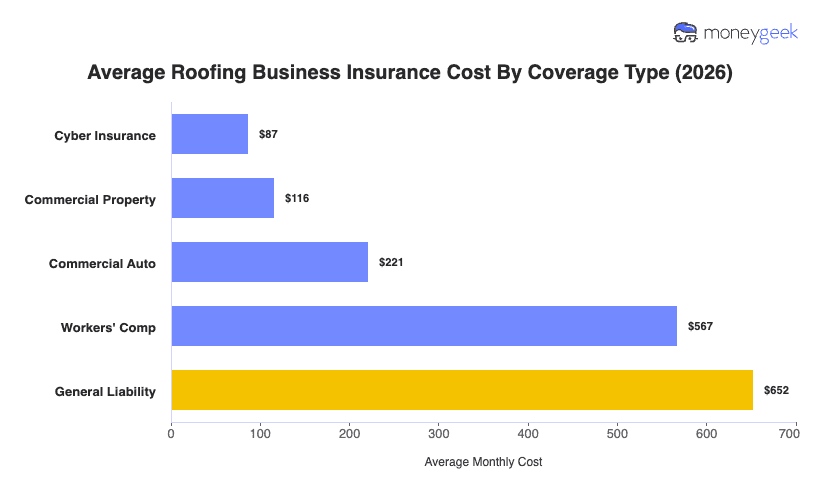
- Which policy is adding the most to your total? For roofers, general liability and workers' comp drive most of the bill, and both swing hard by state. General liability runs $396 a month in West Virginia and $1,158 in California, and workers' comp goes from $306 per employee in Indiana to $1,905 in New York. If a quote feels high, look at those two first. If you have no employees, workers' comp shouldn't be in the quote at all, and if you do, check that your payroll and class codes are right before you assume the carrier overpriced you.
- Are you comparing quotes with the same details? A cheaper quote often just means less coverage. Make sure every carrier is pricing the same limits, the same workers' comp classifications, and the same deductibles before you compare the numbers, or you're comparing different products.
The goal isn't to match the estimates on this page. It's to choose or build a bundle that fits your operation without paying for coverage you don't need.
About Connor Bolton

Connor Bolton is Senior SEO and Content Manager at MoneyGeek, where he leads the business and pet insurance editorial teams. He sets the research framework, data standards and content structure for his team. All content goes through his accuracy review before publication. Connor also writes in-depth guides and has spent more than four years covering insurance products across personal, commercial and specialty lines.
The research infrastructure Connor built covers auto, home, renters, life, health, business and pet insurance across pricing analysis, carrier research, customer experience and coverage evaluation. It includes over 6 million data points for business insurance across 408 industry areas, all 50 states and 16 vehicle types. The pet insurance side covers over 5 million profiles across 18 major providers, 100+ breeds and ages up to 20 years. Connor’s insurance research and his team's work have been cited by the U.S. Chamber of Commerce, Allstate, Liberty Mutual, CBS News, Forbes and LegalZoom.
Connor also talks with underwriters and carrier liaisons at Ethos, The Hartford, ERGO NEXT, Nationwide and State Farm, and monitors business and pet owner communities on Reddit. Those sources shape how his team evaluates carriers, structures rate analysis and writes content for real pet owners.
Questions about MoneyGeek's business or pet insurance content? Reach him at connor@moneygeek.com or on LinkedIn.