
Key Takeaways
blueCheck icon

ERGO NEXT tops our list of best general liability insurance companies in West Virginia, ranking first in customer experience and second in affordability.

blueCheck icon

The Hartford is the most affordable general liability insurance provider in West Virginia at $73 monthly, saving businesses $14 per month (16%).

blueCheck icon

Rate stability, customer service responsiveness and coverage flexibility all matter, and a provider that scores well in only one or two areas may fall short when it counts.

Best General Liability Insurance Companies for Small Businesses in West Virginia

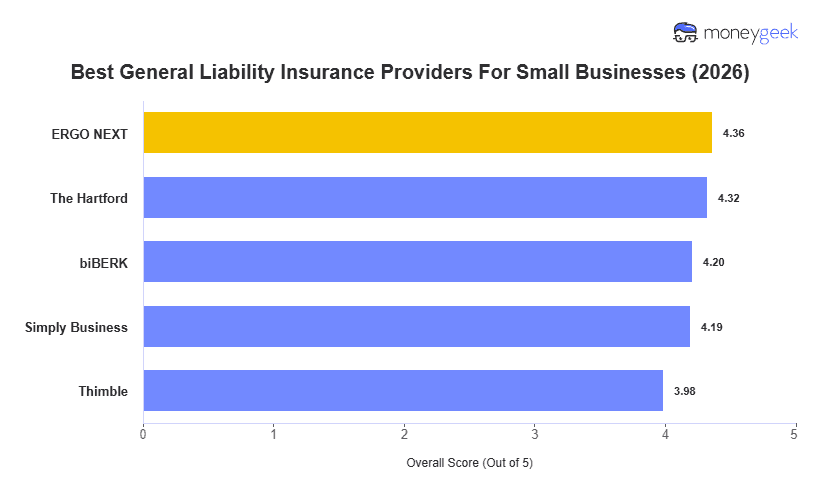
We evaluated 10 major general liability insurers across 408 business types at $1 million per occurrence/$2 million aggregate limits to identify the best and cheapest options for West Virginia small businesses. The five providers below ranked highest in the state, though the right match will vary by business:

  1. ERGO NEXT: Best Overall, Best for Hands-On Service Businesses
  2. The Hartford: Best Cheap General Liability Insurance
  3. Simply Business: Best Carrier Comparison Platform
  4. biBerk: Best for Leisure and Service Businesses
  5. Thimble: Best for Flexible, On-Demand Coverage

Rates and rankings for each provider are in the table below. A whitewater rafting outfitter near Fayetteville and a rural electrical contractor serving Mercer County both carry general liability coverage, but the right provider and rate for each will look different depending on the work and the risk.

ERGO NEXT4.34$7518
The Hartford4.3$7382
Simply Business4.22$8324
biBERK4.2$7947
Thimble3.99$82610
Coverdash3.98$9192
Progressive Commercial3.93$9179
Chubb3.84$9851
Hiscox3.82$9836
Nationwide3.78$97105

For our West Virginia general liability insurance ratings, we analyzed pricing, coverage options and customer experience across 408 industries statewide. Our analysis focuses on one-to-four-person businesses, which represent a large share of West Virginia's small business market, while weighting results for broader industry and location representation across the state's commercial centers and rural service areas, including the Northern Panhandle, Kanawha Valley, Eastern Panhandle and southern coalfield communities.

To do this, we evaluated over 20,000 business profiles, more than 500 customer experience data points and reviewed coverage contracts and endorsements to compare how insurers serve West Virginia businesses consistently across different industries and regions. 

We then rated each company across categories of affordability (50%), customer experience (30%) and coverage options and terms (20%) to form an overall rating. For a detailed breakdown of the metrics, scoring methodology and pricing analysis specific to West Virginia, see our full methodology.

95%

% of Small Businesses Covered

Over 20,000

Business Profiles Studied

517

Customer Experiences Analyzed

ERGO NEXT
Best Overall, Best for Hands-On and Service Industries

ERGO NEXT

On ERGO NEXT's site

ERGO NEXT is the best general liability insurer for small businesses in West Virginia, combining high customer experience scores with competitive rates. When you review coverage options, you can get a quote, bind a policy and receive a certificate of insurance online without working with an agent. One West Virginia business owner said they got a competitive quote for a new brick-and-mortar location without the delays they ran into with another carrier. The provider allows 24/7 self-service COI generation and instant additional insured handling through its app, but some policyholders say resolution can be slow and settlements may feel unfair on more complex claims.

It’s the top carrier for sole proprietors and micro-businesses, and hands-on industries get notable savings from ERGO NEXT: manufacturing and repair and maintenance businesses save 28% each and construction businesses save 27%. Policies with $1 million per-occurrence and $2 million aggregate limits cover financial exposure from the most common GL claims, but the rented premises sublimit caps at $100,000 and there’s no standalone liquor liability on the base GL policy.

Where ERGO NEXT performs best:

  • Solo operators and micro-businesses that want fast, agent-free setup
  • Hands-on trades that want real savings
  • Businesses that need to generate and share COIs often
  • Service businesses that need standard GL without specialty endorsements

Where ERGO NEXT performs less competitively:

  • Health care, fitness and education businesses that want lower rates
  • Operations that need liquor liability or higher per-occurrence limits
  • Businesses that expect hands-on support during complex claims disputes

Learn More: ERGO NEXT Review

The Hartford
Best Cheap General Liability Insurance

The Hartford

On The Hartford's site

The Hartford ranks second overall for general liability insurance in West Virginia, with low premiums and a reliable post-purchase experience. It posts the lowest average GL rates in the state, with the biggest savings in white-collar and institutional sectors: education businesses save 32%, health care businesses save 30% and financial services businesses save 21%. It’s the most affordable option for small businesses with employees and the leading choice for teams of five or more.

To buy coverage, businesses work with an agent. That step adds time upfront but gives access to guidance before committing. Policyholders often mention responsive phone support, flexible billing and low complaint levels for commercial liability. Many also say the claims process felt clear, with fair settlements and steady communication. The Hartford offers per-occurrence limits up to $2 million and includes liquor liability as an endorsement.

Where The Hartford performs best:

  • West Virginia health care, education and financial services businesses that want lower premiums
  • Growing businesses with five or more employees that need steady long-term support
  • Operations that need liquor liability or higher per-occurrence limits
  • Businesses that value responsive claims handling over fast digital setup

Where The Hartford performs less competitively:

  • Trades and agricultural businesses that prioritize affordability
  • Buyers that want instant online binding without agent involvement

Learn More: The Hartford Review

Simply Business
Best Carrier Comparison Platform

Simply Business

Ranking third for West Virginia is Simply Business, with a broker model that allows one application to pull general liability quotes with accurate pricing from multiple carriers in 10 to 15 minutes. Its platform lets buyers compare options that direct carriers can't offer in a single submission. After buying, policy changes and claims route through the carrier that underwrote the policy, not Simply Business, which means service quality varies by carrier.

Consumer-facing service industries find the most savings with Simply Business: businesses in food and beverage, retail and childcare all see double digit savings, ranking from 19% to 26%. While the carrier network gives access to contract-friendly endorsements like additional insured and waiver of subrogation, each carrier sets its own sublimits and controls which endorsements it makes available. 

Where Simply Business performs best:

  • Consumer service businesses comparing multiple carriers before buying
  • Food, retail and childcare operations prioritizing affordable rates
  • Buyers needing contract endorsements across a range of carrier options
  • Solo operators wanting multi-carrier quotes without an agent

Where Simply Business performs less competitively:

  • Construction businesses looking for low-cost coverage
  • Operations needing consistent sublimits or guaranteed endorsement availability
  • Businesses expecting a single point of contact for claims and policy changes

Learn More: Simply Business Review

biBerk
Best for Leisure and Service Businesses

biBerk

At fourth place overall is biBerk because a phone-supported buying experience and competitive premiums carry more weight than weaker post-purchase service. Agents are available by phone before purchase, and Trustpilot reviewers consistently praise individual agents by name for clear, patient guidance. After the sale, users say endorsement changes and additional insured requests take days rather than hours. biBerk has a higher-than-expected NAIC complaint ratio for commercial liability.

The biggest savings go to leisure and service industries, such as hospitality businesses (37%), fitness businesses (21%) and cleaning services (20%). It’s also the most affordable insurer for solo operators in the state. biBerk offers liquor liability as a direct endorsement, which works well for WV hospitality and food service businesses. The rented premises sublimit is $100,000, lower than the industry standard of $300,000, and products and completed operations shares the GL aggregate, which reduces financial protection for product-based businesses with completed work exposure. 

Where biBerk performs best:

  • West Virginia hospitality, fitness and cleaning businesses
  • Solo operators and new business owners who want agent support during purchase
  • Food and beverage operations that need liquor liability included as an endorsement
  • Service businesses that set coverage once and don’t need frequent updates

Where biBerk performs less competitively:

  • Operations that need to add additional insureds quickly for contract deadlines
  • Businesses with commercial leases that require higher rented premises sublimits
  • Childcare and construction businesses that want lower premiums

Learn More: biBerk Review

Thimble
Best for Flexible, On-Demand Coverage

Thimble

With a coverage model no other provider in our study offers, Thimble ranks fifth overall for general liability insurance in West Virginia. Unlike more traditional insurers, policies have coverage terms by the hour, day, month or year. That flexibility is paired with 19% savings for construction businesses and 18% for manufacturing businesses. Quotes take under two minutes, the app generates instant COIs, and additional insured additions are free and self-service, useful for WV contractors who need fast proof of insurance for job-specific requirements. Thimble doesn’t offer phone support, so all contact goes through chat or email. Claims handling ranks lower, with third-party administrators managing the process. One Trustpilot reviewer reported a multi-month resolution with poor communication after a vehicle damage claim. 

Despite the flexible coverage terms, coverage ranks last, with rented premises sublimit capped at $100,000, no liquor liability endorsement, and no umbrella insurance above $2 million, which limits financial protection for businesses taking on larger contracts or commercial leases.

Where Thimble performs best:

  • Contractors and freelancers needing project-specific coverage by the job
  • Construction and manufacturing businesses after affordable coverage
  • Buyers needing instant COIs without agent involvement
  • Seasonal or event-based operations that pause coverage between jobs

Where Thimble performs less competitively:

  • Hospitality and marketing operations looking for savings
  • Any operation expecting responsive, direct claims handling

Learn More: Thimble Review

Explore the Best General Liability Insurance in West Virginia by Industry

General liability premiums in West Virginia aren't uniform: a coal mine support contractor in Logan County and a small outfitter serving Seneca Rocks carry very different risk profiles, and insurers price accordingly. Physical, hands-on work common across much of the state draws higher premiums than desk-based operations because the exposure to third-party injury and property damage claims is much higher. 

The tables below show estimated monthly rates and provider rankings broken out by business type, so you can see where your operation lands.

What Determines the Best General Liability Insurance for West Virginia Businesses

Choose the right general liability insurance in West Virginia based on more than just the lowest monthly rate. A policy that looks affordable at signup can create real problems if the insurer reprices sharply at renewal, responds slowly to claims, or offers limited room to grow. Four factors tell you more about how an insurer actually performs than the starting premium alone:

    coins2 icon
    Affordability without pricing volatility

    A small logging equipment supplier in Randolph County operating through active cutting seasons and slower winter months can't absorb a surprise premium jump at renewal. Rate volatility hits hardest when revenue is uneven, and for businesses tied to West Virginia's outdoor recreation seasons or the cyclical pace of energy and construction work, that unevenness is a built-in reality. 

    An insurer that prices aggressively to win your business and adjusts sharply at renewal creates real budget problems that compound across a multi-year policy relationship, often pushing total cost well past what a stable premium would have cost from the start. Carriers with consistent renewal pricing are worth more to a small operation than those leading with the lowest new-business rate.

    talk icon
    Responsive service throughout your policy term

    When a customer slips at a Lewisburg boutique or a subcontractor damages a client's property on a Wheeling renovation job, how fast and clearly your insurer responds shapes everything that follows. For a business owner juggling a job site and a claim at the same time, it's about getting clear answers promptly and accurately.

    For West Virginia businesses, responsive service could look like the following:

    • A Clarksburg landscaper needing a certificate of insurance issued same-day before a commercial property owner allows work to start
    • A Huntington food service operator reaching a real person quickly after a customer injury claim comes in during a busy weekend
    • A Parkersburg cleaning contractor receiving clear guidance on what documentation to gather after a property damage incident, without repeated follow-ups
    • A rural Pocahontas County outfitter getting policy changes processed accurately after adding a new guided service to their operation

    When service breaks down, the damage is real. A small excavation company in Beckley that can't get a timely COI risks losing a job contract entirely, and that's a loss no claims payout recovers.

    insurance2 icon
    Coverage options that fit common small business risks

    Standard general liability policies carry $1 million per occurrence and $2 million aggregate limits, which works for many small operations, but coverage gaps can appear as your business grows. A one-person landscaping operation starting out in Putnam County has different exposure than that same business two years later with a crew of six and a commercial equipment trailer.

    Businesses may also need to add endorsements when their services expand. Add hired and non-owned auto coverage if your team drives personal vehicles across the rural two-lane routes common in counties like Webster or Nicholas, and tenant's legal liability if you operate out of a leased space in an older downtown building in cities like Martinsburg or Elkins.

    building icon
    Why consistency across all three areas matters most

    An insurer that performs well in one area but falls short in another creates a risk that may not appear until the policy needs to respond. Take a Hardy County fencing contractor working with a provider that has competitive pricing and a solid coverage menu, but COI requests take days to process. A project owner in Moorefield requires updated proof of insurance before breaking ground, the delay stalls the job and the client relationship takes the hit. All three areas need to hold up together, or gaps in one will surface through the others.

How to Choose the Best General Liability Insurance in West Virginia

The steps below walk through the decision in a logical order, from sizing up your coverage needs to confirming final pricing, so you're not circling back or comparing providers on mismatched criteria.

  1. 1

    Optimize your payment and coverage structure

    Before comparing insurers, get a realistic picture of your exposure. How much general liability coverage you need depends on your operations.

    Ask yourself:

    • Does your work involve physical labor, job sites or equipment use where third-party injury or property damage could realistically occur, as it does for many trades and extraction-related businesses in West Virginia?
    • Do any contracts, commercial leases or state licenses require a minimum coverage limit? This often applies to contractors bidding on public infrastructure work or businesses leasing older commercial space in towns like Elkins or Lewisburg.
    • Does paying annually instead of monthly fit your cash flow? Can your business handle a higher deductible for a lower premium, or does a steady out-of-pocket amount make more sense with seasonal revenue?

    Standard limits work well for a sole-proprietor mobile auto detailer in Putnam County or a small retail operation in Shepherdstown. Higher-risk operations don't have that flexibility. A pipeline inspection contractor in Wetzel County taking on larger site contracts may need higher limits or additional endorsements. Paying annually is usually the better value if your cash flow allows it, and a higher deductible can lower your premium. Don't make that trade unless your business can comfortably cover that amount out of pocket when a claim hits.

  2. 2

    Choose your primary priority

    Your situation today should guide which factor matters most. When two providers seem similar at first glance, your top priority becomes the deciding factor. Identify which profile fits your business today:

    • Prioritize pricing stability if your margins run tight or shift with the seasons. A guided hunting outfitter in Pendleton County or a pressure washing operation that slows in winter can’t absorb sudden renewal increases. Focus on consistent pricing over time, not a low starting rate alone.
    • Prioritize service responsiveness if your work relies on fast COI turnaround or frequent policy updates. A general contractor in Fairmont losing a project over a two-day certificate delay shows how quickly slow service turns into a direct cost.
    • Prioritize coverage depth if your business is growing or taking on contracts with higher general liability limits. A civil engineering firm in Charleston moving into municipal work needs flexible limits and endorsement options, not a basic policy.
  3. 3

    Shortlist two to three providers

    Don’t compare every insurer you come across. Focus on your top priority and narrow the list to two or three providers that perform well in that area and meet your baseline coverage needs.

    Then confirm each option fits your operation. West Virginia general liability costs vary by business type, size and location. A provider that prices well for a trail town bed-and-breakfast in Harpers Ferry may not suit a higher-exposure trades business operating across multiple counties in the southern coalfields.

  4. 4

    Double-check for dealbreakers before investing more time

    Before you go deeper into comparisons, make sure each shortlisted provider clears your non-negotiables. Catching one dealbreaker early keeps you from reworking your list later. Watch for these:

    • Coverage availability for your industry: Make sure the insurer actually takes on your type of work. Some don’t cover certain trades, especially extractive work, high-risk outdoor activities or niche contracting common in rural parts of West Virginia.
    • Minimum or maximum coverage limits: Check that the policy meets required limits. If a contract or local license sets a minimum, which often happens with public jobs in places like Clarksburg or Weirton, don’t move forward unless it fits.
    • Certificate of insurance turnaround: Look at how fast you can get a COI. If your jobs depend on quick proof of coverage, delays can cost you work, so don’t assume it’s instant.
    • Policy exclusions for your primary exposure: Go through exclusions tied to your main risks. A rafting outfitter near Fayetteville or a tree service working around the Monongahela National Forest needs to confirm those exposures aren’t excluded before going any further.
  5. 5

    Compare your finalists using the same three lenses

    Run each shortlisted provider through all three areas, not just your primary priority. A strong score in one area doesn’t cancel out a real gap in another. Evaluate each finalist on:

    • Pricing consistency: Focus on how rates change over time, not the initial quote. Check how the insurer explains increases, whether a small claim leads to a spike and if audits stay clear and predictable. In West Virginia’s smaller markets, switching isn’t always easy, so long-term cost matters more than a low first-year rate.
    • Service reliability: Pay attention to how quickly COIs get issued, how smoothly updates go through and how claims move from first contact to final payout. For businesses that rely on fast paperwork to keep projects moving, delays turn into lost time and missed income.
    • Coverage fit and flexibility: Check per occurrence and aggregate limits, along with available endorsements and how the policy adapts as your business grows. A setup that works for a small operation should still hold up when you take on larger or more complex work, without forcing you to switch insurers too soon.
  6. 6

    Use quotes as the final confirmation step

    You've already identified the right provider profile. General liability insurance quotes are the final confirmation, telling you whether actual pricing matches your expectations and whether coverage terms align with your business details. An HVAC contractor in Raleigh County should verify that equipment-related work isn't carved out under GL exclusions before signing off. Catching that detail upfront costs nothing. Missing it before a claim hits can cost plenty.

Best Small Business General Liability Insurance in West Virginia: Bottom Line

The best general liability policy for a West Virginia small business isn’t always the cheapest, and pricing stability, service responsiveness and coverage depth all determine whether a policy holds up over time. ERGO NEXT, The Hartford and Simply Business rank highest in West Virginia, though the right fit among them depends on your industry profile, operation size and how your coverage needs may shift as your business grows. Evaluating providers across all three areas, not just price, points you toward a policy that aligns with your actual risk exposure and budget in West Virginia.

Best General Liability Insurance for Small Businesses in West Virginia: Next Steps

When you're ready to move forward, check pricing and availability for one or two providers using the same coverage assumptions for each. This helps cut through surface-level differences and shows which insurer actually fits your West Virginia operation's risk profile, budget and coverage needs.

If cost is still your main deciding factor

If you’re unsure how much coverage you need

If you’re ready to check quotes now

How We Chose the Best General Liability Insurance Companies

To identify the best general liability insurance companies for West Virginia small businesses, we evaluated insurers across pricing, customer experience and coverage options using a standardized, data-driven approach. Our goal was not to identify the cheapest option in every scenario, but to determine which providers provide the most consistent overall value across common West Virginia small business profiles.

Our best recommendations reflect insurers that perform well across multiple dimensions and remain competitive across industries and business sizes in West Virginia.

Data and Analysis Scope

We base our analysis on standardized estimates designed to represent most West Virginia small businesses:

  • Providers analyzed: 10 major insurers serving West Virginia
  • Industries covered: 408 industries
  • Employee counts: Zero to 49 employees
  • Policy baseline: $1 million per occurrence/$2 million aggregate general liability policy
  • Pricing modeled: Over 20,000 standardized estimates for West Virginia businesses

We incorporated modeled average revenues and payrolls to improve pricing accuracy for West Virginia businesses.

Our Scoring Model

Each insurer received a composite score based on the weighted categories below.

  • Affordability (50%): Measures how competitively and consistently an insurer prices general liability coverage across all West Virginia business profiles studied.
  • Customer experience (30%): Evaluates how effectively insurers support West Virginia businesses throughout the policy lifecycle, from purchase to claims, including buying, policy management and claims handling.
  • Coverage options (20%): Assesses how well insurers address common West Virginia small business risks and allow for flexibility as businesses grow or change.

Read our full business insurance methodology.

About Connor Bolton


Connor Bolton headshot

Connor Bolton is Senior SEO and Content Manager at MoneyGeek, where he leads the business and pet insurance editorial teams. As editorial lead for both verticals, Connor sets the research framework, data standards, and content structure that his writers execute, directly authoring in-depth guides himself and reviewing all team content for accuracy and practical value before it goes live. With over four years evaluating insurance products across personal, commercial, and specialty lines, he brings cross-vertical knowledge to every guide the team produces.

Connor architected MoneyGeek's insurance research infrastructure across all major verticals including auto, home, renters, life, health, business, and pet, building systems for pricing analysis, provider-level research, customer experience evaluation, and coverage analysis with AI support. The infrastructure includes over 6 million data points for business insurance across 408 industry areas, all 50 states, and 16 vehicle types, and over 5 million pet insurance profiles across 18 major providers and hundreds of breed and age combinations. Connor's insurance cost research and his team's work has been cited by the U.S. Chamber of Commerce, Allstate, Liberty Mutual, CBS News, Forbes and LegalZoom.

Beyond the data, Connor stays connected to how the market actually operates, drawing on direct conversations with underwriters and carrier liaisons at Ethos, The Hartford, NEXT Insurance, Nationwide, and State Farm, and monitoring business and pet owner communities including Reddit, to inform how he interprets findings and frames guidance for real buyers.

He is the direct editorial contact for methodology questions at connor@moneygeek.com and can be found on LinkedIn.