
Key Takeaways
blueCheck icon

ERGO NEXT ranks first for best general liability insurance in Vermont, earning top marks for customer experience and second for affordability.

blueCheck icon

The Hartford offers the most affordable general liability insurance rates in Vermont at $76 per month, saving businesses 18% ($22 monthly).

blueCheck icon

A strong general liability provider balances rate stability, customer service responsiveness and coverage flexibility rather than excelling in only one area.

Best General Liability Insurance Companies for Small Businesses in Vermont

Vermont small businesses vary widely in risk and budget, and the right general liability provider for one won't always suit another. After scoring 10 major insurers across 408 business types to determine the best and cheapest options using $1 million/$2 million aggregate limits, these five consistently ranked at the top:

  1. ERGO NEXT: Best Overall, Best for Hands-On and Service Industries
  2. The Hartford: Best for Professional And Institutional Businesses
  3. Simply Business: Best for Comparing Carriers
  4. biBerk: Best for Customer-Facing Businesses
  5. Thimble: Best for Freelancers and Seasonal Businesses

The table below lays out rates and rankings for each insurer so you can see how they compare. Your right fit will look different depending on your business. A contractor in Chittenden County and a farm-to-table restaurant in the Northeast Kingdom won't weigh the same factors.

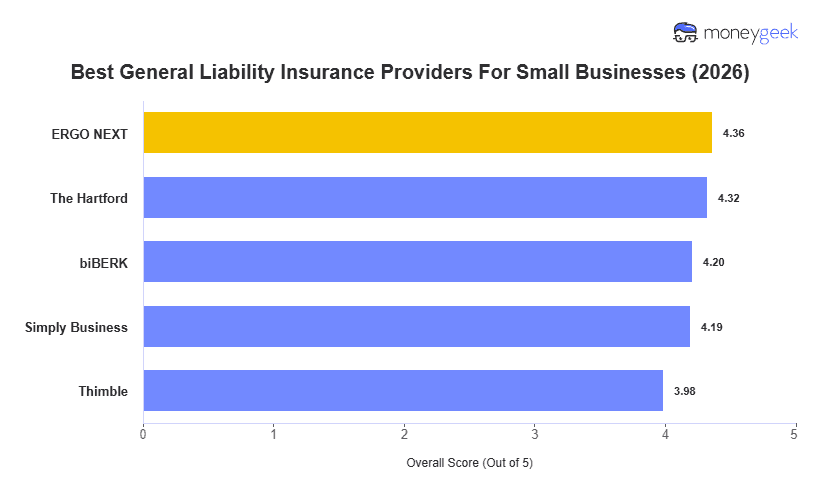
ERGO NEXT4.35$8018
The Hartford4.3$7682
Simply Business4.21$8724
biBERK4.2$8247
Coverdash4$9592
Thimble4$85610
Progressive Commercial3.9$9679
Chubb3.85$10251
Hiscox3.84$10236
Nationwide3.76$101105

For our Vermont general liability insurance ratings, we analyzed pricing, coverage options and customer experience across 408 industries within the state. Our analysis focuses on one-to-four-person businesses, which represent a large share of Vermont's small business market, while weighting results for broader industry and location representation across the Burlington metro, the Upper Valley, the Northeast Kingdom and central Vermont communities.

To do this, we evaluated over 20,000 business profiles, more than 189 customer experience data points and reviewed coverage contracts and endorsements to compare how insurers serve Vermont businesses consistently across different industries and regions. We then rated each company across categories of affordability (50%), customer experience (30%) and coverage options and terms (20%) to form an overall rating. For a detailed breakdown of the metrics, scoring methodology and pricing analysis specific to Vermont, see our full methodology.

95%
% of Small Businesses Covered
Over 20,000
Business Profiles Studied
189
Customer Experiences Analyzed

Find the Best General Liability Insurer for Your Vermont Business

Select your industry and state to get a customized quote from your best general liability insurer match in VT.

Industry
State

Answer 2 questions and see your top insurer in seconds. 100% free.

Company Image
Best Overall, Best for Hands-On and Service Industries

ERGO NEXT

In our general liability study, ERGO NEXT ranks first overall, providing Vermont business owners excellent customer experience for affordable rates. Customers report getting quoted, bound and holding a COI in under 15 minutes through a fully digital process. Policy management tools allow for instant COI generation and free additional insured additions online around the clock, but policyholders report low initial settlement offers, slow resolution on complex cases and difficulty escalating disputes. One BBB complaint described a 60-plus day claims process with delayed information requests.

Vermont businesses in hands-on and service industries, like hospitality, manufacturing, repair and maintenance, and beauty and wellness save the most, ranging from 22% to 33%. ERGO NEXT is the most affordable option in 12 Vermont industries and is the top insurer for solopreneurs and micro-businesses. Coverage caps at standard $1 million per occurrence and $2 million aggregate limits with no higher options, and contract endorsements like additional insured, waiver of subrogation and primary and non-contributory cost nothing and are available digitally. Still, it doesn't offer liquor liability, EPLI or professional liability add-ons to the general liability policies.

Where ERGO NEXT performs best:

  • Solo operators and teams of five or fewer who need coverage quickly
  • Vermont hospitality, manufacturing and repair shops hunting for affordable rates
  • Contractors who pull COIs and add additional insureds on a regular basis
  • Low-risk service businesses with clean claims histories

Where ERGO NEXT performs less competitively:

  • Claims-heavy industries that need a responsive dispute resolution process
  • Vermont agriculture, health care and education operations after the lowest available rates
  • Businesses that need higher policy limits, liquor liability or EPLI endorsements

Learn More: ERGO NEXT Review

Company Image
Best for Professional and Institutional Businesses

The Hartford

The Hartford is the second-best general liability insurer in Vermont, offering customers low cost, flexible coverage. Coverage depth separates it from most competitors. Per-occurrence limits scale up to $2 million and commercial umbrella coverage can extend limits further. A separate products and completed operations aggregate gives product-based businesses and contractors more flexibility. The endorsement portfolio includes liquor liability, EPLI, pollution and data breach options, though businesses that frequently assume liability through contractual liability is often excluded from GL policies.

The Hartford is the most affordable provider across every employee band in Vermont. Health care businesses save 31%, education saves 30% and financial services saves 20%. The quoting process requires working with an independent agent, and complex policies take three to five business days to process. The policyholder experience is a different story. Human support is responsive, endorsements process quickly and billing is flexible. Claims handling reviews are positive too, with customers citing fair settlements, clear communication and timely resolution.

Where The Hartford performs best:

  • Vermont businesses with five or more employees and room to grow
  • Health care, education and financial services operations watching their premiums
  • Owners who want a real person on the phone rather than a self-service portal
  • Businesses that need higher limits or endorsements like EPLI

Where The Hartford performs less competitively:

  • Owners who want a quote and same-day coverage without picking up the phone
  • Vermont real estate, hospitality and wholesale businesses after affordable rates
  • Operations that take on contractual liability on a regular basis

Learn More: The Hartford Review

Company Image
Best for Comparing Carriers

Simply Business

A competitive customer experience puts Simply Business third overall among the general liability insurers we studied in Vermont. Simply Business is a broker, not a carrier, so it aggregates quotes from 20+ insurers including Travelers, Hiscox, CNA and Markel, letting Vermont business owners compare multiple options in about 10 minutes without calling an agent. Customers consistently praise the quoting speed and ease, but once you buy, policy changes and claims go through your insurer directly. BBB and ConsumerAffairs complaints cite difficulty canceling policies and long hold times for post-sale support.

Multi-carrier access means you're not locked into one underwriter's endorsement menu. The platform pulls options across carriers for different coverage types. Savings are concentrated in tech and IT (25%), repair and maintenance (24%), retail (22%) and hospitality (19%).

Where Simply Business performs best:

  • Owners who want to compare quotes from multiple carriers without the hassle
  • Vermont tech, repair and retail businesses after low rates
  • First-time buyers who aren't sure which carrier fits their industry
  • Amazon sellers who need product liability coverage built around their business

Where Simply Business performs less competitively:

  • Businesses that want one point of contact for claims and policy changes
  • Construction, wholesale or marketing operations looking for savings
  • Growing teams of five or more employees watching their premiums

Learn More: Simply Business Review

Company Image
Best for Customer-Facing Businesses

biBerk

biBerk ranks fourth overall in Vermont, with competitive premiums and is backed by Berkshire Hathaway with an A++ AM Best rating. Trustpilot reviewers consistently name individual advisors for patience and willingness to walk first-time buyers through coverage decisions. That human touch fades after purchase, though, and reviews say COI requests take several weeks and simple policy changes require two-plus weeks and multiple phone calls. biBerk also drew more regulatory complaints between 2022 and 2024 than what’s expected for its market share.

Where biBerk wins on price in Vermont, it wins big. Hospitality businesses save 37%, health care saves 24%, fitness saves 21% and cleaning services saves 20%. All seven industries where biBerk ranks first share a pattern: customer-facing work with foot traffic or on-site service delivery. Coverage ranks lower, since damage to rented premises caps at $100,000 and products and completed operations share the general aggregate rather than carrying a separate limit. biBerk offers endorsements like liquor liability, cyber and EPLI, but slower processing and lower sublimits contribute to its lower ranking.

Where biBerk performs best:

  • Vermont hospitality, fitness and cleaning businesses
  • Owners who want to talk through coverage options by phone before buying
  • Businesses with modest lease values and little to no product liability exposure
  • Vermont recreation and real estate operations keeping an eye on costs

Where biBerk performs less competitively:

  • Operations leasing high-value commercial space that need higher sublimits
  • Owners who pull COIs often or swap endorsements on a regular basis
  • Construction and beauty businesses trying to keep premiums down

Learn More: biBerk Review

Company Image
Best for Freelancers and Seasonal Businesses

Thimble

Of all insurers included in our general liability study, Thimble ranks fifth overall for general liability insurance for offering flexible policy terms by the hour, day, month or year. Contractors who need a COI for a single job and event planners covering a weekend can buy and activate a policy through the app in under a minute. Trustpilot reviewers praise that speed, but Thimble offers no phone support, some customers wait days for email replies. Claims go through third-party administrators like Sedgwick, and one Trustpilot reviewer called attention to poor communication during a claim that took several months.

Construction and manufacturing see the most savings with Thimble, with savings ranging from 18% to 20%, but more industries pay more than Vermont’s average. Despite the unique coverage terms, policies have standard limits with minimal endorsements, no commercial auto and low equipment protection caps, resulting in a low ranking in this area.

Where Thimble performs best:

  • Contractors or event planners needing coverage for a single job
  • Seasonal Vermont businesses that pause coverage between projects
  • Owners who want app-based quoting and instant COI generation
  • Businesses in construction and manufacturing wanting to save on premiums

Where Thimble performs less competitively:

  • Businesses that file claims regularly or need a real person to call
  • Vermont hospitality, retail and nonprofit operations hunting for lower rates
  • Operations that need specialized endorsements or broader coverage options

Learn More: Thimble Review

Explore the Best General Liability Insurance in Vermont by Industry

Insurers price general liability policies based on how often claims happen in your industry and how costly they tend to be. A home renovation contractor in Rutland and a craft brewery in the Mad River Valley won't pay the same monthly rates because their risk profiles look very different. Scroll through these tables to find your business type, compare estimated monthly rates by provider and see which companies rank highest for your industry.

What Determines the Best General Liability Insurance for Vermont Businesses

When choosing general liability insurance in Vermont, look beyond monthly rate comparisons. A bed-and-breakfast in Stowe and an excavation company in Bennington have very different claim risks and growth plans, so the top-ranked provider may not be the right match for your operation. Here's what separates an insurer that looks good on a ranking from one that actually works for your business.

    coins2 icon
    Affordability without pricing volatility

    A tree service in Lamoille County that locks in a competitive first-year rate but sees a 20% jump at renewal is worse off than one that pays slightly more upfront with stable pricing year over year. Rate volatility disrupts cash flow and makes planning seasonal hiring or equipment purchases harder. Before you buy, ask about renewal pricing trends for your industry. A low first-year quote means little if your renewal increases are high and unpredictable.

    talk icon
    Responsive service throughout your policy term

    Your insurer should make the entire policy lifecycle easy. For Vermont businesses that deal with short operating windows and seasonal demand, slow service costs time and money.

    • Get a certificate of insurance to a property manager in Burlington before a job starts Monday morning
    • Add a newly leased retail location in Woodstock to your policy without waiting days for confirmation
    • File a slip-and-fall claim from a customer at your storefront without chasing adjusters for weeks
    • Reach a real person during mud season when a subcontractor dispute needs immediate attention

    How quickly an insurer issues certificates and responds to policy questions tells you more about the experience than any satisfaction score. Test that before you commit.

    insurance2 icon
    Coverage options that fit common small business risks

    General liability policies are fairly standard in what they cover, so the real difference between providers comes down to available limits and add-ons you can attach as your business grows. A cleaning company starting out in Windsor County may only need $1 million per occurrence, but landing a commercial contract could require $2 million or an umbrella policy layered on top. Not every insurer offers that flexibility, and switching providers mid-growth adds cost and hassle.

    The right add-ons depend on how your business operates. A catering company that operates across rural Vermont needs hired and non-owned auto coverage because employees regularly drive personal vehicles between venues. Any business leasing commercial space should check whether the standard $100,000 damage to rented premises limit is enough. Many Vermont landlords require higher limits in their lease agreements, which means you'll need an endorsement to increase it. Pick a provider that offers these options without making you start a separate policy for each one.

    building icon
    Why consistency across all three areas matters most

    An insurer with the lowest rate but slow claims processing puts your business at risk when it matters most. Consider a plumbing company in Washington County that lands a large commercial bid. The general contractor requires proof of coverage before work begins, and a property damage claim comes in midway through the project. 

    If the insurer takes weeks to respond or disputes valid coverage, that plumber could lose the contract relationship and future referrals, all because one part of the experience fell short. The provider worth choosing performs reliably across pricing, service and coverage, not only in the area that looks best on a comparison table.

How to Choose the Best General Liability Insurance in Vermont

Vermont's blend of seasonal businesses, tourism-driven operations and rural trades means no single provider works for everyone. These six steps give you a repeatable process to move from a broad list to a confident final choice.

  1. 1

    Optimize your payment and coverage structure

    Before comparing providers, get clear on your own risk profile. A Vermont landscaper with a seasonal crew and heavy equipment has different exposure than a bookkeeping firm working remotely from Middlebury. 

    Ask yourself:

    • Do clients visit your job sites or workspace where a slip-and-fall claim is realistic, like a retail shop or an agritourism venue?
    • Do Vermont general contractors or property managers you work with require minimum limits or additional insured endorsements in their contracts?
    • Would raising your deductible from $500 to $1,000 lower your premium enough to justify the out-of-pocket risk during a slow season?
    • Does your revenue come in steadily enough to pay annually for a discount, or does monthly billing match your cash flow better during off-peak months?

    A timber framing company in the Upper Valley bidding on custom builds will likely need higher limits than a tax preparer working from a home office in Montpelier. Review how much general liability coverage you need based on your operations, then match your payment structure to your cash flow. Paying annually often costs less overall, and raising your deductible can lower your premium, but only if you can cover that amount out of pocket when a claim comes in.

  2. 2

    Choose your primary priority

    Not every Vermont business weighs the same factors when comparing providers. Your current situation should shape which lens you lead with, and that priority becomes your tiebreaker later when two or three insurers score similarly.

    • Affordability first: Prioritize pricing predictability if your margins are tight or seasonal. A maple sugaring operation in Orange County that earns most of its revenue in a few spring months can't absorb surprise rate hikes at renewal. Look for insurers with stable renewal trends and transparent audit processes over the lowest upfront quote.
    • Customer experience first: Prioritize service responsiveness if your work depends on fast turnaround. An event planner in the Champlain Valley who needs same-day certificates for multiple venues each week will burn hours chasing a slow insurer. Look for providers that issue documents quickly and assign dedicated support contacts.
    • Coverage options first: Prioritize coverage breadth if your business is growing or your risk profile is complex. A construction firm in Windham County adding new service lines needs flexible general liability limits and endorsements it can adjust without switching carriers. Look for providers that let you scale limits and add endorsements as your operations expand.
  3. 3

    Shortlist two to three providers

    A side-by-side comparison of every insurer isn’t realistic and leads to decision fatigue. Once you set your priority, narrow your list to two or three providers that align with it and meet your baseline coverage requirements.

    Cross-check each against your industry profile, business size and where you operate in Vermont. A provider that works well for a solo IT consultant in Essex may not have the right appetite for a roofing company in Barre. Use Vermont general liability costs for your industry and business size to spot outliers quickly and focus your comparison on providers priced within a realistic range.

  4. 4

    Double-check for dealbreakers before investing more time

    Confirm that your shortlisted providers don't have disqualifying gaps before doing detailed comparisons. These are the kinds of issues Vermont business owners run into most often:

    • They don't write policies for your industry class code, which can be a problem for niche Vermont operations like ski area maintenance crews or granite quarry subcontractors
    • They can't issue certificates of insurance fast enough for a property manager in Burlington who needs proof before Monday's job
    • They won't write the $2 million aggregate a general contractor requires before you can start a commercial renovation in Brattleboro
    • Their claims process routes everything to adjusters in another state who have no familiarity with local contractors, vendors or repair timelines in Vermont
  5. 5

    Compare your finalists using the same three lenses

    Even after choosing a primary priority, evaluate your finalists across all three areas. A provider that wins on price but falls short on service or coverage will cost you more in the long run.

    • Affordability: Look at more than the initial quote. Compare how each insurer communicates rate changes at renewal and what their audit process looks like. For a seasonal outfitter near Killington whose revenue swings between summer and winter, a clean audit process with no surprise adjustments matters more than the first-year price.
    • Customer experience: Evaluate how fast each provider issues certificates, how easy it is to update your policy online and how claims are assigned. A paving contractor in Caledonia County working on tight municipal deadlines can't wait three days for a certificate update every time a new project starts.
    • Coverage options: Review available per occurrence and aggregate limits, endorsement flexibility and whether you can adjust coverage midterm. A growing property maintenance company in Chittenden County that starts adding snow removal services in winter needs a provider that can scale without requiring a separate policy.
  6. 6

    Use quotes as the final confirmation step

    A quote isn't where you start shopping. It confirms that pricing and coverage match your actual business details. Say you run a small carpentry shop in Addison County and you've narrowed your list to two providers after settling on $1 million per occurrence limits with an additional insured endorsement for the general contractors you work with. 

    Requesting general liability insurance quotes from both using the same business information lets you compare them cleanly. Review each quote for general liability exclusions to confirm nothing you need is carved out and that limits, deductibles and endorsements match what you settled on in step one.

Best Small Business General Liability Insurance in Vermont: Bottom Line

Price alone doesn’t capture the full picture when you choose general liability coverage. A provider worth committing to offers stable renewal pricing, responsive service for certificates and claims and coverage that scales with your operations. ERGO NEXT, The Hartford and Simply Business lead the Vermont rankings across these areas, though the best match depends on your industry, workforce size and how your business runs. Consider all three together to align your risk profile and budget with a provider that fits where your business is headed.

Best General Liability Insurance For Small Business in Vermont Chart

Best General Liability Insurance for Small Businesses in Vermont: Next Steps

If you're ready to move forward, pick one or two providers and request pricing using the same limits, deductibles and endorsements so your comparison is fair. Vermont businesses often need coverage that accounts for seasonal operations, cross-state work and contracts with tight proof-of-insurance deadlines. Confirming these details upfront validates that your chosen provider actually fits how your business runs.

If cost is still your main deciding factor

If you’re unsure how much coverage you need

If you’re ready to check quotes now

Find the Best General Liability Insurer for Your Vermont Business

Select your industry and state to get a customized quote from your top general liability insurance match in VT.

Industry
State

Answer 2 questions and see your top insurer in seconds. 100% free.

How We Chose the Best General Liability Insurance Companies

To identify the best general liability insurance companies for Vermont small businesses, we evaluated insurers across pricing, customer experience and coverage options using a standardized, data-driven approach. Our goal was not to identify the cheapest option in every scenario, but to determine which providers offer the most consistent overall value across common Vermont small business profiles.

Our best recommendations reflect insurers that perform well across multiple dimensions and remain competitive across industries and business sizes in Vermont.

Data and Analysis Scope

Our analysis used standardized estimates designed to represent the majority of Vermont small businesses:

  • Providers analyzed: 10 major insurers serving Vermont
  • Industries covered: 408 industries
  • Employee counts: Zero to 49 employees
  • Policy baseline: $1 million per occurrence / $2 million aggregate general liability policy
  • Pricing modeled: Over 20,000 standardized estimates for Vermont businesses

Modeled average revenues and payrolls were incorporated to improve pricing accuracy for Vermont's business market.

Our Scoring Model

Each insurer received a composite score based on the weighted categories below.

  • Affordability (50%): Affordability reflects how competitively and consistently an insurer prices general liability coverage across all Vermont business profiles studied.
  • Customer experience (30%): Customer experience measures how well insurers support Vermont businesses throughout the policy lifecycle from purchase to claims. We also studied at each level of buying, policy management and claims sub-parts of the process that make it easier and more reliable within each as well for accuracy and comprehensive understanding.
  • Coverage options (20%): Coverage options reflect how well insurers support common Vermont small business risks and allow for flexibility as businesses grow or change.

Read our full business insurance methodology.

About Angelique Palenzuela-Cruz


Angelique Palenzuela-Cruz headshot

Angelique Palenzuela-Cruz is a Content Writer at MoneyGeek specializing in business insurance. She focuses on general liability, workers' compensation and professional liability coverage, helping small business owners cut through policy jargon and understand what they're actually buying.

Angelique has spent over five years reporting on personal finance, with deep experience in both insurance and lending markets. Her psychology background also gives her a unique understanding of how people actually process difficult financial decisions, allowing her to meet readers where they are, simplify complex concepts and build decision making frameworks that give them confidence. Whether you're learning about policies, comparing providers or trying to figure out requirements, Angelique does the legwork, digging into regulations, analyzing policy language and testing her explanations against agent-level standards so you get straight answers without fluff.