
How Much Does General Liability Insurance Cost in Kentucky?

General liability insurance costs in Kentucky average $102 monthly ($1,222 annually) for businesses with one to four employees carrying limits of $1 million per occurrence/$2 million aggregate. This figure falls 17% below the national average, ranking Kentucky 13th for affordability nationally.

Kentucky lands near the middle of the broader South. Mississippi and Alabama average less at $89 and $100 monthly, while Tennessee, which also shares a border with Kentucky, sits higher at $112 monthly, along with other bordering states Indiana and Ohio. That spread reflects Kentucky's moderate regulatory and litigation environment, not a market under structural cost pressure.

The state average considers a wide array of general industries and shouldn't be treated as a rate prediction. More than how your quote compares to Kentucky's average, the more useful lens is understanding which factors explain where your premium lands. A more personalized cost estimate is available through the Kentucky general liability insurance cost calculator below.


To estimate average general liability insurance costs in Kentucky, we analyzed quote data from major U.S. small business insurance providers and modeled standardized premium estimates across common business profiles. These modeled results are designed to provide a consistent state benchmark and show how premiums vary by key baseline factors including business size, industry and location within Kentucky.

Dataset Scope and Assumptions

Our cost modeling uses standardized inputs for consistent comparisons across Kentucky businesses.

  • Providers analyzed: 10 major insurance providers
  • Industries covered: 25 general industry categories relevant to Kentucky's business landscape
  • Employee count bands: zero, one to four, five to nine, 10 to 19 and 20 to 49 employees
  • Policy baseline: standard general liability policy with $1 million per occurrence / $2 million aggregate limits
  • Total estimates modeled: over 20,000 standardized pricing estimates across Kentucky industry and employee count combinations

We also incorporated modeled average revenue and payroll personalized across all combinations of Kentucky regions, industry and employee counts to improve the accuracy of pricing. To model these assumptions against our cost factors, we used data from these sources:

  • CBP (for employee size class density in Kentucky by NAICS)
  • QCEW (for wage/payroll intensity by industry in Kentucky)
  • Economic Census / SUSB (for receipts/output intensity by industry)
  • Calibrated against:
    • Private comp databases
    • IRS SOI totals

How We Calculated Average General Liability Costs in Kentucky

Our published averages represent modeled premiums for standardized business profiles and were aggregated in two ways:

  • Kentucky state average: The Kentucky average cost reflects the modeled premium for a standardized one to four-employee small business across all industries included in our dataset for a standard general liability policy.
  • Segment averages: To show how costs vary within Kentucky, we calculated average modeled premiums for our state base profile and isolated for variables, including:
    • Employee count (business size ranges)
    • General industry categories

Segment averages were produced by aggregating modeled pricing trends across the full dataset so readers can compare how premiums shift across business types and regions within Kentucky.

Read our full business insurance methodology.

Business Insurance Rates by State and Industry

Select your general industry and employee count for a personalized general liability insurance cost estimate for your Wyoming business. Estimates are based for a $1 million per occurrence and $2 million aggregate policy.

Select Industry
Select Employee Count
Average Monthly Rate

What Factors Affect General Liability Insurance Costs Kentucky?

General liability insurance in Kentucky costs vary widely with business size. Solo operators average 44% below the state average. At the other end, businesses with 20 to 49 employees sits 1,680% higher, reflecting how payroll exposure and operational scale compound claim risk.

Industry classification drives a similarly broad range, with tech and IT firms spending 75% less than Kentucky's average, while contractors pay 155% more. Differences in physical exposure, liability frequency and claim severity potential explain most of that spread.

Beyond these two factors, Kentucky-specific conditions also affect where a business lands within these ranges:

    congress icon
    Kentucky's Legal Environment

    Kentucky follows pure comparative negligence, meaning plaintiffs can recover damages even when mostly at fault and no caps limit award amounts. Insurers price for a broader range of potential outcomes than in states with damage limits or modified fault bars. A one-year statute of limitations on personal injury claims partially offsets this by reducing the window insurers must price against for tail risk.

    pin icon
    Kentucky's Geography

    Kentucky sits within an expanding severe weather corridor, with flood-prone river systems concentrated in eastern counties and higher tornado activity in the west. The 2022 eastern Kentucky floods (DR-4663-KY) triggered a federal major disaster declaration covering 13 counties, with FEMA approving more than $164 million in federal assistance, a figure that shows the financial scale of disruption businesses in flood-prone zones absorb.

    tornado icon
    Kentucky's Weather Patterns

    Tornadoes, recurring floods and winter ice and snow drive consistent premises liability and slip-and-fall claim activity across the state. Kentucky received two FEMA major disaster declarations for flooding in 2025 (DR-4860-KY in February and DR-4864-KY in April), confirming that weather-related loss exposure recurs regularly rather than in isolated events.

    driverLicense icon
    Kentucky's Mandatory Coverage Requirements By Business Type

    Licensed electrical contractors must carry a minimum of $500,000 in general liability coverage, licensed child care centers must carry at least $100,000 and certified family child care homes must meet a $50,000 floor. Because these floors are non-negotiable, businesses in these categories can't buy down their coverage to reduce premiums, which keeps their GL costs structurally higher.

    methodologyTwo icon
    Kentucky's Business Growth and Industry Mix

    According to the Kentucky Center for Statistics' 2024 Annual Statewide Press Release, Kentucky's manufacturing sector added 1,748 jobs in 2024 and grew 9.9% over the past decade, while the trade, transportation, and utilities sector (the state's largest) expanded 13.4% over the same period. More higher-risk operations in the state means more GL-exposed businesses in the overall market, which puts upward pressure on aggregate costs.

Average General Liability Insurance Costs in Kentucky by Business Size

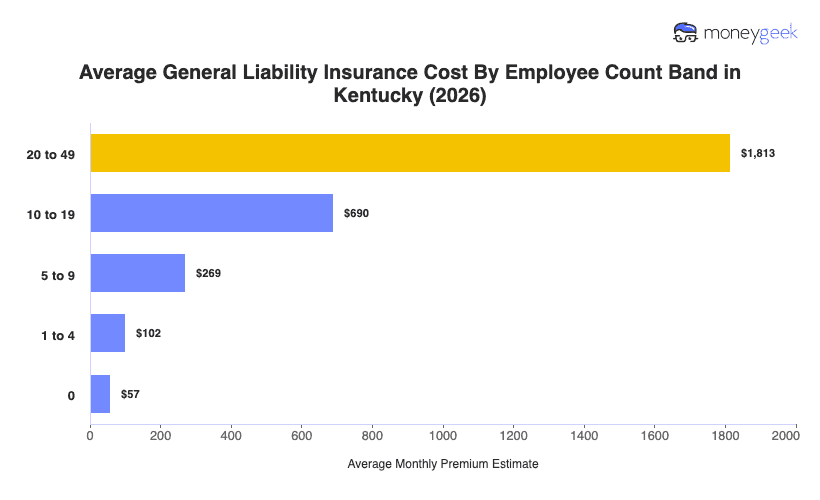
General liability costs in Kentucky scale with employee count, reflecting how insurers price for increased foot traffic, worksite activity and third-party exposure as operations grow. The range runs from $57 monthly for solo operators to $1,813 monthly for businesses with 20 to 49 employees

The sharpest relative jump occurs during your fifth hire, where costs rise 164.4%, as adding staff expands both payroll exposure and the frequency of third-party contact. Use the table to locate which employee band your business falls into and how far your profile sits from the state average.

Kentucky General Liability Insurance Cost Chart

Average General Liability Insurance Costs in Kentucky by Industry

Across 25 general industries, general liability costs in Kentucky run from $25 monthly for tech and IT firms to $260 monthly for contractors. That's a 10x spread that reflects how physical exposure, worksite risk, and third-party contact frequency differ across business types. 

Most industries cluster at or below the state average, with food & beverage and retail sitting within 2% of it in either direction. Above that threshold, the distribution jumps sharply: health care & medical comes in at $176 monthly and construction & contracting at $260, with no industries in between. Use the table to find your industry and see where it falls relative to the state average.

Data filtered by:
Select
Agriculture & Natural Resources$84$1,00718%
Arts, Media & Entertainment$32$38269%
Beauty, Body & Wellness Services$31$36870%
Childcare Services$96$1,1486%
Cleaning Services$78$93124%
Construction & Contracting$260$3,121-155%
Consulting Services$31$37370%
Education$43$51658%
Financial Services$33$39468%
Fitness Services$95$1,1367%
Food & Beverage$100$1,2002%
Healthcare & Medical$176$2,116-73%
Hospitality, Travel & Tourism$83$99619%
Manufacturing$54$65147%
Marketing & Communications$29$35271%
Nonprofit & Associations$46$54855%
Other Professional Services$63$75538%
Pet Care Services$64$76637%
Real Estate & Property Services$43$52157%
Recreation & Sports$86$1,02916%
Repair & Maintenance$58$69843%
Retail & Product Rental$103$1,241-2%
Tech/IT$25$30375%
Transportation & Logistics$79$94523%
Wholesale & Distribution$83$99818%

Use these resources to explore costs for your industry.

How to Lower General Liability Insurance Costs Without Sacrificing Coverage

Kentucky businesses already pay below the national average for GL coverage, but not every quote reflects the lowest rate for your profile. These strategies can help you find more affordable general liability coverage in Kentucky without reducing the financial protection your business actually needs.

    shoppingCart icon
    Compare Multiple Insurers

    A Lexington pressure washing company carries physical exposure (chemical handling, client property access and slip risk), yet general liability quotes for the same business can vary by hundreds of dollars annually depending on which insurer underwrites it. Each carrier weighs industry risk, claims history and coverage structure differently. Always review general liability exclusions across quotes, because a lower premium that excludes a key exposure isn't a savings.

    building icon
    Bundle General Liability Into a Business Owner's Policy

    Kentucky small businesses that need both liability and [commercial property protection](Kentucky small businesses that need both liability and property protection can reduce their total premium by bundling both into a BOP. Compare the cost of a BOP to buying standalone policies separately to see how much bundling saves for your specific business profile. Bourbon distillery tour operators, independent restaurants, and specialty food producers across the state typically need both coverages, making commercial property coverage bundled into a BOP a good match.) can reduce their total premium by bundling both into a BOP. Compare the cost of a BOP to buying separate standalone policies for general liability and commercial property to see how much bundling saves for your specific business profile. Bourbon distillery tour operators, independent restaurants, and specialty food producers across the state typically need both coverages, making a BOP a good fit.

    loanReview icon
    Adjust Your Coverage Limits

    Many of Kentucky's solo and small-office professional service providers (independent consultants, freelance marketers and single-practice financial advisors) may carry general liability limits sized for larger operations with bigger client bases and higher contract values. Paying for coverage beyond your actual exposure adds cost without adding protection. Review how much general liability you need against your contracts, client base and work type before your next renewal.

    barChart icon
    Improve Your Loss Profile Over Time

    A clean general liability claims history is one of the primary factors insurers weigh at renewal. For Kentucky hospitality businesses (hotels, event venues and bars in Louisville's NuLu district or Lexington's entertainment corridor), a multi-year record without claims directly affects how carriers price the next policy cycle.

    Insurers weigh both frequency and severity. One large claim carries more weight than several small ones, so addressing the conditions most likely to produce a significant loss, like a kitchen fire, a serious slip-and-fall or a catering mishap, matters more than avoiding minor incidents.

    stackOfBooks icon
    Strengthen Risk Controls Insurers Care About

    Kentucky's logistics and trucking sector, centered around the UPS and Amazon air hubs in Louisville and the I-75 corridor in Northern Kentucky, relies on documented safety protocols to support GL underwriting. Carriers price risk based on what they can verify, not what they assume.

    Written safety procedures, driver training records and incident response protocols give underwriters documented evidence of lower exposure. For agriculture and natural resources operations in western Kentucky, the same principle applies: documented equipment handling and site safety practices directly affect how a carrier prices your renewal.

General Liability Insurance Cost in Kentucky: Bottom Line

Kentucky's average general liability cost gives businesses a reference point for gauging where their quote lands relative to the broader market, not a prediction of what any specific operation will pay. Three questions help put your quote in context:

  1. How does your quote compare to the state average? A quote above $102 monthly doesn't mean you're overpaying. It may simply reflect your industry tier, employee count or location within Kentucky. The useful question isn't whether your number is higher or lower, but whether the gap is proportionate to your business profile.
  2. What's driving your cost? Some drivers are structural and outside your control: your industry classification, the nature of your operations and Kentucky-specific factors like your location in a flood-prone or high-tornado-activity region. Understanding which drivers affect your profile tells you whether your quote is priced correctly for your risk, not just whether it's expensive.
  3. What could change your cost? Separate from what's driving your current premium, consider what choices haven't been made yet: coverage limit adjustments, bundling options, deductible levels or loss history improvements over time. These are levers you control and could shift your premium at renewal.

Kentucky's economy spans manufacturing, logistics, agriculture and bourbon production, with a business mix that ranges from solo professional service providers to mid-seized operations. The benchmark aggregates all of them, which is why understanding which drivers apply to your operation matters more than matching the average.

General Liability Insurance Cost in Kentucky: Next Steps

Understanding Kentucky's GL cost benchmarks puts your quote in context. From there, the path forward depends on what you're trying to do: find cheaper options, compare providers or request quotes. 
If cost reduction is the goal, start by reviewing the cost-management strategies on this page before approaching the market. To compare providers, request quotes using consistent inputs across all carriers (same business size, same coverage limits, same deductible structure) so comparisons reflect true pricing differences.

Get Personalized General Liability Insurance Quotes in Kentucky

Select your industry and state to get a customized Kentucky general liability quote.

Industry
State

About Angelique Palenzuela-Cruz


Angelique Palenzuela-Cruz headshot

Angelique Palenzuela-Cruz is a Content Writer at MoneyGeek specializing in business insurance. She focuses on general liability, workers' compensation and professional liability coverage, helping small business owners cut through policy jargon and understand what they're actually buying.

Angelique has spent over five years reporting on personal finance, with deep experience in both insurance and lending markets. Her psychology background also gives her a unique understanding of how people actually process difficult financial decisions, allowing her to meet readers where they are, simplify complex concepts and build decision making frameworks that give them confidence. Whether you're learning about policies, comparing providers or trying to figure out requirements, Angelique does the legwork, digging into regulations, analyzing policy language and testing her explanations against agent-level standards so you get straight answers without fluff.


sources