
How Much Does General Liability Insurance Cost in Kansas?

The average cost of general liability insurance for Kansas small businesses is $102 per month or $1,222 per year, 17% below the national average. Kansas ranks 12th nationally for affordability, putting it among the more affordable states in the country.

Kansas sits near the middle of both its adjacent states and the broader Midwest region. Oklahoma and Missouri, which border Kansas and share its regional market, have monthly premiums landing within $3, suggesting similar exposure profiles: moderate claim frequency, lower population density and a business mix that leans toward lower-risk operations. Colorado, which shares a border with Kansas but sits outside the Midwest region, averages $146, likely reflecting higher construction activity and greater urban exposure. Within the region, the Dakotas and Iowa run meaningfully cheaper, while Minnesota is the only Midwest state that exceeds the national average.

Kansas' state average cuts across business types and isn't a rate prediction. The more useful question is what's driving your cost, not just how close your quote is to the benchmark. For an estimate closer to your actual profile, the Kansas general liability insurance cost calculator below accounts for your specific business details.

To estimate average general liability insurance costs in Kansas, we analyzed quote data from major U.S. small business insurance providers and modeled standardized premium estimates across common business profiles. These modeled results are designed to provide a consistent state benchmark and show how premiums vary by key baseline factors including business size, industry and location within Kansas.

Dataset Scope and Assumptions

Our cost modeling uses standardized inputs for consistent comparisons across Kansas businesses.

  • Providers analyzed: 10 major insurance providers
  • Industries covered: 25 general industry categories relevant to Kansas's business landscape
  • Employee count bands: zero, one to four, five to nine, 10 to 19 and 20 to 49 employees
  • Policy baseline: standard general liability policy with $1 million per occurrence / $2 million aggregate limits
  • Total estimates modeled: over 20,000 standardized pricing estimates across Kansas industry and employee count combinations

We also incorporated modeled average revenue and payroll personalized across all combinations of Kansas regions, industry and employee counts to improve the accuracy of pricing. To model these assumptions against our cost factors, we used data from these sources:

  • CBP (for employee size class density in Kansas by NAICS)
  • QCEW (for wage/payroll intensity by industry in Kansas)
  • Economic Census / SUSB (for receipts/output intensity by industry)
  • Calibrated against:
    • Private comp databases
    • IRS SOI totals

How We Calculated Average General Liability Costs in Kansas

Our published averages represent modeled premiums for standardized business profiles and were aggregated in two ways:

  • Kansas state average: The Kansas average cost reflects the modeled premium for a standardized one to four-employee small business across all industries included in our dataset for a standard general liability policy.
  • Segment averages: To show how costs vary within Kansas, we calculated average modeled premiums for our state base profile and isolated for variables, including:
    • Employee count (business size ranges)
    • General industry categories

Segment averages were produced by aggregating modeled pricing trends across the full dataset so readers can compare how premiums shift across business types and regions within Kansas.

Read our full business insurance methodology.

Business Insurance Rates by State and Industry

Select your general industry and employee count for a personalized general liability insurance cost estimate for your Wyoming business. Estimates are based for a $1 million per occurrence and $2 million aggregate policy.

Select Industry
Select Employee Count
Average Monthly Rate—

What Factors Affect General Liability Insurance Costs Kansas?

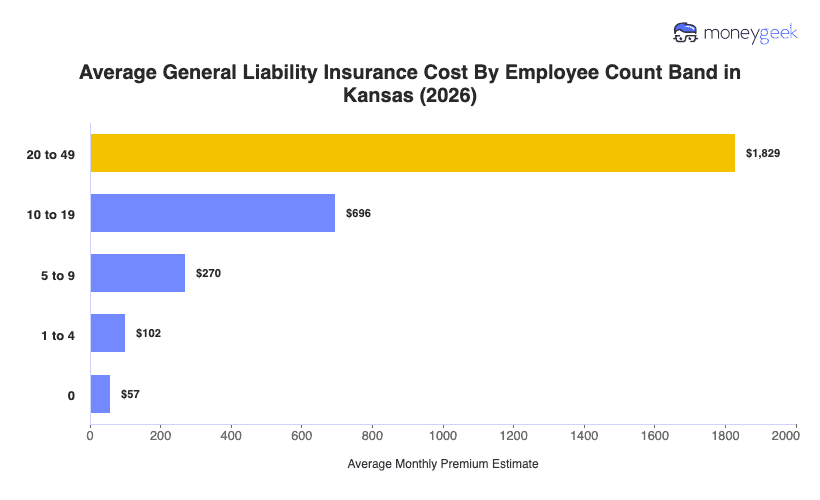
General liability insurance in Kansas costs scale sharply with headcount. Premiums for solo operators run 44% below the state average, while businesses with 20 to 49 employees average nearly 17 times that benchmark. More employees mean more client-facing interactions and a larger payroll footprint, both signals insurers use to estimate how often and how severely claims are likely to occur.

The range across industries is just as wide. Software firms and IT consultants sit 75% below the state average, while general contractors and homebuilders average 159% above it. Higher physical exposure and greater third-party contact increase the likelihood and severity of claims, which insurers price into the premium. The nature of the work, more than business size alone, determines where an operation falls on that spectrum.

Kansas-specific conditions build on these two factors, further influencing where a given business lands within the range:

    tornado icon
    Kansas's Severe Weather Exposure

    Kansas sits in Tornado Alley, where 2024 recorded 1,796 confirmed tornadoes, the second-highest count on record per NOAA. Outdoor operations, events and construction businesses carry elevated third-party injury exposure during weather events, an exposure pattern insurers factor into general liability premiums for Kansas operations.

    briefcase icon
    Kansas's Litigation Environment

    Kansas does not recognize bad faith as a standalone tort claim against insurers, and its broader litigation culture runs moderate compared to more litigious states. For private businesses, lower claim severity potential keeps general liability costs from climbing as steeply as they might where large jury awards are more common.

    forest icon
    Kansas's Agricultural and Rural Business Concentration

    A high share of Kansas businesses operate in agriculture, agritourism and rural industries. These operations introduce distinct liability exposures, including farm equipment, food production and client-facing rural activities, that differ from urban business profiles and can shift pricing depending on the nature of the work.

    driverLicense icon
    Kansas's Lack of a Statewide General Liability Requirement

    Kansas does not mandate general liability insurance at the state level for most businesses, though cities and counties may impose their own requirements. Lower mandatory demand affects market dynamics and contributes to competitive pricing across the state.

    vsDocuments icon
    Kansas's Insurance Market Composition

    Kansas draws both regional and national carriers, supporting a reasonably competitive market. Broader carrier participation keeps pricing stable, consistent with the state's below-average premium position relative to the national benchmark.

Average General Liability Insurance Costs in Kansas by Business Size

Kansas general liability costs scale sharply with headcount, from $57 per month for solo operations to $1,829 for businesses with 20 to 49 employees. The steepest relative increase occurs early: hiring your first employee raises costs 79%, and growing your business to have between five and nine people adds another 165%, as insurers assess the volume of work performed and the breadth of client-facing operations at each threshold.

Through the mid-to-upper bands, percentage increases stay within a narrow range across three consecutive tiers, suggesting insurers apply a consistent scaling logic once a business moves past the initial growth threshold. The table breaks down average monthly and annual premiums by employee band:

Kansas General Liability Insurance Cost Chart

Average General Liability Insurance Costs in Kansas by Industry

Most Kansas industries fall below the state average: only three of 25 exceed it, and two of those by a wide margin. Health care & medical averages $175 per month and construction & contracting averages $263, reflecting the higher third-party injury exposure and property damage risk those operations carry. At the other end, Technology and IT averages $25 per month. 

The full spread between the lowest and highest-cost industries is roughly 10x, based on how much physical contact, on-site work and third-party interaction a given operation involves. The table breaks out average monthly and annual premiums across all 25 Kansas industries.

Data filtered by:
Select
Agriculture & Natural Resources$85$1,01517%
Arts, Media & Entertainment$32$38568%
Beauty, Body & Wellness Services$31$37869%
Childcare Services$97$1,1625%
Cleaning Services$79$94223%
Construction & Contracting$263$3,160-159%
Consulting Services$31$37469%
Education$41$49060%
Financial Services$33$39867%
Fitness Services$93$1,1119%
Food & Beverage$99$1,1932%
Healthcare & Medical$175$2,097-72%
Hospitality, Travel & Tourism$83$99818%
Manufacturing$55$65846%
Marketing & Communications$29$35371%
Nonprofit & Associations$47$56054%
Other Professional Services$63$76038%
Pet Care Services$66$78836%
Real Estate & Property Services$44$52557%
Recreation & Sports$82$98819%
Repair & Maintenance$59$70642%
Retail & Product Rental$104$1,244-2%
Tech/IT$25$30475%
Transportation & Logistics$77$92724%
Wholesale & Distribution$84$1,01117%

Use these resources to explore costs for your industry.

How to Lower General Liability Insurance Costs Without Sacrificing Coverage

Kansas premiums run below the national average, but there's still room to optimize. These five strategies focus on the levers most relevant to affordable general liability coverage in Kansas without reducing the financial protection your business needs.

    shoppingCart icon
    Compare Multiple Insurers

    General liability quotes can vary more than most business owners expect, even for the same operation. A Wichita-based cleaning company, for example, might see notable differences in premiums across regional and national carriers writing in Kansas, and the spread can be wider than in states with fewer competing insurers.

    Reviewing multiple quotes shows you where your business sits relative to other Kansas businesses with a similar profile. Check general liability exclusions across policies too, because the cheapest quote isn't always the most complete one.

    building icon
    Bundle General Liability Into a Business Owner's Policy

    Kansas has a high concentration of small, owner-operated businesses that need both liability and commercial property protection. A BOP packages both coverage types into a single policy, usually costing less than buying separate policies.

    While it simplifies coverage management, the cost of a BOP varies by business type and not all operations qualify. Higher-risk industries like construction typically need standalone policies instead.

    loanReview icon
    Adjust Your Coverage Limits

    Kansas's moderate litigation environment means some businesses carry general liability limits higher than their actual exposure warrants, which means you could be paying for protection that doesn't match your risk profile. An Overland Park software firm and a Hutchinson event venue both need coverage, but how much general liability you need differs based on client contract requirements and the nature of third-party exposure each operation carries.

    barChart icon
    Improve Your Loss Profile Over Time

    Kansas businesses with fewer general liability claims on record present a lower risk profile to insurers, which translates to better pricing at renewal. A Topeka food truck operator who goes several policy cycles without a slip-and-fall or property damage claim builds a track record that supports more competitive premiums over time.

    Consistency matters more than any single claim-free year. Insurers look at trends across multiple policy periods, so maintaining clean operations builds on itself and gives you stronger footing when comparing quotes at renewal.

    stackOfBooks icon
    Strengthen Risk Controls Insurers Care About

    Businesses that document safety protocols give underwriters concrete evidence of active risk management. In Kansas, where hail and tornado season creates seasonal risk for businesses with outdoor operations or street-facing storefronts, a written weather preparedness plan and an incident response protocol can shift how an insurer assesses your operation.

    These measures don't need to be elaborate. A Salina-based garden center that documents pre-storm property checks, maintains clear customer walkways and logs any incidents presents a materially different risk profile than one without formal controls, which underwriters factor into pricing at renewal.

General Liability Insurance Cost in Kansas: Bottom Line

Kansas general liability insurance averages $102 per month for small businesses with one to four employees, placing the state among the more affordable markets nationally. It reflects a broad cross-section of industries and business sizes, a reference point for orientation, not a prediction of what any individual operation will pay.

Three questions help put your own quote in context:

  1. Is your quote telling you something about your risk profile? A quote above the state average isn't necessarily wrong, it may accurately reflect your industry, headcount or operating environment. The more useful read is whether the gap between your quote and the benchmark reflects factors you understand, or whether it warrants closer review of how your business was underwritten.
  2. What fixed factors shape your baseline cost? Industry classification, business size and Kansas-specific conditions, including the state's weather exposure and litigation environment, establish a floor that exists independent of the choices you make.
  3. Are you paying for choices or circumstances? Some cost drivers are fixed, including your industry, location and the nature of your operations. Others reflect decisions: coverage limits, policy structure and loss history. The distinction shows where you have real leverage and where the cost simply reflects your risk profile.

Kansas's economy leans heavily on agriculture, manufacturing and trade, industries with distinct liability profiles that push the state average away from what many individual operations actually pay. Understanding which drivers apply to your business matters more than closing the gap with a statewide number.

General Liability Insurance Cost in Kansas: Next Steps

Knowing where Kansas general liability costs land makes quote comparisons more useful. For businesses looking for cheaper options or comparing providers, request quotes from multiple carriers, both regional and national, using consistent inputs: the same business profile, coverage limits and policy terms across every request. Variation in those inputs makes comparisons unreliable and harder to read across carriers.

Industry classification and business size account for the widest spread in Kansas GL costs and will likely explain most of the variation across carriers. Treating those two factors as the primary filters when reviewing quotes makes price a more meaningful signal once you've reviewed coverage scope and exclusions across each option.

Get Personalized General Liability Insurance Quotes in Kansas

Select your industry and state to get a customized Kansas general liability quote.

Industry
State

About Angelique Palenzuela-Cruz


Angelique Palenzuela-Cruz headshot

Angelique Palenzuela-Cruz is a Content Writer at MoneyGeek specializing in business insurance. She focuses on general liability, workers' compensation and professional liability coverage, helping small business owners cut through policy jargon and understand what they're actually buying.

Angelique has spent over five years reporting on personal finance, with deep experience in both insurance and lending markets. Her psychology background also gives her a unique understanding of how people actually process difficult financial decisions, allowing her to meet readers where they are, simplify complex concepts and build decision making frameworks that give them confidence. Whether you're learning about policies, comparing providers or trying to figure out requirements, Angelique does the legwork, digging into regulations, analyzing policy language and testing her explanations against agent-level standards so you get straight answers without fluff.


sources