
How Much Does General Liability Insurance Cost in Iowa?

The cost of general liability insurance for small Iowa businesses with one to four employees is $95 monthly ($1,135 annually) for coverage limits of $1 million per occurrence/$2 million aggregate limits. That makes Iowa the fourth most affordable state for general liability coverage, as its average monthly rate falls 23% below the national figure of $123.

Most of Iowa's neighboring states are more expensive, with Nebraska being the closest at $105 monthly. Minnesota and Illinois are 36% and 48% higher. Beyond border states, Midwest pricing compresses into a narrower range: North Dakota nearly matches Iowa at $96 monthly, while Kansas and Missouri both hover near $105. Most regional states fall within a narrow $10 band, with Iowa and North Dakota forming the low end.

This state average serves as a starting reference. The useful comparison isn't "Am I near $95?" but "Which drivers explain my distance from it?" Industry claim frequency, operational risk controls and prior loss experience all contribute to where your quote lands, regardless of the limits you select. To get a cost estimate based on your business profile, use the Iowa general liability insurance cost calculator below.

To estimate average general liability insurance costs in Iowa, we analyzed quote data from major U.S. small business insurance providers and modeled standardized premium estimates across common business profiles. These modeled results are designed to provide a consistent state benchmark and show how premiums vary by key baseline factors including business size, industry and location within Iowa.

Dataset Scope and Assumptions

Our cost modeling uses standardized inputs for consistent comparisons across Iowa businesses.

  • Providers analyzed: 10 major insurance providers
  • Industries covered: 25 general industry categories relevant to Iowa's business landscape
  • Employee count bands: zero, one to four, five to nine, 10 to 19 and 20 to 49 employees
  • Policy baseline: standard general liability policy with $1 million per occurrence / $2 million aggregate limits
  • Total estimates modeled: over 20,000 standardized pricing estimates across Iowa industry and employee count combinations

We also incorporated modeled average revenue and payroll personalized across all combinations of Iowa regions, industry and employee counts to improve the accuracy of pricing. To model these assumptions against our cost factors, we used data from these sources:

  • CBP (for employee size class density in Iowa by NAICS)
  • QCEW (for wage/payroll intensity by industry in Iowa)
  • Economic Census / SUSB (for receipts/output intensity by industry)
  • Calibrated against:
    • Private comp databases
    • IRS SOI totals

How We Calculated Average General Liability Costs in Iowa

Our published averages represent modeled premiums for standardized business profiles and were aggregated in two ways:

  • Iowa state average: The Iowa average cost reflects the modeled premium for a standardized one to four-employee small business across all industries included in our dataset for a standard general liability policy.
  • Segment averages: To show how costs vary within Iowa, we calculated average modeled premiums for our state base profile and isolated for variables, including:
    • Employee count (business size ranges)
    • General industry categories

Segment averages were produced by aggregating modeled pricing trends across the full dataset so readers can compare how premiums shift across business types and regions within Iowa.

Read our full business insurance methodology.

Business Insurance Rates by State and Industry

Select your general industry and employee count for a personalized general liability insurance cost estimate for your Iowa business. Estimates are based for a $1 million per occurrence and $2 million aggregate policy.

Select Industry
Select Employee Count
Average Monthly Rate

What Factors Affect General Liability Insurance Costs Iowa?

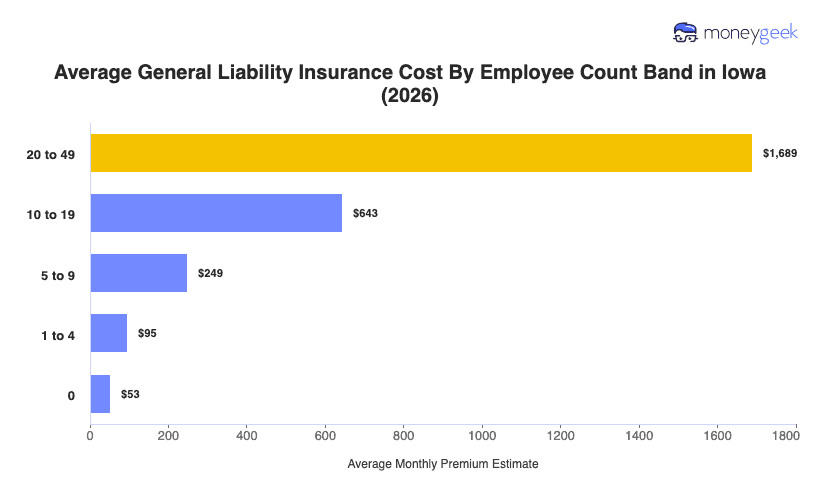
Business size accounts for the widest cost swings in general liability insurance in Iowa. Using the state average as a baseline, companies with 20 to 49 employees pay roughly 1,686% more, while sole proprietors fall about 44% below. Headcount tracks with exposure since more employees typically means more customer interactions and higher claim potential.

Industry classification creates a wide spread around that same benchmark. Construction and contracting operations run about 152% above the Iowa average, reflecting higher injury and property damage risk. Tech and IT firms sit roughly 74% below average with their lower physical-risk profile. 

These baseline factors layer together with Iowa-specific conditions, such as local claims trends, competitive insurer presence and regional exposure patterns, to shape final quotes.

    congress icon
    Iowa's Modified Comparative Fault Law (51% Rule)

    Iowa reduces claim payouts when injured parties share responsibility for accidents. Plaintiffs who are 50% or less at fault recover damages reduced by their fault percentage. Those 51% or more at fault receive nothing. This legal framework moderates general liability costs by limiting recovery when customers or visitors contribute to their own injuries. Insurers price this favorable legal environment into Iowa rates, creating downward pressure compared to pure comparative negligence states.

    checkList icon
    Iowa's Joint and Several Liability Rule

    Businesses found 50% or more at fault in multi-party accidents become liable for 100% of economic damages (medical bills, lost wages and property damage) even when other defendants share responsibility. For non-economic damages like pain and suffering, liability remains proportional to fault. This rule increases worst-case exposure for majority-fault defendants in complex claims. Insurers account for this asymmetric risk when pricing policies for businesses with higher third-party interaction.

    tornado icon
    Iowa's Severe Weather Exposure

    Iowa experienced 86 billion-dollar weather disasters from 1980 to 2024, with event frequency accelerating from 1.9 annually to 5.4 per year since 2020. Flooding ranks as the state's most common natural disaster, while tornadoes, derechos and severe storms create additional property damage. These events generate premises liability claims through slip-and-fall incidents on weather-damaged property and operational hazards during severe conditions. The accelerating trend suggests Iowa's relative cost advantage may narrow over time.

    driverLicense icon
    Iowa's Lack of State-Mandated GL Requirements

    Iowa doesn't require most businesses to carry general liability insurance at the state level, though some municipalities impose local requirements and certain licensed professions like contractors and electricians face coverage mandates. This market-driven approach fosters insurer competition rather than compliance-based purchasing. Without universal state requirements dictating minimum coverage levels, insurers compete more aggressively on price, creating moderate downward pressure on premiums.

    forest icon
    Iowa's Agriculture and Manufacturing Base

    Iowa's economy concentrates in agriculture and manufacturing, industries with elevated liability exposures compared to office-based sectors. Agricultural operations involve equipment hazards, grain storage facilities and agribusiness supply chains. Manufacturing creates industrial workplace risks through machinery operation and production processes. Insurers price Iowa's industry mix into state-level costs, creating upward pressure. Businesses in lower-risk sectors benefit from broader market competition despite the elevated baseline.

    iowa icon
    Iowa's Population Density and Litigation Environment

    Iowa's lower population density reduces claim frequency by limiting the traffic accidents and pedestrian incidents common in urban centers. The state maintains a moderate litigation environment without the aggressive plaintiff attorney activity seen in more litigious jurisdictions. Lower cost of living correlates with lower claim severity, as medical expenses and wage loss calculations reflect regional economics. These factors combine to moderate both claim frequency and severity statewide.

Average General Liability Insurance Costs in Iowa by Business Size

General liability costs in Iowa scale with employee count, ranging from $53 monthly for sole proprietors to $1,689 for businesses with 20 to 49 employees. The steepest percentage increase occurs when businesses grow past having four employees. Our analysis shows that rates increase 164% upon their fifth hire, reflecting substantially higher customer interaction and operational exposure. 

The table below details premiums at each tier and shows tier-to-tier percentage changes, which cluster near 160% after the initial scaling phase.

Iowa General Liability Insurance Cost Chart

Average General Liability Insurance Costs in Iowa by Industry

Tech and IT operations average $25 monthly while construction and contracting businesses run $238 month, a nearly 10x gap that reflects the difference in physical exposure between office-based work and job-site operations. Most industries fall below the state benchmark, with only Retail & Product Rental, Healthcare & Medical, and Construction & Contracting exceeding it. Notably, Transportation & Logistics and Wholesale & Distribution land at nearly identical rates ($75 monthly) despite different day-to-day operations, suggesting their exposure profiles carry similar weight in insurer pricing.

The table breaks out monthly and annual estimates by industry, with a percent-difference column showing where each classification sits relative to the state average.

Data filtered by:
Select
Agriculture & Natural Resources$81$97015%
Arts, Media & Entertainment$31$36868%
Beauty, Body & Wellness Services$29$35369%
Childcare Services$89$1,0735%
Cleaning Services$73$87923%
Construction & Contracting$238$2,857-152%
Consulting Services$31$36968%
Education$38$45560%
Financial Services$31$37167%
Fitness Services$86$1,0369%
Food & Beverage$93$1,1181%
Healthcare & Medical$163$1,960-73%
Hospitality, Travel & Tourism$78$93318%
Manufacturing$51$61446%
Marketing & Communications$29$34570%
Nonprofit & Associations$45$53753%
Other Professional Services$60$71637%
Pet Care Services$63$75933%
Real Estate & Property Services$43$51355%
Recreation & Sports$71$84825%
Repair & Maintenance$55$65642%
Retail & Product Rental$102$1,225-8%
Tech/IT$25$29874%
Transportation & Logistics$75$89421%
Wholesale & Distribution$75$89521%

Use these resources to explore costs for your industry.

How to Lower General Liability Insurance Costs Without Sacrificing Coverage

If your quotes came in higher than expected, affordable general liability coverage in Iowa often comes down to adjusting how you buy and manage your policy rather than cutting corners on protection. The strategies below focus on lowering costs while keeping coverage aligned with your actual exposure.

    insurance2 icon
    Provide clean, accurate underwriting information

    Insurers price general liability based on payroll, revenue and operations and these numbers shift for Iowa businesses with seasonal cycles. A farm equipment dealer in Sioux City, for example, may triple its workforce during harvest season. Underreporting peak-season payroll can trigger audit corrections and retroactive charges, while overestimating slow-season revenue may mean overpaying year-round.

    shoppingCart icon
    Compare multiple insurers

    Specialized industries in Iowa may see wider quote variation because fewer carriers focus on their risk profiles. A food processing operation in Waterloo requesting general liability quotes from five insurers might find one prices manufacturing operations lower while others treat them as high-risk. Beyond pricing, reviewing each policy's terms reveals general liability exclusions that could create gaps.

    building icon
    Bundle general liability into business owner's policies (BOP)

    A gift shop in the Amana Colonies that sees steady tourist traffic typically needs both general liability and commercial property coverage for its historic storefront. Bundling these into a single policy is a more affordable option since the cost of a BOP is usually lower by 10% to 15% compared to purchasing each coverage separately, while simplifying renewals during the busy summer season.

    money2 icon
    Increase your deductible (if you can afford it)

    An established HVAC contractor in Council Bluffs with consistent year-round revenue could consider a higher deductible, lowering monthly premiums in exchange for more out-of-pocket responsibility when a general liability claim occurs. This approach fits less well for newer operations or businesses with unpredictable cash flow tied to Iowa's seasonal demand swings.

    stackOfBooks icon
    Improve your loss profile over time

    A wedding venue near Lake Okoboji that hosts outdoor receptions from May through September may accumulate slip-and-fall claims tied to uneven lakeside terrain or wet grass. Addressing these patterns (leveling walkways, adding drainage, improving lighting) reduces claim frequency across multiple seasons.

    As your loss history improves, insurers reassess your risk at each renewal. This shift typically takes two to three claim-free policy cycles to appear in pricing, making the upfront investment in site improvements easier to justify.

General Liability Insurance Cost in Iowa: Bottom Line

Iowa's insurance market reflects the state's agricultural heritage and manufacturing concentration, creating cost variations that state averages can't capture. Using a single benchmark number ignores the factors insurers actually price into your premium.

Evaluate your specific situation within Iowa's business environment, not just the statewide figure, by considering:

  1. Where do you operate? Rural agricultural suppliers in western Iowa pay less than Davenport riverfront retailers dealing with flood zones and severe weather claims.
  2. What separates your premium from similar businesses? Two grain processing facilities with identical employee counts can see 30% rate differences based on safety investments, claims history and equipment maintenance records.
  3. Which changes cut costs fastest? Annual billing saves 5% to 10% immediately. Maintaining three claim-free years reduces premiums 15% to 20% through improved risk tier placement.

Get quotes from at least four carriers to compare how they evaluate your specific risk profile. Insurers weigh your employee count, industry sector and operational characteristics differently when calculating general liability premiums.

General Liability Insurance Cost in Iowa: Next Steps

Understanding where your business falls relative to Iowa benchmarks is a starting point, but what follows depends on your situation. If your current premium seems high for your industry or employee count, requesting quotes from multiple insurers using the same business details, limits and coverage terms reveals where pricing varies. Providers weigh industry classification and business size differently, so standardizing these inputs across quotes makes comparisons meaningful.

Beyond comparing quotes, some operations may find that bundling into a BOP or adjusting limits lowers costs. When exploring these options, verifying that each covers the same exposures avoids coverage gaps that could affect your cost-to-protection balance.

Get Personalized General Liability Insurance Quotes in Iowa

Select your industry and state to get a customized Iowa general liability quote.

Industry
State

About Angelique Palenzuela-Cruz


Angelique Palenzuela-Cruz headshot

Angelique Palenzuela-Cruz is a Content Writer at MoneyGeek specializing in business insurance. She focuses on general liability, workers' compensation and professional liability coverage, helping small business owners cut through policy jargon and understand what they're actually buying.

Angelique has spent over five years reporting on personal finance, with deep experience in both insurance and lending markets. Her psychology background also gives her a unique understanding of how people actually process difficult financial decisions, allowing her to meet readers where they are, simplify complex concepts and build decision making frameworks that give them confidence. Whether you're learning about policies, comparing providers or trying to figure out requirements, Angelique does the legwork, digging into regulations, analyzing policy language and testing her explanations against agent-level standards so you get straight answers without fluff.


sources