
Key Takeaways
blueCheck icon

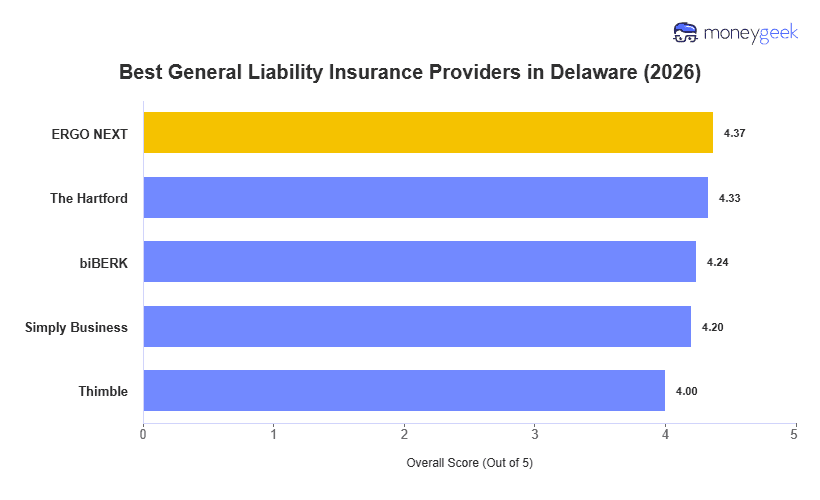
Delaware's best general liability insurance provider is ERGO NEXT, which ranks first for both affordability and customer experience.

blueCheck icon

Businesses save $22 per month with The Hartford, the cheapest general liability insurance option at $108 monthly and 17% below typical rates.

blueCheck icon

The best provider depends on your business needs, so compare pricing stability, service responsiveness and coverage flexibility before choosing.

Best General Liability Insurance Companies for Small Businesses in Delaware

Choose the right general liability coverage by knowing which insurers offer consistent value in your state. We evaluated 10 major providers across 25 general industries in Delaware, comparing rates, service quality and policy flexibility. The five below represent the best and cheapest options for Delaware small businesses:

  1. ERGO NEXT: Best Overall, Best for Hands-On and Service Industries
  2. The Hartford: Best Cheap General Liability Insurance
  3. biBerk: Best for Solo Operators
  4. Simply Business: Best for Food and Wholesale Businesses
  5. Thimble: Best for Short-Term and Project-Based Coverage

Your ideal general liability match depends on your exposure and budget, whether you run a corporate services firm in Wilmington or a retail shop near Rehoboth Beach. This table breaks down monthly rates and overall rankings so you can compare options side by side.


ERGO NEXT4.37$11418
The Hartford4.33$10882
biBERK4.24$12047
Simply Business4.2$12524
Thimble4$121610
Coverdash3.98$13592
Progressive Commercial3.91$14079
Hiscox3.85$14736
Chubb3.84$14751
Nationwide3.76$147105

For our Delaware general liability insurance ratings, we analyzed pricing, coverage options and customer experience across 408 industries within the state. Our analysis focuses on one-to-four-person businesses, which represent a large share of Delaware's small business market, while weighting results to ensure broader industry and location representation across New Castle County, Kent County, Sussex County and smaller markets throughout the state.

To do this, we evaluated over 20,000 business profiles, more than 300 customer experience data points and performed in-depth analysis of coverage contracts and endorsements to compare how insurers serve Delaware businesses consistently across different industries and regions. 

We then rated each company across categories of affordability (50%), customer experience (30%) and coverage options and terms (20%) to form an overall rating. For a detailed breakdown of the metrics, scoring methodology and pricing analysis specific to Delaware, see our full methodology.

95%

% of Small Businesses Covered

Over 20,000

Business Profiles Studied

308

Customer Experiences Analyzed

ERGO NEXT
Best Overall, Best for Hands-On and Service Industries

ERGO NEXT

On ERGO NEXT's site

In Delaware, ERGO NEXT ranks first overall, earning top marks for customer experience and competitive pricing across most industries. Users report getting bindable quotes in under 10 minutes through a fully online process, with no phone calls required. Its self-service portal makes COI generation instant, a feature contractors and vendors frequently praise. Businesses needing phone support may find response times slower, with email replies often taking 24 to 48 hours. Reddit and Trustpilot reviews cite slow communication after filing and settlements that feel lower than expected.

ERGO NEXT ranks second for affordability, with savings up to 37% for hospitality and tourism operations, 28% for repair and maintenance and 26% for manufacturing. It ranks first among GL providers for 12 Delaware industries, including solo operators and micro-businesses. Standard limits and common endorsements like additional insured and waiver of subrogation are available, though businesses needing higher limits or specialized coverage won't find as many options as traditional carriers offer.

Where ERGO NEXT performs best:

  • Solo operators and micro-businesses wanting fast, online quotes
  • Hospitality, repair or manufacturing businesses in Delaware seeking savings
  • Contractors needing instant COI generation
  • Owners who prefer managing policies digitally

Where ERGO NEXT performs less competitively:

  • Businesses that want hands-on claims support
  • Health care, education or agriculture operations in Delaware
  • Companies needing high limits or customized coverage

Learn More: ERGO NEXT Review

The Hartford
Best Cheap General Liability Insurance

The Hartford

On The Hartford's site

The Hartford ranks second for Delaware, leading in affordability and scoring high in coverage breadth. It offers the biggest savings in health care (31%), wholesale and distribution (28%) and education (28%). Businesses with one to 49 employees get the lowest rates, with double-digit savings across the board.

Coverage ranks second through direct limits up to $2 million per occurrence and $4 million aggregate, plus a contractor broad form endorsement that bundles blanket additional insured status, waiver of subrogation and primary and noncontributory language. Policy management tops all providers through responsive agent support and fast endorsement processing, but the buying experience ranks mid-pack, as some business types can't complete a purchase entirely online.

Where The Hartford performs best:

  • Growing Delaware businesses with five or more employees needing affordable GL
  • Health care, education or wholesale operations seeking the deepest industry savings
  • Contractors requiring waiver of subrogation and blanket additional insured coverage
  • Businesses prioritizing responsive agents and claims support over digital self-service

Where The Hartford performs less competitively:

  • Trades and physical-risk businesses where affordability lags top options
  • Real estate operations, where rates cost more than the Delaware benchmark
  • Buyers who need a fully digital quote-to-bind experience without agent involvement

Learn More: The Hartford Review

biBerk
Best for Solo Operators

biBerk

Affordability and customer experience drive biBerk’s performance, placing it third overall in Delaware. As a direct arm of Berkshire Hathaway, biBerk keeps purchasing simple: users report clear underwriting questions and quick online quotes without broker involvement. Policy management and claims handling are mid-pack, with users noting slower endorsement processing and COI generation. That said, Berkshire Hathaway's financial strength provides confidence that claims will be paid.

The tradeoff extends to coverage options. Although biBerk offers standard limits and makes common endorsements like additional insured and waiver of subrogation available digitally, the $300,000 damage to rented premises sublimit is lower than some competitors. It's the most affordable option for solopreneurs, and businesses in hospitality and tourism, fitness services, cleaning and real estate see the most savings, ranging from 20% to 36%.

Where biBerk performs best:

  • Solo operators who value Berkshire Hathaway’s financial backing
  • Delaware hospitality, fitness or cleaning businesses seeking savings
  • Owners who prefer a simple digital buying process
  • Real estate or tech operations with basic coverage needs

Where biBerk performs less competitively:

  • Construction, childcare or consulting businesses in Delaware
  • Companies that need quick endorsements or instant COIs
  • Businesses that need higher limits or more tailored coverage

Learn More: biBerk Review

Simply Business
Best for Food and Wholesale Businesses

Simply Business

Ranking fourth is Simply Business, with above-average competitive customer experience rank as an insurance aggregator rather than a direct carrier. Unlike other providers in our analysis, Simply Business presents quotes from multiple carriers in one interface. Delaware business owners can compare options side-by-side, though once you purchase, policy management and claims handling shift to whichever carrier you select. That means your ongoing experience depends on that carrier's service quality.

The aggregator model brings a different kind of flexibility. It connects you with multiple carriers, so you'll likely find more limit options or endorsements than a single direct carrier provides, though you'll need to evaluate each carrier's policy terms yourself. Simply Business offers notable savings in certain Delaware industries: 26% for food and beverage operations and 22% for repair and maintenance businesses. Wholesale, retail and beauty services also get competitive rates.

Where Simply Business performs best:

  • Food, beverage or wholesale businesses in Delaware looking to cut costs
  • Owners wanting side-by-side quotes from multiple carriers
  • Repair, retail or beauty operations with straightforward coverage needs
  • Buyers who don't mind handling carrier relationships after purchase

Where Simply Business performs less competitively:

  • Delaware marketing, professional services or nonprofit organizations
  • Businesses that want the same provider handling both sales and claims
  • Owners who'd rather deal with one contact for all support needs

Learn More: Simply Business Review

Thimble
Best for Short-Term and Project-Based Coverage

Thimble

Thimble is the fifth provider in our analysis of the best general liability insurance in Delaware, built around flexible, short-term policies rather than annual coverage. Unlike other carriers, Thimble offers policies by the hour, day, week or month, appealing to freelancers, event vendors and seasonal contractors who need coverage for individual projects. Delaware construction businesses see the highest savings at 20%, with manufacturing and beauty services also showing competitive rates.

The short-term model keeps buying fast and simple. Users praise quick mobile-friendly quotes and the ability to bind coverage immediately. While buying is a clear strength, policy management is mid-pack, though short-term policies usually need less ongoing attention. Claims handling also ranks lower, with user reviews citing slower communication and lower settlement satisfaction. Thimble’s streamlined approach translates to narrower limits (like its $100,000 limit for damage to rented premises), fewer endorsements and limited customization options.

Where Thimble performs best:

  • Freelancers or event vendors needing hourly or daily coverage
  • Delaware construction or manufacturing businesses seeking savings
  • Seasonal contractors with short-term project needs
  • Owners who prioritize fast quotes over policy customization

Where Thimble performs less competitively:

  • Hospitality, retail or nonprofit businesses in Delaware
  • Companies expecting to file claims
  • Businesses needing high sublimits or extensive endorsements

Learn More: Thimble Review

Explore the Best General Liability Insurance in Delaware by Industry

What a Dover accounting firm pays for general liability coverage won't match what a Lewes charter fishing operation sees in quotes. Risk profiles vary by industry, and so do premiums. The tables below move past statewide averages to show how insurers price policies for your specific business type and where their coverage terms differ.

What Determines the Best General Liability Insurance for Delaware Businesses

Choose general liability insurance in Delaware by weighing more than monthly premiums. A Wilmington registered agent serving thousands of incorporated entities carries different exposure than a Bethany Beach surf shop handling summer tourist traffic. These four factors separate insurers that work well on paper from those that work well in practice.

    coins2 icon
    Affordability without pricing volatility

    A Sussex County poultry processor operating on thin margins can't absorb a 40% rate hike at renewal without warning. Delaware’s small businesses, from Georgetown accountants to Rehoboth restaurant owners dealing with seasonal swings, depend on costs that stay manageable year over year, not only a low starting quote.

    Unpredictable pricing forces hard tradeoffs, like a Newark auto shop cutting limits after an unexpected premium jump and leaving gaps when a customer claim hits. Insurers with transparent rate-setting and stable renewals let you plan ahead instead of reacting to budget surprises.

    talk icon
    Responsive service throughout your policy term

    Service quality reveals itself at specific moments, not just when you buy. A Middletown landscaper bidding on a HOA contract needs a certificate of insurance within hours, not days. A Wilmington financial consultant dealing with a client property damage allegation needs a claims rep who explains the process clearly.

    Look for insurers that step up when Delaware businesses need support most:

    • A Milford HVAC contractor lands a commercial job but the property manager demands proof of coverage by end of day. COI turnaround time matters.
    • A Dewey Beach bar owner receives a liability complaint mid-season and needs a claims rep who answers calls, not an automated queue.
    • A Camden daycare adds a second location and needs to update coverage without waiting on hold for an hour.

    When service breaks down, small problems compound quickly. A delayed certificate can cost you a contract, and a mishandled claim can leave a Seaford shop owner paying out of pocket while repairs stall for weeks.

    insurance2 icon
    Coverage options that fit common small business risks

    A Claymont cleaning company with $500,000 per-occurrence limits may be underinsured if a slip-and-fall lawsuit exceeds that threshold. A Smyrna caterer expanding into alcohol service needs liquor liability that wasn't necessary at launch. And with Delaware's proximity to Maryland and Pennsylvania, many businesses serve clients across state lines, adding complexity that basic policies don't always cover. Your limits need to match your actual exposure, and the insurer should offer endorsements that grow with your operations.

    building icon
    Why consistency across all three areas matters most

    Delaware's business density creates a competitive environment where reputation travels fast. This plays out clearly along the coast, where Rehoboth and Bethany Beach businesses see claims spike during summer months when foot traffic peaks. If an insurer offers low premiums but takes weeks to process a visitor injury claim, the rate savings disappear into legal costs and lost operating time. Providers worth keeping on your list perform consistently across all areas. In a state this small, one bad claims experience can follow your business for years.

How to Choose the Best General Liability Insurance in Delaware

Narrow down the right general liability provider without evaluating every insurer on the market. The steps below provide a repeatable process to filter options, compare finalists and choose a provider that fits your Delaware business.

  1. 1
    Optimize your payment and coverage structure

    Before comparing providers, get clear on your risk profile and coverage requirements, including how much general liability coverage you need. A Wilmington registered agent managing filings for thousands of corporations carries different exposure than a Bethany Beach seafood restaurant handling summer tourist crowds.

    Ask yourself:

    • Where does most of my risk come from, whether that is customer injuries at a Milford storefront, property damage during service calls in Smyrna or claims tied to my marketing?
    • Do any contracts with corporate clients, Dover landlords or out-of-state partners in Philadelphia or Baltimore set minimum coverage limits I need to meet?
    • How do I want to pay for coverage, upfront for the year or monthly, especially if most of my revenue comes in between Memorial Day and Labor Day?
    • Would taking on a higher deductible lower my premium enough to make sense during Sussex County’s slower winter months?

    A Claymont retail shop benefiting from tax-free shopping traffic may only need standard limits, while a Dover-based IT consultant working remotely with few in-person client interactions could opt for lower limits. At the other end, a New Castle County contractor bidding on Philadelphia-area commercial projects may need $2 million per occurrence to meet out-of-state contract requirements.

  2. 2
    Choose your primary priority

    Once your coverage structure is set, decide which factor matters most based on your current situation. Use that as your tiebreaker when providers perform similarly across the board.

    • Prioritize affordability if your margins are tight or your revenue shifts throughout the year. A Rehoboth Beach rental company that earns most of its income between May and September or a Newark startup working with limited capital may benefit more from stable, predictable rates than from broader coverage.
    • Prioritize customer experience if your operations involve frequent insurer interactions. A Wilmington corporate services firm that issues certificates for client entities each week or a Sussex County poultry supplier working with multiple distributors depends on responsive service more than the lowest pricing.
    • Prioritize coverage options if your business deals with more complex or changing risks. A Lewes caterer adding liquor service for wedding season or a Wilmington fintech consultancy expanding into regulated advisory work may need flexible general liability limits and endorsements that can scale without switching carriers.
  3. 3
    Shortlist two to three providers

    Evaluate insurers selectively to avoid wasted time and decision fatigue. Focus on building a short list of providers that match your primary priority and meet baseline requirements for your industry, size and location.

    Delaware’s compact geography works in your favor. Most insurers that write policies in the state serve all three counties, so the decision comes down to industry fit and coverage strength rather than regional availability. Review Delaware general liability costs to set realistic expectations, then narrow your list to two or three providers whose strengths align with the priority you chose in step two.

  4. 4
    Double-check for dealbreakers before investing more time

    Confirm that your shortlisted providers meet basic requirements before you compare them in detail. Catching dealbreakers early saves hours of research.

    • Industry exclusions are common for Sussex County poultry operations, roofing contractors and Fenwick Island bars with high alcohol revenue.
    • Certificate turnaround times that exceed your contract requirements can create problems for Wilmington registered agents and corporate services firms with tight filing deadlines.
    • Required endorsements, such as liquor liability for Rehoboth hospitality venues or hired auto for Milford delivery businesses, may not be included with every carrier.
    • Seasonal coverage adjustments are not always offered, which can leave Bethany Beach vacation rental operators and Lewes charter fishing businesses paying full premiums during off-season closures.
  5. 5
    Compare your finalists using the same three lenses

    After clearing dealbreakers, evaluate your remaining providers across all three areas, not just your primary priority.

    • Affordability: Look at renewal rate history, how audits are handled and whether rate changes are communicated clearly. A Sussex County agricultural supplier with thin margins may struggle to absorb a 30% premium increase at renewal without clear notice.
    • Customer experience: Review COI turnaround times, how easy it is to make midterm policy changes, claims responsiveness and portal usability. A Georgetown electrician bidding on jobs across Kent and Sussex counties may need same-day certificates rather than waiting 48 hours.
    • Coverage options: Check whether per occurrence and aggregate limits meet your contract requirements and whether endorsements you may need later are included. A Wilmington financial services contractor working with Philadelphia and Baltimore clients may require higher limits than standard Delaware operations.
  6. 6
    Use quotes as the final confirmation step

    Quotes confirm whether pricing and coverage align with your actual business details. After narrowing to one or two finalists, request a quote for general liability coverage using accurate revenue, payroll and operations data.

    This step shows whether the rates you saw in research hold up for your profile and whether coverage terms match what you expected. Review general liability exclusions as part of the quote to check for any gaps that could affect your business.

    If a quote comes back higher or leaves out key protections, revisit your shortlist before committing.

Best Small Business General Liability Insurance in Delaware: Bottom Line

ERGO NEXT, The Hartford and biBerk rank highest for Delaware small businesses, but the right choice depends on your setup. A Dover professional services firm, a Sussex County seasonal operation or a Newark retailer drawing tax-free shoppers from Maryland each deals with different risks.

Don’t default to the lowest quote. Compare how each provider handles pricing over time, how quickly they respond and how flexible their policies are. Choose coverage that fits your actual exposure and budget. A one-size-fits-all decision usually misses key details that matter to your business.

Best General Liability Insurance for Small Businesses in Delaware: Next Steps

If you’re ready to move forward, narrow your options to one or two providers and confirm pricing and availability using the same coverage assumptions for your business. This avoids misleading comparisons and keeps quotes consistent.

You’ll see which insurer offers the right mix of cost and policy features, whether you run a Middletown contractor business that issues certificates weekly or a Lewes tourism business that adjusts coverage between seasons.

Focus on cost as your main deciding factor

Figure out how much coverage you need

Check quotes with your final shortlist

How We Chose the Best General Liability Insurance Companies

To identify the best general liability insurance companies for Delaware small businesses, we evaluated insurers across pricing, customer experience and coverage options using a standardized, data-driven approach. Our goal wasn't to identify the cheapest option in every scenario, but to determine which providers offer the most consistent overall value across common Delaware small business profiles.

Our best recommendations reflect insurers that perform well across multiple dimensions and remain competitive across industries and business sizes in Delaware.

Data and Analysis Scope

We based our analysis on standardized estimates designed to represent the majority of Delaware small businesses:

  • Providers analyzed: 10 major insurers serving Delaware
  • Industries covered: 408 industries
  • Employee counts: Zero to 49 employees
  • Policy baseline: $1 million per occurrence/$2 million aggregate general liability policy
  • Pricing modeled: More than 20,000 standardized estimates for Delaware businesses

Modeled average revenues and payrolls were incorporated to improve pricing accuracy across Delaware's business market.

Our Scoring Model

Each insurer received a composite score based on the weighted categories below.

  • Affordability (50%): Measures how competitively and consistently an insurer prices general liability coverage across all Delaware business profiles studied.
  • Customer experience (30%): Evaluates how well insurers support Delaware businesses throughout the policy lifecycle, from purchase to claims. This includes how easy it is to buy, manage policies and handle claims, with a focus on reliability and clarity at each stage.
  • Coverage options (20%): Assesses how well insurers address common Delaware small business risks and support flexibility as businesses grow or change.

Read our full business insurance methodology.

About Connor Bolton


Connor Bolton headshot

Connor Bolton is Senior SEO and Content Manager at MoneyGeek, where he leads the business and pet insurance editorial teams. As editorial lead for both verticals, Connor sets the research framework, data standards, and content structure that his writers execute, directly authoring in-depth guides himself and reviewing all team content for accuracy and practical value before it goes live. With over four years evaluating insurance products across personal, commercial, and specialty lines, he brings cross-vertical knowledge to every guide the team produces.

Connor architected MoneyGeek's insurance research infrastructure across all major verticals including auto, home, renters, life, health, business, and pet, building systems for pricing analysis, provider-level research, customer experience evaluation, and coverage analysis with AI support. The infrastructure includes over 6 million data points for business insurance across 408 industry areas, all 50 states, and 16 vehicle types, and over 5 million pet insurance profiles across 18 major providers and hundreds of breed and age combinations. Connor's insurance cost research and his team's work has been cited by the U.S. Chamber of Commerce, Allstate, Liberty Mutual, CBS News, Forbes and LegalZoom.

Beyond the data, Connor stays connected to how the market actually operates, drawing on direct conversations with underwriters and carrier liaisons at Ethos, The Hartford, NEXT Insurance, Nationwide, and State Farm, and monitoring business and pet owner communities including Reddit, to inform how he interprets findings and frames guidance for real buyers.

He is the direct editorial contact for methodology questions at connor@moneygeek.com and can be found on LinkedIn.